
Detailed Solutions: CBSE Class 10 Maths Sample Paper 2027 – Set 1
Every written question from the paper (2, 3, 4 and 5 marks) is solved here in order, with the marks given for each step, so you can check your answer sheet the way an examiner would. Where a question has an internal choice (OR), both options are solved. The 1-mark questions are answered, with explanations, in the quiz on the Question Paper page.
Section B (10 marks)
Question 21 (2 marks)
Given that is irrational, prove that is irrational.
Answer.
- Assume , a rational number; then — 1 mark
- RHS is rational but is irrational - a contradiction; hence is irrational — 1 mark
Question 22 (2 marks)
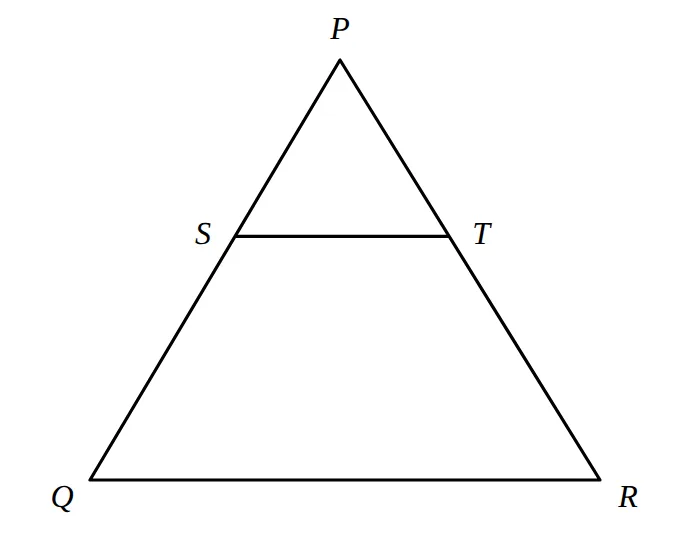
In , and are points on and respectively such that . If cm, cm, cm and cm, find the value of .
Answer.
- By BPT, — 1 mark
- , so — 1 mark
Question 23 (2 marks)
Find the values of for which the distance between the points and is 5 units.
Answer.
- , so — 1 mark
- , so or — 1 mark
Question 24 (2 marks)
Evaluate:
Answer.
- — 1 mark
- — 1 mark
OR
If and , where and , find and .
Answer.
- and — 1 mark
- Adding, ; then — 1 mark
Question 25 (2 marks)
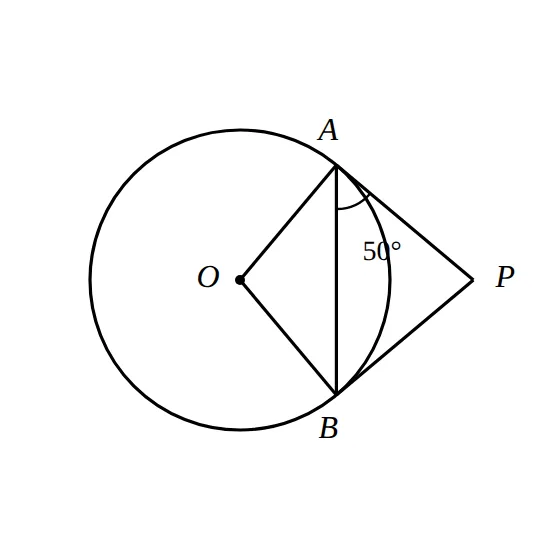
From an external point , two tangents and are drawn to a circle with centre . If , find .
Answer.
- , so and — 1 mark
- In quadrilateral , , so — 1 mark
OR
Two concentric circles have radii 13 cm and 5 cm. Find the length of the chord of the larger circle which touches the smaller circle.
Answer.
- The radius of the smaller circle is perpendicular to the chord at the point of contact and bisects it; half-chord cm — 1 mark
- Chord cm — 1 mark
Section C (18 marks)
Question 26 (3 marks)
Students of Class X are planting saplings along three straight paths of lengths 120 m, 168 m and 240 m. On every path the saplings are planted at equal distances, with one sapling at each end of the path, and the distance between two consecutive saplings is the same on all three paths. What is the greatest possible distance between two consecutive saplings? How many saplings are needed in all?
Answer.
- , , — 1 mark
- Greatest distance = HCF m — 1 mark
- Saplings — 1 mark
Question 27 (3 marks)
Find the ratio in which the x-axis divides the line segment joining the points and . Also find the coordinates of the point of division.
Answer.
- Let the ratio be ; the point is — 1 mark
- On the x-axis, , so , i.e. the ratio is — 1 mark
- ; the point is — 1 mark
Question 28 (3 marks)
Prove that .
Answer.
- LHS — 1 mark
- — 1 mark
- RHS — 1 mark
OR
Prove that .
Answer.
- LHS — 1 mark
- — 1 mark
- RHS — 1 mark
Question 29 (3 marks)
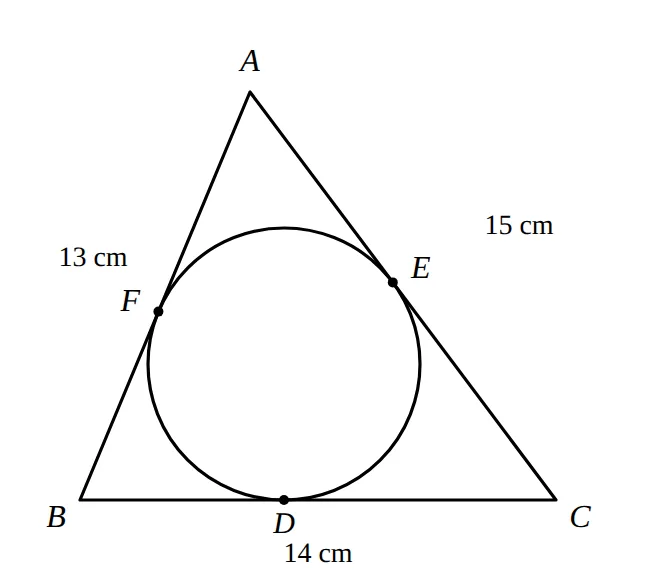
A circle is inscribed in and touches the sides , and at , and respectively. If cm, cm and cm, find the lengths of , and .
Answer.
- Tangents from an external point are equal: let AF = AE = x, BF = BD = y, CD = CE = z — 1 mark
- x + y = 13, y + z = 14, z + x = 15; adding, x + y + z = 21 — 1 mark
- x = 21 - 14 = 7, y = 21 - 15 = 6, z = 21 - 13 = 8 — 1 mark
Question 30 (3 marks)
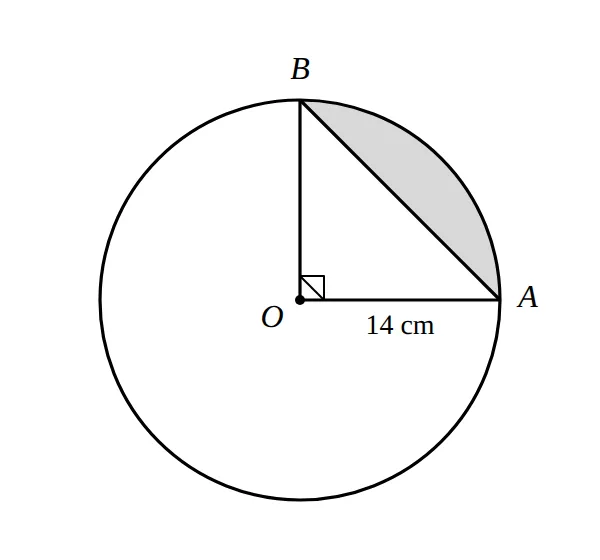
A chord of a circle of radius 14 cm subtends a right angle at the centre. Find the area of the corresponding minor segment. (Use )
Answer.
- Area of sector — 1 mark
- Area of the right triangle — 1 mark
- Area of minor segment — 1 mark
OR
A cow is tied with a 14 m long rope to a peg at one corner of a square field of side 21 m. Find the area of the field over which the cow can graze. Also find the increase in the grazing area if the rope were 21 m long. (Use )
Answer.
- The cow grazes a quadrant of radius 14 m (the corner angle is ) — 0.5 marks
- Grazed area — 1 mark
- With a 21 m rope: ; increase — 1.5 marks
Question 31 (3 marks)
A box contains 50 cards numbered 3, 4, 5, …, 52. One card is drawn at random from the box. Find the probability that the number on the card is (i) a perfect square, (ii) a multiple of 7, (iii) divisible by both 2 and 5.
Answer.
- (i) Perfect squares: 4, 9, 16, 25, 36, 49; — 1 mark
- (ii) Multiples of 7: 7, 14, …, 49 (7 numbers); — 1 mark
- (iii) Multiples of 10: 10, 20, 30, 40, 50; — 1 mark
Section D (20 marks)
Question 32 (5 marks)
A parking lot charges a fixed amount per hour for a car and a different fixed amount per hour for a scooter. Rakesh parked his car for 3 hours and his scooter for 5 hours and paid ₹ 190. Nisha parked her car for 4 hours and her scooter for 2 hours and paid ₹ 160. Find the hourly charge for a car and for a scooter. How much will be paid for parking one car and one scooter for 6 hours each?
Answer.
- Let the hourly charges be ₹ (car) and ₹ (scooter): and — 2 marks
- Multiplying: and ; subtracting, , so — 1 mark
- , so — 1 mark
- For 6 hours each: ₹ 300 — 1 mark
OR
Solve the following pair of linear equations graphically: and . Also find the coordinates of the vertices of the triangle formed by these lines and the x-axis, and find its area.
Answer.
- Table of values for : — 1 mark
- Table of values for : — 1 mark
- Both lines correctly drawn on the same graph — 1 mark
- Solution , ; vertices , and — 1 mark
- Area square units — 1 mark
Question 33 (5 marks)
A shopkeeper buys a certain number of notebooks for ₹ 1200. If he had bought 10 more notebooks for the same amount, each notebook would have cost him ₹ 20 less. Find the number of notebooks he bought and the cost of each notebook.
Answer.
- Let the number be ; cost of one notebook — 1 mark
- — 1 mark
- , i.e. — 1 mark
- , so ( rejected) — 1 mark
- Cost of each notebook ₹ 60 — 1 mark
Question 34 (5 marks)
State and prove the Basic Proportionality Theorem. Using it, find if in , and are points on and such that , and cm.
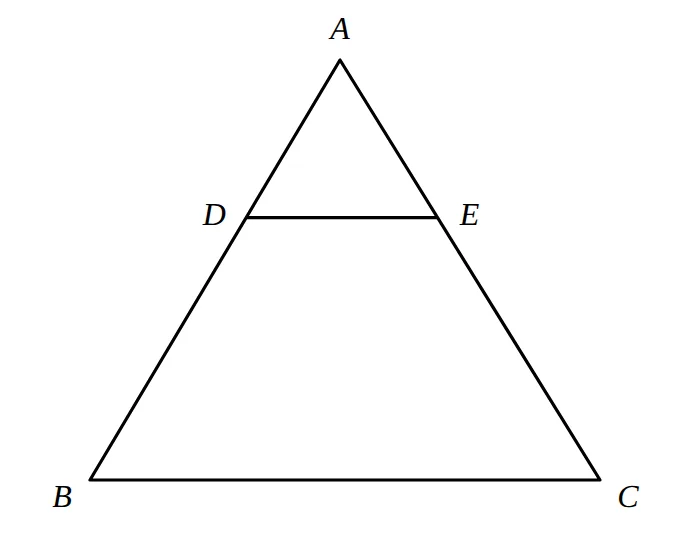
Answer.
- Correct statement of the theorem — 1 mark
- Given, to prove, construction (join BE and CD, draw EN perpendicular to AB and DM perpendicular to AC) and figure — 1 mark
- and ; (same base DE, between the same parallels) - hence — 1 mark
- , so — 1 mark
- cm — 1 mark
Question 35 (5 marks)
The table shows the time (in minutes) that 50 students of a class spent on a learning app on a particular day.
| Time (minutes) | 0-20 | 20-40 | 40-60 | 60-80 | 80-100 | 100-120 |
|---|---|---|---|---|---|---|
| Number of students | 4 | 8 | 14 | 12 | 7 | 5 |
Find the mean and the mode of the data.
Answer.
- Class marks 10, 30, 50, 70, 90, 110; — 1.5 marks
- Mean minutes — 1 mark
- Modal class 40-60; , , , , — 1 mark
- Mode minutes — 1.5 marks
OR
The median of the following distribution of the ages of 100 people who visited a health camp is 32 years. Find the values of and .
| Age (years) | 0-10 | 10-20 | 20-30 | 30-40 | 40-50 | 50-60 |
|---|---|---|---|---|---|---|
| Number of people | 10 | 25 | 30 | 10 |
Answer.
- Cumulative frequencies: 10, 10 + x, 35 + x, 65 + x, 65 + x + y, 75 + x + y = 100, so x + y = 25 — 1.5 marks
- Median 32 lies in 30-40; , , , , — 1 mark
- , so , — 1.5 marks
- y = 25 - 9 = 16 — 1 mark
Section E (12 marks)
Question 36 (4 marks)
The seats in a school auditorium are arranged in 20 rows. The first row has 18 seats and every row has 3 seats more than the row in front of it.
(i) How many seats are there in the 10th row? (1 mark)
Answer.
- — 1 mark
(ii) Which row has 63 seats? (1 mark)
Answer.
- gives ; the 16th row — 1 mark
(iii) Find the total number of seats in the auditorium. (2 marks)
Answer.
- — 1 mark
- — 1 mark
OR
(iii) How many seats are there in the last 5 rows taken together? (2 marks)
Answer.
- , — 1 mark
- Sum — 1 mark
Question 37 (4 marks)
A mobile tower stands on the flat roof of a building, at the edge of the roof nearest to . From a point on the level ground, 30 m away from the foot of the building, the angle of elevation of the top of the building is and the angle of elevation of the top of the tower is . (Use )
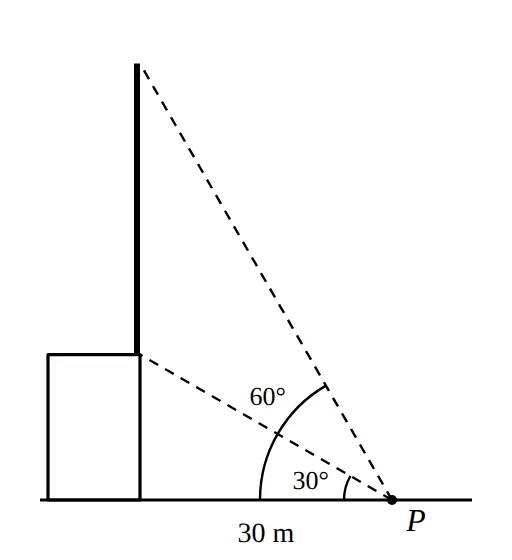
(i) Find the height of the building. (1 mark)
Answer.
- , so m m — 1 mark
(ii) Find the distance of from the top of the tower. (1 mark)
Answer.
- , so m — 1 mark
(iii) Find the height of the tower. (2 marks)
Answer.
- Top of tower: , so m — 1 mark
- Tower m — 1 mark
OR
(iii) An observer at walks towards the building until the angle of elevation of the top of the building becomes . How far does the observer walk? (2 marks)
Answer.
- New distance: , so m — 1 mark
- Distance walked = 30 - 10 = 20 m — 1 mark
Question 38 (4 marks)
A tent at a scouts' camp is in the shape of a right circular cylinder surmounted by a right circular cone of the same radius. The radius of the base is 3.5 m, the height of the cylindrical part is 3 m and the height of the conical part is 1.2 m. (Use )
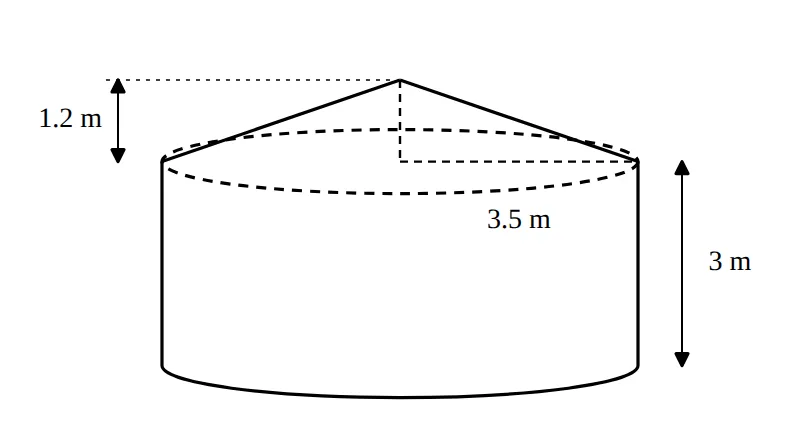
(i) Find the slant height of the conical part. (1 mark)
Answer.
- m — 1 mark
(ii) Find the curved surface area of the cylindrical part. (1 mark)
Answer.
- — 1 mark
(iii) Find the area of canvas used to make the tent (floor not included). Also find its cost at ₹ 100 per . (2 marks)
Answer.
- Cone CSA ; canvas — 1 mark
- Cost ₹ 10670 — 1 mark
OR
(iii) Find the volume of air inside the tent. (2 marks)
Answer.
- ; cylinder — 1 mark
- Cone ; total — 1 mark