
CBSE Class 10 Maths Sample Paper 2027 – Set 2
Time allowed: 3 hours · Maximum marks: 80
General Instructions
- This question paper contains 38 questions. All questions are compulsory.
- The question paper is divided into five sections: A, B, C, D and E.
- In Section A, questions 1 to 18 are multiple choice questions (MCQs) and questions 19 and 20 are Assertion-Reason based questions of 1 mark each.
- In Section B, questions 21 to 25 are very short answer (VSA) type questions of 2 marks each.
- In Section C, questions 26 to 31 are short answer (SA) type questions of 3 marks each.
- In Section D, questions 32 to 35 are long answer (LA) type questions of 5 marks each.
- In Section E, questions 36 to 38 are case study based questions of 4 marks each, with sub-parts of 1, 1 and 2 marks.
- There is no overall choice. However, an internal choice has been provided in 2 questions each of Sections B, C and D, and in the 2-mark sub-part of every question in Section E.
- Draw neat figures wherever required. Take pi = 22/7 wherever required, if not stated.
- Use of calculators is not allowed.
How to use this paper: set a 3-hour timer and write all your answers on paper, just like the board exam. When you finish, take the quiz at the end of this page to score your objective (MCQ) answers instantly, then open the Detailed Solutions and check the rest step by step, with the marks each step carries.
Section A (20 marks)
This section has 18 multiple choice questions and 2 Assertion-Reason based questions of 1 mark each.
1. If and are the zeroes of the polynomial , then the value of is
(a)
(b)
(c)
(d)
2. Which of the following statements about the polynomial is correct?
(a) Its zeroes are and .
(b) The sum of its zeroes is .
(c) The product of its zeroes is .
(d) The graph of does not meet the x-axis.
3. The pair of linear equations and has
(a) a unique solution
(b) exactly two solutions
(c) infinitely many solutions
(d) no solution
4. If , is the solution of the pair of equations and , then
(a) ,
(b) ,
(c) ,
(d) ,
5. If is a root of the quadratic equation , then its other root is
(a)
(b)
(c)
(d)
6. The number of terms in the AP is
(a) 20
(b) 22
(c) 21
(d) 25
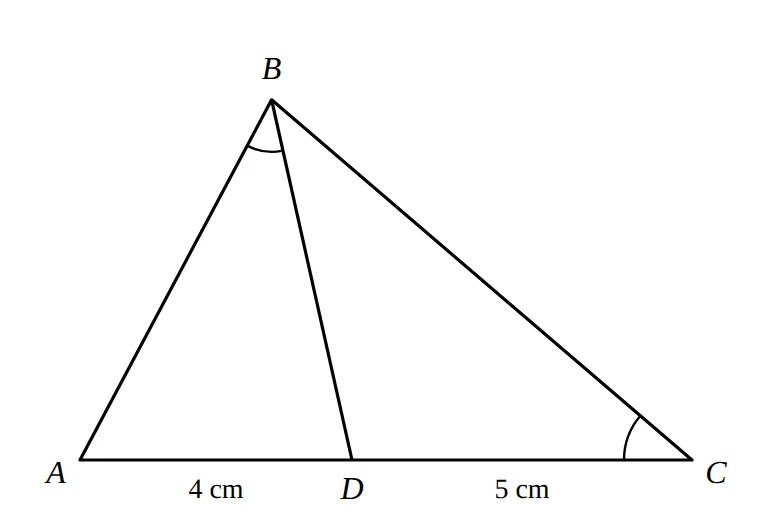
7. In the figure, is a point on the side of such that . If cm and cm, then is
(a) 4.5 cm
(b) 5 cm
(c) cm
(d) 6 cm
8. The coordinates of the point which divides the line segment joining and internally in the ratio are
(a)
(b)
(c)
(d)
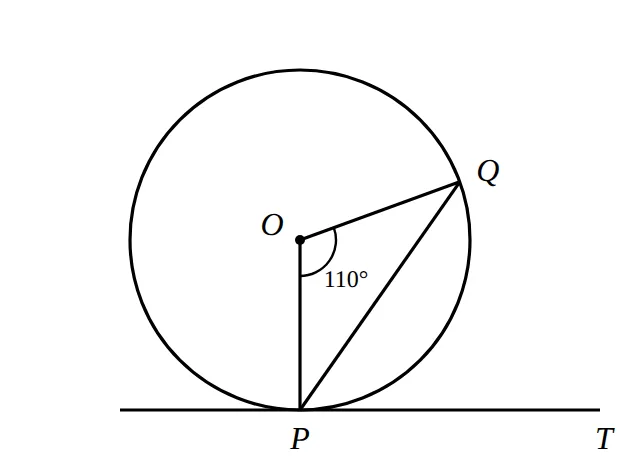
9. In the figure, is the centre of the circle, is a chord and is the tangent at . If , then is
(a)
(b)
(c)
(d)
10. From an external point , two tangents and are drawn to a circle. If cm and , then the length of the chord is
(a) 3 cm
(b) cm
(c) 6 cm
(d) cm
11. If , where is acute, then the value of is
(a)
(b)
(c)
(d)
12. A ladder 12 m long leans against a vertical wall and makes an angle of with the level ground. The height at which the top of the ladder touches the wall is
(a) 6 m
(b) m
(c) m
(d) m
13. The perimeter of a sector of a circle of radius 7 cm with central angle is (use )
(a) 25 cm
(b) 11 cm
(c) 18 cm
(d) 38.5 cm
14. Two identical cubes, each of edge 6 cm, are joined end to end. The total surface area of the resulting cuboid is
(a)
(b)
(c)
(d)
15. A right circular cylinder and a right circular cone have equal base radii and equal volumes. If the height of the cylinder is 5 cm, the height of the cone is
(a) 5 cm
(b) cm
(c) 10 cm
(d) 15 cm
16. Consider the following frequency distribution.
| Class | 10-20 | 20-30 | 30-40 | 40-50 | 50-60 |
|---|---|---|---|---|---|
| Frequency | 6 | 16 | 12 | 9 | 7 |
The sum of the upper limit of the median class and the lower limit of the modal class is
(a) 60
(b) 70
(c) 50
(d) 80
17. Two dice are thrown at the same time. The probability that the sum of the numbers on them is 8 is
(a)
(b)
(c)
(d)
18. A bag contains 4 red balls, 6 white balls and some green balls. If the probability of drawing a green ball at random is , then the number of green balls in the bag is
(a) 15
(b) 5
(c) 10
(d) 3
Directions: In questions 19 and 20, a statement of Assertion (A) is followed by a statement of Reason (R). Choose the correct option.
19. Assertion (A): If the HCF of two numbers is 12, their LCM is 360 and one of the numbers is 72, then the other number is 60.
Reason (R): The HCF of two numbers is always a factor of their LCM.
(a) Both Assertion (A) and Reason (R) are true and Reason (R) is the correct explanation of Assertion (A).
(b) Both Assertion (A) and Reason (R) are true, but Reason (R) is not the correct explanation of Assertion (A).
(c) Assertion (A) is true, but Reason (R) is false.
(d) Assertion (A) is false, but Reason (R) is true.
20. Assertion (A): The points , and are collinear.
Reason (R): If three points , and satisfy , then they are collinear.
(a) Both Assertion (A) and Reason (R) are true and Reason (R) is the correct explanation of Assertion (A).
(b) Both Assertion (A) and Reason (R) are true, but Reason (R) is not the correct explanation of Assertion (A).
(c) Assertion (A) is true, but Reason (R) is false.
(d) Assertion (A) is false, but Reason (R) is true.
Section B (10 marks)
This section has 5 very short answer (VSA) type questions of 2 marks each.
21. Given that is irrational, prove that is irrational. (2 marks)
22. In the figure, and the line segments and intersect at . If cm, cm, cm and cm, find and . (2 marks)
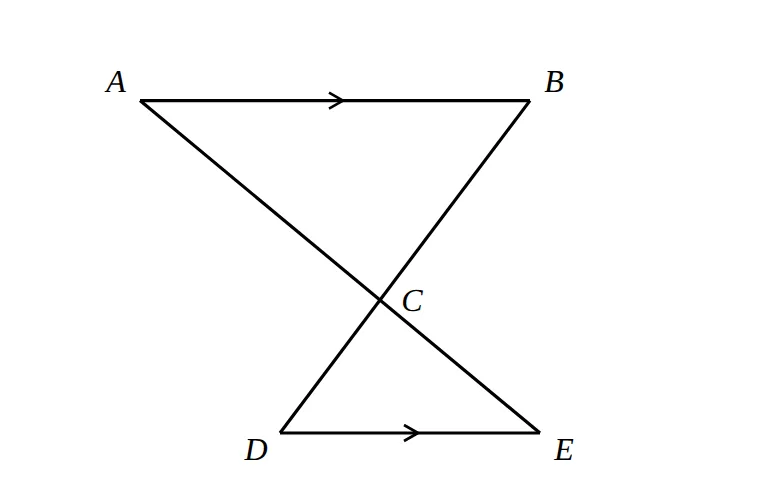
OR
. If cm, cm, cm, cm and cm, find and the perimeter of .
23. Find the zeroes of the quadratic polynomial and verify the relationship between the zeroes and the coefficients. (2 marks)
24. Priya evaluated as follows.
Step 1:
Step 2:
In which step did she make a mistake? Find the correct value of the expression. (2 marks)
OR
Evaluate:
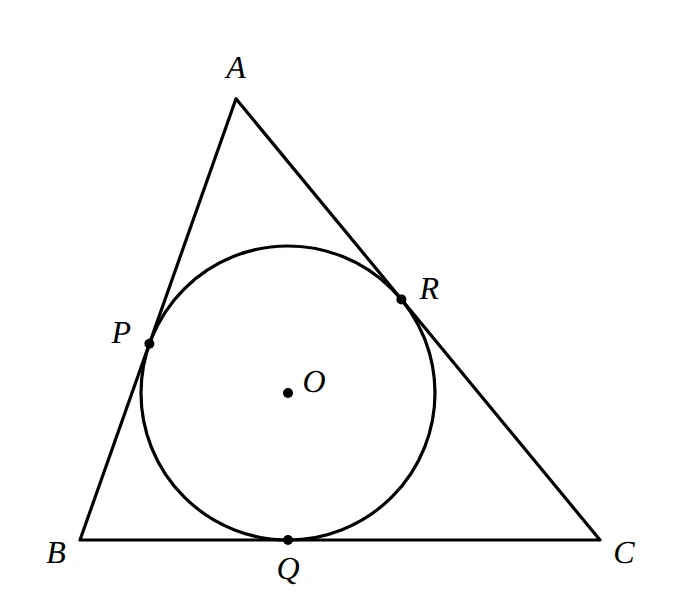
25. In the figure, a circle with centre is inscribed in and touches the sides , and at , and respectively. If cm, cm, cm and cm, find the value of . (2 marks)
Section C (18 marks)
This section has 6 short answer (SA) type questions of 3 marks each.
26. Three bells in a temple ring at intervals of 18 minutes, 24 minutes and 32 minutes respectively. They ring together at 6:00 a.m. At what time will they next ring together? How many times in all will they ring together from 6:00 a.m. to 6:00 p.m. on the same day, counting the ring at 6:00 a.m.? (3 marks)
27. Prove that . (3 marks)
28. and are tangents drawn from an external point to a circle with centre . Prove that bisects . (3 marks)
OR
is a chord of length 24 cm of a circle of radius 20 cm. The tangents at and intersect at a point . Find the length of .
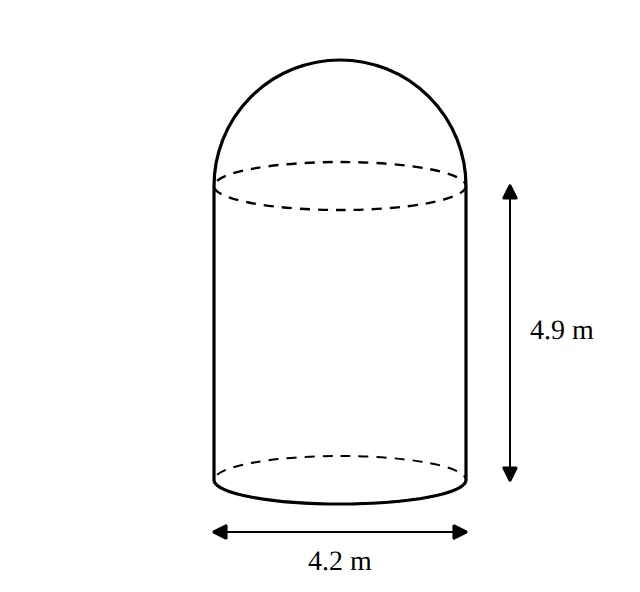
29. A grain storage bin on a farm is in the shape of a right circular cylinder surmounted by a hemispherical dome of the same radius. The diameter of the bin is 4.2 m and the height of the cylindrical part is 4.9 m. The outer curved surface of the bin (the cylindrical wall and the dome, not the base) is to be painted at the rate of ₹ 20 per . Find the cost of painting. (Use ) (3 marks)
OR
From a solid cylinder of radius 7 cm and height 30 cm, a conical cavity of the same radius and of height 24 cm is hollowed out from one end. Find the total surface area of the remaining solid in terms of .
30. All the black face cards are removed from a well-shuffled pack of 52 playing cards. A card is then drawn at random from the remaining cards. Find the probability that the card drawn is (i) a red card, (ii) a face card, (iii) a spade or an ace. (3 marks)
31. In a T20 match, a batter hit 16 boundaries, each of them a four or a six, and scored 76 runs from these boundaries. How many fours and how many sixes did the batter hit? How many runs came from sixes? (3 marks)
Section D (20 marks)
This section has 4 long answer (LA) type questions of 5 marks each.
32. A State Transport bus covers a distance of 240 km between two towns at a uniform speed. If its speed had been 10 km/h more, it would have taken 2 hours less for the journey. Find the usual speed of the bus and the time it takes for the journey. (5 marks)
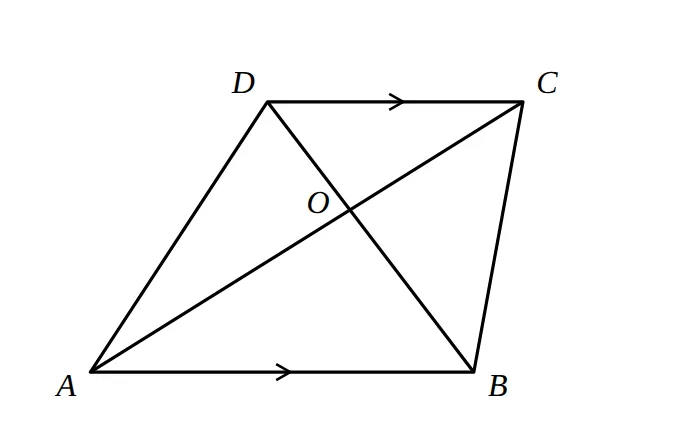
33. In the figure, is a trapezium in which , and its diagonals and intersect at .
(i) Prove that .
(ii) Hence show that .
(iii) If cm, cm, cm and cm, find and the length of . (5 marks)
OR
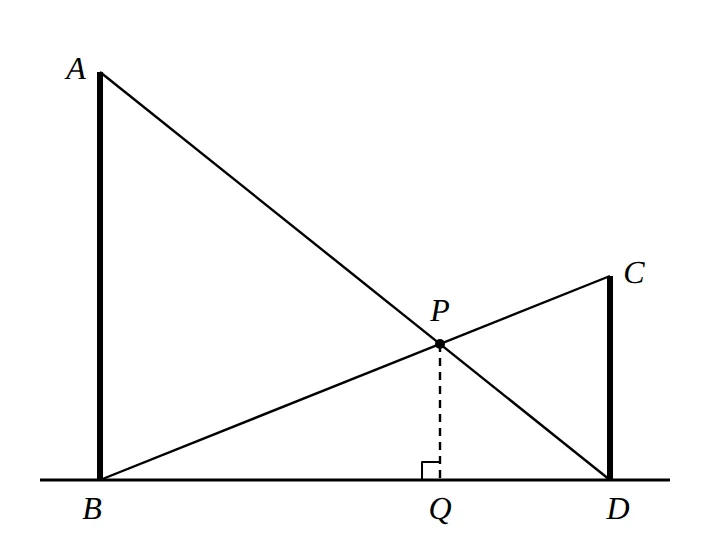
In the figure, and are two vertical poles standing on level ground . The wires and cross each other at , and .
(i) Prove that and .
(ii) Hence show that .
(iii) If m, m and m, find and .
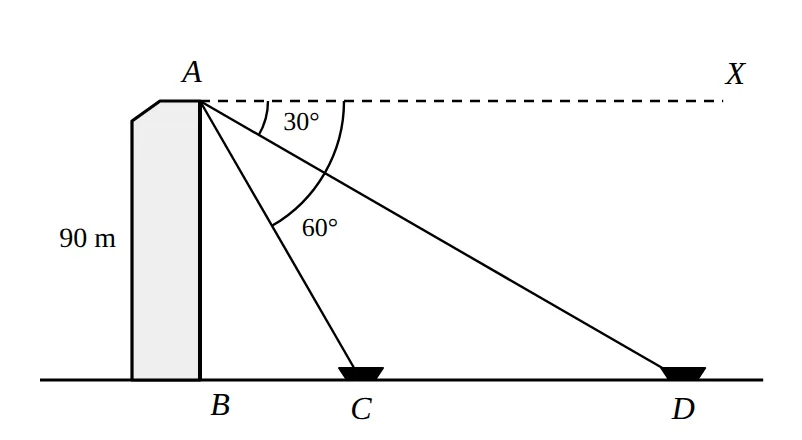
34. From the top of a vertical cliff 90 m high, the angles of depression of two boats and on the sea, due east of the cliff and in line with its foot , are and respectively. (i) Find the distance between the two boats. (ii) The boat at sails towards the cliff at a uniform speed and reaches the position of the other boat in 3 minutes. Find its speed in metres per minute. (Use ) (5 marks)
35. The table shows the distance (in km) that 50 employees of a company travel daily to reach their office. The mean distance is 23.4 km.
| Distance (km) | 0-10 | 10-20 | 20-30 | 30-40 | 40-50 |
|---|---|---|---|---|---|
| Number of employees | 8 | 12 | 6 |
Find the missing frequencies and . (5 marks)
OR
The mode of the following distribution of the time (in seconds) taken by some students to solve a puzzle is 54 seconds. Find the missing frequency .
| Time (seconds) | 20-30 | 30-40 | 40-50 | 50-60 | 60-70 | 70-80 |
|---|---|---|---|---|---|---|
| Number of students | 6 | 10 | 16 | 12 | 7 |
Section E (12 marks)
This section has 3 case study based questions of 4 marks each.
36. Ramesh runs a tea stall. He joins a monthly savings scheme at the post office and deposits ₹ 500 in the first month. Every month after that he deposits ₹ 100 more than in the previous month.
(i) How much does he deposit in the 10th month? (1 mark)
(ii) In which month does he deposit ₹ 2500? (1 mark)
(iii) Find the total amount he deposits in the first 2 years. (2 marks)
OR
(iii) Find the total amount he deposits in the second year, that is, from the 13th month to the 24th month. (2 marks)
37. The map of a village is drawn on a coordinate grid, with the Panchayat Bhawan at the origin and the main road along the x-axis. One unit on the grid stands for 100 m. The school is at , the health centre at , the market at and the temple at .
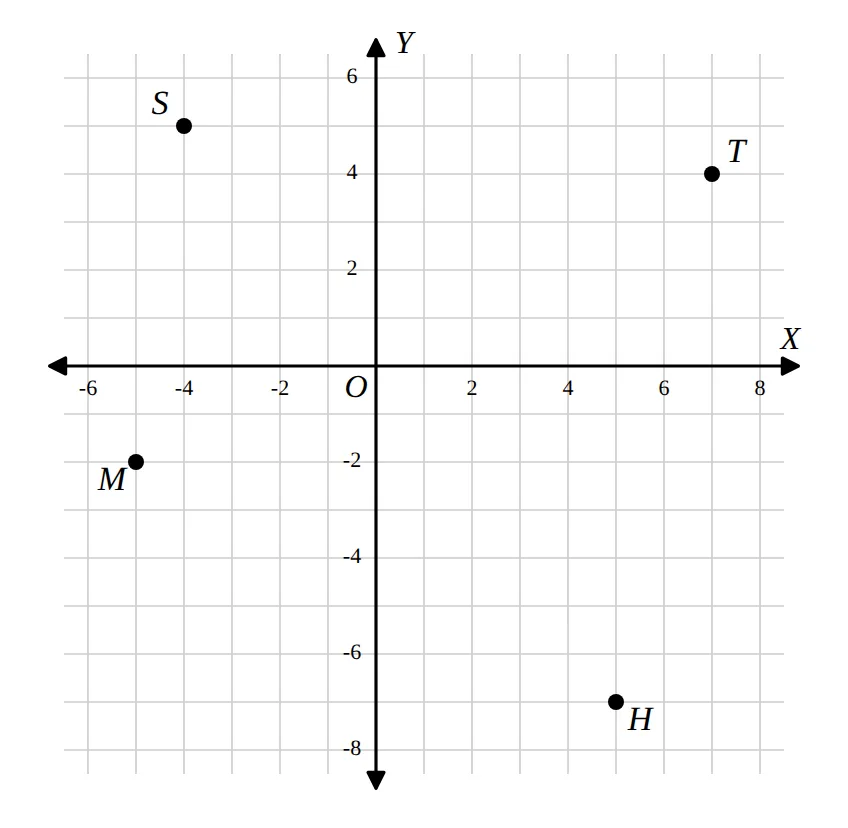
(i) How far is the health centre from the school, in metres? (1 mark)
(ii) A bus stop is to be built exactly midway between the market and the temple. Find its coordinates. (1 mark)
(iii) A straight road joins the market and the temple. In what ratio does the main road (the x-axis) divide the line segment ? At which point do the two roads cross? (2 marks)
OR
(iii) A water tank is to be built beside the lane that runs along the y-axis, at the same distance from the market and the temple. Find the coordinates of . (2 marks)
38. The windscreen wiper of a car has an arm of length 42 cm, pivoted at . The rubber blade is fixed on the outer half of the arm, so cm. In one sweep the arm turns through an angle of and the blade wipes the region between the two arcs (shaded in the figure). (Use )
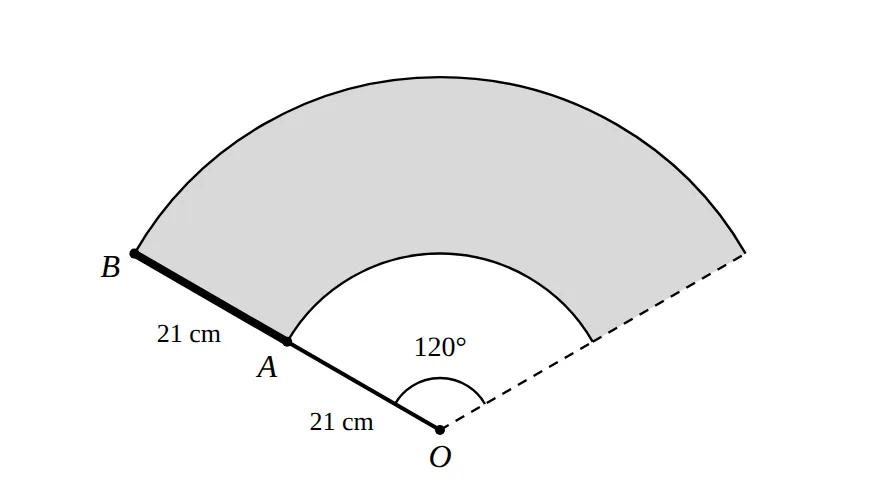
(i) Find the length of the arc traced by the tip in one sweep. (1 mark)
(ii) Find the area of the sector swept by the whole arm in one sweep. (1 mark)
(iii) Find the area wiped by the blade in one sweep. The car has a second, identical wiper, and the regions wiped by the two blades are separate. What total area do the two blades wipe in one sweep? (2 marks)
OR
(iii) Find the perimeter of the region wiped by one blade in one sweep. (2 marks)