Detailed Solutions: CBSE Class 10 Maths Sample Paper 2027 – Set 3
Every written question from the paper (2, 3, 4 and 5 marks) is solved here in order, with the marks given for each step, so you can check your answer sheet the way an examiner would. Where a question has an internal choice (OR), both options are solved. The 1-mark questions are answered, with explanations, in the quiz on the Question Paper page.
Section B (10 marks)
Question 21(2 marks)
The floor of a school's computer lab is a rectangle 5.4 m long and 4.2 m wide. It is to be covered with identical square tiles without cutting any tile. Find the side of the largest square tile that can be used and the number of such tiles needed.
Answer.
In cm: 540=22×33×5 and 420=22×3×5×7; largest side = HCF =22×3×5=60 cm — 1 mark
Number of tiles =60540×60420=9×7=63 — 1 mark
Question 22(2 marks)
One zero of the quadratic polynomial x2−9x+k is twice the other. Find the zeroes and the value of k.
Answer.
Let the zeroes be α and 2α; sum =3α=9, so α=3 and the zeroes are 3 and 6 — 1 mark
k= product of the zeroes =3×6=18 — 1 mark
OR
Find a quadratic polynomial the sum and product of whose zeroes are −41 and −43 respectively. Also find its zeroes.
Answer.
Polynomial =k(x2+41x−43); taking k=4, it is 4x2+x−3 — 1 mark
4x2+x−3=4x2+4x−3x−3=(4x−3)(x+1), so the zeroes are 43 and −1 — 1 mark
Question 23(2 marks)
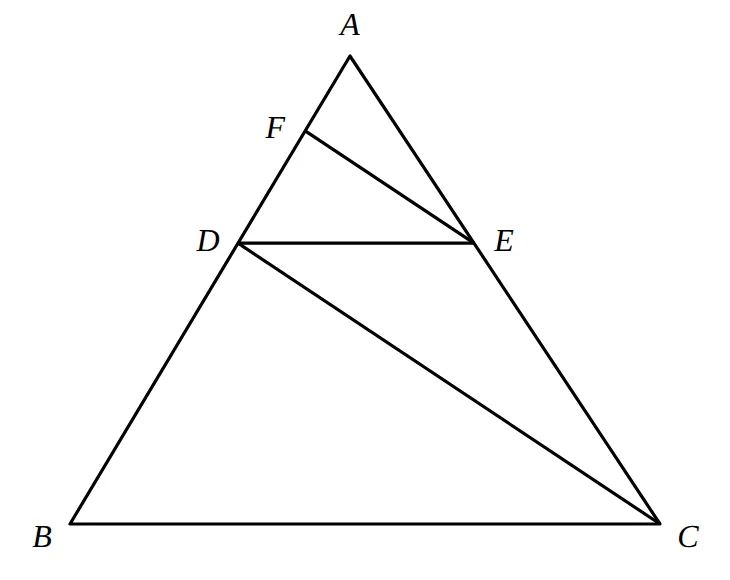
In the figure, D and E are points on the sides AB and AC of △ABC such that DE∥BC, and F is a point on AD such that EF∥CD. If AF=4 cm and FD=6 cm, find DB.
Answer.
In △ADC, FE∥DC, so FDAF=ECAE (BPT); in △ABC, DE∥BC, so DBAD=ECAE — 1 mark
Hence DBAD=FDAF, i.e. DB10=64, so DB=15 cm — 1 mark
Question 24(2 marks)
If secA=2129, where A is an acute angle, find the value of cosA1+sinA.
Answer.
cosA=2921 and sinA=1−841441=2920 — 1 mark
cosA1+sinA=29211+2920=2149=37 — 1 mark
Question 25(2 marks)
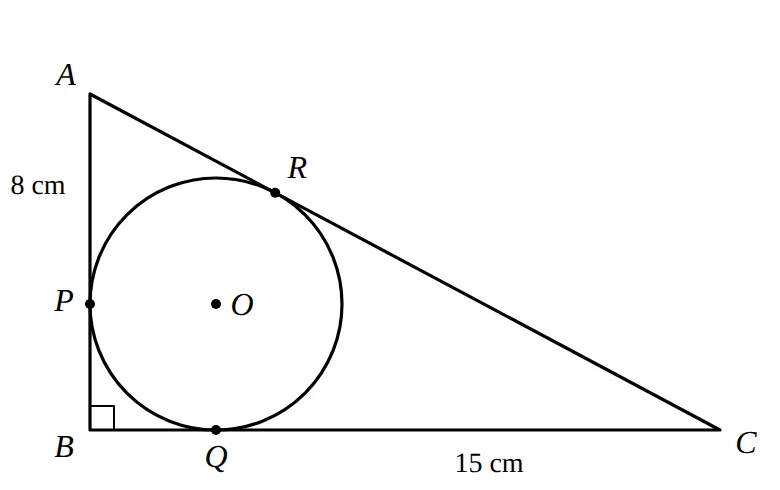
In the figure, a circle with centre O is inscribed in △ABC, which is right-angled at B. The circle touches AB, BC and CA at P, Q and R respectively. If AB=8 cm and BC=15 cm, find the radius of the circle.
Answer.
AC=82+152=17 cm; OP⊥AB, OQ⊥BC and OP=OQ, so OPBQ is a square and BP=BQ=r — 1 mark
Tangents from A and C: AR=AP=8−r and CR=CQ=15−r; (8−r)+(15−r)=17, so r=3 cm — 1 mark
OR
From an external point P, two tangents PA and PB are drawn to a circle with centre O. If PA=12 cm and OP=15 cm, find the perimeter of the quadrilateral OAPB.
Answer.
OA⊥PA, so OA=152−122=9 cm; also OB=9 cm and PB=PA=12 cm — 1 mark
Perimeter =9+12+12+9=42 cm — 1 mark
Section C (18 marks)
Question 26(3 marks)
Prove that 5 is an irrational number.
Answer.
Assume 5 is rational: 5=ba, where a and b are co-prime integers and b=0; squaring, 5b2=a2 — 1 mark
So 5 divides a2, and hence 5 divides a. Write a=5c: then 25c2=5b2, i.e. b2=5c2, so 5 divides b2 and hence 5 divides b — 1 mark
5 is a common factor of a and b, which contradicts that they are co-prime; hence 5 is irrational — 1 mark
Question 27(3 marks)
Find the coordinates of the points of trisection of the line segment joining A(−2,−3) and B(7,9). Also verify that the distance from A of the point of trisection nearer to A is one-third of AB.
Answer.
The points divide AB in the ratios 1:2 and 2:1; P=(31(7)+2(−2),31(9)+2(−3))=(1,1) — 1 mark
Q=(32(7)+1(−2),32(9)+1(−3))=(4,5) — 1 mark
AP=32+42=5 and AB=92+122=15, so AP=31AB — 1 mark
Question 28(3 marks)
Prove that sec4A−sec2A=tan4A+tan2A.
Answer.
LHS =sec2A(sec2A−1) — 1 mark
=(1+tan2A)tan2A, using sec2A=1+tan2A — 1 mark
=tan2A+tan4A= RHS — 1 mark
OR
Prove that (secA−cosA)(cotA+tanA)=tanAsecA.
Answer.
secA−cosA=cosA1−cos2A=cosAsin2A — 1 mark
cotA+tanA=sinAcosAcos2A+sin2A=sinAcosA1 — 1 mark
LHS =cosAsin2A×sinAcosA1=cosAsinA×cosA1=tanAsecA= RHS — 1 mark
Question 29(3 marks)
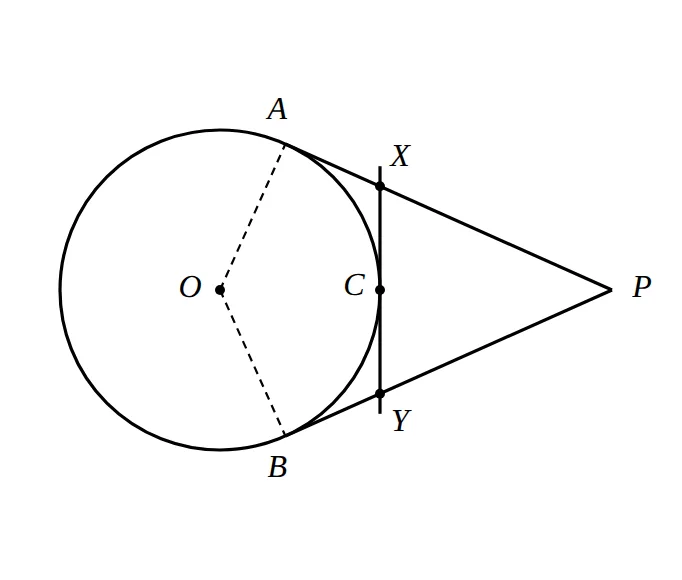
Prove that the lengths of the tangents drawn from an external point to a circle are equal. Using this result, find the perimeter of △PXY in the figure, where PA and PB are tangents from P to a circle with centre O, and the tangent at the point C of the circle meets PA at X and PB at Y. It is given that PA=10 cm.
Answer.
Figure, given and to prove; join OA, OB and OP; ∠OAP=∠OBP=90∘ (radius is perpendicular to the tangent) — 1 mark
In △OAP and △OBP: OA=OB (radii) and OP is common, so △OAP≅△OBP (RHS) and PA=PB — 1 mark
XA=XC and YB=YC; perimeter =PX+XC+CY+YP=PX+XA+YB+PY=PA+PB=20 cm — 1 mark
Question 30(3 marks)
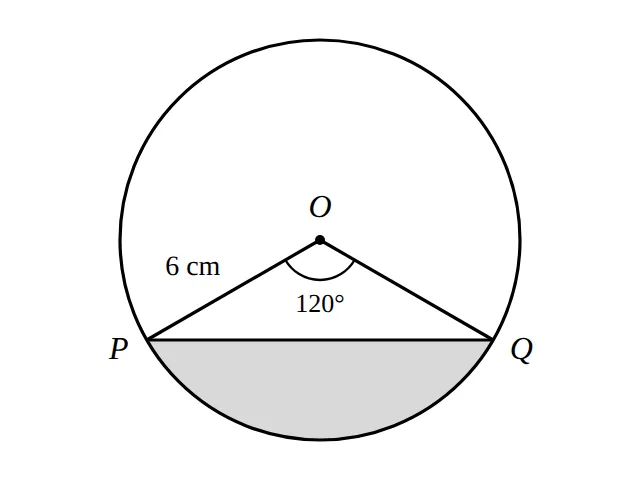
In the figure, PQ is a chord of a circle with centre O and radius 6 cm, and ∠POQ=120∘. Find the area of the shaded minor segment. (Use π=3.14 and 3=1.73)
Answer.
Area of the sector =360120×3.14×6×6=37.68 cm2 — 1 mark
Draw OM⊥PQ: ∠POM=60∘, OM=6cos60∘=3 cm, PM=6sin60∘=33 cm; area of the triangle =21×63×3=93=15.57 cm2 — 1 mark
Area of minor segment =37.68−15.57=22.11 cm2 — 1 mark
OR
An arc of a circle of radius 14 cm is 22 cm long. Find (i) the angle subtended by the arc at the centre, (ii) the area of the minor sector formed by the arc, (iii) the area of the corresponding major sector. (Use π=722)
Answer.
360θ×2×722×14=22, i.e. 360θ×88=22, so θ=90∘ — 1 mark
Minor sector =36090×722×14×14=154 cm2 — 1 mark
Area of the circle =616 cm2; major sector =616−154=462 cm2 — 1 mark
Question 31(3 marks)
Two dice, one red and one blue, are thrown together. Find the probability that (i) the sum of the numbers on the two dice is 9, (ii) the product of the numbers on the two dice is a perfect square, (iii) the number on the red die is less than the number on the blue die.
Answer.
Total outcomes =36. (i) Sum 9: (3,6),(4,5),(5,4),(6,3); P=364=91 — 1 mark
(ii) Product a perfect square: (1,1),(2,2),(3,3),(4,4),(5,5),(6,6),(1,4),(4,1); P=368=92 — 1 mark
(iii) Red less than blue: 5+4+3+2+1=15 outcomes; P=3615=125 — 1 mark
Section D (20 marks)
Question 32(5 marks)
The length of a rectangular garden in a housing society is 16 m more than its breadth, and its area is 1700 m2. A gravel path of uniform width is laid inside the garden along all four sides, leaving a rectangular lawn of area 1092 m2 in the middle. Find the length and breadth of the garden and the width of the path.
Answer.
Let the breadth be x m: x(x+16)=1700, i.e. x2+16x−1700=0 — 1 mark
(x+50)(x−34)=0, so x=34 (x=−50 rejected); the garden is 50 m long and 34 m wide — 1 mark
Let the width of the path be w m: (50−2w)(34−2w)=1092 — 1 mark
4w2−168w+608=0, i.e. w2−42w+152=0 — 1 mark
(w−4)(w−38)=0; w=38 is rejected since 2×38>34, so the path is 4 m wide — 1 mark
Question 33(5 marks)
Solve the following pair of linear equations graphically: 2x+y=8 and x−y+2=0. Also find the coordinates of the vertices of the triangle formed by these lines and the y-axis, and find its area.
Answer.
Table of values for 2x+y=8: (0,8),(4,0),(2,4) — 1 mark
Table of values for x−y+2=0: (0,2),(−2,0),(2,4) — 1 mark
Both lines correctly drawn on the same graph — 1 mark
Solution x=2, y=4; vertices (2,4), (0,8) and (0,2) — 1 mark
Area =21×(8−2)×2=6 square units — 1 mark
OR
At a school fete, a food stall sold 45 veg rolls and 60 glasses of lemonade on the first day and collected ₹ 2250. On the second day it sold 60 veg rolls and 40 glasses of lemonade and collected ₹ 2400. Find the price of one veg roll and of one glass of lemonade. How much would a customer pay for 4 veg rolls and 3 glasses of lemonade?
Answer.
Let a roll cost ₹ x and a glass cost ₹ y: 45x+60y=2250 and 60x+40y=2400, i.e. 3x+4y=150 and 3x+2y=120 — 2 marks
Subtracting, 2y=30, so y=15 — 1 mark
3x=150−60=90, so x=30 — 1 mark
Cost =4×30+3×15= ₹ 165 — 1 mark
Question 34(5 marks)
A devotee whose eyes are 1.5 m above the ground sees the top of a temple gopuram at an angle of elevation of 30∘. After walking 50 m straight towards the gopuram on level ground, he finds that the angle of elevation of its top is 60∘. Find the height of the gopuram and his distance from the gopuram at the second position. (Use 3=1.73)
Answer.
Correct figure: top A of the gopuram, eye-level line meeting the gopuram at E, eye positions C and D with CD=50 m; let AE=h m and DE=x m — 1 mark
In right △AED: tan60∘=xh, so h=3x — 1 mark
In right △AEC: tan30∘=x+50h, so 3h=x+50 — 1 mark
3x=x+50, so x=25 m and h=253=43.25 m — 1 mark
Height of the gopuram =43.25+1.5=44.75 m; distance at the second position =25 m — 1 mark
Question 35(5 marks)
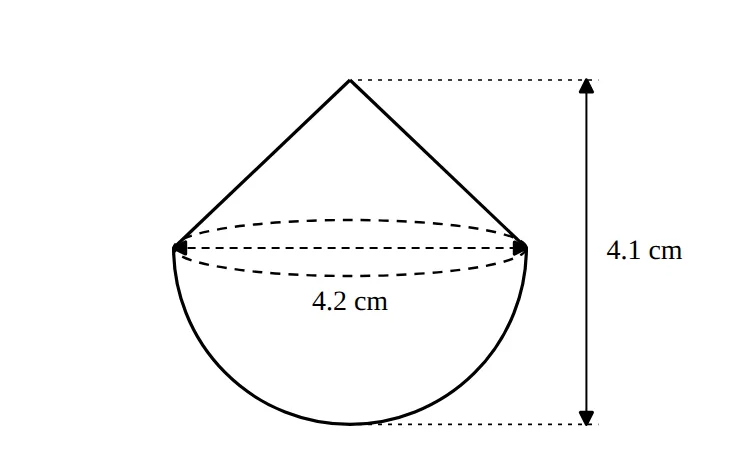
A wooden top (lattu) is in the shape of a cone mounted on a hemisphere of the same radius. The diameter of the hemisphere is 4.2 cm and the total height of the top is 4.1 cm. Find the total surface area of the top and the volume of wood in it. (Use π=722)
Answer.
r=2.1 cm; height of the cone =4.1−2.1=2 cm; slant height l=2.12+22=8.41=2.9 cm — 1 mark
CSA of hemisphere =2πr2=2×722×2.1×2.1=27.72 cm2; CSA of cone =πrl=722×2.1×2.9=19.14 cm2 — 1 mark
Total surface area =27.72+19.14=46.86 cm2 — 1 mark
Volume of hemisphere =32πr3=19.404 cm3; volume of cone =31πr2h=31×13.86×2=9.24 cm3 — 1 mark
Volume of wood =19.404+9.24=28.644 cm3 — 1 mark
OR
A memento is made of a solid wooden cube of edge 10 cm with a solid hemisphere of radius 4.2 cm fixed on the middle of its top face. The memento stands on its bottom face, which is not polished; every other outer surface, including the curved surface of the hemisphere, is to be polished. Find the area to be polished and the volume of the memento. (Use π=722)
Answer.
Faces of the cube other than the bottom: 5×10×10=500 cm2; the circle of radius 4.2 cm under the hemisphere is hidden — 1 mark
πr2=722×4.2×4.2=55.44 cm2; CSA of hemisphere =2πr2=110.88 cm2 — 1 mark
Area to be polished =500−55.44+110.88=555.44 cm2 — 1 mark
Volume of cube =103=1000 cm3; volume of hemisphere =32×722×4.23=155.232 cm3 — 1 mark
Volume of the memento =1000+155.232=1155.232 cm3 — 1 mark
Section E (12 marks)
Question 36(4 marks)
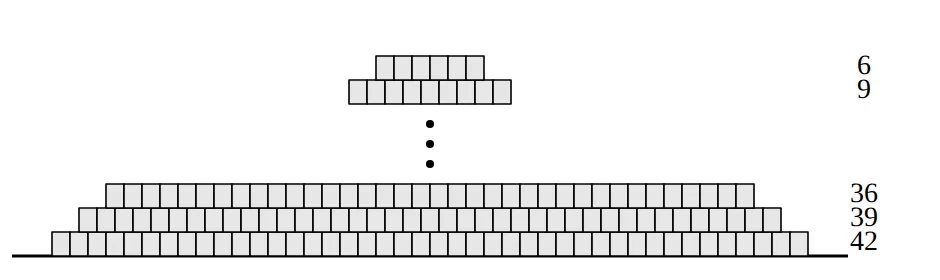
At a brick kiln, bricks are stacked in rows, one row on top of another. The bottom row has 42 bricks, the row above it has 39, the next one has 36, and so on: every row has 3 bricks fewer than the row just below it. The top row has 6 bricks.
(i) How many bricks are there in the 6th row from the bottom? (1 mark)
Answer.
a=42, d=−3; a6=42+5(−3)=27 — 1 mark
(ii) How many rows are there in the stack? (1 mark)
Answer.
42+(n−1)(−3)=6 gives n−1=12, so n=13 rows — 1 mark
(iii) Find the total number of bricks in the stack. (2 marks)
Answer.
S13=213(42+6) — 1 mark
=13×24=312 bricks — 1 mark
OR
(iii) Find the total number of bricks in all the rows that have more than 30 bricks each. (2 marks)
Answer.
Rows with more than 30 bricks: 42, 39, 36, 33 (the 5th row has exactly 30), i.e. 4 rows — 1 mark
Sum =24(42+33)=150 bricks — 1 mark
Question 37(4 marks)
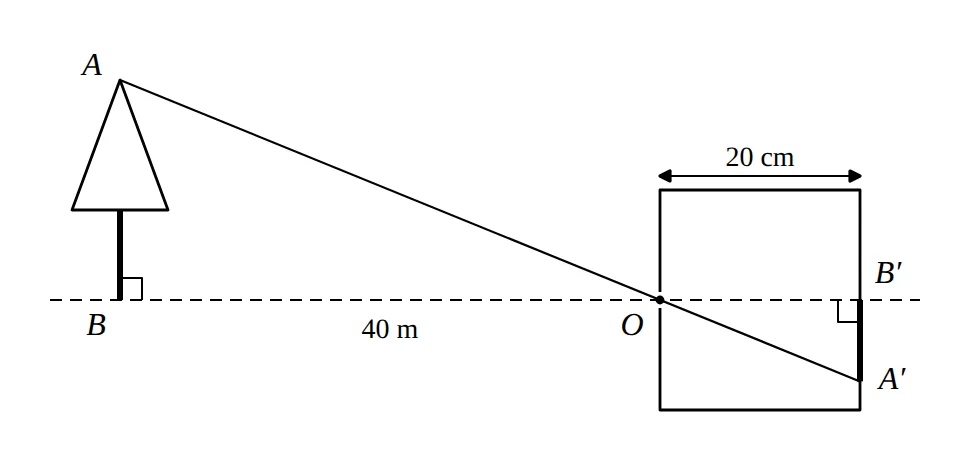
For his science project, Kabir made a pinhole camera: a closed box with a tiny hole O in the front face and a screen on the back face, 20 cm behind the hole. He points it at a tree AB which is 12 m tall and stands 40 m away from the hole. Light from the top A of the tree passes through O and reaches the screen at A′, so an inverted image A′B′ of the tree is formed. Take the foot B of the tree, the hole O and the point B′ to lie on one horizontal line, with the tree and the screen both vertical.
(i) By which criterion is △OAB∼△OA′B′? (1 mark)
Answer.
∠ABO=∠A′B′O=90∘ and ∠AOB=∠A′OB′ (vertically opposite angles), so the triangles are similar by the AA criterion — 1 mark
(ii) Find the height of the image A′B′. (1 mark)
Answer.
ABA′B′=OBOB′, so A′B′=40001200×20=6 cm — 1 mark
(iii) Kabir moves the camera 10 m closer to the tree. Find the new height of the image. (2 marks)
Answer.
Now OB=30 m =3000 cm, and 1200A′B′=300020 — 1 mark
A′B′=30001200×20=8 cm — 1 mark
OR
(iii) Kabir's friend, who is 1.5 m tall, stands in front of the camera, and the image of the friend on the screen is 5 cm tall. How far from the hole is the friend standing? (2 marks)
Answer.
Heights in cm: 1505=OB20 — 1 mark
OB=5150×20=600 cm =6 m — 1 mark
Question 38(4 marks)
An electricity company surveyed 60 households in a colony. The table shows the number of units of electricity they used in a month.
Units used
50-100
100-150
150-200
200-250
250-300
300-350
Number of households
4
7
16
15
12
6
(i) How many households used 200 units or more in the month? (1 mark)
Answer.
15 + 12 + 6 = 33 households — 1 mark
(ii) Write the modal class and the median class. (1 mark)
Answer.
Modal class 150-200 (highest frequency 16); cumulative frequencies 4, 11, 27, 42, … and 2n=30, so the median class is 200-250 — 1 mark
(iii) Find the median of the data. (2 marks)
Answer.
2n=30; median class 200-250: l=200, cf=27, f=15, h=50 — 1 mark
Median =200+1530−27×50=200+10=210 units — 1 mark
OR
(iii) Find the mode of the data. (2 marks)
Answer.
Modal class 150-200: l=150, f1=16, f0=7, f2=15, h=50 — 1 mark
Mode =150+32−7−1516−7×50=150+45=195 units — 1 mark
Ready to test your knowledge?
Take a quick interactive quiz on this topic —
free, works without login.