Detailed Solutions: CBSE Class 10 Maths Sample Paper 2027 – Set 4
Every written question from the paper (2, 3, 4 and 5 marks) is solved here in order, with the marks given for each step, so you can check your answer sheet the way an examiner would. Where a question has an internal choice (OR), both options are solved. The 1-mark questions are answered, with explanations, in the quiz on the Question Paper page.
Section B (10 marks)
Question 21(2 marks)
Given that 2 is irrational, prove that 7−32 is irrational.
Answer.
Assume 7−32=r, a rational number; then 2=37−r — 1 mark
37−r is rational because r is rational, but 2 is irrational - a contradiction; hence 7−32 is irrational — 1 mark
Question 22(2 marks)
A circle has its centre at C(2,−3) and passes through the point P(−4,5). Find the radius of the circle. Does the point Q(10,3) lie on this circle? Give a reason.
Answer.
Radius =CP=(2+4)2+(−3−5)2=36+64=10 units — 1 mark
CQ=(10−2)2+(3+3)2=64+36=10 units, equal to the radius, so Q lies on the circle — 1 mark
Question 23(2 marks)
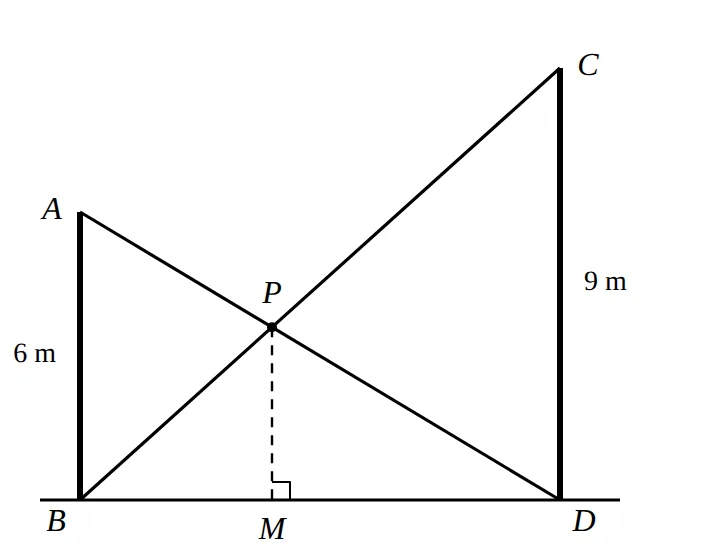
Two vertical poles AB and CD, of heights 6 m and 9 m, stand on level ground at B and D. Wires are stretched from A to D and from C to B, and they cross at P, as shown in the figure. Find the height PM of the crossing point above the ground.
Answer.
Let PM=h, with M on BD. △BMP∼△BDC and △DMP∼△DBA (AA), so 9h=BDBM and 6h=BDMD — 1 mark
Adding, 9h+6h=BDBM+MD=1, so 185h=1 and h=3.6 m — 1 mark
OR
In △ABC and △PQR, ∠A=∠P and ∠B=∠Q. If AB=6 cm, BC=(2x+1) cm, PQ=4 cm and QR=(x+2) cm, find x and the lengths of BC and QR.
Answer.
△ABC∼△PQR (AA), so PQAB=QRBC, i.e. 46=x+22x+1 — 1 mark
3(x+2)=2(2x+1) gives x=4; BC=9 cm and QR=6 cm — 1 mark
Question 24(2 marks)
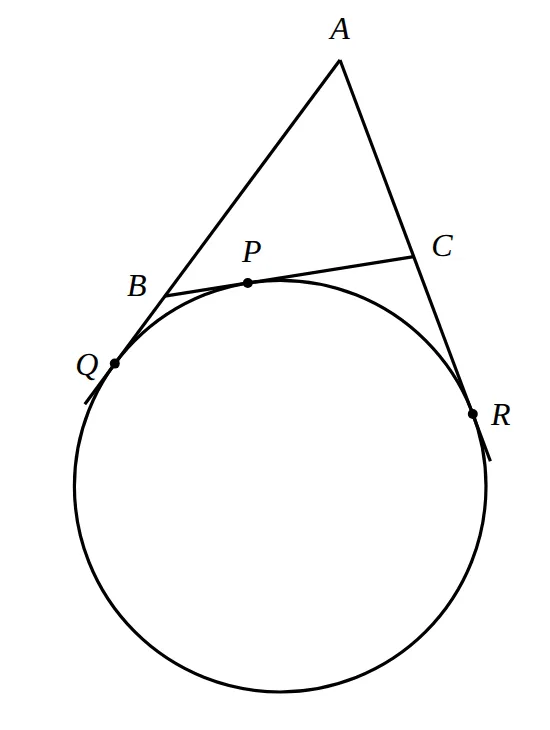
In the figure, a circle touches the side BC of △ABC at P, and touches AB produced and AC produced at Q and R respectively. If AB=7 cm, BC=6 cm and CA=5 cm, find the length of AQ.
Answer.
Tangents from an external point are equal: AQ=AR, BQ=BP and CR=CP — 1 mark
AQ+AR=(AB+BQ)+(AC+CR)=AB+AC+(BP+CP)=7+5+6=18, so 2AQ=18 and AQ=9 cm — 1 mark
Question 25(2 marks)
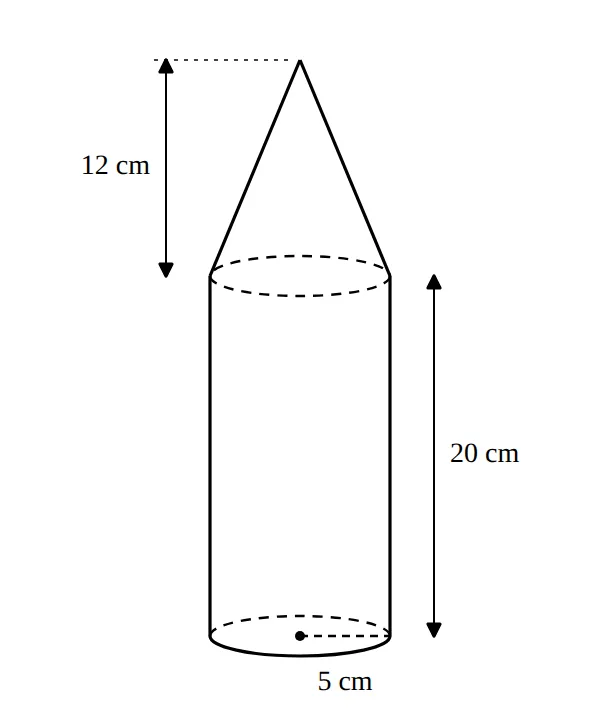
A solid model of a rocket is made of a right circular cylinder of radius 5 cm and height 20 cm, with a right circular cone of the same radius and height 12 cm fixed on its top, as shown in the figure. Find the total surface area of the model in terms of π.
Answer.
Slant height of the cone l=52+122=13 cm; the surface is the cone's curved surface, the cylinder's curved surface and the circular base — 1 mark
Total surface area =πrl+2πrh+πr2=65π+200π+25π=290π cm2 — 1 mark
OR
A measuring vessel is a hollow cylinder of internal radius 3 cm and height 10 cm, closed at the bottom by a hemispherical bowl of the same radius. How much liquid can the vessel hold? Give your answer in terms of π.
Answer.
Cylinder: πr2h=π×9×10=90π cm3; hemisphere: 32πr3=32π×27=18π cm3 — 1 mark
Capacity =90π+18π=108π cm3 — 1 mark
Section C (18 marks)
Question 26(3 marks)
A school librarian has 336 Hindi books, 240 English books and 216 Science books. She wants to arrange them in stacks so that every stack has the same number of books and each stack has books of only one subject. What is the greatest number of books she can put in each stack? How many stacks will she make in all?
Answer.
336=24×3×7, 240=24×3×5, 216=23×33 — 1 mark
Greatest number of books in a stack = HCF =23×3=24 — 1 mark
Number of stacks =24336+24240+24216=14+10+9=33 — 1 mark
Question 27(3 marks)
If α and β are the zeroes of the polynomial x2−3x−10, find a quadratic polynomial whose zeroes are α2 and β2.
Answer.
α+β=3 and αβ=−10 — 1 mark
α2+β2=(α+β)2−2αβ=9+20=29 and α2β2=(αβ)2=100 — 1 mark
The required polynomial is x2−29x+100 (or any non-zero constant multiple of it); check: the zeroes of x2−3x−10 are 5 and −2, and 25+4=29, 25×4=100 — 1 mark
Question 28(3 marks)
Meera was asked to find the sum of all the multiples of 6 between 100 and 200. Her working is shown below.
First term a=102, last term l=198, common difference d=6.
Number of terms n=6198−102=16.
Sum =216(102+198)=2400.
Is her answer correct? If not, point out the mistake and find the correct sum.
Answer.
The mistake is in the number of terms: 198=102+(n−1)×6 gives n−1=16, so n=17, not 16 — 1.5 marks
Correct sum =217(102+198)=17×150=2550 — 1.5 marks
OR
The 5th term of an AP is 17 and the sum of its first 10 terms is 185. Find the AP.
Answer.
a5=a+4d=17 and S10=210(2a+9d)=185, i.e. 2a+9d=37 — 1 mark
Doubling the first, 2a+8d=34; subtracting, d=3, and then a=17−12=5 — 1 mark
The AP is 5,8,11,14,… — 1 mark
Question 29(3 marks)
The point P(x,6) lies on the line segment joining A(−6,9) and B(10,−3). Find the ratio in which P divides AB and the value of x. Verify the ratio by finding AP and PB with the distance formula.
Answer.
Let the ratio be k:1. From the y-coordinate, k+1−3k+9=6, so −3k+9=6k+6 and k=31; the ratio is 1:3 — 1 mark
x=41×10+3×(−6)=4−8=−2, so P is (−2,6) — 1 mark
AP=42+32=5 and PB=122+92=15, so AP:PB=1:3; verified — 1 mark
Question 30(3 marks)
Prove that 1−sinAcos2A+1+cosAsin2A=2+sinA−cosA.
Answer.
1−sinAcos2A=1−sinA1−sin2A=1−sinA(1−sinA)(1+sinA)=1+sinA — 1 mark
1+cosAsin2A=1+cosA1−cos2A=1+cosA(1−cosA)(1+cosA)=1−cosA — 1 mark
LHS =(1+sinA)+(1−cosA)=2+sinA−cosA= RHS — 1 mark
OR
Prove that secA−1tan2A+cosecA+1cot2A=secA+cosecA.
Answer.
secA−1tan2A=secA−1sec2A−1=secA−1(secA−1)(secA+1)=secA+1 — 1 mark
cosecA+1cot2A=cosecA+1cosec2A−1=cosecA+1(cosecA−1)(cosecA+1)=cosecA−1 — 1 mark
LHS =(secA+1)+(cosecA−1)=secA+cosecA= RHS — 1 mark
Question 31(3 marks)
A card is drawn at random from a well-shuffled deck of 52 playing cards. Find the probability that the card drawn is (i) a red king, (ii) neither a heart nor a king, (iii) a black card that is not a face card.
Answer.
(i) There are 2 red kings; P=522=261 — 1 mark
(ii) Hearts or kings: 13+3=16 cards (the king of hearts is counted once), so 52−16=36 cards are neither; P=5236=139 — 1 mark
(iii) There are 26 black cards, of which 6 are face cards, leaving 20; P=5220=135 — 1 mark
Section D (20 marks)
Question 32(5 marks)
The roll numbers of three students sitting next to each other in a row are three consecutive natural numbers. The product of the smallest and the largest roll number, increased by 5 times the middle roll number, is 233. Find the three roll numbers.
Answer.
Let the roll numbers be n, n+1 and n+2 — 1 mark
n(n+2)+5(n+1)=233 — 1 mark
n2+7n+5=233, i.e. n2+7n−228=0 — 1 mark
(n−12)(n+19)=0, so n=12 (n=−19 is rejected, as a roll number is a natural number) — 1 mark
The roll numbers are 12, 13 and 14 (check: 12×14+5×13=168+65=233) — 1 mark
OR
A mother is 26 years older than her daughter. Five years from now, the product of their ages (in years) will be 615. Find their present ages.
Answer.
Let the daughter's present age be x years; then the mother's present age is (x+26) years — 1 mark
After 5 years: (x+5)(x+31)=615 — 1 mark
x2+36x+155=615, i.e. x2+36x−460=0 — 1 mark
(x−10)(x+46)=0, so x=10 (x=−46 is rejected, as an age cannot be negative) — 1 mark
The daughter is 10 years old and the mother is 36 years old — 1 mark
Question 33(5 marks)
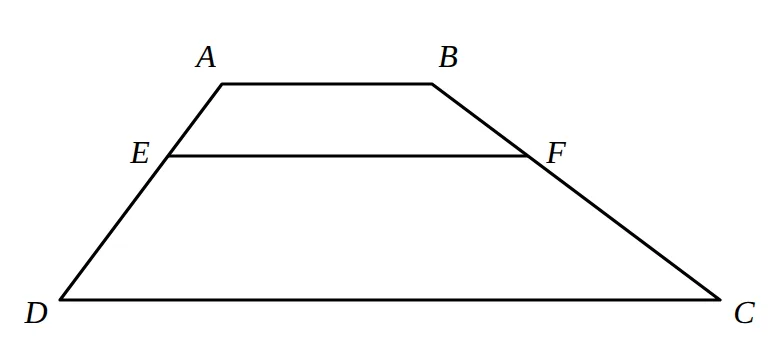
State and prove the Basic Proportionality Theorem (take △PQR with ST∥QR). Using it, solve the following: in the figure, ABCD is a trapezium with AB∥DC, and E and F are points on AD and BC such that EF∥AB. If AE=(x−1) cm, ED=(x+2) cm, BF=x cm and FC=2x cm, find x.
Answer.
Correct statement of the theorem — 1 mark
Given: in △PQR, ST∥QR with S on PQ and T on PR; to prove: SQPS=TRPT; construction: join QT and RS, draw TN⊥PQ and SM⊥PR; figure — 1 mark
ar(QST)ar(PST)=21×SQ×TN21×PS×TN=SQPS (same height TN) and ar(RST)ar(PST)=21×TR×SM21×PT×SM=TRPT (same height SM); ar(QST)=ar(RST) (same base ST, between the same parallels ST and QR) - hence SQPS=TRPT — 1 mark
Join AC, meeting EF at G. In △ADC, EG∥DC gives EDAE=GCAG; in △CAB, GF∥AB gives GCAG=FCBF; so EDAE=FCBF — 1 mark
x+2x−1=2xx=21, so 2x−2=x+2 and x=4 (then AE=3 cm, ED=6 cm, BF=4 cm, FC=8 cm) — 1 mark
Question 34(5 marks)
An aeroplane is flying horizontally at a constant height of 2500 m above the ground, moving away from an observer standing on the ground. At one instant the angle of elevation of the aeroplane from the observer is 45∘, and 10 seconds later it is 30∘. Find the speed of the aeroplane in km/h. Also find the distance of the aeroplane from the observer at the second instant. (Use 3=1.73)
Answer.
Correct figure: observer O on the ground; aeroplane at P and then at Q, 2500 m above the ground points M and N — 1 mark
In △OMP: tan45∘=OM2500, so OM=2500 m — 1 mark
In △ONQ: tan30∘=ON2500, so ON=25003 m — 1 mark
Distance flown =MN=2500(3−1)=2500×0.73=1825 m in 10 s; speed =182.5 m/s =182.5×518=657 km/h — 1 mark
At the second instant, sin30∘=OQ2500, so OQ=5000 m — 1 mark
Question 35(5 marks)
The weights (in kg) of 60 students of Class X of a school are given below.
Weight (kg)
35-40
40-45
45-50
50-55
55-60
60-65
Number of students
5
7
10
16
14
8
Find the median and the mode of the weights.
Answer.
Cumulative frequencies: 5, 12, 22, 38, 52, 60; 2n=30, so the median class is 50-55 — 1 mark
l=50, cf=22, f=16, h=5 — 1 mark
Median =50+1630−22×5=50+2.5=52.5 kg — 1 mark
Modal class 50-55; l=50, f1=16, f0=10, f2=14, h=5 — 1 mark
Mode =50+32−10−1416−10×5=50+3.75=53.75 kg — 1 mark
OR
The table shows the quantity of milk (in litres) supplied in a day by the farmers of a village to a dairy cooperative. The median quantity is 24 litres. Find the missing frequency p, and then find the mode of the data.
Milk (litres)
0-10
10-20
20-30
30-40
40-50
Number of farmers
8
12
15
p
7
Answer.
n=42+p; cumulative frequencies 8, 20, 35, 35+p, 42+p; the median 24 lies in the class 20-30 — 1 mark
24=20+15242+p−20×10 — 1 mark
242+p−20=6, so 42+p=52 and p=10 — 1 mark
Modal class 20-30; l=20, f1=15, f0=12, f2=10, h=10 — 1 mark
Mode =20+30−12−1015−12×10=20+3.75=23.75 litres — 1 mark
Section E (12 marks)
Question 36(4 marks)
A city zoo sells entry tickets at one price for an adult and a lower price for a child. The Sharma family bought tickets for 2 adults and 3 children and paid ₹ 330. The Iyer family bought tickets for 3 adults and 4 children and paid ₹ 470. Let the price of an adult ticket be ₹ x and that of a child ticket be ₹ y.
(i) Write the pair of linear equations that describes this situation. (1 mark)
Answer.
2x+3y=330 and 3x+4y=470 — 1 mark
(ii) Will the lines representing these equations intersect, be parallel or coincide? Give a reason. (1 mark)
Answer.
a2a1=32 and b2b1=43 are unequal, so the lines intersect at exactly one point — 1 mark
(iii) Find the price of an adult ticket and the price of a child ticket. (2 marks)
Answer.
Multiplying by 3 and 2: 6x+9y=990 and 6x+8y=940; subtracting, y=50 — 1 mark
2x=330−150=180, so x=90; adult ticket ₹ 90, child ticket ₹ 50 — 1 mark
OR
(iii) Inside the zoo, a toy-train ride costs ₹ a for an adult and ₹ b for a child. The fare for 4 adults and 2 children is ₹ 200, and the fare for 2 adults and 5 children is ₹ 220. Find a and b. (2 marks)
Answer.
4a+2b=200, i.e. 2a+b=100, and 2a+5b=220; subtracting, 4b=120, so b=30 — 1 mark
2a=100−30=70, so a=35; adult ₹ 35, child ₹ 30 — 1 mark
Question 37(4 marks)
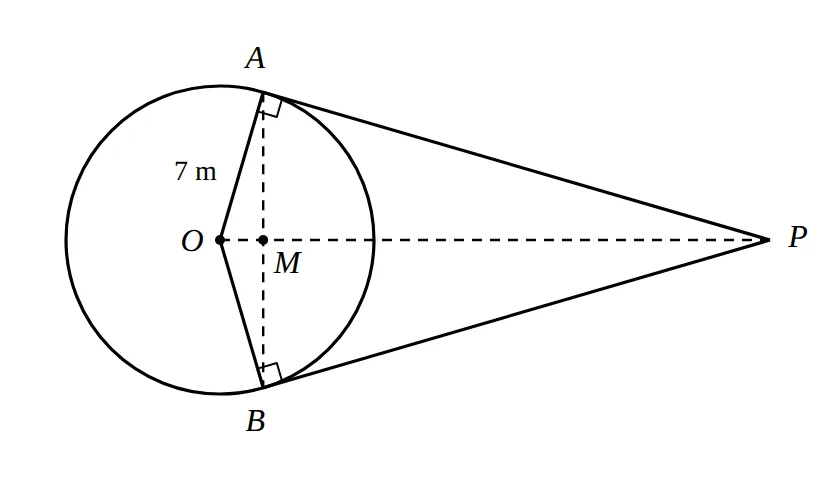
A park has a circular fountain with centre O and radius 7 m. A gate P of the park is 25 m from O. Two straight paths PA and PB go from the gate and just touch the edge of the fountain at A and B, as shown in the figure.
(i) Find the length of the path PA. (1 mark)
Answer.
OA⊥PA (the radius is perpendicular to the tangent), so PA=252−72=576=24 m — 1 mark
(ii) Find the area of the quadrilateral OAPB. (1 mark)
Answer.
PB=PA=24 m (tangents from P), so △OAP≅△OBP and the area =2×21×7×24=168 m2 — 1 mark
(iii) A straight water pipe is laid from A to B. It meets OP at M. Find the length of the pipe AB. (2 marks)
Answer.
PA=PB and OA=OB, so OP is the perpendicular bisector of AB: AM⊥OP and AB=2AM — 1 mark
21×OP×AM=21×OA×PA (both are the area of △OAP), so AM=257×24=6.72 m and AB=13.44 m — 1 mark
OR
(iii) Another gate G is placed so that the two straight paths from G that just touch the fountain make an angle of 60∘ with each other. How far is G from the centre O, and how long is each of these paths? (Use 3=1.73) (2 marks)
Answer.
Let one path touch the fountain at T. OG bisects the angle between the paths, so ∠OGT=30∘, and ∠OTG=90∘; sin30∘=OG7 gives OG=14 m — 1 mark
GT=142−72=147=73=12.11 m — 1 mark
Question 38(4 marks)
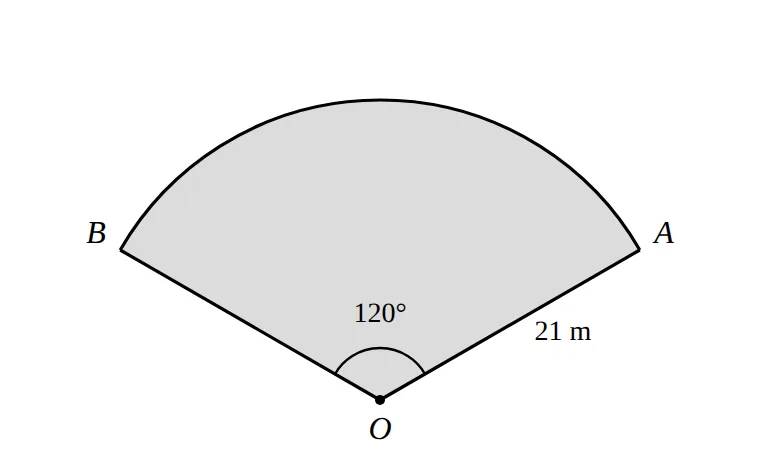
A rotating sprinkler is fixed at a point O on the lawn of a park. It throws water up to a distance of 21 m and turns back and forth through an angle of 120∘, so that it waters the sector OAB of the lawn shown in the figure. (Use π=722)
(i) Find the length of the arc AB. (1 mark)
Answer.
Arc =360120×2×722×21=44 m — 1 mark
(ii) Find the area of the lawn watered by the sprinkler. (1 mark)
Answer.
Area =360120×722×21×21=31×1386=462 m2 — 1 mark
(iii) To save water, the gardener changes the setting so that the sprinkler turns through only 90∘, with the same range. By how much does the watered area decrease? In the new setting, find the area of the watered part that lies between the arc and the chord joining its two ends. (2 marks)
Answer.
New area =41×722×21×21=346.5 m2; decrease =462−346.5=115.5 m2 — 1 mark
Segment =346.5−21×21×21=346.5−220.5=126 m2 — 1 mark
OR
(iii) A second sprinkler on another part of the lawn has a range of 28 m and turns through 90∘. Find the area watered by it and the total length of the boundary of the region it waters. (2 marks)
Answer.
Area =36090×722×28×28=616 m2 — 1 mark
Arc =36090×2×722×28=44 m; boundary =28+28+44=100 m — 1 mark
Ready to test your knowledge?
Take a quick interactive quiz on this topic —
free, works without login.