
CBSE Class 10 Maths Sample Paper 2027 – Set 5
Time allowed: 3 hours · Maximum marks: 80
General Instructions
- This question paper contains 38 questions. All questions are compulsory.
- The question paper is divided into five sections: A, B, C, D and E.
- In Section A, questions 1 to 18 are multiple choice questions (MCQs) and questions 19 and 20 are Assertion-Reason based questions of 1 mark each.
- In Section B, questions 21 to 25 are very short answer (VSA) type questions of 2 marks each.
- In Section C, questions 26 to 31 are short answer (SA) type questions of 3 marks each.
- In Section D, questions 32 to 35 are long answer (LA) type questions of 5 marks each.
- In Section E, questions 36 to 38 are case study based questions of 4 marks each, with sub-parts of 1, 1 and 2 marks.
- There is no overall choice. However, an internal choice has been provided in 2 questions each of Sections B, C and D, and in the 2-mark sub-part of every question in Section E.
- Draw neat figures wherever required. Take pi = 22/7 wherever required, if not stated.
- Use of calculators is not allowed.
How to use this paper: set a 3-hour timer and write all your answers on paper, just like the board exam. When you finish, take the quiz at the end of this page to score your objective (MCQ) answers instantly, then open the Detailed Solutions and check the rest step by step, with the marks each step carries.
Section A (20 marks)
This section has 18 multiple choice questions and 2 Assertion-Reason based questions of 1 mark each.
1. For the quadratic polynomial with zeroes and , the sum of the squares of the zeroes, , equals
(a)
(b)
(c)
(d)
2. The value of for which the pair of linear equations and has no solution is
(a)
(b)
(c)
(d)
3. Which of the following quadratic equations has two distinct real roots?
(a)
(b)
(c)
(d)
4. If , and are three consecutive terms of an AP, then the value of is
(a)
(b)
(c)
(d)
5. In , and are points on and such that . If , then is
(a)
(b)
(c)
(d)
6. is a diameter of a circle whose centre is . If one end of the diameter is , the other end is
(a)
(b)
(c)
(d)
7. Which of the following is true about the triangle with vertices , and ?
(a) It is an equilateral triangle.
(b) It is isosceles but not right-angled.
(c) It is right-angled but not isosceles.
(d) It is an isosceles right-angled triangle.
8. Which of the following statements is correct?
(a)
(b)
(c)
(d)
9. The value of is
(a)
(b)
(c)
(d)
10. From the top of a building 20 m high, the angle of depression of a car parked on the level road is . The distance of the car from the foot of the building is
(a) m
(b) 20 m
(c) m
(d) 40 m
11. The length of the tangent drawn from a point to a circle is 15 cm, and is 17 cm away from the centre of the circle. The diameter of the circle is
(a) cm
(b) cm
(c) cm
(d) cm
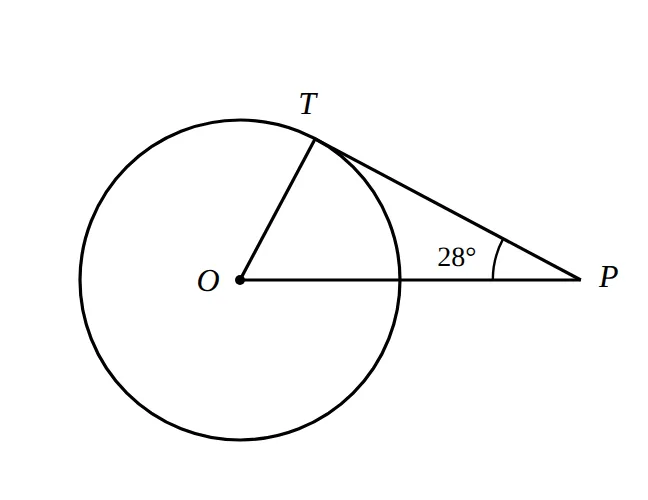
12. In the figure, is a tangent at to a circle with centre . If , then is
(a)
(b)
(c)
(d)
13. A sector cut from a circle of radius 21 cm has an area of . The angle it makes at the centre is (use )
(a)
(b)
(c)
(d)
14. The circumference of a circle is 44 cm. The area of a quadrant of this circle is (use )
(a)
(b)
(c)
(d)
15. Two identical solid cones, each of base radius 3 cm and height 4 cm, are joined base to base to make a spinning top. The total surface area of the top is
(a)
(b)
(c)
(d)
16. The curved surface area of a right circular cone is and its slant height is 25 cm. The radius of its base is (use )
(a) 7 cm
(b) 14 cm
(c) 3.5 cm
(d) 22 cm
17. For the following frequency distribution, the cumulative frequency of the class just before the median class is
| Class | 0-10 | 10-20 | 20-30 | 30-40 | 40-50 |
|---|---|---|---|---|---|
| Frequency | 4 | 12 | 10 | 8 | 6 |
(a) 26
(b) 12
(c) 16
(d) 20
18. A number is chosen at random from the numbers 1, 2, 3, …, 25. The probability that it is a prime number is
(a)
(b)
(c)
(d)
Directions: In questions 19 and 20, a statement of Assertion (A) is followed by a statement of Reason (R). Choose the correct option.
19. Assertion (A): If for an event , then , where is the event 'not '.
Reason (R): The probability of an event always lies between 0 and 1, both inclusive.
(a) Both Assertion (A) and Reason (R) are true and Reason (R) is the correct explanation of Assertion (A).
(b) Both Assertion (A) and Reason (R) are true, but Reason (R) is not the correct explanation of Assertion (A).
(c) Assertion (A) is true, but Reason (R) is false.
(d) Assertion (A) is false, but Reason (R) is true.
20. Assertion (A): ends with the digit 0 for some natural number .
Reason (R): A natural number ends with the digit 0 if and only if both 2 and 5 are among its prime factors.
(a) Both Assertion (A) and Reason (R) are true and Reason (R) is the correct explanation of Assertion (A).
(b) Both Assertion (A) and Reason (R) are true, but Reason (R) is not the correct explanation of Assertion (A).
(c) Assertion (A) is true, but Reason (R) is false.
(d) Assertion (A) is false, but Reason (R) is true.
Section B (10 marks)
This section has 5 very short answer (VSA) type questions of 2 marks each.
21. Given that is irrational, prove that is irrational. (2 marks)
22. Find a quadratic polynomial whose zeroes are and . (2 marks)
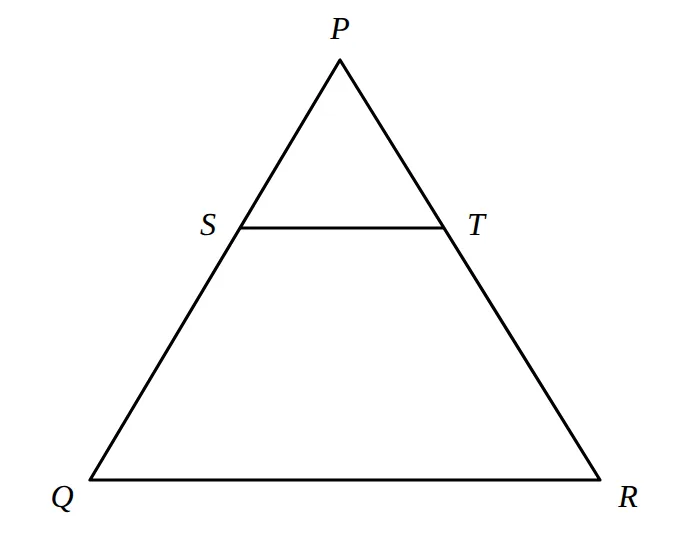
23. In the figure, and are points on the sides and of such that cm, cm, cm and cm. Show that . (2 marks)
OR
is a parallelogram and is a point on the side . The line , when produced, meets produced at . Prove that .
24. Prove that the tangents drawn at the ends of a chord of a circle make equal angles with the chord. (2 marks)
OR
is a tangent at to a circle with centre and radius , and . The segment meets the circle at . Find and show that is equilateral.
25. If , where is an acute angle, find . Hence find the value of . (2 marks)
Section C (18 marks)
This section has 6 short answer (SA) type questions of 3 marks each.
26. Anjali and Farhan start running together from the same point on a circular track, in the same direction. Anjali takes 4 minutes 12 seconds to complete one round and Farhan takes 4 minutes 40 seconds. After how many minutes will they next meet at the starting point? How many rounds will each of them have completed by then? (3 marks)
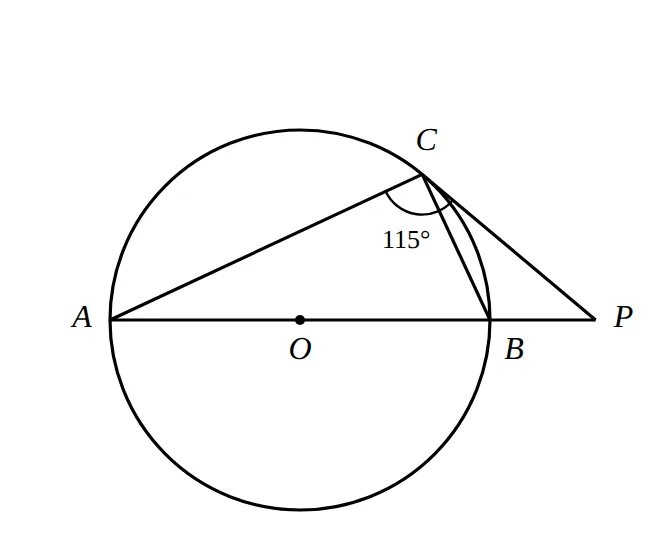
27. In the figure, is a diameter of a circle with centre , and the tangent at a point of the circle meets produced at . If , find (i) , (ii) , (iii) . (3 marks)
28. Prove that . (3 marks)
OR
Prove that .
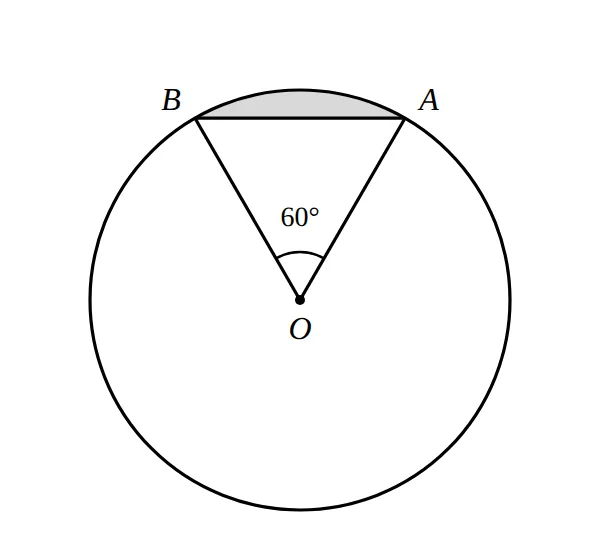
29. A circular paper disc of radius 42 cm is cut along a chord which subtends an angle of at the centre . Find the area of the smaller piece (the minor segment). (Use and ) (3 marks)
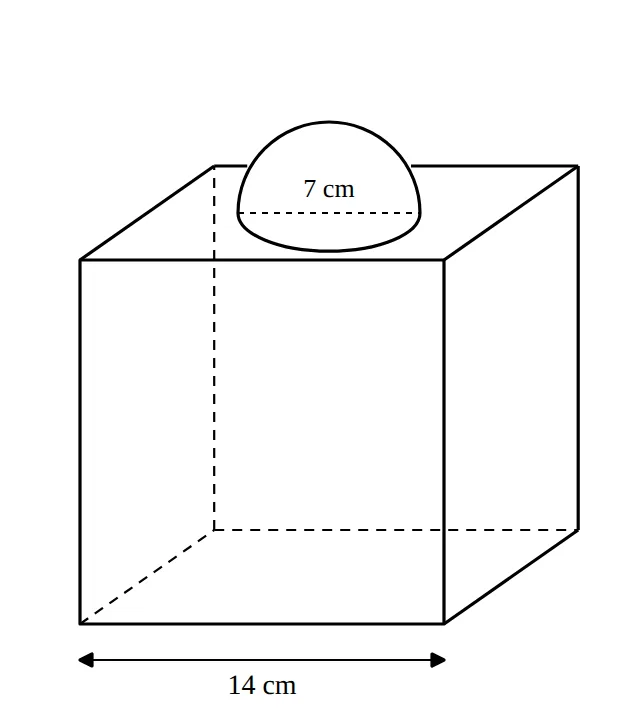
30. A wooden block for a children's play corner is a cube of edge 14 cm, with a solid hemisphere of diameter 7 cm fixed on the middle of its top face. The whole outer surface of the block is to be painted at ₹ 10 per 100 . Find the total surface area of the block and the cost of painting it. (Use ) (3 marks)
OR
A wooden pen holder is a cuboid with a square base of side 10 cm and height 12 cm. A cylindrical hole of radius 3.5 cm and depth 10 cm is scooped out of it from the top to hold pens. Find the volume of wood left in the pen holder. If 1 of the wood has a mass of 0.8 g, find the mass of the pen holder. (Use )
31. A die is thrown twice. Find the probability that (i) the sum of the two numbers obtained is a prime number, (ii) the product of the two numbers is odd, (iii) the two numbers differ by 2. (3 marks)
Section D (20 marks)
This section has 4 long answer (LA) type questions of 5 marks each.
32. A swimming pool charges a fixed monthly fee and, in addition, a fixed amount for every visit. In June, Ritu visited the pool 12 times and paid ₹ 1300 in all, while Kabir visited it 20 times and paid ₹ 1700 in all. Find the fixed monthly fee and the charge per visit. Meera has ₹ 2000 to spend at the pool in July. At most how many times can she visit the pool that month? (5 marks)
OR
Sunita invested a part of her savings in a scheme paying 6% simple interest per annum and the rest in a scheme paying 8% simple interest per annum. Her total interest for one year was ₹ 3600. Had she invested the two parts the other way round, her interest for the year would have been ₹ 200 less. How much did she invest in each scheme? What would her interest for one year have been if she had invested all her savings at 7% per annum?
33. Two taps together can fill an overhead water tank in hours. The larger tap alone takes 4 hours less than the smaller tap alone to fill the tank. Find the time each tap takes to fill the tank alone. One morning, with the tank empty, both taps were opened together for 2 hours and then the larger tap was closed. How much more time did the smaller tap take to fill the tank? (5 marks)
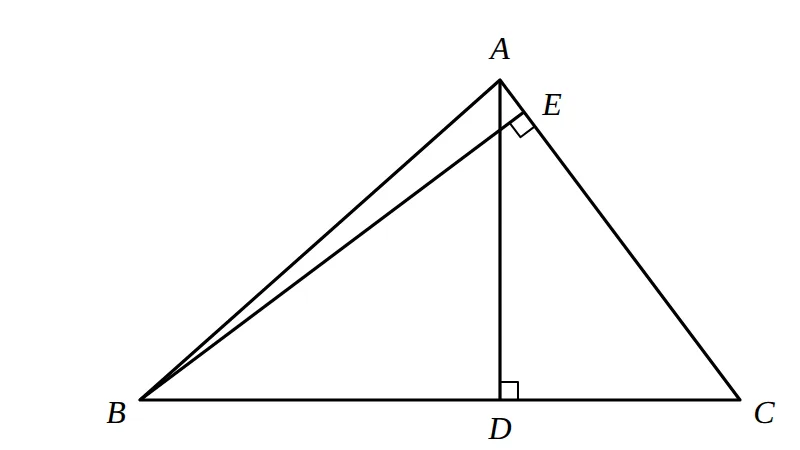
34. In the figure, and are altitudes of the acute-angled triangle , with on and on .
(i) Prove that .
(ii) Hence show that .
(iii) If cm, cm and cm, find and . (5 marks)
35. The daily water consumption of 50 households in a housing society is given below.
| Water used (litres) | 100-150 | 150-200 | 200-250 | 250-300 | 300-350 | 350-400 |
|---|---|---|---|---|---|---|
| Number of households | 6 | 7 | 15 | 10 | 7 | 5 |
Find the mean daily water consumption using the step-deviation method. Also find the median daily water consumption. (5 marks)
OR
The table shows the mobile data (in GB) used in a month by 60 families of a colony.
| Data used (GB) | 10-20 | 20-30 | 30-40 | 40-50 | 50-60 | 60-70 |
|---|---|---|---|---|---|---|
| Number of families | 4 | 5 | 12 | 18 | 14 | 7 |
Find the median and the mode of the data.
Section E (12 marks)
This section has 3 case study based questions of 4 marks each.
36. Kavya is training for a half marathon. In the first week of her training plan she runs a total of 12 km, and in every week after that she runs 1.5 km more than in the week before.
(i) How many kilometres does she run in the 8th week? (1 mark)
(ii) In which week does she run 30 km for the first time? (1 mark)
(iii) Find the total distance she runs in the first 12 weeks. (2 marks)
OR
(iii) Find the total distance she runs from the 5th week to the 12th week, both weeks included. (2 marks)
37. At a winter fair, a hot-air balloon is rising vertically from a point on level ground. Anil is standing at the edge of the flat roof of a building 50 m high, on the side facing the balloon. At a certain instant, the angle of depression of from is and the angle of elevation of the balloon from is . (Take as the point of observation, and use and )
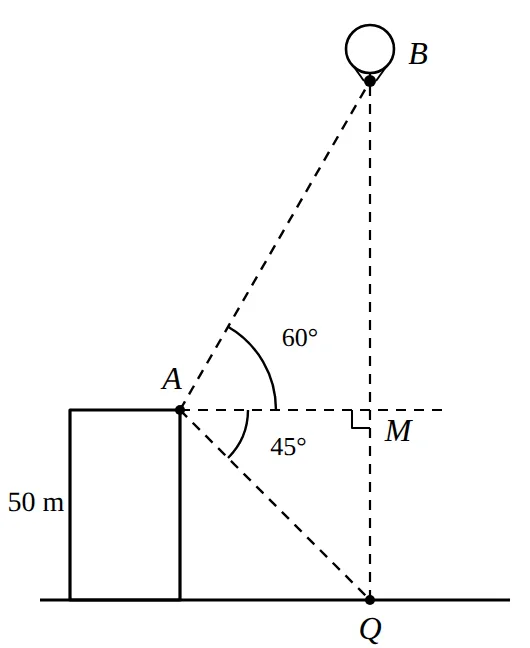
(i) How far is from the foot of the building? (1 mark)
(ii) Find the distance . (1 mark)
(iii) Find the height of the balloon above the ground at that instant. (2 marks)
OR
(iii) Find the distance between Anil and the balloon at that instant. (2 marks)
38. The map of a town is drawn on a coordinate plane in which 1 unit = 1 km (see the figure). A delivery company's warehouse is at , one of its regular customers lives at , and its second store is at . The x-axis runs along the town's ring road.
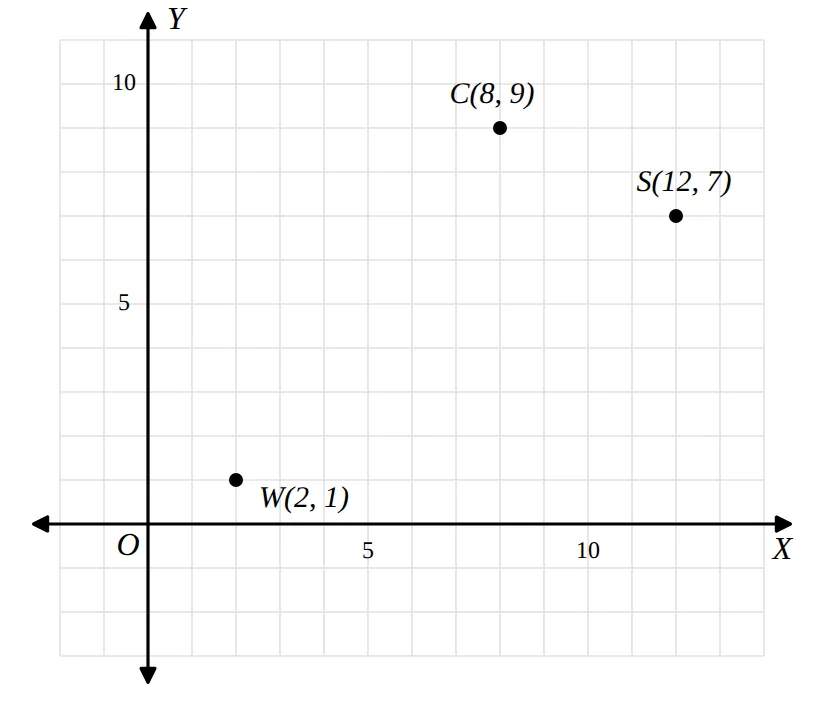
(i) Find the distance between the warehouse and the customer's house. (1 mark)
(ii) A delivery rider stops at the point on the straight path from to for which . Find the coordinates of . (1 mark)
(iii) The company wants to open a depot such that , , and , taken in order, are the vertices of a parallelogram. Find the coordinates of . (2 marks)
OR
(iii) A fuel station is to be built on the ring road so that it is equidistant from and . Find the coordinates of . (2 marks)