
CBSE Class 10 Science Sample Paper 2027 – Set 2
Time allowed: 3 hours · Maximum marks: 80
General Instructions
- This question paper contains 39 questions. All questions are compulsory.
- The question paper is divided into THREE sections: Section A - Biology (30 marks), Section B - Chemistry (25 marks) and Section C - Physics (25 marks).
- The question paper has MCQs, VSAs, SAs, LAs and CBQs. Marks are given against each question.
- There are Case Based Questions (CBQs) with three sub-questions, of 4 marks each.
- Divide your answer sheet into three sections as per the question paper: Section A (Biology), Section B (Chemistry) and Section C (Physics). Answer each question in its own section, and do not mix answers of one section with another.
- Instructions are given with each section and question, wherever necessary.
- There is no overall choice in the question paper. However, an internal choice has been provided in a few questions. Only one of the choices in such questions must be attempted.
How to use this paper: set a 3-hour timer and write all your answers on paper, just like the board exam. When you finish, take the quiz at the end of this page to score your objective (MCQ) answers instantly, then open the Detailed Solutions and check the rest step by step, with the marks each step carries.
Section A - Biology (30 marks)
Questions 1 to 7 are multiple choice questions and questions 8 and 9 are Assertion-Reason questions, of 1 mark each. Questions 10 to 12 carry 2 marks each, questions 13 and 14 carry 3 marks each, question 15 is a case based question of 4 marks and question 16 is a long answer question of 5 marks.
1. Read the following statements about what happens in a leaf during photosynthesis.
(i) Light energy is absorbed by chlorophyll.
(ii) Light energy is converted into chemical energy, and water molecules are split into hydrogen and oxygen.
(iii) Carbon dioxide is reduced to carbohydrates.
(iv) The carbohydrate that is not used at once is stored in the leaf in the form of glucose.
Which of these statements are correct?
(a) (i) and (ii) only
(b) (ii), (iii) and (iv)
(c) (i), (ii) and (iii)
(d) (i), (ii), (iii) and (iv)
2. Harsh put some freshly germinated seeds in a conical flask and stood a small test tube P, containing potassium hydroxide solution, inside it. He closed the flask with a cork carrying a bent delivery tube Q, whose other end dipped into water in a beaker, as shown. After about an hour, the water had risen some way up the delivery tube. Which conclusion can he draw from this?
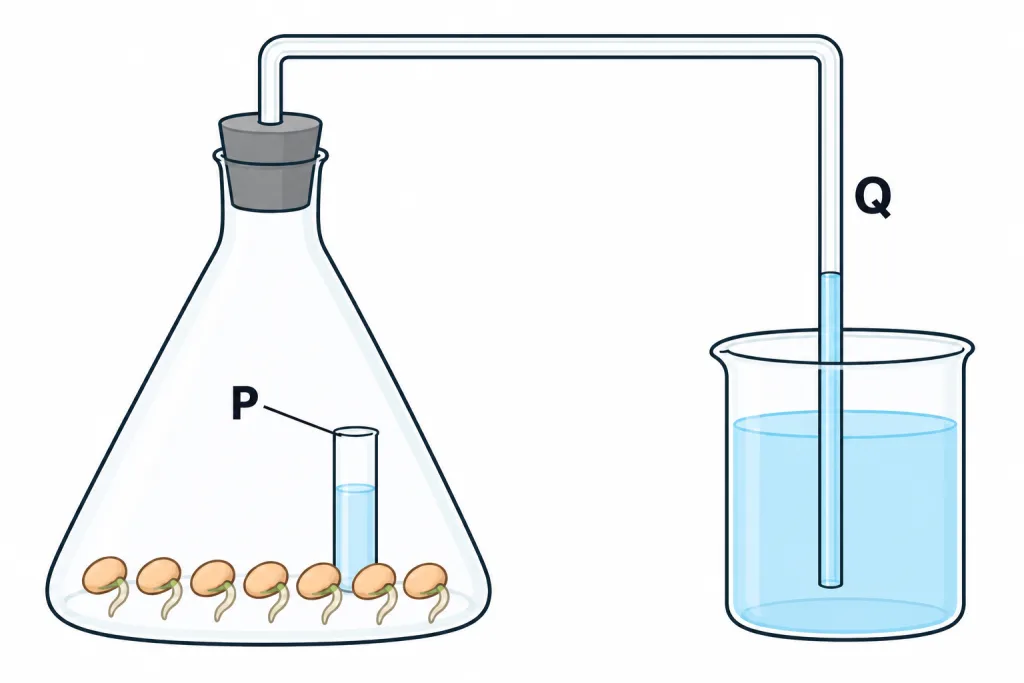
(a) The seeds used up oxygen from the air in the flask, and the carbon dioxide they gave out was absorbed by the potassium hydroxide.
(b) The seeds gave out oxygen, which was absorbed by the potassium hydroxide.
(c) The seeds gave out carbon dioxide, which pushed the water up the delivery tube.
(d) The potassium hydroxide gave out a gas that dissolved in the water of the beaker.
3. A nursery raises new plants of Bryophyllum and potato without using seeds. Read the following statements.
(i) New Bryophyllum plants can grow from the buds in the notches along the margin of its leaves.
(ii) Potato is grown by planting pieces of the tuber, each carrying a bud (an 'eye').
(iii) Plants raised in this way can bear flowers and fruits earlier than plants raised from seeds.
(iv) Plants raised in this way show more variation than plants raised from seeds.
Which statements are correct?
(a) (i) and (iv)
(b) (ii) and (iii) only
(c) (i), (ii) and (iv)
(d) (i), (ii) and (iii)
4. Two students describe what happens in a mustard flower.
Ritu: "Fertilisation is complete as soon as a pollen grain lands on the stigma."
Sahil: "After landing on the stigma, the pollen grain grows a tube that carries the male germ-cell through the style to the female germ-cell in the ovule."
Who is correct?
(a) Only Ritu
(b) Only Sahil
(c) Both Ritu and Sahil
(d) Neither of them
5. Tenzin has just learnt to ride a bicycle. Now he keeps his balance and steers smoothly along a narrow lane without thinking about each movement. Which part of the brain is mainly responsible for his posture, balance and the precision of these movements?
(a) Cerebellum
(b) Medulla
(c) Pons
(d) Midbrain
6. The zygote of a rice plant has 24 chromosomes. How many chromosomes will be present in a male gamete, in the egg cell and in a root-tip cell of the grown plant, respectively?
(a) 24, 24 and 48
(b) 12, 12 and 12
(c) 12, 12 and 24
(d) 24, 12 and 24
7. Consider the following statements about decomposers such as bacteria and fungi.
(i) They break down the dead remains and wastes of organisms into simpler substances.
(ii) They return nutrients to the soil, where plants can use them again.
(iii) They can break down plastic and glass if given enough time.
(iv) They form the first trophic level of every food chain.
Which statements are correct?
(a) (i) and (ii) only
(b) (i), (ii) and (iii)
(c) (ii) and (iv)
(d) (i), (iii) and (iv)
Directions: Questions 8, 9, 24 and 32 each consist of two statements, Assertion (A) and Reason (R). Answer these questions by selecting the appropriate option (a), (b), (c) or (d) given with each.
8. Assertion (A): The right ventricle pumps oxygenated blood to all parts of the body.
Reason (R): The left side of the heart receives oxygenated blood from the lungs.
(a) Both Assertion (A) and Reason (R) are true and Reason (R) is the correct explanation of Assertion (A).
(b) Both Assertion (A) and Reason (R) are true, but Reason (R) is not the correct explanation of Assertion (A).
(c) Assertion (A) is true, but Reason (R) is false.
(d) Assertion (A) is false, but Reason (R) is true.
9. Assertion (A): Food chains in nature usually have only three or four trophic levels.
Reason (R): Green plants are called producers because they make food from simple inorganic substances using the energy of sunlight.
(a) Both Assertion (A) and Reason (R) are true and Reason (R) is the correct explanation of Assertion (A).
(b) Both Assertion (A) and Reason (R) are true, but Reason (R) is not the correct explanation of Assertion (A).
(c) Assertion (A) is true, but Reason (R) is false.
(d) Assertion (A) is false, but Reason (R) is true.
10. Answer the following:
(a) Some pepsin was added to two test tubes, each containing small pieces of boiled egg white in water. A few drops of dilute hydrochloric acid were also added to the first tube only. After an hour at body temperature, the egg white had been digested only in the first tube. What does this show about the role of hydrochloric acid in the stomach? (1 mark)
(b) A colourless fluid that has leaked out of the blood capillaries bathes the cells of the body. It later gathers into small vessels of its own and finally drains back into the blood. Name this fluid and give one of its functions. (1 mark)
11. In a mango orchard near Ratnagiri, a gardener removed a complete ring of bark, including the phloem, from one branch of a tree, leaving the wood (xylem) in place. The leaves on that branch stayed fresh and green for many weeks, but the bark just above the ring slowly became swollen. Explain these two observations, bringing out two differences between transport in the xylem and transport in the phloem. (2 marks)
12. Attempt either option (A) or (B).
(A) One summer, the water of a lake became much warmer than usual. Most fish of one kind died, but a few survived and went on to breed. Explain how variation among the individuals of a species helps it to survive such a change. Why is a way of reproduction that produces more variation useful to a species in the long run? (2 marks)
OR
(B) A variety of rose raised only from stem cuttings for many years is badly hit when a new disease spreads, because every plant is affected. A plant breeder suggests raising new plants from seeds produced by crossing two different varieties. Give two advantages of sexual reproduction that support this suggestion.
13. Nandini peeled the thin lower skin of a leaf picked at 10 am on a mild morning and looked at it under a microscope. Most of the stomatal pores were open. When she did the same with a leaf picked from the same plant at 2 pm on a very hot, dry afternoon, most of the pores were closed.
(a) Draw a neat diagram of a stomatal pore as Nandini saw it at 2 pm, together with the cells next to it. Label any four of these parts: guard cell, stomatal pore, chloroplast, nucleus, epidermal cell. Use arrows to show the direction in which water moved in the guard cells as the pore reached this state. (2 marks)
(b) How does this movement of water close the pore? How did closing the pores help the plant at 2 pm? (1 mark)
14. The figure shows a food chain in a lake near Udaipur. The letters stand for: A - phytoplankton, B - zooplankton, C - small fish, D - large fish, E - kingfisher. Each arrow points from the organism that is eaten to the organism that eats it.
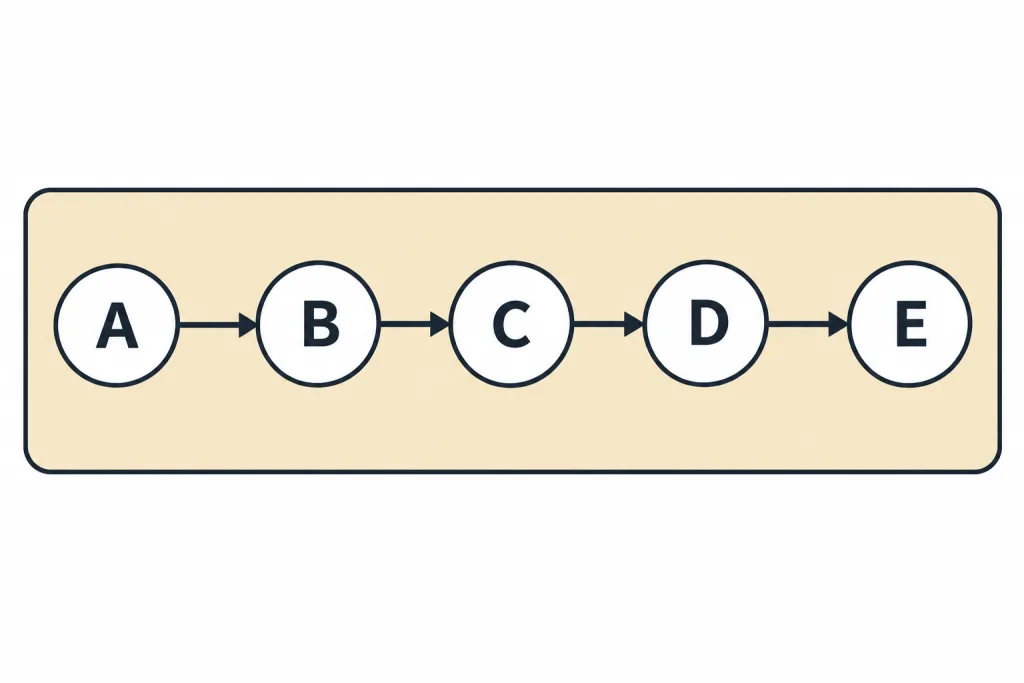
(a) The phytoplankton trap 1,00,000 J of energy from sunlight. Using the 10 per cent law, find the energy available to D and to E. (1 mark)
(b) A pesticide washed into the lake from nearby fields. Tests gave these amounts of the pesticide, in parts per million (ppm):
| Sample | Lake water | A | C | D | E |
|---|---|---|---|---|---|
| Pesticide (ppm) | 0.02 | 0.04 | 0.5 | 2 | 25 |
Name the process shown by these values. Why do the phytoplankton (A) already hold twice as much pesticide as the lake water in which they float? (1 mark)
(c) Only a small part of the energy in D reaches E. What happens to most of the rest? (1 mark)
15. Kiran, a Class 10 student in Dehradun, crossed pea plants from a pure line with yellow seeds with plants from a pure line with green seeds in her school garden. All the seeds of the F1 generation were yellow. She grew F1 plants from these seeds and let them self-pollinate. The seeds that formed in the pods of these F1 plants make up the F2 generation. She counted them:
| Seed colour (F2) | Number of seeds |
|---|---|
| Yellow | 615 |
| Green | 201 |
(a) Which seed colour is dominant? How does the F1 generation show this? (1 mark)
(b) Work out the ratio of yellow to green seeds in the F2 generation from Kiran's counts. What does the reappearance of green seeds tell us? (1 mark)
(c) Using Y for yellow and y for green, show the cross between two F1 plants. In what ratio are the two kinds of yellow seeds expected in F2, and about how many of Kiran's 615 yellow seeds are expected to be pure-breeding? (2 marks)
OR
(c) Traits such as seed colour and plant height are controlled by genes. Explain, with the example of the height of a plant, how a gene controls a trait. (2 marks)
16. Attempt either option (A) or (B).
(A) The brain is the main coordinating centre of the body.
(i) Draw a neat diagram of the human brain and label any four of these parts: forebrain, midbrain, pons, cerebellum, medulla. (2 marks)
(ii) Three patients have had head injuries. For each, name the part of the brain most likely to be damaged, and state the normal function of that part.
(I) Patient P has strong muscles, but cannot walk in a straight line or pick up a pencil smoothly.
(II) In patient Q, the blood pressure and the flow of saliva are no longer regulated properly.
(III) Patient R can see and hear, but cannot think through a simple problem or remember what she learnt that morning. (3 marks)
OR
(B) Anusha, a student in Hubballi, did two things in her school garden. She touched a leaflet of a sensitive plant (touch-me-not): within two seconds the leaflets folded up, and about twenty minutes later they had opened again. She also pushed a thin stick into the soil beside a young bitter-gourd plant. Over the next three days, a tendril that touched the stick coiled tightly round it.
(i) Anusha's friend says, "The leaflets folded because the cells on one side grew faster, just as in the tendril." Is the friend right? Explain how the leaflets fold after being touched, how the message of the touch is passed on, and why the leaflets can open again within minutes. (3 marks)
(ii) If the stick is pulled out after a week, will the tendril uncoil? Give a reason. State one more way in which the movement of the tendril differs from the folding of the leaflets. (2 marks)
Section B - Chemistry (25 marks)
Questions 17 to 23 are multiple choice questions and question 24 is an Assertion-Reason question, of 1 mark each. Question 25 carries 2 marks, questions 26 and 27 carry 3 marks each, question 28 is a case based question of 4 marks and question 29 is a long answer question of 5 marks.
17. When steam is passed over red-hot iron, iron(II,III) oxide and hydrogen are formed. Which of these is the correctly balanced equation with the physical states?
(a)
(b)
(c)
(d)
18. Zoya added zinc granules to dilute sulphuric acid in one test tube, and to sodium hydroxide solution in another test tube, which she then warmed. Bubbles of gas formed in both. Which option correctly names the gas in the two tubes and gives a test for it?
(a) Hydrogen in the first tube and oxygen in the second; both relight a glowing splinter
(b) Sulphur dioxide in the first tube and hydrogen in the second; both turn lime water milky
(c) Hydrogen in both tubes; it burns with a pop sound when a burning candle is brought near it
(d) Carbon dioxide in both tubes; it turns lime water milky
19. Read the following statements about how some metals react with water.
(i) Potassium and sodium react violently with cold water, and the hydrogen given off catches fire.
(ii) Calcium reacts with cold water, but less violently than sodium.
(iii) Magnesium does not react with cold water, but reacts with hot water to form magnesium hydroxide and hydrogen.
(iv) Iron reacts with hot water to form iron(II) hydroxide and hydrogen.
Which statements are correct?
(a) (i) and (ii) only
(b) (ii), (iii) and (iv)
(c) (i), (iii) and (iv)
(d) (i), (ii) and (iii)
20. Pranav tested four liquids with universal indicator: P - lemon juice, Q - pure water, R - baking soda solution, S - milk of magnesia. In which option are they arranged in increasing order of pH?
(a) S, R, Q, P
(b) P, Q, R, S
(c) P, R, Q, S
(d) P, Q, S, R
21. Identify the compound drawn in the figure and the functional group it contains.
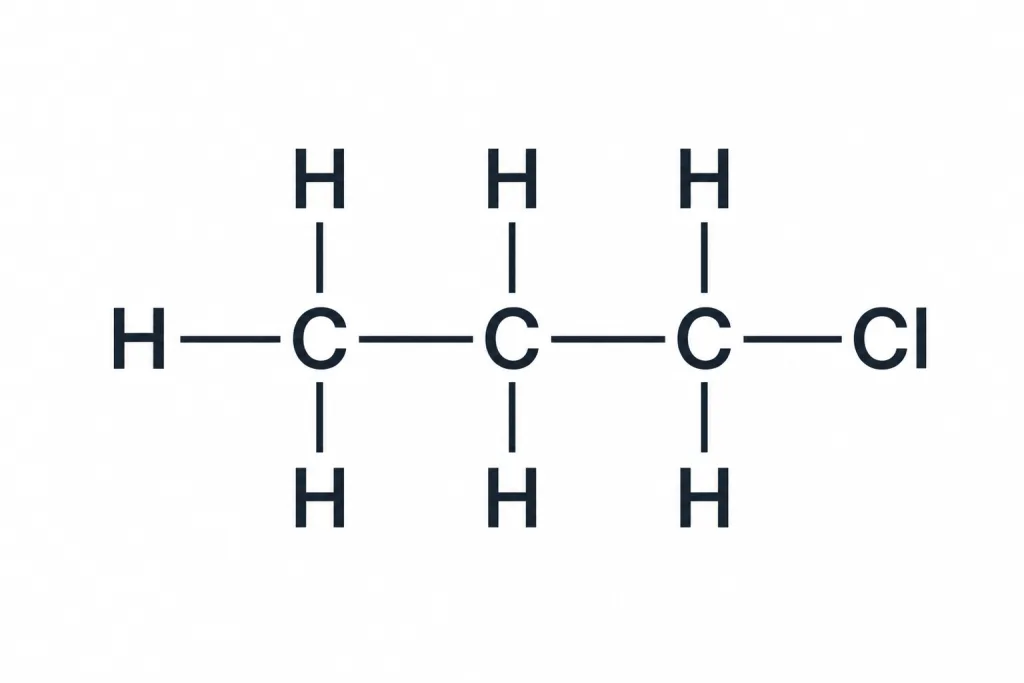
(a) Chloroethane; halo group
(b) Chloropropane; halo group
(c) Propanol; alcohol group
(d) Chloropropene; halo group and a double bond
22. A few crystals of ferrous sulphate were heated strongly in a dry boiling tube. What is observed?
(a) The crystals turn blue, and a smell of rotten eggs is given off.
(b) The crystals turn white, and no gas is given off.
(c) The crystals melt into a colourless liquid, and oxygen is given off.
(d) The green crystals lose their water and then leave a reddish-brown solid, and a gas with the smell of burning sulphur is given off.
23. Railway workers join broken rails using the reaction . Which statement about this reaction is correct?
(a) Iron displaces aluminium from its oxide, because iron is more reactive than aluminium.
(b) The reaction absorbs a large amount of heat, which is why the rails have to be heated first.
(c) Aluminium, being more reactive, takes oxygen from iron(III) oxide, and so much heat is given out that the iron formed is molten.
(d) The aluminium oxide formed acts as a glue that holds the broken ends together.
24. Assertion (A): In a village where the only water supply is hard water from a borewell, clothes washed with a detergent come out clean, and no scum is left on them.
Reason (R): Unlike soap, a detergent is not thrown out of solution as a solid by the calcium and magnesium ions of hard water.
(a) Both Assertion (A) and Reason (R) are true and Reason (R) is the correct explanation of Assertion (A).
(b) Both Assertion (A) and Reason (R) are true, but Reason (R) is not the correct explanation of Assertion (A).
(c) Assertion (A) is true, but Reason (R) is false.
(d) Assertion (A) is false, but Reason (R) is true.
25. Rehana dropped a small piece of a silvery-white metal M into a beaker of cold water. The metal reacted steadily but not violently. Bubbles of a colourless gas formed on its surface, and after a while the piece began to float.
(a) Identify M. Give one reason why M cannot be sodium, and one reason why it cannot be magnesium. (1 mark)
(b) Write the balanced chemical equation for the reaction, and describe a test for the gas. Why does the metal float? (1 mark)
26. Pieces of four metals A, B, C and D were placed in solutions of salts of the other metals. The results are shown below.
| Metal | Salt solution of A | Salt solution of B | Salt solution of C | Salt solution of D |
|---|---|---|---|---|
| A | — | No change | Deposit formed | No change |
| B | Deposit formed | — | Deposit formed | Deposit formed |
| C | No change | No change | — | No change |
| D | Deposit formed | No change | Deposit formed | — |
(a) Arrange the four metals in decreasing order of reactivity. Explain how you used the table. (2 marks)
(b) Which of the other metals could be used to make a container for storing the salt solution of A? Give a reason. (1 mark)
27. Attempt either option (A) or (B).
(A) Write the balanced chemical equation, with the physical states, for each of the following, and name the type of reaction.
(i) Hydrogen gas and chlorine gas combine in sunlight to give hydrogen chloride gas. (1 mark)
(ii) A strip of magnesium is dipped into copper sulphate solution; the blue colour fades and a reddish-brown coating forms on the strip. (1 mark)
(iii) Sodium carbonate solution is mixed with calcium chloride solution, and a white precipitate forms. (1 mark)
OR
(B) A family keeps a pair of silver anklets in a drawer, and after some months they have turned black. A packet of namkeen left open in the kitchen for many days begins to smell and taste bad.
(i) Name the process that has taken place in the anklets, and the black substance formed on them. (1 mark)
(ii) Name the process that has taken place in the namkeen, and say why it happens. (1 mark)
(iii) Give two ways to prevent each of these changes. (1 mark)
28. In a school laboratory in Guwahati, Mrinal's group made some indicators of their own. They rubbed turmeric paste on strips of filter paper, boiled red cabbage leaves in water to get a purple extract, and kept strips of cloth with finely chopped onions in a closed plastic bag overnight. They also had a small bottle of clove oil. They tested two colourless solutions, X and Y, from the teacher's table and noted:
| Indicator | Solution X | Solution Y |
|---|---|---|
| Turmeric paper | Turns reddish-brown | No change |
| Red cabbage extract | Turns green | Turns red |
| Smell of the onion-soaked cloth | Smell disappears | Smell remains |
(a) Which of the two solutions is acidic? Give the observation from the table that shows it. (1 mark)
(b) Why are onion and clove oil called olfactory indicators? What would happen to the smell of clove oil in solution X? (1 mark)
(c) Mrinal says, "Turmeric paper alone is enough to show whether a solution is acidic." Is he right? Explain using the table. Which of the group's indicators would suit a visually impaired student, and why? (2 marks)
OR
(c) The teacher tells them that X is sodium hydroxide solution and Y is dilute sulphuric acid. To some of X coloured with red cabbage extract, they add Y drop by drop. The colour changes from green to purple and then to red. Explain these colour changes, and write the balanced chemical equation for the reaction. (2 marks)
29. Attempt either option (A) or (B).
(A) Answer the following about naming carbon compounds and their isomers.
(i) Priya named five compounds as shown. Check each name. Where it is wrong, write the correct name. Also name the functional group in each compound.
(I) : bromoethane
(II) : propanone
(III) : methanal
(IV) : propanal
(V) : butanoic acid (3 marks)
(ii) Pentane, , has three structural isomers. Draw their structures, showing all the atoms. What do the three have in common, and how do they differ? (2 marks)
OR
(B) Answer the following about soaps and the oxidation of ethanol.
(i) Draw a diagram of a soap micelle formed round a drop of oil in water, and label the oil drop, the hydrocarbon tail, the ionic end and the water. Why does soap give very little lather and form a scum in hard water? (3 marks)
(ii) Vikram added alkaline potassium permanganate solution drop by drop to warm ethanol in one test tube and to warm ethanoic acid in another. In the ethanol tube the purple colour disappeared as each of the first few drops went in; in the ethanoic acid tube the colour stayed from the very first drop. His friend says, "The colour vanished in the ethanol tube only because the permanganate got diluted." Is the friend right? Explain the two observations, and write the chemical equation for the change in the ethanol. (2 marks)
Section C - Physics (25 marks)
Questions 30 and 31 are multiple choice questions and question 32 is an Assertion-Reason question, of 1 mark each. Questions 33 and 34 carry 2 marks each, questions 35 to 37 carry 3 marks each, question 38 is a case based question of 4 marks and question 39 is a long answer question of 5 marks.
30. While testing the concave reflector of a torch, Arjun finds that when the bulb is 30 cm in front of the mirror, the light is reflected straight back on to the bulb itself. Where should the bulb be placed so that the torch gives a strong parallel beam of light?
(a) At the centre of curvature, 30 cm from the pole
(b) At 60 cm from the pole
(c) At 7.5 cm from the pole
(d) At the principal focus, 15 cm from the pole
31. Meghna looks up from her book at a distant hill. Consider these statements about the changes in her eyes.
(i) The ciliary muscles relax.
(ii) The eye lens becomes thinner.
(iii) The focal length of the eye lens increases.
(iv) The eye lens moves farther away from the retina.
Which statements are correct?
(a) (i), (ii) and (iii)
(b) (i) and (iv)
(c) (ii), (iii) and (iv)
(d) (iii) only
32. Assertion (A): A narrow beam of white light passing through a glass prism comes out as a band of seven colours.
Reason (R): In the prism, violet light bends the least and red light bends the most.
(a) Both Assertion (A) and Reason (R) are true and Reason (R) is the correct explanation of Assertion (A).
(b) Both Assertion (A) and Reason (R) are true, but Reason (R) is not the correct explanation of Assertion (A).
(c) Assertion (A) is true, but Reason (R) is false.
(d) Assertion (A) is false, but Reason (R) is true.
33. Attempt either option (A) or (B).
(A) Mr Menon, who is seventy, has worn concave lenses for years to see distant objects clearly. Now he also has to hold his newspaper at arm's length to read it.
(I) Name the defect that has now developed, and state its cause. (1 mark)
(II) What kind of spectacle lens will his doctor now prescribe? Describe how it is made up. (1 mark)
OR
(B) Aman says, "The sky looks blue because the blue sea reflects its colour on to the sky."
(I) Give one observation which shows that Aman is wrong. (1 mark)
(II) Explain the real reason why a clear sky looks blue. (1 mark)
34. In an activity, Sneha connected a nichrome wire in a circuit with a battery, an ammeter and a voltmeter across the wire. She changed the number of cells and recorded:
| Potential difference V (volt) | Current I (ampere) |
|---|---|
| 1.0 | 0.2 |
| 2.0 | 0.4 |
| 3.0 | 0.6 |
| 4.0 | 0.8 |
(a) Show from her readings that the wire obeys Ohm's law, and find its resistance. (1 mark)
(b) What is the shape of the graph of V (along the y-axis) against I (along the x-axis)? Her friend's readings for another wire gave a similar graph with a smaller slope. Which wire has the lower resistance? Give one way in which the friend's wire may differ from Sneha's. (1 mark)
35. On a sunny morning in Shillong, just after a shower, Daphira saw a rainbow in the sky.
(a) In which part of the sky, east or west, did she see the rainbow? Give a reason. (1 mark)
(b) Daphira notices that red is always on the outer (upper) edge of the bow and violet on the inner edge. Draw a labelled diagram of the path of sunlight through one raindrop, showing the red and violet light that leaves it, and use your diagram to explain her observation. (2 marks)
36. Hritik passed a thick copper wire vertically through the centre of a horizontal sheet of cardboard and sprinkled iron filings evenly on the cardboard. He switched on a current flowing upwards through the wire and tapped the cardboard gently.
(a) Draw the pattern formed by the iron filings, as seen from above, and show the direction of the magnetic field lines. (1 mark)
(b) Name and state the rule you used to find the direction of the field lines. (1 mark)
(c) P is a point on the cardboard 4 cm from the wire. How will the magnetic field at P change if (I) the current is doubled, (II) the point is taken 8 cm from the wire instead, with the same current? (1 mark)
37. The figure shows the magnetic field lines round a bar magnet whose ends are marked X and Y. P, Q and R are three points near the magnet.
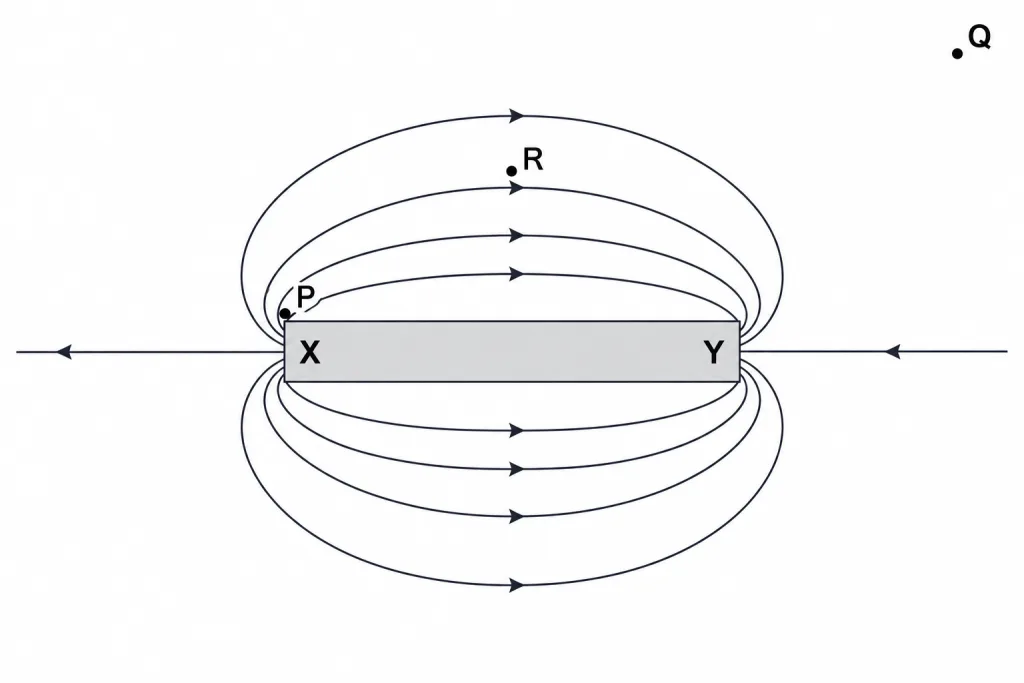
(a) At which of the points P, Q and R is the magnetic field the strongest? How does the figure show this? (1 mark)
(b) Which end of the magnet, X or Y, is its north pole? Explain using the figure. (1 mark)
(c) A student draws two field lines of a magnet crossing each other at a point. Explain why this can never happen. (1 mark)
38. For its annual exhibition, the science club of a school in Kochi built a simple slide projector. A bright lamp lights up a small transparent slide, and a convex lens of focal length 20 cm forms an image of the slide on a white screen. Anna, the club secretary, puts the slide in upside down, places it 25 cm from the lens and moves the screen until the picture is sharp.
(a) State the nature of the image formed on the screen. Why does Anna put the slide in upside down? (1 mark)
(b) Find the power of the lens. (1 mark)
(c) How far from the lens must the screen be? How many times larger than the slide is the picture? (2 marks)
OR
(c) Draw a ray diagram to show how the lens forms the image of the slide placed between F1 and 2F1. (2 marks)
39. Attempt either option (A) or (B).
(A) Study the circuit shown. The battery gives 6 V, and the key K is closed.
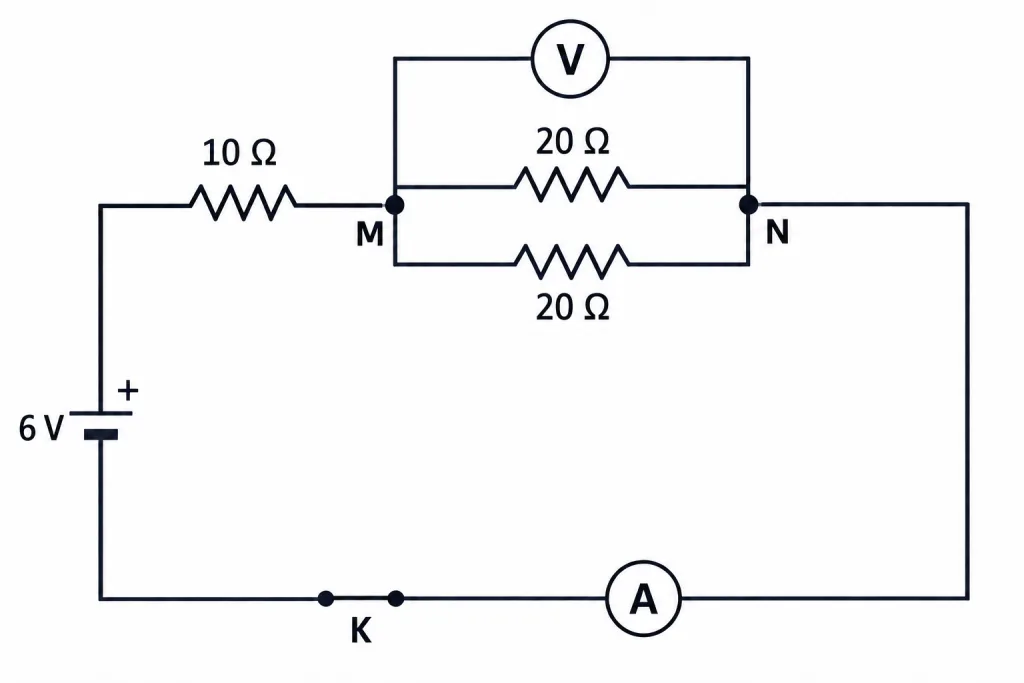
(i) Work out the equivalent resistance of the whole circuit, and hence the reading of the ammeter. (1 mark)
(ii) Find the reading of the voltmeter and the current through each 20 Ω resistor. (1 mark)
(iii) Find the power used in the 10 Ω resistor. (1 mark)
(iv) One of the 20 Ω resistors burns out and breaks. Find the new readings of the ammeter and the voltmeter. Does the 10 Ω resistor now use more power or less? (2 marks)
OR
(B) A room heater has two identical nichrome coils of 110 Ω each. A switch connects the two coils either in series or in parallel to the 220 V mains.
(i) Find the power of the heater when the coils are in series. (1 mark)
(ii) Find the power of the heater when the coils are in parallel. (1 mark)
(iii) Which setting heats the room faster? Find the current drawn from the mains in that setting. (1 mark)
(iv) In the series setting both coils are working, yet the heater gives only a quarter of the power it gives in the parallel setting. Explain why, by finding the potential difference across each coil and the power used in each coil in the two settings. (2 marks)