Detailed Solutions: CBSE Class 10 Science Sample Paper 2027 – Set 3
Every written question from the paper (2, 3, 4 and 5 marks) is solved here in order, with the marks given for each step, so you can check your answer sheet the way an examiner would. Where a question has an internal choice (OR), both options are solved. The 1-mark questions are answered, with explanations, in the quiz on the Question Paper page.
Section A - Biology (30 marks)
Question 10 (2 marks)
Answer the following:
(a) Desert plants such as cactus keep their stomata closed during the day and open them at night. Why? How do they manage to photosynthesise during the day? (1 mark)
Answer.
- Keeping the stomata closed in the hot day cuts down the loss of water by transpiration — 0.5 marks
- They take in carbon dioxide at night and store it as an intermediate substance, which is used during the day when chlorophyll absorbs light energy — 0.5 marks
(b) ATP is called the energy currency of the cell. What does this mean? Name one activity in the body that uses it. (1 mark)
Answer.
- The energy released during respiration is used to make ATP; when a cell needs energy, ATP is broken down and releases a fixed amount of energy — 0.5 marks
- Any one: contraction of muscles, making proteins, conduction of nerve impulses — 0.5 marks
Question 11 (2 marks)
Farida crossed pure-breeding pea plants that were tall with green pods with pure-breeding plants that were dwarf with yellow pods. All the F1 plants were tall with green pods. When the F1 plants self-pollinated, the F2 generation had four kinds of plants, including some that were tall with yellow pods and some that were dwarf with green pods. Give the expected ratio of the four kinds of F2 plants. How do these results show that the two traits are inherited independently?
Answer.
- Tall-green : tall-yellow : dwarf-green : dwarf-yellow = 9 : 3 : 3 : 1 — 1 mark
- Tall-yellow and dwarf-green are new combinations not seen in either parent, so the genes for height and for pod colour were not passed on together; each trait still gives 3 : 1 on its own, i.e. the two are inherited independently — 1 mark
Question 12 (2 marks)
Attempt either option (A) or (B).
(A) A doctor tells a woman in the third month of pregnancy that the placenta has formed well. What is the placenta? Name two things that pass through it from the mother to the embryo, and one thing that passes the other way.
Answer.
- The placenta is a disc-like tissue embedded in the wall of the uterus; it has villi on the embryo's side, surrounded by blood spaces on the mother's side — 1 mark
- Mother to embryo: glucose and oxygen (0.5); embryo to mother: waste substances (0.5) — 1 mark
OR
(B) Sunaina is four months pregnant. Her doctor tells her to eat regular, balanced meals and not to go without food, because "whatever the baby gets, it gets from your meals". Trace how the food she eats reaches the growing embryo. Why can the embryo not get its food in any other way?
Answer.
- Her food is digested and absorbed into her blood; in the placenta, her blood flows in spaces round the villi of the embryo, and glucose and other nutrients pass across into the embryo's blood (the villi give a large surface for this) — 1 mark
- The embryo lies inside the uterus and has no way of taking in or digesting food itself; it depends entirely on the mother's blood through the placenta, so if she eats too little, the embryo gets less of what it needs to grow — 1 mark
Question 13 (3 marks)
Ritika crossed pure-breeding pea plants with violet flowers and pure-breeding plants with white flowers. All the F1 plants had violet flowers. She let the F1 plants self-pollinate and counted the flowers on the F2 plants:
| Flower colour | Number of F2 plants |
|---|---|
| Violet | 450 |
| White | 150 |
(a) Which trait is dominant? Work out the F2 ratio from the table. (1 mark)
Answer.
- Violet is dominant — 0.5 marks
- 450 : 150 = 3 : 1 — 0.5 marks
(b) Using V for the dominant gene and v for the recessive one, show the cross between two F1 plants and write the genotype ratio of the F2 plants. (1 mark)
Answer.
- Vv × Vv; gametes V and v from each parent, combined in a checkerboard — 0.5 marks
- VV : Vv : vv = 1 : 2 : 1 — 0.5 marks
(c) About how many of the 450 violet F2 plants are expected to be pure-breeding (VV)? If a white F2 plant is self-pollinated, what colour flowers will its offspring have? Give a reason. (1 mark)
Answer.
- One-third of the violet plants are VV: about 150 — 0.5 marks
- All white, because a white plant is vv and can pass on only v — 0.5 marks
Question 14 (3 marks)
A wheat field in a village near Hisar has the food chain: wheat → rat → snake → eagle. The figure shows its pyramid of energy, with the levels marked P, Q, R and S from the bottom.
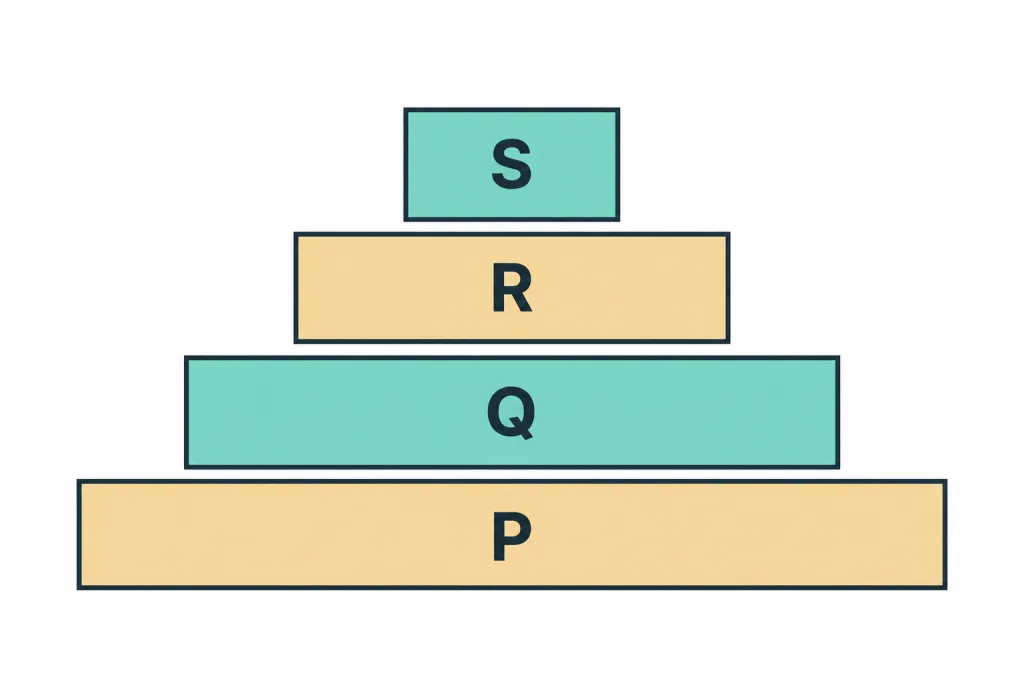
(a) Why is a crop field called an artificial ecosystem? Which organism is at level R, and which trophic level is it? (1 mark)
Answer.
- It is made and looked after by human beings (sowing, watering, weeding), not formed naturally — 0.5 marks
- The snake is at R, the third trophic level (secondary consumer) — 0.5 marks
(b) The wheat plants in the field store 60,000 kJ of energy as food. Using the 10 per cent law, find the energy available to the snakes and to the eagles. (1 mark)
Answer.
- Snakes: 60,000 → 6,000 → 600 kJ — 0.5 marks
- Eagles: 60 kJ — 0.5 marks
(c) Karan says, "When an eagle dies in the field, decomposers break down its body, and the energy stored in it goes back to the wheat. So energy keeps going round and round in this field." Is Karan right? Give a reason. (1 mark)
Answer.
- No (0.5); decomposers return only the raw materials (minerals) to the soil; the energy is used up or lost as heat at each level and never comes back to the plants, which must trap fresh energy from sunlight, so the flow of energy is one-way (unidirectional) (0.5) — 1 mark
Question 15 (4 marks)
Tanvi's class in a school in Bhopal set up two activities. In the first, a few germinating bean seeds were pressed between wet cotton wool and the inside wall of a clear glass jar, so that they could be seen, and the jar was laid on its side in a dark cupboard. After three days, the shoots had curved upwards and the roots had curved downwards. In the second, bean seedlings were kept in a closed cardboard box that had a narrow slit on one side, facing a window. After a few days, all the shoots had bent towards the slit. Their teacher explained that a plant hormone made at the tip of the shoot is responsible for this bending.
(a) Name the movement shown by the shoots in the second activity, and the hormone responsible. (1 mark)
Answer.
- Phototropism (0.5); auxin (0.5) — 1 mark
(b) In the first activity, which part shows positive geotropism and which shows negative geotropism? (1 mark)
Answer.
- The root shows positive geotropism (0.5); the shoot shows negative geotropism (0.5) — 1 mark
(c) Explain how the hormone makes the shoots bend towards the slit. The first slit is now closed and a new slit is cut in the opposite side of the box, which is turned so that the new slit faces the window. What will happen to the shoots over the next few days? (2 marks)
Answer.
- Light from one side makes auxin move to the shaded side of the shoot; the cells there grow longer, so the shoot curves towards the light — 1 mark
- The shoots will slowly bend the other way, towards the new slit, because auxin now collects on the other side (away from the light); being a growth movement, this takes a few days — 1 mark
OR
(c) Why do the root and the shoot respond to gravity in opposite ways? Why did the class keep the jar of the first activity in a dark cupboard and not near the window? (2 marks)
Answer.
- The shoot grows up, away from gravity, towards light and air; the root grows down into the soil for anchorage, water and minerals, so each response is useful to the plant — 1 mark
- In the dark there is no light from one side, so the bending could only be a response to gravity and not to light — 1 mark
Question 16 (5 marks)
Attempt either option (A) or (B).
(A) In human beings, the heart keeps oxygen-rich and oxygen-poor blood completely apart.
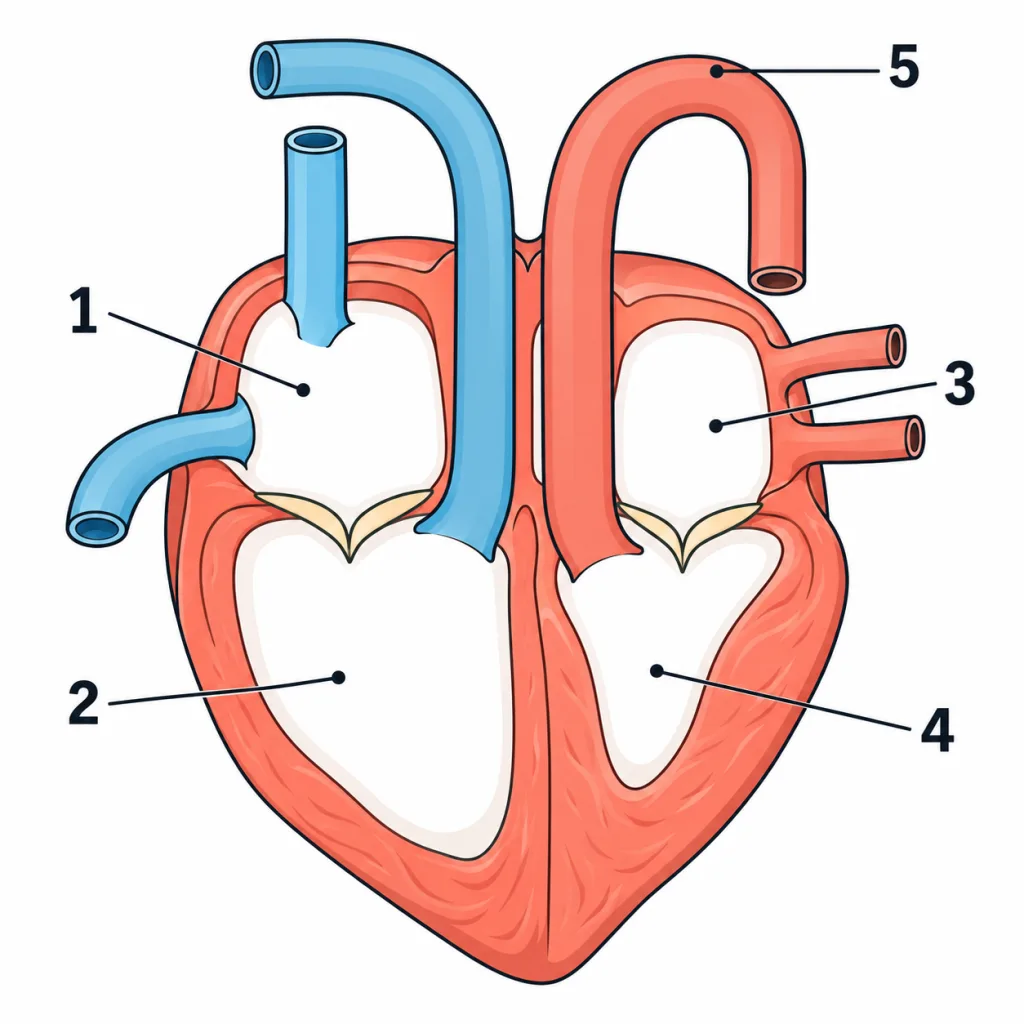
(i) Draw a schematic sectional view of the human heart and label any four of these: right atrium, right ventricle, left atrium, left ventricle, aorta. Which chamber has the thickest muscular wall, and why? (3 marks)
Answer.
Model answer:
The heart has four chambers: two atria above and two ventricles below, with a wall between the right and left sides. The left ventricle has the thickest muscular wall. It pumps oxygen-rich blood into the aorta and on to every part of the body, so it has to push the blood with the greatest force.
Marking scheme:
- Correct schematic diagram of the heart with four chambers — 1 mark
- Any four parts correctly labelled, 0.25 each (in the figure: 1 right atrium, 2 right ventricle, 3 left atrium, 4 left ventricle, 5 aorta) — 1 mark
- The left ventricle, because it has to pump blood out to all parts of the body — 1 mark
(ii) What is meant by double circulation? Why is it important for birds and mammals that the oxygenated and deoxygenated blood do not mix? (2 marks)
Answer.
Model answer:
Double circulation means that blood goes through the heart twice in each round trip. Deoxygenated blood from the body enters the right atrium, goes to the right ventricle and is pumped to the lungs. Oxygenated blood returns to the left atrium, passes to the left ventricle and is pumped to the rest of the body. Because the two kinds of blood never mix, the body gets blood that is fully loaded with oxygen. Birds and mammals are warm-blooded: they burn a lot of food to keep their body temperature steady, so they need this efficient supply of oxygen.
Marking scheme:
- In one complete cycle, the blood passes through the heart twice: right side to the lungs and back (pulmonary), then left side to the body and back (systemic) — 1 mark
- Keeping the two kinds of blood apart gives a highly efficient supply of oxygen to the body; birds and mammals need this because they use a lot of energy to keep their body temperature constant — 1 mark
OR
(B) Harpreet covered the leafy shoot of a potted balsam plant with a clear polythene bag and tied it round the base of the stem, so that the soil stayed outside the bag. She kept the pot in sunlight. After a few hours, drops of water appeared on the inside of the bag.
(i) Name the process that produced the drops. Why did she keep the soil outside the bag? Explain how this process helps water to rise to the top of a tall tree, and give one other use of this process to the plant. (3 marks)
Answer.
Model answer:
The drops came from transpiration, the loss of water vapour from the aerial parts of the plant, mainly through the stomata of the leaves. The soil was kept outside the bag so that the water could not have come from the damp soil; it had to come from the leaves. When water evaporates from the leaves, the water in the leaf xylem moves in to take its place. This creates a suction that pulls the unbroken column of water up the xylem all the way from the roots. This transpiration pull is the main force that lifts water to the top of a tall tree during the day. Transpiration also helps the plant to take in water and minerals from the soil and to keep its temperature down.
Marking scheme:
- Transpiration (0.5); the soil was kept out so that the water collected could only have come from the leaves, not from evaporation from the moist soil (0.5) — 1 mark
- Water lost from the leaves through the stomata is replaced by water from the xylem of the leaf; this creates a suction (transpiration pull) that draws water up the continuous column of xylem from the roots — 1 mark
- Any one: it helps in the absorption and upward movement of water and dissolved minerals from roots to leaves; it helps in temperature regulation — 1 mark
(ii) Give two differences between the transport of food in the phloem (translocation) and the transport of water in the xylem. (2 marks)
Answer.
Model answer:
First, the direction and the material differ. The phloem carries food made in the leaves, such as sucrose and amino acids, to the roots, fruits, seeds and growing parts, so it moves both upwards and downwards. The xylem carries water and minerals only upwards, from the roots. Second, translocation needs energy: sucrose is transferred into the phloem using energy from ATP, which raises the pressure there and pushes the food along. Water moves up the xylem by physical forces such as transpiration pull and root pressure, without the plant spending ATP.
Marking scheme:
- The phloem carries food such as sucrose and amino acids from the leaves to other parts, both upwards and downwards; the xylem carries water and minerals only upwards, from the roots — 1 mark
- Translocation uses energy from ATP (sucrose is moved into the phloem actively); water moves in the xylem by physical forces such as transpiration pull and root pressure — 1 mark
Section B - Chemistry (25 marks)
Question 25 (2 marks)
Answer the following:
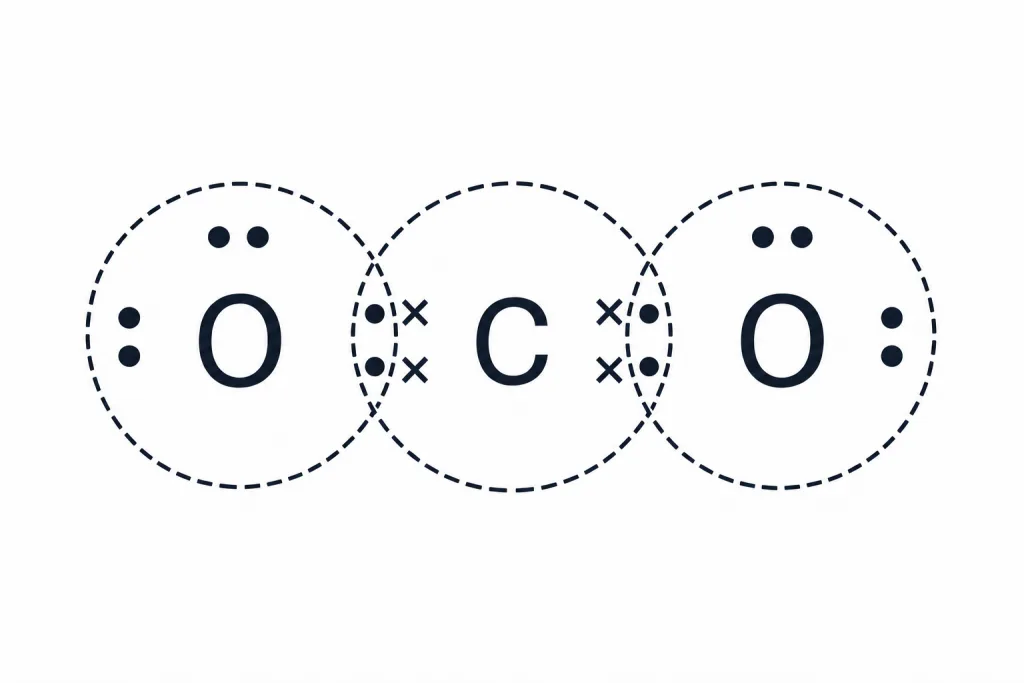
(a) Draw the electron dot structure of a molecule of carbon dioxide, . (Atomic numbers: C = 6, O = 8) (1 mark)
Answer.
- Correct structure: two shared pairs of electrons between the carbon atom and each oxygen atom, and two lone pairs on each oxygen atom — 1 mark
(b) Dry ice (solid carbon dioxide) does not conduct electricity, but soda water, which is carbon dioxide dissolved in water under pressure, conducts it slightly. Explain both observations. (1 mark)
Answer.
- In dry ice the atoms are held by covalent bonds (shared electrons), so there are no ions to carry the current — 0.5 marks
- In water, carbon dioxide forms carbonic acid, a weak acid, which gives a few hydrogen ions, so the solution conducts only slightly — 0.5 marks
Question 26 (3 marks)
Attempt either option (A) or (B).
(A) Sonal dropped a small piece of sodium into a test tube containing a little absolute ethanol.
(i) Write the balanced chemical equation for the reaction and name the organic product. (1 mark)
Answer.
- (0.5); sodium ethoxide (0.5) — 1 mark
(ii) How can she test the gas given off? (1 mark)
Answer.
- Bring a burning splinter near the mouth of the test tube: the gas burns with a pop sound, showing it is hydrogen — 1 mark
(iii) Ethanol is also used as a fuel. Write the balanced chemical equation for its complete combustion, and say what kind of flame it gives. (1 mark)
Answer.
- (0.5); a clean blue flame (0.5) — 1 mark
OR
(B) Sonal took 1 mL of ethanol and 1 mL of glacial ethanoic acid in a test tube, added a few drops of concentrated sulphuric acid and warmed the tube in a water bath for five minutes. She then poured the mixture into a beaker of water.
(i) What has Sonal made? Give the equation for its formation, the name of the organic product and the class of compounds it belongs to. (1 mark)
Answer.
- (in the presence of an acid) (0.5); ethyl ethanoate, an ester (0.5) — 1 mark
(ii) How can Sonal tell, after pouring the mixture into water, that the product has formed? What is the job of the sulphuric acid? (1 mark)
Answer.
- A sweet, fruity smell is noticed (0.5); the sulphuric acid acts as a catalyst (0.5) — 1 mark
(iii) Her friend says, "This is just a neutralisation, like an acid reacting with sodium hydroxide, because ethanol is a base." Is the friend right? Give a reason. (1 mark)
Answer.
- No (0.5); ethanol is not a base: it gives no hydroxide ions and does not turn red litmus blue, and the product is an ester, not a salt; this is esterification, which needs an acid catalyst (0.5) — 1 mark
Question 27 (3 marks)
Tanya mixed the following pairs of solutions in three test tubes:
P: silver nitrate solution and sodium chloride solution
Q: copper sulphate solution and sodium hydroxide solution
R: potassium nitrate solution and sodium chloride solution
(a) In tube P a precipitate forms. Write the balanced chemical equation and give the colour and name of the precipitate. (1 mark)
Answer.
- (0.5); a white precipitate of silver chloride (0.5) — 1 mark
(b) In tube Q a precipitate also forms. Write the balanced chemical equation and give the colour and name of the precipitate. (1 mark)
Answer.
- (0.5); a blue precipitate of copper(II) hydroxide (0.5) — 1 mark
(c) The mixture in tube R stays clear. Why is no precipitate formed? Name the type of reaction that took place in P and Q. (1 mark)
Answer.
- The salts that could form, potassium chloride and sodium nitrate, are both soluble in water, so no insoluble product separates out (0.5); P and Q are double displacement (precipitation) reactions (0.5) — 1 mark
Question 28 (4 marks)
During the holidays, Rupa helped at her uncle's bakery in Kolkata, where baking soda is used to make cakes soft and spongy. At home, her mother cleans greasy vessels with hot water in which washing soda has been dissolved. The same week, Rupa's brother fractured his wrist. In the plaster room of the hospital, the wrist was wrapped in a bandage coated with a white powder mixed with water, which set into a hard cast within minutes. This white powder is Plaster of Paris, .
(a) Which gas makes the cake rise? Write the chemical equation for the reaction that gives this gas when baking soda is heated. (1 mark)
Answer.
- Carbon dioxide — 0.5 marks
- — 0.5 marks
(b) Will the solution of washing soda have a pH more than 7 or less than 7? Give a reason based on the acid and the base from which washing soda is formed. (1 mark)
Answer.
- More than 7 (basic) — 0.5 marks
- Washing soda (sodium carbonate) is the salt of a strong base, sodium hydroxide, and a weak acid, carbonic acid — 0.5 marks
(c) What does '' in the formula of Plaster of Paris stand for? Plaster of Paris is made by heating gypsum carefully at about 373 K. One batch was heated far more strongly by mistake, and the powder obtained did not set at all when it was mixed with water. Explain why, and write the chemical equation for the setting of good Plaster of Paris. (2 marks)
Answer.
- It is the water of crystallisation: a fixed number of water molecules present in one formula unit of the salt; here two formula units of calcium sulphate share one molecule of water — 1 mark
- Strong heating drove out all the water of crystallisation, leaving anhydrous calcium sulphate, which does not take up water and set (0.5); (0.5) — 1 mark
OR
(c) Rupa's uncle uses baking powder, which is baking soda mixed with a mild edible acid such as tartaric acid, instead of baking soda alone. What would go wrong if he used only baking soda? How does the acid prevent this? (2 marks)
Answer.
- On heating, baking soda alone leaves sodium carbonate behind, which gives the cake a bitter taste — 1 mark
- The acid reacts with the baking soda to give carbon dioxide (which still makes the cake rise) and the sodium salt of the acid, so no sodium carbonate is left — 1 mark
Question 29 (5 marks)
Attempt either option (A) or (B).
(A) Ionic compounds are formed by the transfer of electrons from a metal to a non-metal.
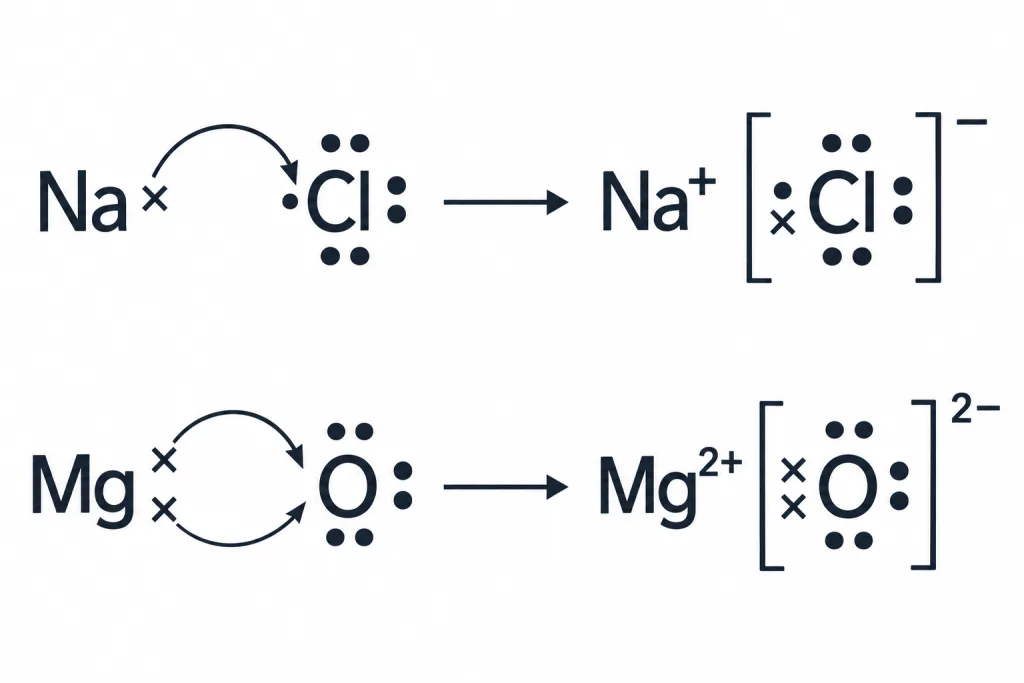
(i) Write the electronic configurations of sodium (atomic number 11), chlorine (17), magnesium (12) and oxygen (8). Show, using electron dot structures, the formation of sodium chloride and of magnesium oxide by the transfer of electrons. (3 marks)
Answer.
- Na 2, 8, 1; Cl 2, 8, 7; Mg 2, 8, 2; O 2, 6 — 1 mark
- NaCl: sodium gives its one outer electron to chlorine, forming and ions (0.5 + 0.5) — 1 mark
- MgO: magnesium gives its two outer electrons to oxygen, forming and ions (0.5 + 0.5) — 1 mark
(ii) The table gives the melting and boiling points of four substances W, X, Y and Z.
| Substance | Melting point (°C) | Boiling point (°C) |
|---|---|---|
| W | 801 | 1413 |
| X | −182 | −162 |
| Y | 2852 | 3600 |
| Z | −114 | 78 |
Which two of these are likely to be ionic compounds? Give a reason. Which substance is a liquid at room temperature (25 °C)? (2 marks)
Answer.
Model answer:
W and Y are likely to be ionic compounds. Their melting and boiling points are very high. In an ionic compound the positive and negative ions attract each other strongly, and a large amount of energy is needed to break this attraction, so ionic compounds melt and boil only at high temperatures. X and Z melt and boil at low temperatures, which is typical of covalent compounds. Z is a liquid at room temperature: 25 °C is above its melting point of −114 °C, so it is no longer solid, but below its boiling point of 78 °C, so it has not turned into a gas. (X is a gas at room temperature.)
Marking scheme:
- W and Y (0.5); they have very high melting and boiling points, because a lot of energy is needed to overcome the strong force of attraction between the oppositely charged ions (0.5) — 1 mark
- Z, since 25 °C lies between its melting point (−114 °C) and its boiling point (78 °C) — 1 mark
OR
(B) Kavita's teacher gave her these observations on three metals, P, Q and R, and asked her to decide how each metal could be obtained from its compounds.
| Test | P | Q | R |
|---|---|---|---|
| A small piece is put in cold water | Reacts vigorously; hydrogen is given off | No reaction | No reaction |
| A small piece is put in dilute hydrochloric acid | Not tried (too dangerous) | Bubbles of hydrogen | No reaction |
| Its oxide is heated strongly with carbon | No change | The metal is formed | The metal is formed |
(i) Arrange P, Q and R in decreasing order of reactivity, using the evidence in the table. Which of the three could also be found in the free state in nature? How should P be obtained from its compounds, and why can carbon not be used for it? (3 marks)
Answer.
Model answer:
The order of reactivity is P > Q > R. P is the most reactive, because it reacts vigorously even with cold water. Q does not react with water, but it gives hydrogen with dilute hydrochloric acid, so it is more reactive than hydrogen. R reacts with neither, so it is the least reactive. R is the one that could be found in the free state, because a metal this unreactive is hardly attacked by air, water or acids. P is so reactive that carbon cannot remove the oxygen from its oxide, as the table shows: P holds on to oxygen more strongly than carbon does. So P has to be obtained by electrolysis of its molten chloride, and the metal collects at the cathode.
Marking scheme:
- P > Q > R (0.5); P reacts even with cold water, Q does not react with water but displaces hydrogen from dilute acid, and R does neither (0.5) — 1 mark
- R (0.5), because it is the least reactive and is hardly attacked by air, water or acids (0.5) — 1 mark
- By electrolysis of its molten chloride (0.5); P is more reactive than carbon (it holds oxygen more strongly), so carbon cannot take the oxygen from its oxide, as the table shows (0.5) — 1 mark
(ii) Highly reactive metals can also be used as reducing agents.
(I) Kavita heats the oxide of Q with powdered P. Can she get the metal Q in this way? Give a reason.
(II) Manganese is obtained by heating manganese dioxide with aluminium powder. Write the balanced chemical equation for the reaction and name the reducing agent. (2 marks)
Answer.
Model answer:
(I) Yes. P is more reactive than Q, so when the two are heated together, P takes the oxygen away from the oxide of Q. The oxide of P is formed and the metal Q is set free. Here P acts as the reducing agent. (II) . Aluminium is more reactive than manganese, so it removes the oxygen from manganese dioxide. Aluminium is oxidised to aluminium oxide, so it is the reducing agent, and manganese dioxide is reduced to manganese.
Marking scheme:
- (I) Yes (0.5); P is more reactive than Q, so it takes the oxygen from the oxide of Q and sets Q free (0.5) — 1 mark
- (II) (0.5); aluminium is the reducing agent (0.5) — 1 mark
Section C - Physics (25 marks)
Question 33 (2 marks)
The refractive index of water is and that of a certain kind of glass is , both with respect to air.
(a) Find the refractive index of this glass with respect to water. Which of the two is optically denser? (1 mark)
Answer.
- (0.5); glass is optically denser than water (0.5) — 1 mark
(b) A ray of light travelling in water falls on the glass surface such that . Using Snell's law, find in the glass. Does the ray bend towards or away from the normal? (1 mark)
Answer.
- — 0.5 marks
- Since sin r is smaller than sin i, the angle of refraction is smaller: the ray bends towards the normal — 0.5 marks
Question 34 (2 marks)
Attempt either option (A) or (B).
(A) A torch bulb draws a current of 0.3 A when it is connected to a 4.5 V battery. Assume that its resistance stays the same.
(I) Find the current it will draw if it is connected to a 6 V battery instead. (1 mark)
Answer.
- Ω — 0.5 marks
- A — 0.5 marks
(II) Will the bulb glow more or less brightly on the 6 V battery? Justify by comparing the power in the two cases. (1 mark)
Answer.
- W; W — 0.5 marks
- More power is used up in the filament, so it glows more brightly (and may fuse sooner) — 0.5 marks
OR
(B) Wires P and Q are both made of copper. Wire Q is twice as long as wire P and has twice the diameter of P.
(I) Find the ratio of the resistance of Q to that of P. (1 mark)
Answer.
- and the area depends on the square of the diameter, so — 1 mark
(II) The same potential difference is applied across each wire in turn. Which wire carries the larger current, and how many times larger is it? (1 mark)
Answer.
- Wire Q (0.5), since its resistance is half, it carries twice the current (0.5) — 1 mark
Question 35 (3 marks)
Ayesha, a Class 7 student, sees distant objects clearly, but the words in her book look blurred when she holds it at the usual reading distance of 25 cm. Her eye doctor says she has hypermetropia.
(a) State two possible causes of this defect. (1 mark)
Answer.
- The focal length of the eye lens is too long (0.5); the eyeball has become too small (0.5) — 1 mark
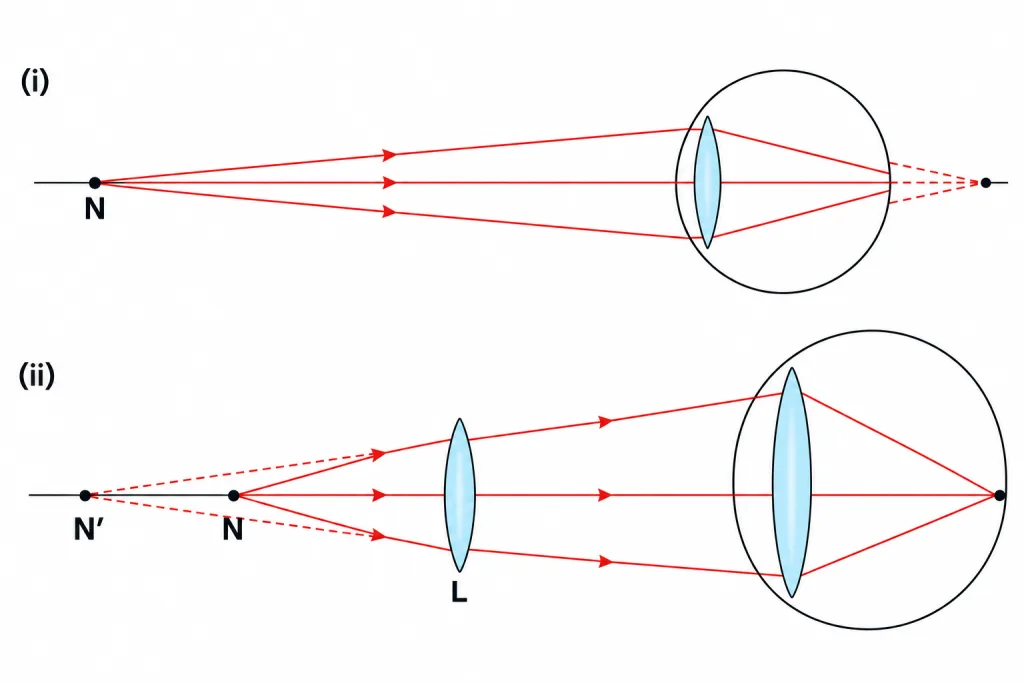
(b) Draw ray diagrams to show (i) where the image of a book held at the normal near point N is formed in Ayesha's eye, and (ii) how the correct spectacle lens lets her read it clearly. Mark the near point N′ of her eye in (ii). (2 marks)
Answer.
- (i) Rays from N meet behind the retina, so the image on the retina is blurred — 1 mark
- (ii) A convex lens in front of the eye bends the rays from N so that they seem to come from N′; the eye lens then focuses them on the retina — 1 mark
Question 36 (3 marks)
Answer the following:
(a) In a school laboratory, a coil of resistance wire dipped in a beaker of water is used as a small immersion heater. When the current through the same coil is doubled, keeping the time the same, Asif says the heat produced will double. Is he right? Justify. (1 mark)
Answer.
- No: , so doubling the current makes the heat times, not 2 times — 1 mark
(b) Farhan is making a small toaster for a science fair. He wants to wind its heating coil from copper wire, "because copper conducts electricity so well". Is this a good choice? Give two reasons. (1 mark)
Answer.
- No. Copper has a very low resistivity, so a coil of the usual size has too little resistance to produce enough heat (it would draw a very large current); an alloy such as nichrome has a much higher resistivity — 0.5 marks
- Red-hot copper oxidises (burns) quickly, so the coil would soon break; nichrome does not oxidise readily at high temperatures — 0.5 marks
(c) Farhan then suggests using nichrome wire for the wiring of his house, "so that the wires never melt". What would go wrong? Why are copper wires used instead? (1 mark)
Answer.
- Nichrome's high resistivity would make the wires themselves heat up, wasting energy and risking a fire, and less voltage would reach the appliances (0.5); copper has a very low resistivity, so the connecting wires stay cool and waste very little energy (0.5) — 1 mark
Question 37 (3 marks)
Mohit built the circuit shown on a board in the physics laboratory. The key K is closed.
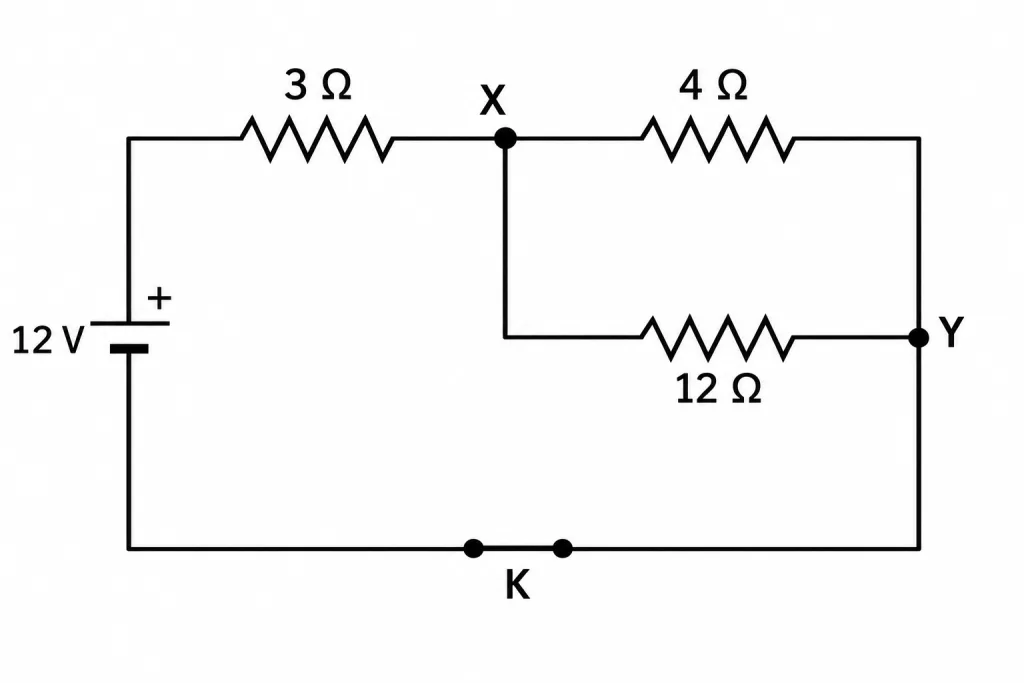
(a) What single resistor could replace all three without changing the battery current? What current flows through the 3 Ω resistor? (1 mark)
Answer.
- , so Ω; total Ω, so a single 6 Ω resistor — 0.5 marks
- A, and all of it flows through the 3 Ω resistor — 0.5 marks
(b) What is the voltage across the part XY? How is the battery current shared between the 4 Ω and 12 Ω resistors? (1 mark)
Answer.
- V — 0.5 marks
- A through 4 Ω and A through 12 Ω — 0.5 marks
(c) Mohit says, "The 12 Ω resistor will produce the most heat every second, because it has the largest resistance." Is he right? Justify by finding the power in each resistor. (1 mark)
Answer.
- : 3 Ω: W; 4 Ω: W; 12 Ω: W — 0.5 marks
- No: the 3 Ω resistor, which carries the whole current, produces the most heat; the 12 Ω resistor produces the least, because very little current flows through it — 0.5 marks
Question 38 (4 marks)
Mandi Gobindgarh in Punjab is known for its steel re-rolling mills. In a scrap yard there, a crane lifts heavy iron scrap with a large electromagnet: a thick coil of insulated copper wire wound on a soft-iron core. When the operator switches the current on, the magnet picks up a load of iron scrap; when she switches it off, the load drops. Aluminium cans and pieces of copper wire lying in the same heap are left behind.
(a) Why is the core made of soft iron and not of steel? (1 mark)
Answer.
- Soft iron becomes a strong magnet while the current flows and loses its magnetism almost as soon as the current is switched off, so the scrap can be dropped; steel would stay magnetised — 1 mark
(b) Why are the aluminium cans and copper wires not lifted? (1 mark)
Answer.
- Aluminium and copper are not magnetic materials, so they are not attracted by the magnet — 1 mark
(c) Suggest two ways to make the crane lift heavier loads. What will happen to the poles of the electromagnet if the direction of the current in the coil is reversed? Will it still lift iron scrap? (2 marks)
Answer.
- Any two: increase the current in the coil; increase the number of turns in the coil; use a larger (thicker) soft-iron core (0.5 each) — 1 mark
- The poles interchange (0.5); it still lifts the scrap, because iron is attracted by either pole (0.5) — 1 mark
OR
(c) Looking at the lower face of the electromagnet from below, the operator sees the current flowing clockwise in the coil. Use the right-hand thumb rule to find whether this face is a north or a south pole. Why is the coil made of many turns rather than a single loop? (2 marks)
Answer.
- The field inside the coil points upwards, away from the viewer, so field lines enter at the lower face: it is a south pole — 1 mark
- The magnetic field produced by each turn adds up, so a coil of many turns gives a much stronger field than a single loop — 1 mark
Question 39 (5 marks)
Attempt either option (A) or (B).
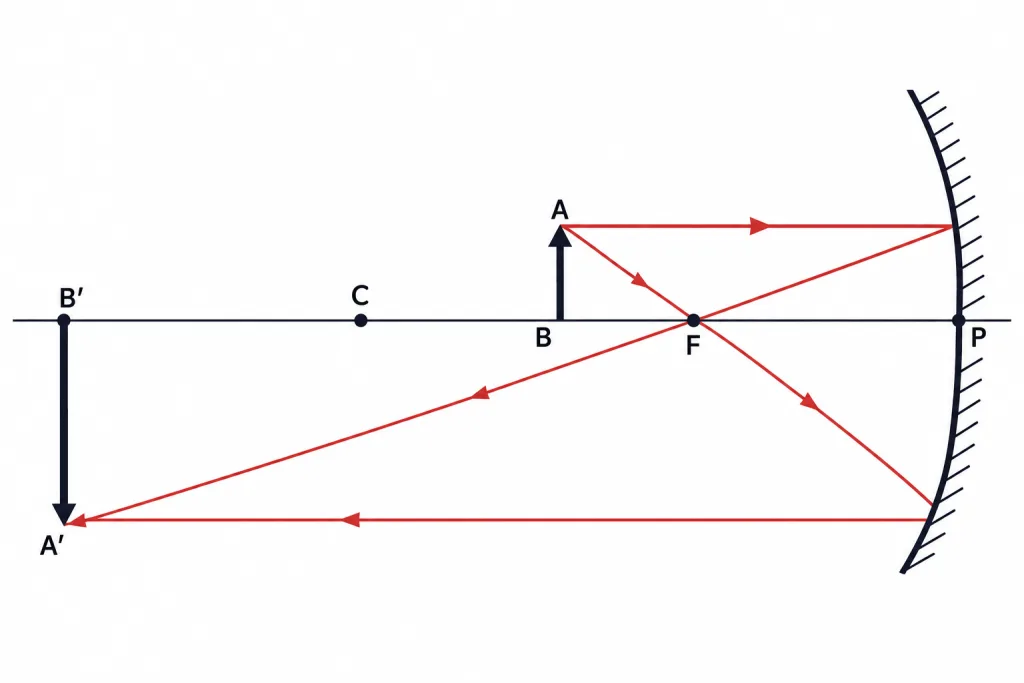
(A) In the physics laboratory, Swati places a small candle 20 cm in front of a concave mirror of focal length 15 cm and moves a screen until she gets a sharp image of the flame.
(i) Where must the screen be placed? (1 mark)
Answer.
- cm, cm; , so cm: 60 cm in front of the mirror — 1 mark
(ii) Work out the magnification. Is the image real or virtual, erect or inverted, larger or smaller? (1 mark)
Answer.
- — 0.5 marks
- Real, inverted and three times enlarged — 0.5 marks
(iii) Give two uses of concave mirrors in daily life. (1 mark)
Answer.
- Any two: as reflectors in torches, vehicle headlights and searchlights; as shaving or make-up mirrors; as a dentist's mirror; to concentrate sunlight in solar furnaces (0.5 each) — 1 mark
(iv) Using two rays from the tip of the flame, draw a ray diagram to show where the mirror forms its image. (2 marks)
Answer.
- Any two standard rays from the tip, correctly reflected (0.5 + 0.5): a ray parallel to the principal axis reflected through F; a ray through F reflected parallel to the axis; a ray through C reflected back along itself; a ray to the pole reflected at an equal angle — 1 mark
- The rays meeting beyond C to give a real, inverted, enlarged image — 1 mark
OR
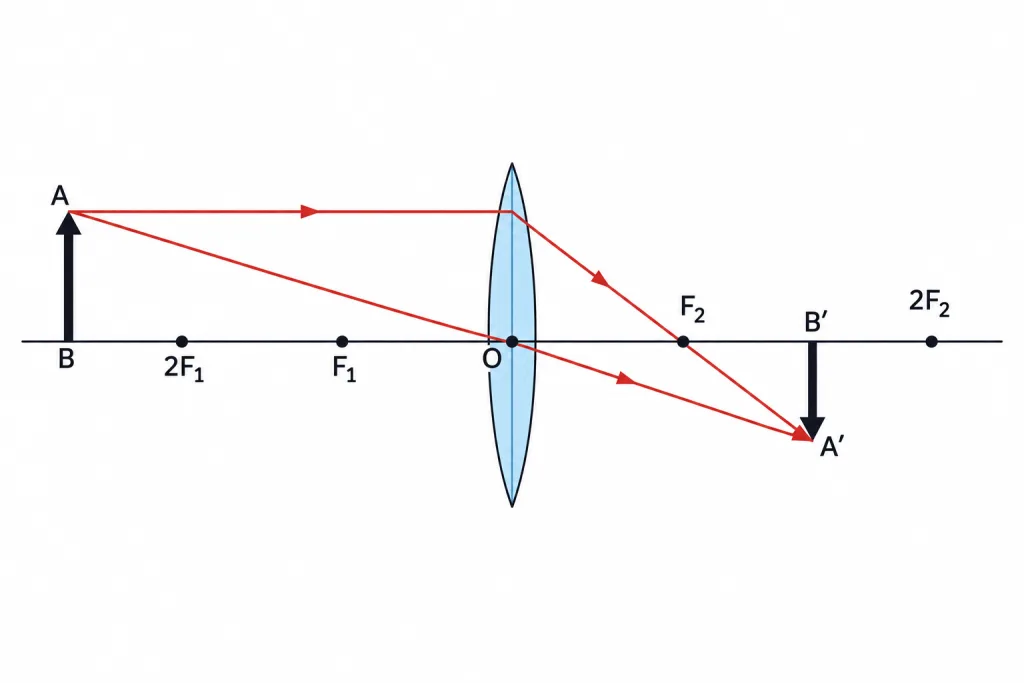
(B) A convex lens of focal length 12 cm forms an image of an object placed 36 cm in front of it.
(i) Find the position of the image. (1 mark)
Answer.
- , so cm on the other side of the lens — 1 mark
(ii) How large is the image compared with the object? Is it real or virtual, and erect or inverted? Use the magnification. (1 mark)
Answer.
- — 0.5 marks
- Real, inverted and half the size of the object — 0.5 marks
(iii) Define the power of a lens and give its SI unit. A second convex lens has a power of +5 D. Find its focal length, and say which of the two lenses converges light more strongly. (1 mark)
Answer.
- Power is the reciprocal of the focal length in metres; its SI unit is the dioptre (D) (0.5) — 0.5 marks
- m cm; the 12 cm lens has the shorter focal length, so it converges more strongly (0.5) — 0.5 marks
(iv) Draw a ray diagram, using two rays from the top of the object, to show where this lens forms the image. (2 marks)
Answer.
- Any two standard rays from the top, correctly refracted (0.5 + 0.5): a ray parallel to the principal axis passing through F2; a ray through the optical centre going straight on; a ray through F1 coming out parallel to the axis — 1 mark
- The rays meeting between F2 and 2F2 to give a real, inverted, diminished image — 1 mark