
Nationalism in India
Nationalism in India carried 7 or 8 marks in the 2026-27 sample paper and both 2026 board papers, including the 2-mark map question, which has come from this chapter every time. It set the History 5-marker in the sample paper (the economic effects of Non-Cooperation or merchants in Civil Disobedience) and in May 2026 (women in Civil Disobedience), the source-based question in February 2026 (Quit India), a 3-marker on Non-Cooperation in 2025, and an MCQ in every recent paper.
Marks are most often lost on the map (Kheda, Ahmedabad and Dandi are all in Gujarat; Calcutta and Nagpur both held sessions in 1920), on mixing up the Non-Cooperation and Civil Disobedience Movements, on dates, and on answers that list events without saying why a group joined the movement or stayed away.
Revise in 5 Minutes
Timeline
| Year | Event |
|---|---|
| 1915 | Gandhiji returns from South Africa (January) |
| 1917-1918 | Satyagrahas at Champaran (indigo planters), Kheda (revenue) and Ahmedabad (mill workers, 1918) |
| 1919 | Rowlatt Act; hartal on 6 April; Jallianwala Bagh, Amritsar, 13 April; Khilafat Committee, Bombay (March) |
| 1920 | Calcutta session (September) agrees to non-cooperation; Nagpur session (December) adopts the programme; Oudh Kisan Sabha (October) |
| 1922 | Non-Cooperation withdrawn (February) after violence at Chauri Chaura |
| 1928 | Simon Commission: 'Go back Simon' |
| 1929 | Lahore session (December): Purna Swaraj; 26 January 1930 as Independence Day |
| 1930 | Letter to Irwin with 11 demands (31 January); Salt March, Sabarmati to Dandi, 24 days; salt law broken on 6 April |
| 1931 | Gandhi-Irwin Pact (5 March); Second Round Table Conference (December) |
| 1932 | Poona Pact (September) |
| 1942 | Quit India: after the Cripps Mission failed; Wardha resolution (July); 'Do or Die' (Bombay, 8 August) |
Map list: Calcutta (West Bengal), Nagpur (Maharashtra), Madras (Tamil Nadu), Champaran (Bihar), Kheda, Ahmedabad and Dandi (Gujarat), Amritsar (Punjab).
Strands of Non-Cooperation: Awadh peasants (Baba Ramchandra; begar, high rents; nai-dhobi bandh), Gudem Hills (Alluri Sitarama Raju; forest closure), Assam plantation workers ('Gandhi Raj'), towns (students, lawyers, boycott; foreign cloth imports nearly halved).
Non-Cooperation vs Civil Disobedience: the first asked people to refuse cooperation; the second also asked them to break colonial laws (salt, forest laws, revenue).
Who joined Civil Disobedience, and why: rich peasants (lower revenue); poor peasants (rent remission); business (end to colonial curbs; FICCI, 1927); workers (mainly the Nagpur region); women (high-caste urban and rich peasant homes). Most dalits and many Muslims stayed away.
Traps
- The Justice Party in Madras did not boycott the council elections.
- Gandhi-Irwin Pact (1931) is not the Poona Pact (1932).
- The Salt March started at Sabarmati (Ahmedabad); the salt law was broken at Dandi on the coast.
- Kheda and Ahmedabad are both inland in Gujarat, close to each other.
How to use this page: try each question on paper first, then read the answer. The marks against each step show what an examiner looks for. The 1-mark MCQs and Assertion-Reason questions are in the quiz at the end, together with questions that test how well you understand the chapter; every quiz answer comes with its explanation.
Short Answer Questions (2 and 3 Marks)
Question 1 (2 marks)
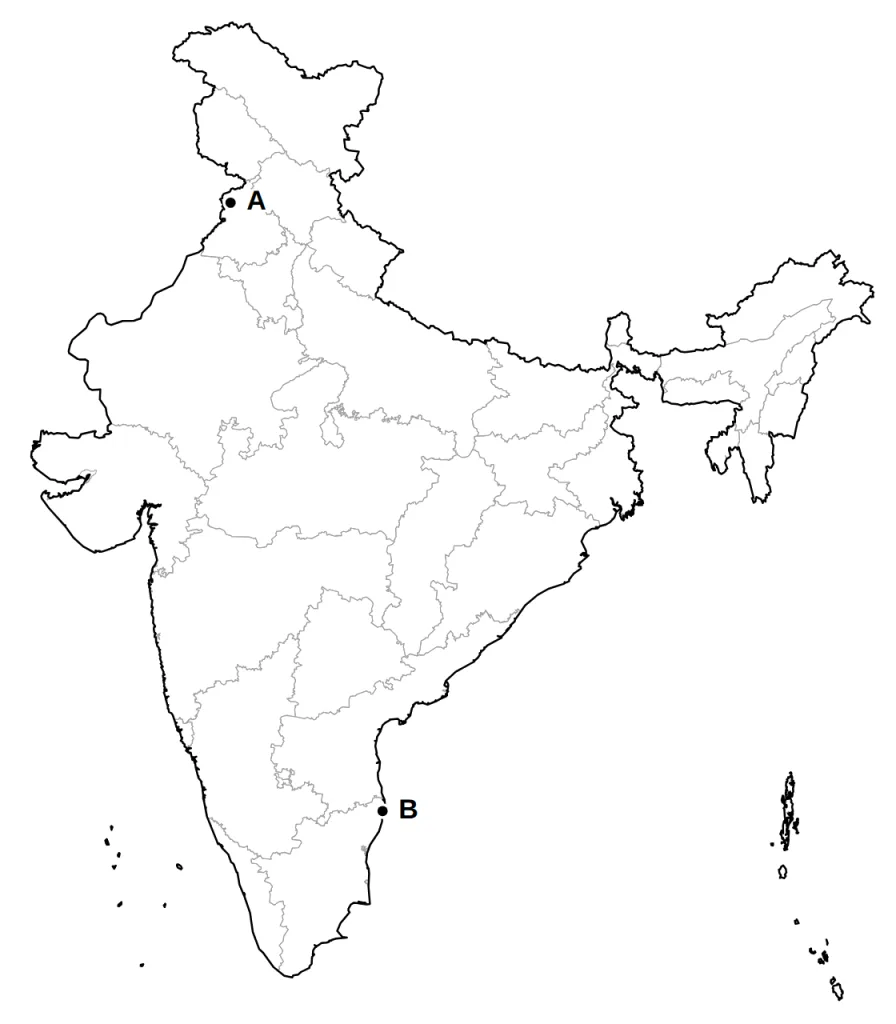
Two places, A and B, are marked on the outline map of India given below. Identify them with the help of the following information and write their correct names.
A. The Punjab city where the police fired on a peaceful procession on 10 April 1919, after which martial law was imposed.
B. The capital of the old Madras Presidency, on the east coast, where the Congress held its session in 1927.
Answer.
Model answer:
A. Amritsar, in Punjab, close to the border in the north-west.
B. Madras (now Chennai), on the east coast in Tamil Nadu.
Marking scheme:
- A: Amritsar (Punjab) — 1 mark
- B: Madras, now Chennai (Tamil Nadu) — 1 mark
Question 2 (2 marks)
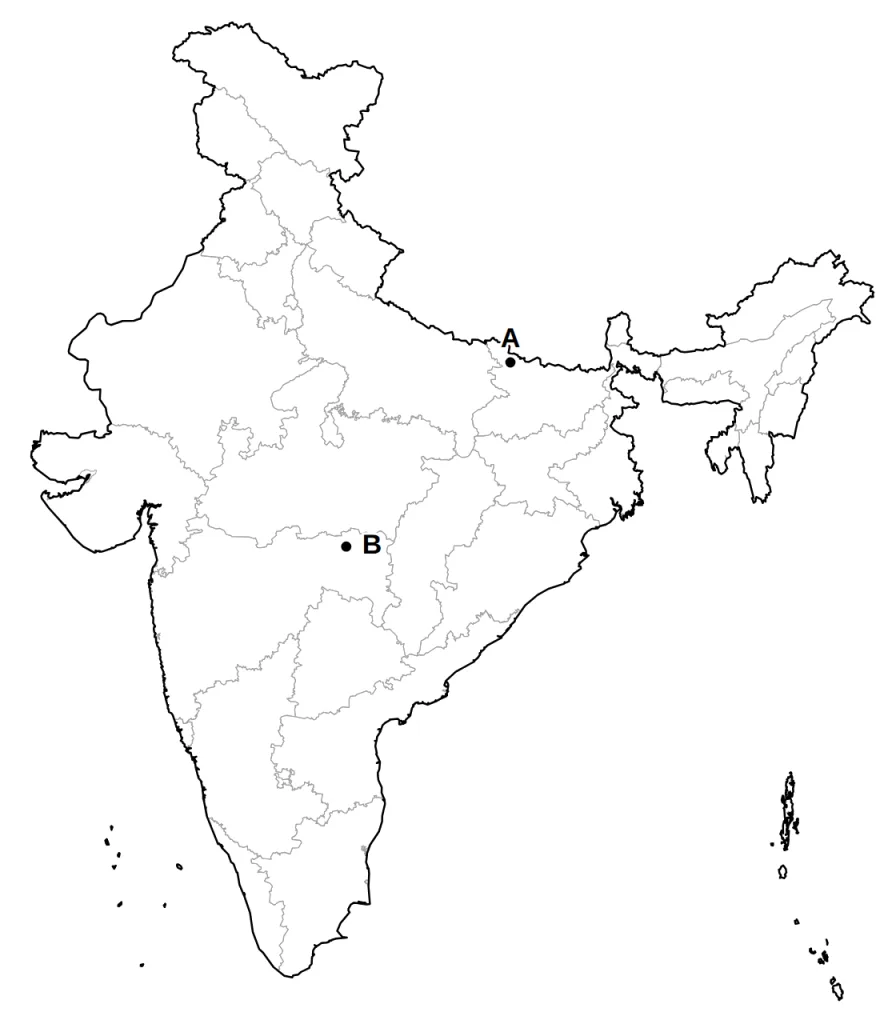
Two places, A and B, are marked on the outline map of India given below. Identify them with the help of the following information and write their correct names.
A. The district of north Bihar that saw the first of Gandhiji's satyagrahas in India, in 1917.
B. The city whose Congress session of December 1920 was followed, a month later, by the start of the Non-Cooperation-Khilafat Movement.
Answer.
Model answer:
A. Champaran, in the north-west of Bihar, near the Nepal border.
B. Nagpur, in Maharashtra, close to the centre of India.
Marking scheme:
- A: Champaran (Bihar) — 1 mark
- B: Nagpur (Maharashtra) — 1 mark
Question 3 (3 marks)
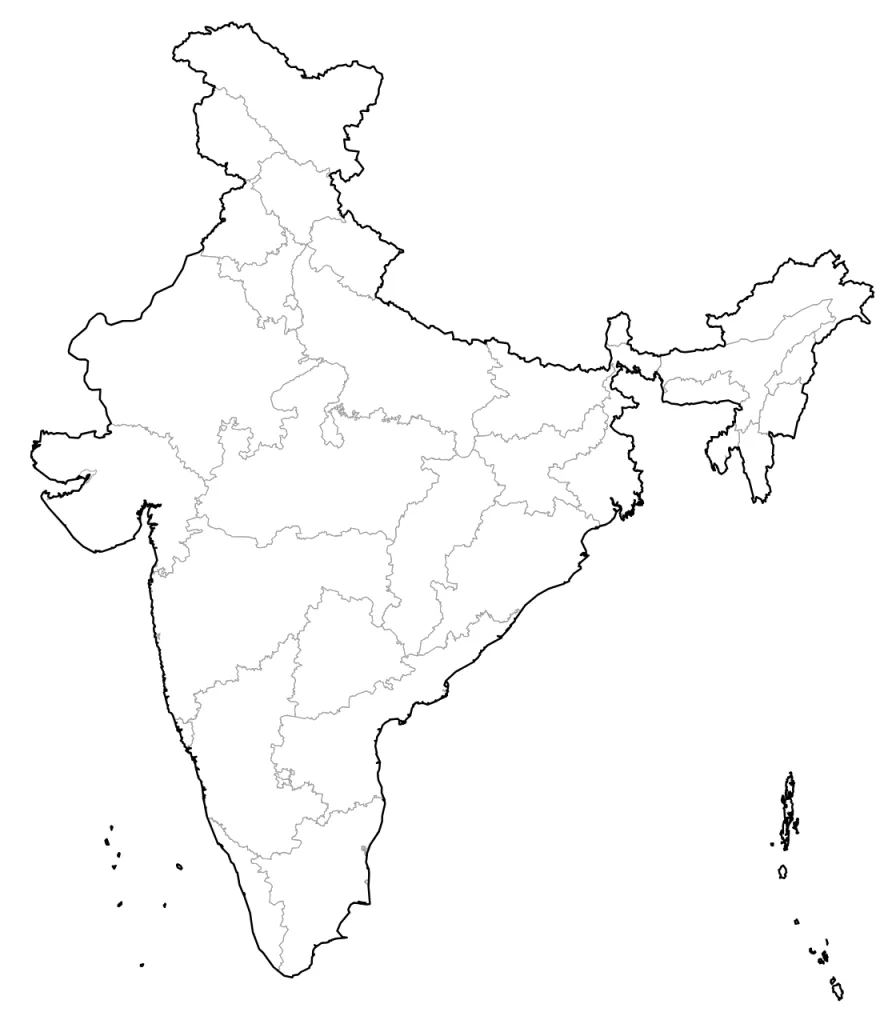
On the outline map of India given below, locate and label the following with suitable symbols.
(a) The eastern city where the Congress met in September 1920 and agreed to start non-cooperation.
(b) The textile city of Gujarat where Gandhiji took up the cause of cotton mill workers in 1918.
(c) The village on the Gujarat coast that was the end point of a 240-mile walk in 1930.
Answer.
Model answer:
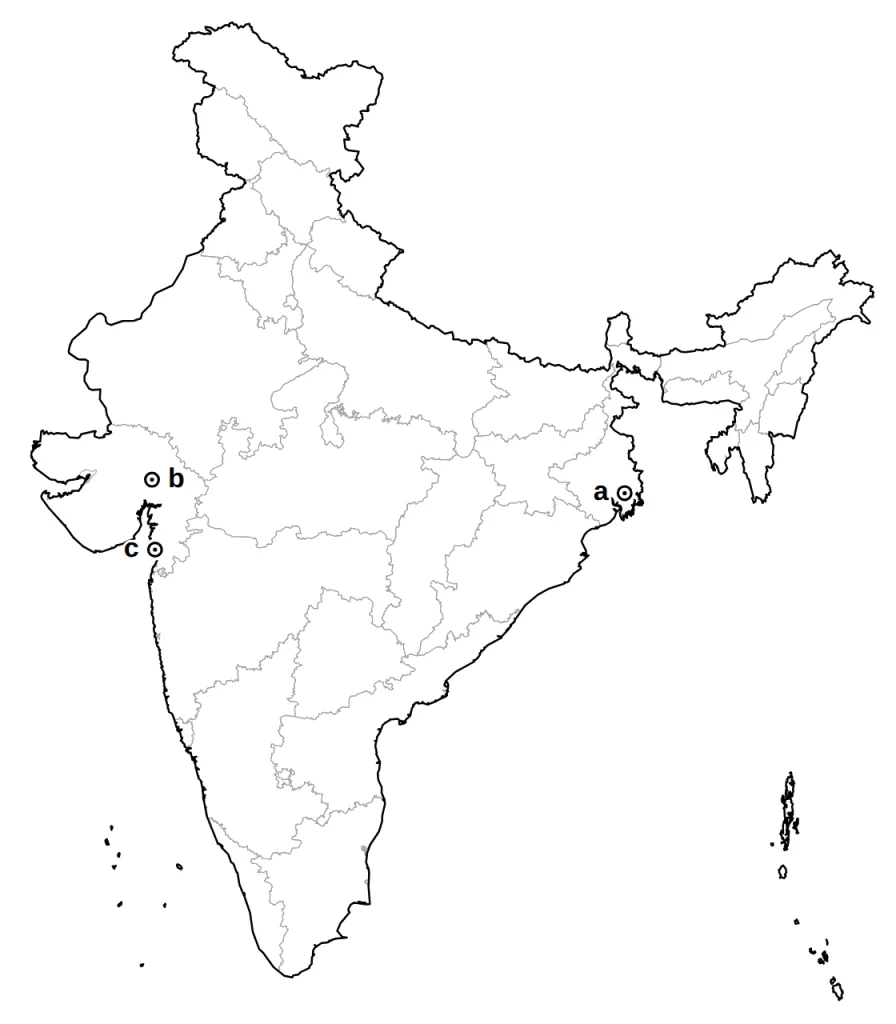
(a) Calcutta (now Kolkata), on the Hooghly river in West Bengal, in the east.
(b) Ahmedabad, inland in Gujarat, on the Sabarmati river.
(c) Dandi, on the Gujarat coast south of Surat.
The answer map shows the three places as a, b and c.
Marking scheme:
- (a) Calcutta (now Kolkata), West Bengal, correctly located and labelled — 1 mark
- (b) Ahmedabad, Gujarat, correctly located and labelled — 1 mark
- (c) Dandi, Gujarat, correctly located and labelled — 1 mark
Question 4 (2 marks)
After some months, the Non-Cooperation Movement slowed down in the cities. Give two reasons.
Answer.
Model answer:
- Khadi cost more than mass-produced mill cloth, so poor people could not afford it.
- Indian schools, colleges and courts to replace British ones were slow to come up, so students, teachers and lawyers began to return.
Marking scheme:
- Khadi cloth was often more expensive than mass-produced mill cloth, and poor people could not afford it. — 1 mark
- British institutions could be boycotted only if Indian ones took their place; these came up slowly, so students and teachers drifted back to government schools and lawyers returned to the courts. — 1 mark
Question 5 (3 marks)
How did people in north India react to the massacre at Jallianwala Bagh, and how did the government respond? Explain with three points.
Answer.
Model answer:
- Crowds came out in many north Indian towns, with strikes, clashes with the police and attacks on government buildings.
- The government humiliated people: satyagrahis were made to rub their noses on the ground, crawl on the streets and salute every sahib.
- People were flogged and villages near Gujranwala were bombed. As violence spread, Gandhiji called off the movement.
Marking scheme:
- As the news spread, crowds took to the streets in many north Indian towns: there were strikes, clashes with the police and attacks on government buildings. — 1 mark
- The government replied with brutal repression meant to humiliate and terrorise: satyagrahis were made to rub their noses on the ground, crawl on the streets and salute all sahibs. — 1 mark
- People were flogged and villages around Gujranwala in Punjab were bombed; as violence spread, Gandhiji called off the movement. — 1 mark
Question 6 (3 marks)
Why was the Simon Commission greeted with the slogan 'Go back Simon' in 1928? What two steps followed in 1929?
Answer.
Model answer:
- The Commission had come to review India's constitutional system but had no Indian member, so all parties, including the Congress and the Muslim League, protested.
- In October 1929, Lord Irwin offered 'dominion status' at some unstated future date and a Round Table Conference.
- In December 1929, the Lahore session under Nehru declared Purna Swaraj the goal.
Marking scheme:
- The Commission, set up by the Tory government in Britain under Sir John Simon to look into the working of the constitutional system in India, did not have a single Indian member; so all parties, including the Congress and the Muslim League, protested. — 1 mark
- In October 1929, Viceroy Lord Irwin announced a vague offer of 'dominion status' for India at an unspecified future date, and a Round Table Conference. — 1 mark
- This did not satisfy the radicals; in December 1929, the Lahore session under Jawaharlal Nehru formalised the demand for Purna Swaraj, and 26 January 1930 was to be celebrated as Independence Day. — 1 mark
Question 7 (3 marks)
Imagine an Indian mill-owner who gave money to the Congress in 1930 and refused to deal in imported goods, but who had grown cautious by 1932. Explain what he hoped swaraj would bring, how he helped, and why his enthusiasm cooled.
Answer.
Model answer:
- He wanted protection from foreign imports and an exchange rate that kept imports down; swaraj meant business free of colonial curbs.
- He gave funds and refused to trade in imported goods, like FICCI leaders Thakurdas and Birla.
- After the Round Table Conference failed, he feared militant activity, long business losses and socialism among young Congressmen.
Marking scheme:
- Hope: businessmen, who had made large profits during the First World War, wanted protection against foreign imports and a rupee-sterling exchange rate that would discourage imports; swaraj meant an end to colonial curbs on trade and industry. — 1 mark
- Help: through bodies such as the Federation of the Indian Chamber of Commerce and Industries (1927), led by men like Purshottamdas Thakurdas and G.D. Birla, they gave money to the movement and refused to buy or sell imported goods. — 1 mark
- Cooling: after the Round Table Conference failed, they feared militant activity, a long disruption of business, and the growing influence of socialism among younger Congress members. — 1 mark
Question 8 (3 marks)
Why did the relationship between the poorer peasants and the Congress remain uncertain during the Civil Disobedience Movement? Explain three points.
Answer.
Model answer:
- Poorer peasants rented their land from landlords. With falling cash incomes, they could not pay the rent and wanted it remitted.
- Many of them joined radical movements, often led by Socialists and Communists.
- The Congress feared upsetting rich peasants and landlords, so it would not back 'no rent' campaigns in most places.
Marking scheme:
- Poorer peasants were small tenants on land rented from landlords; as their cash incomes shrank, they could not pay their rent and wanted it remitted. — 1 mark
- Many of them joined radical movements, often led by Socialists and Communists. — 1 mark
- The Congress did not want to upset rich peasants and landlords, so in most places it refused to support 'no rent' campaigns. — 1 mark
Question 9 (2 marks)
What is the difference between a boycott and picketing? Give one example of each from the Non-Cooperation Movement.
Answer.
Model answer:
- A boycott is refusing to buy, use or deal with something as a protest. People stopped buying foreign cloth and burnt it in bonfires.
- Picketing is blocking the entrance to a shop or office. Volunteers picketed liquor shops.
Marking scheme:
- Boycott: refusing to deal with people, take part in activities, or buy and use things, as a form of protest; for example, foreign cloth was not bought and was burnt in bonfires (or students left government schools). — 1 mark
- Picketing: protesters block the entrance to a shop, factory or office; for example, volunteers picketed liquor shops and shops selling foreign cloth. — 1 mark
Long Answer and Case-Based Questions
Question 10 (5 marks)
In Hind Swaraj (1909), Gandhiji wrote: 'The English have not taken India; we have given it to them.' Explain how this idea and the Khilafat issue shaped the Non-Cooperation Movement, and describe the stages the movement planned.
Answer.
Model answer:
- Turkey lost the First World War, and a harsh treaty was feared for the Khalifa. A Khilafat Committee was formed in Bombay in March 1919.
- Gandhiji saw a chance to unite Hindus and Muslims. In the summer of 1920 he and Shaukat Ali toured widely to win support.
- His idea was that British rule lasted only because Indians cooperated; if they stopped, it would collapse within a year.
- First, people would give up government titles and boycott the civil services, army, police, courts, councils and schools.
- Foreign goods would be boycotted, and if the government used repression, a full civil disobedience campaign would follow.
Marking scheme:
- The First World War ended with the defeat of Ottoman Turkey; rumours spread of a harsh peace treaty on the Ottoman emperor, the Khalifa, and a Khilafat Committee was formed in Bombay in March 1919. — 1 mark
- Gandhiji saw a chance to bring Hindus and Muslims together in one mass movement; through the summer of 1920 he and Shaukat Ali toured widely to build support. — 1 mark
- Hind Swaraj argued that British rule was set up and survived only with Indian cooperation; if Indians refused to cooperate, it would collapse within a year and swaraj would come. — 1 mark
- First stages: surrender of titles given by the government; boycott of civil services, army, police, courts, legislative councils and schools. — 1 mark
- Boycott of foreign goods; and if the government turned to repression, a full civil disobedience campaign. — 1 mark
OR
Gandhiji called off a nationwide movement in February 1922 and again in March 1931. Compare the reasons for the two decisions and what followed each.
Answer.
Model answer:
- In 1922, Gandhiji stopped the movement because it was turning violent, as at Chauri Chaura in Gorakhpur.
- He felt satyagrahis needed training before a mass struggle.
- Afterwards, some leaders formed the Swaraj Party to enter the councils, while Nehru and Bose wanted a radical struggle for full independence.
- In 1931, after harsh repression and about 1,00,000 arrests, he signed the Gandhi-Irwin Pact: he would attend the Round Table Conference and prisoners would be freed.
- The conference failed, repression returned and the Congress was declared illegal. The relaunched movement lost momentum by 1934.
Marking scheme:
- 1922, reason: the Non-Cooperation Movement was turning violent in many places; at Chauri Chaura in Gorakhpur a peaceful demonstration became a violent clash with the police. — 1 mark
- Gandhiji felt that satyagrahis needed proper training before they were ready for mass struggle. — 1 mark
- 1922, what followed: some leaders, tired of mass struggle, formed the Swaraj Party to enter the councils, while younger leaders such as Nehru and Bose pressed for radical agitation and full independence. — 1 mark
- 1931, reason: after brutal repression, with peaceful satyagrahis beaten and about 1,00,000 people arrested, Gandhiji signed the Gandhi-Irwin Pact on 5 March 1931; he agreed to attend the Round Table Conference, and the government agreed to release political prisoners. — 1 mark
- 1931, what followed: the conference in London failed, the government began fresh repression and declared the Congress illegal; the movement was relaunched but lost momentum by 1934. — 1 mark
Question 11 (5 marks)
Explain four ways in which Indian nationalists, from the late nineteenth century onwards, used images, folklore, symbols and history to make people feel that they belonged to one nation. State one problem that this created.
Answer.
Model answer:
- Bankim Chandra Chattopadhyay's hymn 'Vande Mataram', later part of Anandamath, was sung in the Swadeshi movement. Abanindranath Tagore painted Bharat Mata as calm and spiritual.
- Tagore collected ballads, nursery rhymes and myths, and Natesa Sastri published a four-volume collection of Tamil folk tales.
- The Swadeshi flag had eight lotuses and a crescent moon; Gandhiji's Swaraj flag, with a spinning wheel, was carried in marches as a sign of defiance.
- Nationalists wrote about India's great past in science, art and philosophy, and its decline under colonial rule.
- Problem: this past and its images were mostly Hindu, so other communities felt left out.
Marking scheme:
- Image of Bharat Mata: Bankim Chandra Chattopadhyay wrote 'Vande Mataram' in the 1870s, later included in his novel Anandamath and widely sung in the Swadeshi movement; Abanindranath Tagore painted Bharat Mata as calm, composed, divine and spiritual. — 1 mark
- Folklore: nationalists recorded folk tales, songs and legends; Rabindranath Tagore collected ballads, nursery rhymes and myths and led the folk revival; Natesa Sastri published The Folklore of Southern India, a four-volume collection of Tamil folk tales. — 1 mark
- Icons and symbols: the Swadeshi flag of Bengal (red, green and yellow, with eight lotuses and a crescent moon) and, by 1921, Gandhiji's Swaraj flag (red, green and white, with a spinning wheel), carried in marches as a sign of defiance. — 1 mark
- History: nationalists wrote about India's glorious past in art and architecture, science and mathematics, religion, law and philosophy, crafts and trade, and its decline under colonial rule, so that Indians would take pride in their past. — 1 mark
- Problem: the past that was glorified was mainly Hindu and the images were drawn from Hindu iconography, so people of other communities felt left out. — 1 mark
OR
'The Poona Pact of 1932 settled a sharp disagreement, but it did not remove the doubts of the dalits.' Explain the statement.
Answer.
Model answer:
- Gandhiji called the 'untouchables' harijan, worked for their entry into temples and use of public wells and schools, and asked upper castes to change their hearts.
- Many dalit leaders wanted a political answer instead: reserved seats in education and a separate electorate.
- Dr Ambedkar, who formed the Depressed Classes Association in 1930, demanded separate electorates at the Second Round Table Conference, and the British agreed.
- Gandhiji fasted unto death, fearing this would keep dalits apart from society. Under the Poona Pact (1932), they got reserved seats, but voted for by the general electorate.
- Dalits still doubted the Congress-led national movement.
Marking scheme:
- Gandhiji called the 'untouchables' harijan (children of God); he organised satyagraha for their entry into temples and access to public wells, tanks, roads and schools, cleaned toilets himself, and urged upper castes to change their hearts. — 1 mark
- Many dalit leaders wanted a political solution: reserved seats in educational institutions and a separate electorate that would choose dalit members for the legislative councils. — 1 mark
- Dr B.R. Ambedkar, who formed the Depressed Classes Association in 1930, clashed with Gandhiji at the Second Round Table Conference by demanding separate electorates for dalits, and the British government agreed. — 1 mark
- Gandhiji began a fast unto death, as he felt separate electorates would slow down the integration of dalits into society; Ambedkar accepted his position, and the Poona Pact of September 1932 gave the Depressed Classes reserved seats in the provincial and central legislative councils, to be voted in by the general electorate. — 1 mark
- Even so, the dalit movement remained wary of the Congress-led national movement. — 1 mark
Question 12 (4 marks)
Read the source given below and answer the questions that follow.
When the Barber Stayed Away
In some villages of Awadh in 1920, a landlord might wake up to find that no barber would shave him and no washerman would take his clothes. The village panchayat had decided to cut him off. This nai-dhobi bandh was one of the weapons the peasants used against talukdars and landlords who took very high rents and many other cesses, forced them to work without pay (begar), and could throw a tenant off his land at will.
The man who gave this anger a voice was Baba Ramchandra, a sanyasi who had once been an indentured labourer in Fiji. From June 1920, Jawaharlal Nehru too began visiting these villages and listening to the peasants. By October, the Oudh Kisan Sabha had been set up, and within a month it had more than 300 branches.
The Congress hoped to bring this struggle into the Non-Cooperation Movement. But in 1921 the protests took a turn it had not planned: houses of talukdars and merchants were attacked, bazaars were looted and stores of grain were seized. Local leaders even told peasants that Gandhiji had declared that no taxes were to be paid and that land would be shared out among the poor.
(a) What was a nai-dhobi bandh, and against whom was it used? (1 mark)
Answer.
Model answer:
It was a social boycott in which panchayats stopped barbers and washermen from serving oppressive landlords and talukdars.
Marking scheme:
- A social boycott organised by village panchayats: barbers and washermen refused to serve oppressive landlords and talukdars (0.5 + 0.5). — 1 mark
(b) Why did the Congress find the Awadh movement troubling in 1921? (1 mark)
Answer.
Model answer:
It turned violent, with attacks on talukdars' and merchants' houses, looting of bazaars and seizure of grain stores.
Marking scheme:
- It turned violent: houses of talukdars and merchants were attacked, bazaars looted and grain stores seized. (Also accept: leaders spread rumours in Gandhiji's name about no taxes and land for the poor.) — 1 mark
(c) Explain two ways in which the Awadh peasants' idea of swaraj differed from the Congress's idea of the struggle. (2 marks)
Answer.
Model answer:
- The peasants wanted lower rents, an end to begar and even land for the poor; the Congress wanted to end British rule.
- The peasants attacked talukdars and merchants, but the Congress wanted a non-violent struggle.
Marking scheme:
- For the peasants, swaraj meant relief from their landlords: lower rents and revenue, an end to begar, and even land for the poor; the Congress aimed at ending British rule. — 1 mark
- The peasants were ready to use force against talukdars and merchants, while the Congress wanted a non-violent struggle. — 1 mark
OR
(c) Evaluate the Oudh Kisan Sabha. Give one point that shows its strength and one that shows its limits. (2 marks)
Answer.
Model answer:
- Strength: it spread fast, with over 300 branches in a month, and linked village grievances to the national movement.
- Limit: it could not keep the protests peaceful, and rumours were spread in Gandhiji's name.
Marking scheme:
- Strength: it grew to more than 300 branches within a month and joined the peasants' local grievances to the national movement. — 1 mark
- Limit: it could not keep the movement peaceful; in 1921 there were attacks and looting, and rumours were spread in Gandhiji's name. — 1 mark
Question 13 (4 marks)
Read the source given below and answer the questions that follow.
Gandhi Caps in the Tin Mines
The miners of the Chotanagpur tin mines did not wait to be invited. In 1930, thousands of them turned up at protest rallies wearing Gandhi caps and joined campaigns to boycott foreign goods. Along the railway lines the same year, and at the docks two years later, workers went on strike.
These men were not simply following orders from the Congress. They had their own quarrels with their employers over low wages and hard working conditions, and they borrowed those parts of the Gandhian programme, such as the boycott, that helped them in these fights.
The Congress, for its part, kept their demands out of its programme. The industrialists, who were drawing closer to the Congress in these years, would have been alarmed, and the leaders feared a split in the forces ranged against British rule. The result was a mixed picture. Across most of India, industrial workers stayed away from the movement in large numbers; only in the Nagpur region did they join it on a large scale.
(a) In which region did industrial workers join the movement on a large scale? (1 mark)
Answer.
Model answer:
In the Nagpur region.
Marking scheme:
- The Nagpur region. — 1 mark
(b) According to the source, why did some workers take up the boycott? (1 mark)
Answer.
Model answer:
It helped them in their own fights with employers over low wages and poor working conditions.
Marking scheme:
- It helped them in their own struggles with employers over low wages and poor working conditions. — 1 mark
(c) Evaluate the Congress's decision to keep the workers' demands out of its programme. Give one point in its favour and one against it. (2 marks)
Answer.
Model answer:
- For: the industrialists, who funded the movement and backed the boycott, stayed with it, and the forces against British rule remained united.
- Against: workers felt their low wages and poor conditions were ignored, so most stayed away and the movement lost wide support.
Marking scheme:
- For: it kept the industrialists, who gave money and supported the boycott, on the side of the movement and kept the anti-imperial forces united. — 1 mark
- Against: workers felt their problems of low wages and poor conditions were ignored, so most of them stayed away and the movement lost a large body of support. — 1 mark
OR
(c) The source says the workers 'were not simply following orders from the Congress'. Explain this with two pieces of evidence from the source. (2 marks)
Answer.
Model answer:
- They had their own fights with employers over wages and conditions, and took up only what helped them, like the boycott.
- They acted on their own: tin miners joined rallies uninvited, and railway and dock workers struck work.
Marking scheme:
- They had their own disputes with employers over low wages and hard working conditions, and borrowed only the parts of the programme, like the boycott, that helped them. — 1 mark
- They acted on their own: the tin miners came to rallies without waiting to be invited, and railway workers (1930) and dockworkers (1932) went on strike, while the Congress kept their demands out of its programme. — 1 mark