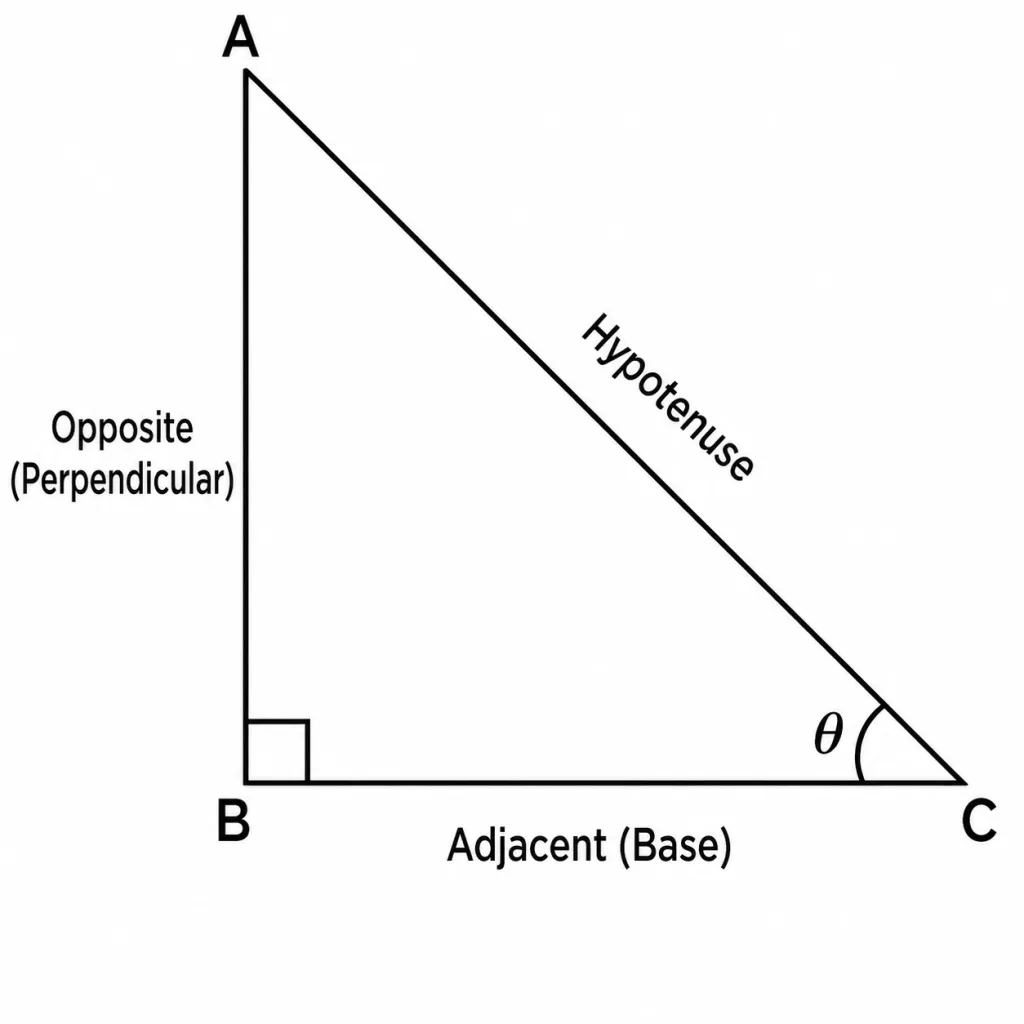
The word trigonometry comes from Greek: tri (three), gon (sides), metron (measure) — literally 'measuring three-sided figures'. At Class 10 level, it studies the relationship between the angles and sides of a right-angled triangle.
Think of it this way: if you know one acute angle and one side of a right triangle, trigonometry lets you find every other side.
Key Point: All the trigonometric ratios in this chapter are defined for an acute angle inside a right-angled triangle.
[Board Important] The hypotenuse is always the side opposite the right angle — it never changes. But 'opposite' and 'adjacent' depend on which acute angle you are looking at.
The Three Sides Relative to an Angle
For an acute angle θ in a right triangle, the three sides are named relative toθ:
Hypotenuse — the side opposite the right angle (the longest side).
Opposite (Perpendicular) — the side directly across from θ.
Adjacent (Base) — the remaining side, next to θ (not the hypotenuse).
Key Point: If you switch attention to the other acute angle, the 'opposite' and 'adjacent' sides swap. The hypotenuse stays the same.
[Board Important] Always identify the sides freshly for the angle in the question. A common error is using the opposite side of the wrong angle.
A classic mnemonic: 'Pandit Badri Prasad Har Har Bole' → P/H, B/H, P/B for sin, cos, tan (Perpendicular, Base, Hypotenuse). In English, SOH-CAH-TOA (Sin = Opp/Hyp, Cos = Adj/Hyp, Tan = Opp/Adj).
Key Point: sin, cos, tan are the three basic ratios; cosec, sec, cot are their reciprocals.
[JEE/NEET Tip] Memorise SOH-CAH-TOA cold — it is the single most-used fact in all of trigonometry.
Reciprocal and Quotient Relationships
The last three ratios are simply reciprocals of the first three:
cscθ=sinθ1,secθ=cosθ1,cotθ=tanθ1
Also, two quotient relations connect them:
tanθ=cosθsinθ,cotθ=sinθcosθ
Key Point: Pair each ratio with its reciprocal: sin↔cosec, cos↔sec, tan↔cot. And tanθ=sinθ/cosθ.
[Board Important] These relations let you find all six ratios once you know any one of them (plus the triangle), using the Pythagoras theorem to get the third side.
Solved Examples
Example 1: Basic ratios
In a right triangle, the side opposite θ is 3 and the hypotenuse is 5. Find sinθ and cosθ.
Solution:
sinθ=HypOpp=53.
Adjacent =52−32=4, so cosθ=54.
Final Answer:sinθ=53, cosθ=54.
Takeaway: Use Pythagoras to get the missing side.
Example 2: All six ratios
If tanθ=34, find all six trigonometric ratios.
Solution:
Opposite =4, Adjacent =3, so Hyp =16+9=5.
sinθ=54, cosθ=53, tanθ=34.
cscθ=45, secθ=35, cotθ=43.
Final Answer: As above.
Takeaway: From one ratio, build the triangle, then read off all six.
Example 3: Reciprocal
If sinθ=257, find cscθ.
Solution:
cscθ=sinθ1=725.
Final Answer:cscθ=725.
Takeaway: cosec is just the reciprocal of sin.
Example 4: Find cos from sin
If sinθ=1312, find cosθ and tanθ.
Solution:
Adjacent =132−122=169−144=5.
cosθ=135, tanθ=512.
Final Answer:cosθ=135, tanθ=512.
Takeaway:(5,12,13) is a Pythagorean triple.
Example 5: Quotient relation
If sinθ=53 and cosθ=54, verify tanθ.
Solution:
tanθ=cosθsinθ=4/53/5=43.
Final Answer:tanθ=43.
Takeaway:tanθ=sinθ/cosθ always holds.
Example 6: cot from a triangle
In a right triangle, adjacent to θ is 8 and opposite is 15. Find cotθ and secθ.
Solution:
cotθ=OppAdj=158.
Hyp =64+225=17, so secθ=817.
Final Answer:cotθ=158, secθ=817.
Takeaway:(8,15,17) is a Pythagorean triple.
Example 7: Value of an expression
If tanθ=43, find sinθ−cosθsinθ+cosθ.
Solution:
With Opp 3, Adj 4: sinθ=53, cosθ=54.
3/5−4/53/5+4/5=−1/57/5=−7.
Final Answer:−7.
Takeaway: Substitute the actual ratio values, then simplify.
Example 8: Both acute angles
In right △ABC (right angle at B), AB=24, BC=7. Find sinA and sinC.
Solution:
AC=242+72=25.
sinA=ACBC=257 (opposite to A is BC).
sinC=ACAB=2524 (opposite to C is AB).
Final Answer:sinA=257, sinC=2524.
Takeaway: 'Opposite' changes with the angle you choose.
Example 9: Show a ratio cannot exceed 1
Can sinθ=45 for an acute angle?
Solution:
sinθ=HypOpp, and the hypotenuse is the longest side, so Opp < Hyp.
Hence sinθ<1 always. 45>1 is impossible.
Final Answer: No — sinθ of an acute angle is always less than 1.
Takeaway: Both sinθ and cosθ lie between 0 and 1 for acute angles.
Example 10: Mixed ratio expression
If cosθ=1715, find 1+tan2θ1−tan2θ.
Solution:
Opp =172−152=8, so tanθ=158.
tan2θ=22564.
1+64/2251−64/225=289/225161/225=289161.
Final Answer:289161.
Takeaway: Build the triangle, get tan, then substitute.
Ready to test your knowledge?
Take a quick interactive quiz on this topic —
free, works without login.