
The Big Idea — Lines and Intersections
Every linear equation in two variables is a straight line when drawn on graph paper. So a pair of equations is two lines. Solving the pair graphically means drawing both lines and finding where they meet.
The point of intersection satisfies both equations, so it is the solution.
Key Point: To draw a line, find at least two points on it (often the x- and y-intercepts), plot them, and join with a ruler. The coordinates of the intersection give the solution.
There are exactly three possibilities for how two lines can relate, and each tells us how many solutions the pair has. Let's look at all three.
[Board Important] When drawing graphs in the exam, make a neat table of at least 2 (preferably 3) points per line, and label both lines clearly.
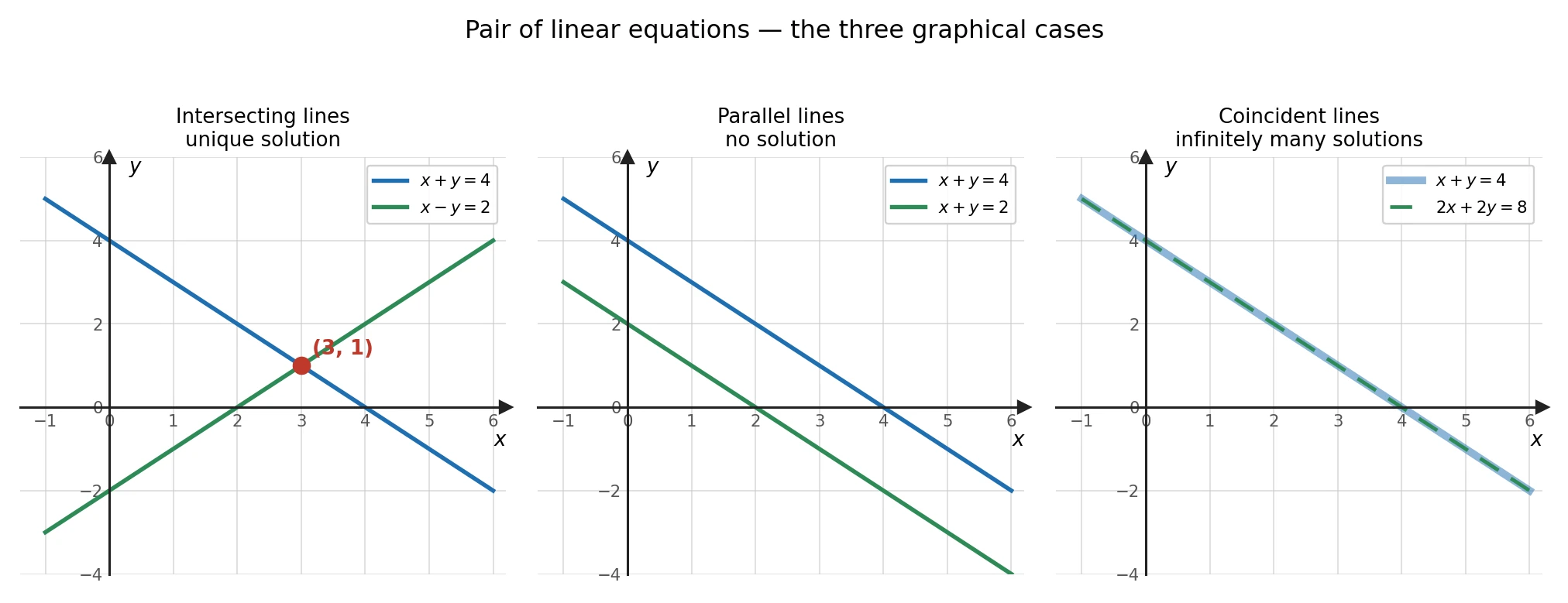
Case 1: Intersecting Lines — Unique Solution
If the two lines cross at exactly one point, the pair has exactly one solution — the coordinates of that crossing point.
Example
and . Plotting both, they cross at . Check: ✓ and ✓. So the unique solution is , .
This is the consistent and independent case.
Key Point: Intersecting lines ⇒ a unique solution ⇒ the system is consistent (with exactly one answer).
In terms of the coefficients, this happens when:
[Board Important] The ratio test lets you predict a unique solution without drawing the graph.
Case 2 & 3: Coincident and Parallel Lines
Case 2: Coincident lines — infinitely many solutions
If the two equations represent the same line (one lies exactly on top of the other), every point on the line is common, so there are infinitely many solutions. This is the consistent and dependent case. It happens when:
Case 3: Parallel lines — no solution
If the two lines are parallel (same slope, never meet), there is no common point, so there is no solution. This is the inconsistent case. It happens when:
Key Point: Compare the three ratios , , to instantly tell the type of solution.
[Board Important] Memorise the three ratio conditions — they are asked directly and also save graph-drawing time.
Summary Table of the Three Cases
Here's everything in one place. For the pair and :
| Ratio comparison | Lines | Solutions | Consistency |
|---|---|---|---|
| Intersecting | Unique | Consistent | |
| Coincident | Infinitely many | Consistent (dependent) | |
| Parallel | None | Inconsistent |
Key Point: Write all equations in the form (move everything to one side) before computing the ratios — otherwise the comparison goes wrong.
[Board Important] This table is the single most useful summary of the chapter. If you remember only one thing, remember this.
Solved Examples
Example 1: Type of solution from ratios
Does and have a unique solution, no solution, or infinitely many?
Solution:
- Write as and .
- Ratios: . All equal.
- So the lines are coincident.
Final Answer: Infinitely many solutions.
Takeaway: All three ratios equal ⇒ infinitely many solutions.
Example 2: Parallel lines
Classify and .
Solution:
- As and .
- , but .
- So .
Final Answer: No solution (parallel, inconsistent).
Takeaway: First two ratios equal but the third different ⇒ no solution.
Example 3: Unique solution
Classify and .
Solution:
- As and .
- vs . Since , the ratios .
Final Answer: Unique solution (intersecting, consistent).
Takeaway: ⇒ unique solution.
Example 4: Solve graphically (find the point)
Solve graphically: and .
Solution:
- For : points .
- For : points .
- The lines intersect at .
Final Answer: , .
Takeaway: Plot two points per line; read off the intersection.
Example 5: Find points for graphing
Find two points to plot the line .
Solution:
- Put : , giving .
- Put : , giving .
Final Answer: and .
Takeaway: The intercepts (set , then ) are the easiest two points.
Example 6: Find for no solution
Find so that and has no solution.
Solution:
- For no solution: .
- .
- Check third ratio: — equal, so it would be infinitely many, not no solution.
- Re-examine: with , all three ratios equal , giving infinitely many solutions. So there is no value of giving 'no solution' here (the constants are proportional).
Final Answer: No value of gives 'no solution'; gives infinitely many.
Takeaway: Always check the third ratio — proportional constants change the conclusion.
Example 7: Find for infinitely many solutions
Find so that and has infinitely many solutions.
Solution:
- Need .
- ✓ (constants match).
- .
Final Answer: .
Takeaway: For infinitely many, all three ratios must be equal.
Example 8: Find for a unique solution
For what value(s) of does and have a unique solution?
Solution:
- Unique solution needs , i.e. .
- .
Final Answer: All .
Takeaway: Unique solution fails only when the first two ratios become equal.
Example 9: Lines through the axes (graphing triangle)
The lines , and form a triangle. Find its vertices.
Solution:
- and meet at the origin .
- meets at and at .
Final Answer: Vertices , , .
Takeaway: Intersect each pair of lines to get the triangle's corners.
Example 10: Read solution from a description
Two lines are drawn and found to be parallel. How many solutions does the corresponding pair have, and is it consistent?
Solution:
- Parallel lines never meet, so there is no common point.
- Hence no solution; the pair is inconsistent.
Final Answer: No solution; inconsistent.
Takeaway: Parallel ⇒ no solution ⇒ inconsistent.