
Zeroes on the Graph — The Big Idea
In the last section a zero of was a number with . Now let's see what that means on a graph.
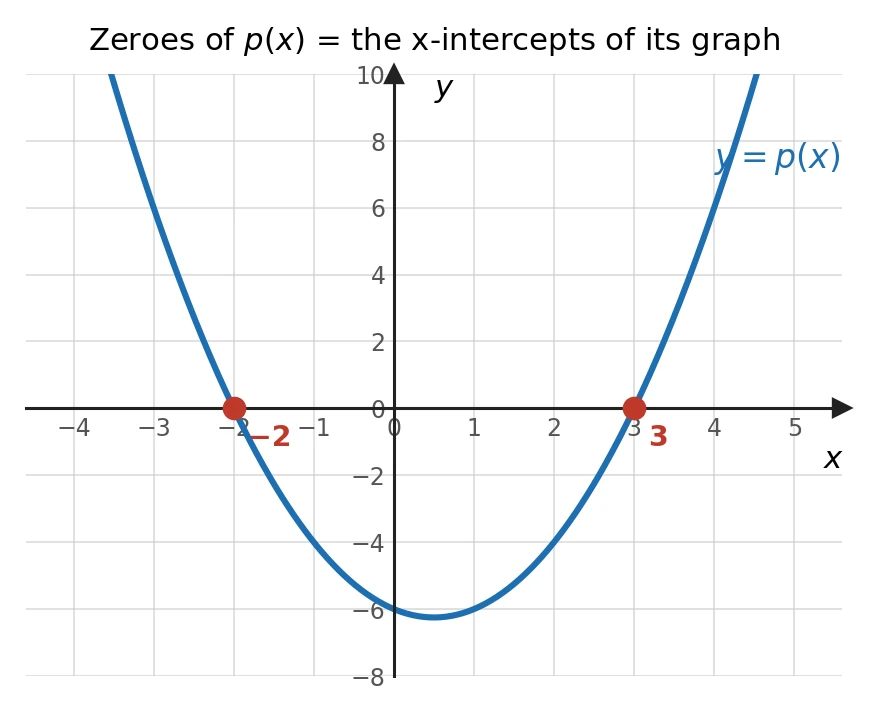
When we plot , we get a curve. The zeroes of are exactly the x-coordinates of the points where the graph cuts (or touches) the x-axis. This is because on the x-axis, , and is precisely the condition for a zero.
Key Point: Geometrically, the zeroes of a polynomial are the x-intercepts of its graph — the points where .
Think of it this way: solving algebraically and finding where the graph crosses the x-axis are two views of the same thing.
[Board Important] A common 1-mark question shows a graph and asks for the number of zeroes. Just count how many times the curve meets the x-axis.
Linear Polynomial — A Straight Line
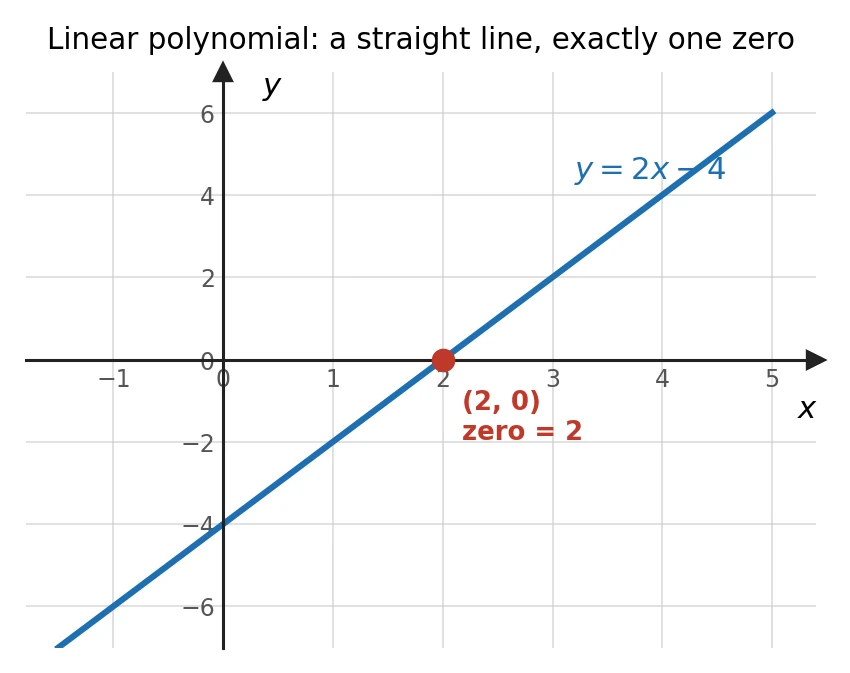
The graph of a linear polynomial is a straight line.
- A straight line (that is not horizontal) crosses the x-axis at exactly one point.
- That point is , so a linear polynomial has exactly one zero.
Example
For , the line meets the x-axis where , i.e. at . So the single zero is 2, matching the one x-intercept.
Key Point: A non-constant linear polynomial always has exactly one real zero — its graph crosses the x-axis once.
[Board Important] A horizontal line like (a non-zero constant) never meets the x-axis, so it has no zero — consistent with a degree-0 polynomial.
Quadratic Polynomial — A Parabola
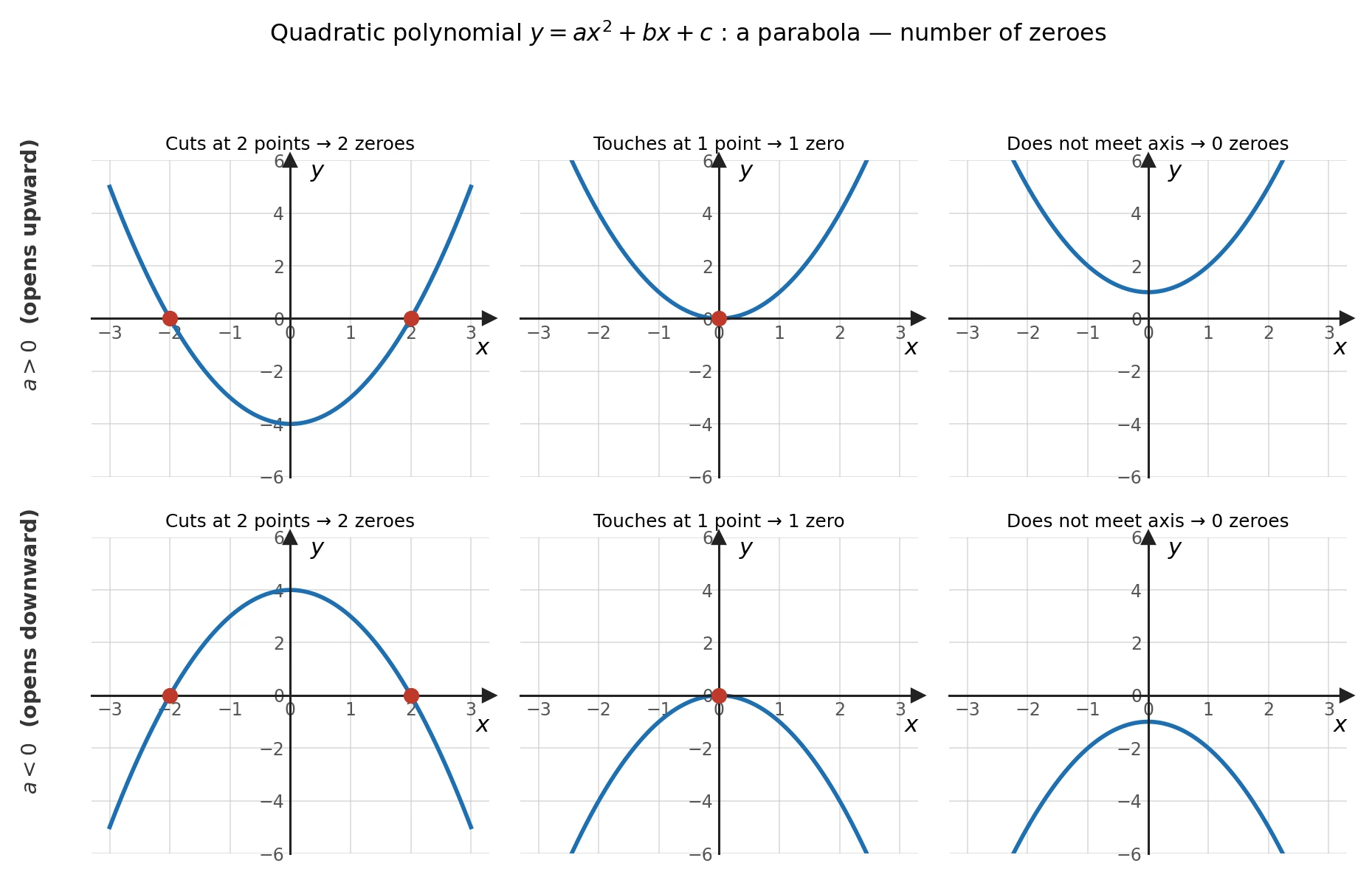
The graph of a quadratic is a U-shaped curve called a parabola.
- If , the parabola opens upwards (∪).
- If , it opens downwards (∩).
The number of zeroes depends on how the parabola meets the x-axis:
| Situation | Zeroes |
|---|---|
| Cuts the x-axis at two distinct points | 2 distinct zeroes |
| Just touches the x-axis at one point | 1 zero (repeated/equal) |
| Does not meet the x-axis | 0 real zeroes |
Key Point: A quadratic has at most 2 real zeroes. 'Touching' the axis means the two zeroes coincide (equal roots).
[Board Important] When a parabola only touches the x-axis, the polynomial has two equal zeroes — examiners count this as one distinct zero but two coincident roots. Read the question's wording carefully.
Cubic Polynomial and the General Rule
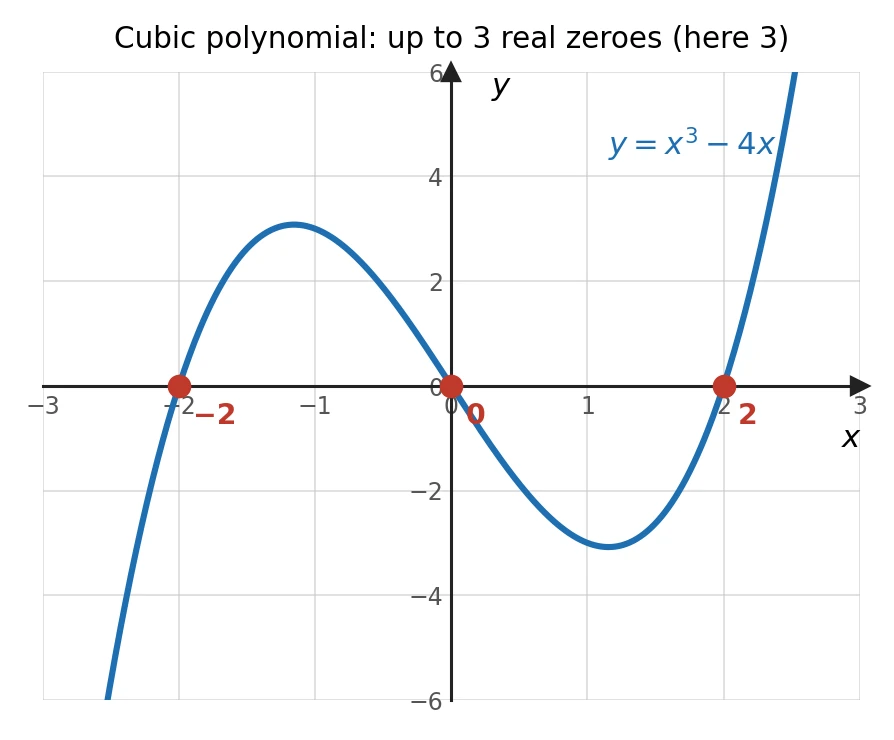
The graph of a cubic is a smooth curve that can bend twice.
- A cubic can meet the x-axis at 3, 2, or 1 point(s), so it has at most 3 real zeroes.
- It always meets the x-axis at least once (so a cubic always has at least one real zero).
The general principle
For any polynomial: the number of real zeroes is at most equal to its degree, because that is the maximum number of times its graph can cross the x-axis.
Key Point: Degree ⇒ at most real zeroes ⇒ graph meets the x-axis at most times.
[Board Important] If a graph is shown crossing the x-axis at 3 points, the minimum possible degree of the polynomial is 3. 'Number of x-intercepts ≤ degree' is the key reasoning.
Solved Examples
Example 1: Zeroes from a graph (count)
A graph cuts the x-axis at exactly 2 points. How many zeroes does the polynomial have?
Solution:
- Each x-intercept corresponds to one zero.
- Two intercepts ⇒ two zeroes.
Final Answer: 2 zeroes.
Takeaway: Number of zeroes = number of times the graph meets the x-axis.
Example 2: Linear graph zero
Where does the graph of cross the x-axis, and what is the zero?
Solution:
- On the x-axis : .
- , so the graph crosses at .
Final Answer: Crosses at ; the zero is 2.
Takeaway: Set to find the x-intercept = the zero.
Example 3: Parabola opening direction
Does the graph of open upwards or downwards?
Solution:
- The coefficient of is .
- Since , the parabola opens downwards.
Final Answer: Downwards (∩).
Takeaway: Sign of decides direction: up, down.
Example 4: Number of zeroes when a parabola touches the axis
A parabola just touches the x-axis at one point. How many zeroes does the quadratic have?
Solution:
- Touching at one point means the two zeroes are equal (coincident).
- So there is one distinct zero (a repeated root).
Final Answer: One (repeated) zero.
Takeaway: Touching the axis = equal/coincident zeroes.
Example 5: No real zeroes
If a parabola lies entirely above the x-axis and never meets it, how many real zeroes does the quadratic have?
Solution:
- Real zeroes correspond to x-intercepts.
- The graph does not meet the x-axis, so there are no x-intercepts.
Final Answer: Zero real zeroes.
Takeaway: No intercepts ⇒ no real zeroes.
Example 6: Minimum degree from a graph
A graph crosses the x-axis at 3 distinct points. What is the minimum possible degree of the polynomial?
Solution:
- Number of real zeroes (x-intercepts) = 3.
- Degree must be at least the number of zeroes.
Final Answer: Minimum degree is 3.
Takeaway: Degree ≥ number of x-intercepts.
Example 7: Reading zeroes from intercepts
A quadratic graph cuts the x-axis at and . What are its zeroes?
Solution:
- Zeroes are the x-coordinates of the intercepts.
- So the zeroes are and .
Final Answer: and .
Takeaway: Read the zeroes directly off the x-axis crossings.
Example 8: Zeroes of graphically
Where does meet the x-axis?
Solution:
- Set : .
- or .
- So the parabola cuts the x-axis at and .
Final Answer: At and (two zeroes).
Takeaway: Solving gives the x-intercepts.
Example 9: Shape of a linear graph
What is the shape of the graph of , and how many times does it cross the x-axis?
Solution:
- A degree-1 (linear) polynomial graphs as a straight line.
- A non-horizontal straight line crosses the x-axis exactly once.
Final Answer: A straight line; it crosses the x-axis once.
Takeaway: Linear ⇒ straight line ⇒ exactly one zero.
Example 10: Maximum zeroes of a cubic
A cubic polynomial's graph is drawn. What is the maximum number of points at which it can meet the x-axis?
Solution:
- A cubic has degree 3.
- The graph can cross the x-axis at most 3 times.
Final Answer: At most 3 points.
Takeaway: Maximum x-intercepts = degree = 3 for a cubic.