
The Quadratic Formula
Applying completing-the-square to the general equation gives one master formula that solves every quadratic:
Here , , are read directly from the standard form. The gives the two roots.
Quick example
For : .
Key Point: Always write the equation in standard form first, then substitute , , carefully (with signs) into the formula.
[Board Important] The formula works even when factorisation fails. It is the most reliable method — but watch your signs, especially for .
The Discriminant
The quantity under the square root is the discriminant, denoted (or ):
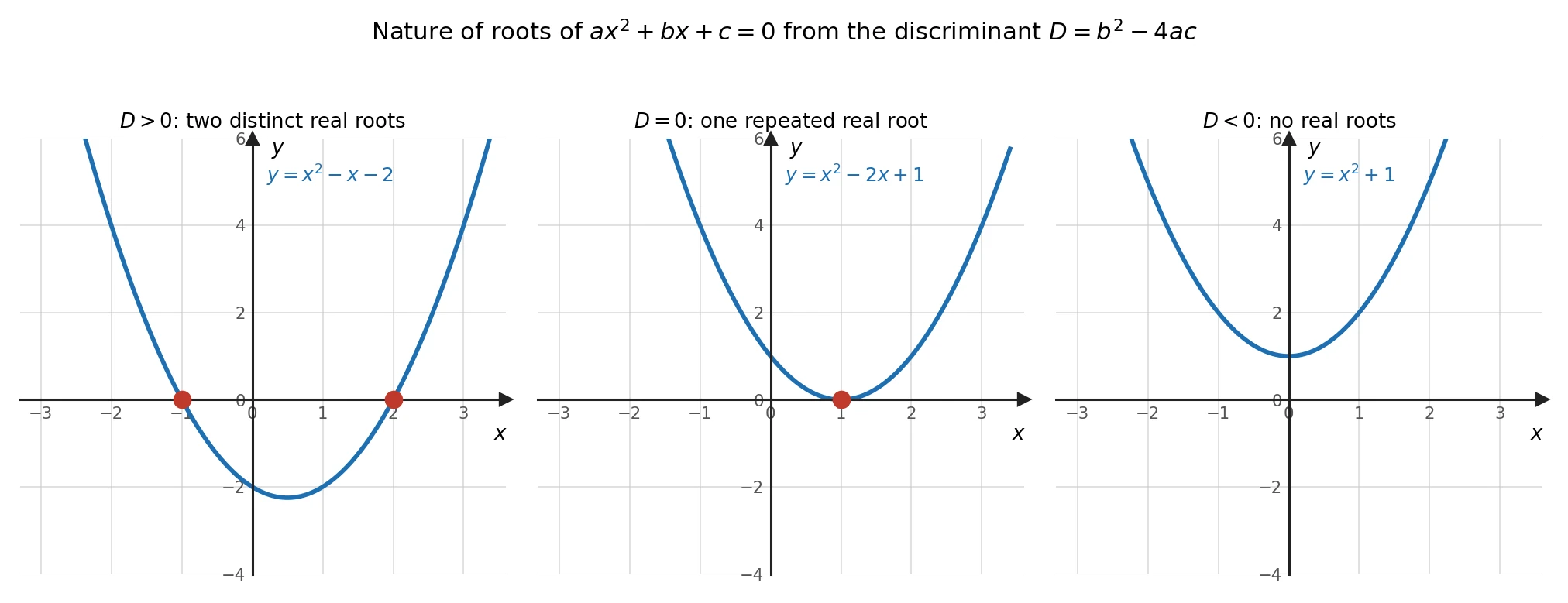
The discriminant alone — without solving — tells you the nature of the roots, because the decides what kind of numbers the roots are.
Key Point: Compute first. Its sign instantly classifies the roots.
The three cases
| Discriminant | Nature of roots |
|---|---|
| Two distinct real roots | |
| Two equal real roots (one repeated) | |
| No real roots |
[Board Important] 'Find the nature of the roots' means: compute and state which of the three cases applies. You do NOT need to find the roots themselves.
Using the Discriminant to Find Conditions
A very common exam type: 'Find the value of for which the equation has equal roots.' This uses .
Worked outline
For to have equal roots: .
- .
Similarly:
- For real roots, require .
- For no real roots, require .
Key Point: Translate the condition on the roots into a condition on , then solve for the unknown.
[Board Important] 'Equal roots' ⇒ ; 'real and distinct' ⇒ ; 'real roots' (allowing equal) ⇒ . Read the wording carefully.
Roots When They Are Equal
When , the two roots coincide and are both equal to:
(This is the formula with the term dropped.)
Example
: , so the roots are equal: .
Key Point: For equal roots, you don't need the full formula — just .
[Board Important] When asked to find the equal root after showing , use directly. It saves time and avoids errors.
Solved Examples
Example 1: Apply the quadratic formula
Solve using the formula.
Solution:
- . .
- .
- or .
Final Answer: .
Takeaway: Compute , then apply the formula.
Example 2: Find the discriminant
Find the discriminant of and state the nature of roots.
Solution:
- .
- .
- .
Final Answer: , so no real roots.
Takeaway: Negative discriminant ⇒ no real roots.
Example 3: Roots with surds
Solve using the formula.
Solution:
- . .
- .
Final Answer: .
Takeaway: Simplify and reduce the fraction.
Example 4: Equal roots — find
Find so that has equal roots.
Solution:
- Equal roots ⇒ : .
- .
Final Answer: or .
Takeaway: Equal roots ⇒ set and solve.
Example 5: Distinct real roots condition
For what values of does have two distinct real roots?
Solution:
- Distinct real roots ⇒ : .
- or .
Final Answer: or .
Takeaway: gives an inequality in the unknown.
Example 6: Equal root value
Show that has equal roots and find the root.
Solution:
- . So roots are equal.
- Equal root: .
Final Answer: Equal roots, .
Takeaway: ⇒ use for the repeated root.
Example 7: Formula with
Solve using the formula.
Solution:
- . .
- .
- or .
Final Answer: .
Takeaway: A perfect-square discriminant gives rational roots.
Example 8: No real roots — find range
For what values of does have no real roots?
Solution:
- No real roots ⇒ : .
- .
Final Answer: .
Takeaway: gives the no-real-roots range.
Example 9: Discriminant decides a real-life feasibility
Can a rectangle have perimeter 20 m and area 30 m²? (Set up and use the discriminant.)
Solution:
- Let length and breadth have sum (half-perimeter) and product 30. So they are roots of .
- .
- No real roots, so such a rectangle is impossible.
Final Answer: No — the discriminant is negative, so no such rectangle exists.
Takeaway: A negative discriminant shows a situation has no real solution.
Example 10: Solve and simplify
Solve using the formula.
Solution:
- . .
- .
Final Answer: .
Takeaway: When is not a perfect square, leave the roots in surd form.