
Building Numbers from Primes
Let's break this down with a simple idea. Just as every word is built from letters, every composite number is built from prime numbers. A prime number has exactly two factors — 1 and itself (e.g. 2, 3, 5, 7, 11). A composite number has more than two factors (e.g. 6, 12, 100).
Take 12. We can write . Take 100. We can write . No matter how you start factorising, you always land on the same set of primes.
Fundamental Theorem of Arithmetic: Every composite number can be expressed (factorised) as a product of primes, and this factorisation is unique, apart from the order in which the prime factors occur.
This is why we call it 'fundamental' — primes are the building blocks of all numbers.
[Board Important] 'Unique apart from order' means count as the same factorisation. The collection of primes (two 2's and one 3) never changes.
Prime Factorisation in Practice
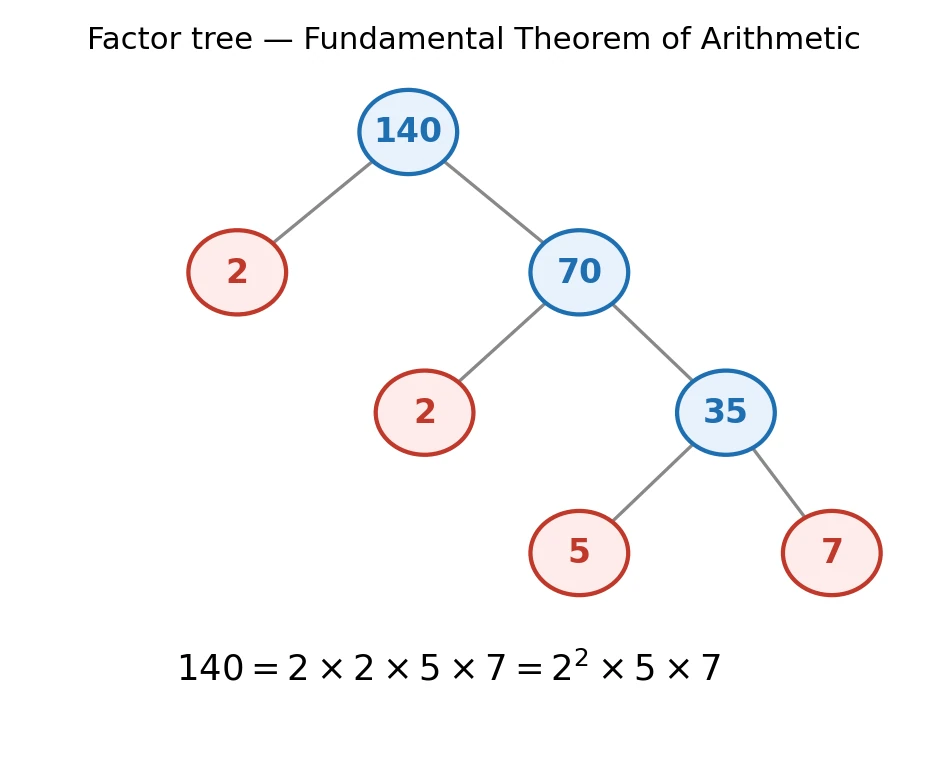
The usual way to find the prime factorisation of a number is the factor tree or repeated division by the smallest possible prime.
Example: Factorise 3825
- 17 is prime.
Collecting everything: .
Writing the factorisation with exponents (powers) is the neat, standard form used in exams:
where are distinct primes.
Key Point: Always start dividing by the smallest prime (2), then 3, then 5, and so on. Keep going until you reach 1.
[Board Important] Write the final answer in exponential form, e.g. — it is the expected presentation and is easier to use for HCF/LCM.
Finding HCF and LCM by Prime Factorisation
Once you have prime factorisations, finding the HCF and LCM is quick.
HCF (Highest Common Factor)
Take each common prime factor, raised to its smallest (lowest) power appearing in the numbers, and multiply.
LCM (Lowest Common Multiple)
Take every prime factor that appears (common or not), raised to its greatest (highest) power, and multiply.
Example: HCF and LCM of 96 and 404
- Common prime: 2, smallest power . So .
- All primes at highest powers: . So .
Memory Aid: HCF → lowest powers of common primes. LCM → highest powers of all primes. (HCF is smaller, so it takes the smaller powers.)
[Board Important] A neat self-check: . ✓
The HCF–LCM Relationship
For any two positive integers and , there is a beautiful relationship:
In words: the product of the HCF and LCM of two numbers equals the product of the numbers themselves.
This is extremely handy. If you know any three of the four quantities (HCF, LCM, , ), you can find the fourth instantly.
Common Mistake: This relationship holds only for two numbers. For three or more numbers, product of the numbers. Be careful!
Quick application
If two numbers have HCF 9 and LCM 360, and one number is 45, the other is:
[Board Important] This formula appears almost every year as a 1- or 2-mark question. Memorise it and the 'two numbers only' restriction.
Why Can Never End in Zero
The uniqueness of prime factorisation lets us answer 'can this number end in a certain digit?' questions without any calculation.
For a number to end in 0, it must be divisible by 10, i.e. it must have both 2 and 5 in its prime factorisation.
Example reasoning
Consider where is a natural number. Then . Its only prime factor is 2 — there is no 5. By the uniqueness of factorisation, no 5 can ever appear. Hence can never end in the digit 0.
Key Point: A number ends in 0 only if its prime factorisation contains at least one 2 and at least one 5. If either is missing, it cannot end in 0.
[Board Important] This is a classic exam question (e.g. 'Check whether can end in 0'). — it has 2 but no 5, so it can never end in 0 either.
Solved Examples
Example 1: Prime factorisation
Express 156 as a product of its prime factors.
Solution:
- .
- .
- , and 13 is prime.
- So .
Final Answer: .
Takeaway: Divide by the smallest prime each time, and stop at 1.
Example 2: HCF and LCM by prime factorisation
Find the HCF and LCM of 6 and 20 by the prime factorisation method.
Solution:
- and .
- HCF = product of smallest powers of common primes = .
- LCM = product of greatest powers of all primes = .
Final Answer: HCF , LCM .
Takeaway: Check: . ✓
Example 3: HCF and LCM of three numbers
Find the HCF and LCM of 6, 72 and 120 using prime factorisation.
Solution:
- ; ; .
- HCF: common primes are 2 and 3, smallest powers and . HCF .
- LCM: all primes at highest powers .
Final Answer: HCF , LCM .
Takeaway: For three numbers, a prime must appear in all of them to count towards the HCF.
Example 4: Using the HCF × LCM relation
The HCF of two numbers is 23 and their LCM is 1449. If one of the numbers is 161, find the other.
Solution:
- Use .
- .
- .
Final Answer: The other number is .
Takeaway: With three of the four quantities known, the fourth follows from the product relation (valid for two numbers).
Example 5: Can end in zero?
Check whether can end with the digit 0 for any natural number .
Solution:
- For a number to end in 0, it must be divisible by 10, i.e. contain both 2 and 5 as factors.
- , whose only prime factor is 2.
- By uniqueness of prime factorisation, 5 can never appear.
- So is never divisible by 5, hence never ends in 0.
Final Answer: No, can never end in 0.
Takeaway: 'Ends in 0' ⇔ divisible by 10 ⇔ has both a 2 and a 5 in its factorisation.
Example 6: LCM for circular motion / bells problem
Three bells ring at intervals of 9, 12 and 15 minutes. If they ring together at 8:00 a.m., at what time will they next ring together?
Solution:
- They ring together again after LCM(9, 12, 15) minutes.
- ; ; .
- LCM minutes hours.
- a.m. hours a.m.
Final Answer: They will next ring together at a.m.
Takeaway: 'Happen together again' problems use the LCM.
Example 7: HCF as the largest equal-share size
Two tankers contain 850 litres and 680 litres of petrol. Find the maximum capacity of a container that can measure the petrol of each tanker an exact number of times.
Solution:
- Required capacity .
- ; .
- Common primes at smallest powers: .
Final Answer: The maximum capacity is litres.
Takeaway: 'Largest container measuring both exactly' = HCF.
Example 8: Showing a number is composite
Explain why is a composite number.
Solution:
- Factor out the common 13: .
- Since the expression equals , it has factors other than 1 and itself.
- Hence it is composite (in fact ).
Final Answer: It is composite because it can be written as .
Takeaway: If you can factor an expression as a product of two integers each greater than 1, it is composite.
Example 9: Smallest number divisible by 1 to 10
Find the smallest number that is exactly divisible by every number from 1 to 10.
Solution:
- The required number is LCM(1, 2, 3, …, 10).
- Highest powers of primes up to 10: (from 8), (from 9), (from 5 or 10), (from 7).
- LCM .
Final Answer: .
Takeaway: For 'divisible by all of these', take the LCM using the highest power of each prime in range.
Example 10: Smallest number leaving the same remainder
Find the smallest number which, when divided by 35, 56 and 91, leaves a remainder of 7 in each case.
Solution:
- A number leaving remainder 7 in each case is .
- ; ; .
- LCM .
- Required number .
Final Answer: .
Takeaway: 'Same remainder on division by several numbers' = LCM of those numbers, plus .