
Introduction to 3D Coordinate System
Just as we use the ordered pair (x,y) to locate a point on a 2D plane, we use an ordered triplet (x, y, z) to locate a point in 3D space. This system is built upon three mutually perpendicular axes: the x-axis, y-axis, and z-axis, which intersect at the origin (0,0,0).
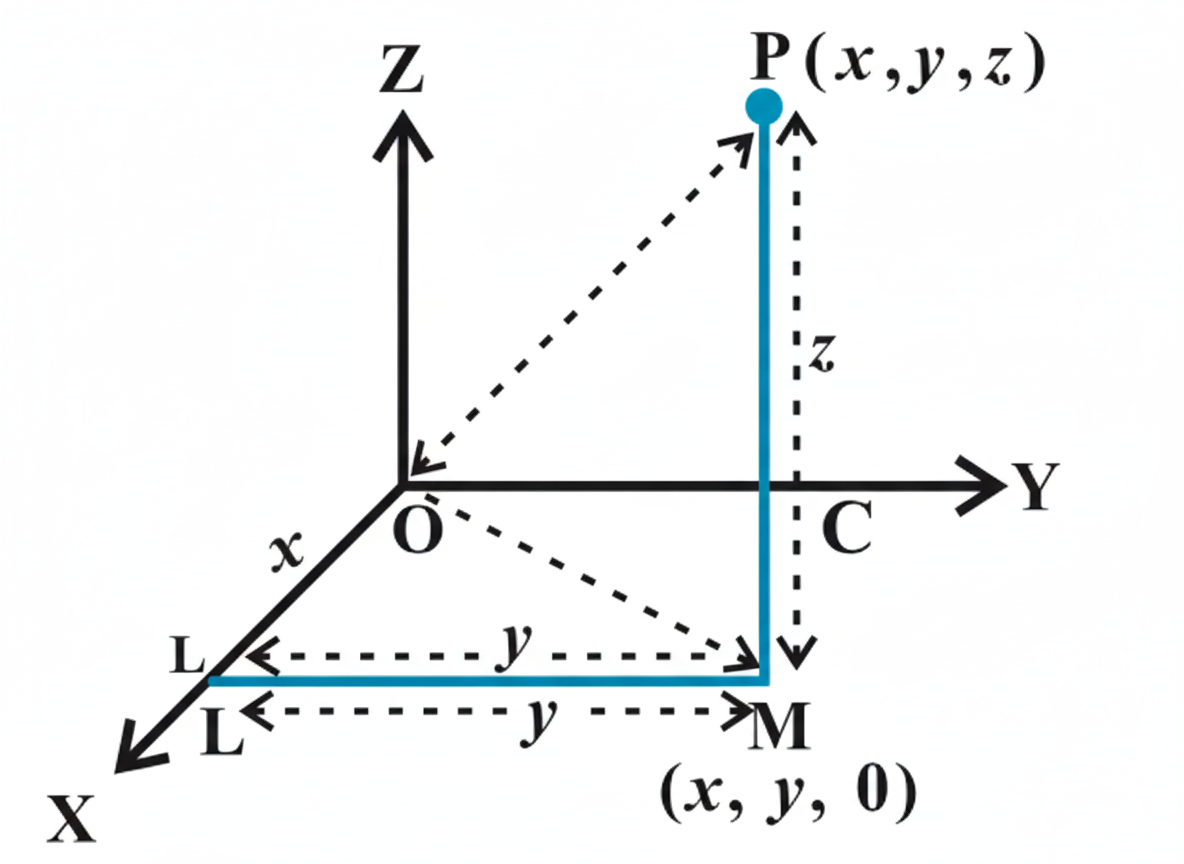
Coordinate Planes: The axes define three coordinate planes that act as reference surfaces:
The xy-plane (where z=0)
The yz-plane (where x=0)
The xz-plane (where y=0)
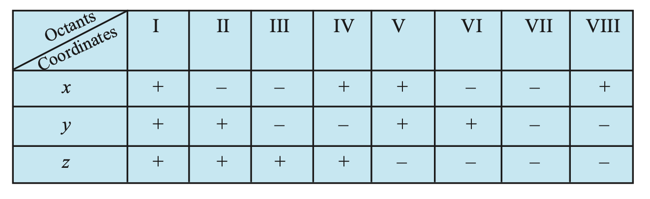
Octants: These three planes divide the space into eight regions called octants. The sign of the coordinates (x,y,z) determines the octant in which a point lies.
Coordinates of a Point in Space
A point P in space is represented by P(x, y, z). Here, x, y, and z are the perpendicular distances of P from the yz-plane, xz-plane, and xy-plane, respectively.
Distance Formula in 3D
The distance between two points and is a direct extension of the 2D formula, derived using the Pythagorean theorem twice.
The distance of a point P(x, y, z) from the origin is:
Example 1: Basic Distance Formula
Question: Find the distance between the points P(1, -3, 4) and Q(-4, 1, 2).
Solution:
Using the distance formula :
Example 2: Identifying the Octant
Question: In which octant does the point (-3, 1, -2) lie?
Solution:
We look at the signs of the coordinates (x, y, z), which are (-, +, -).
x is negative
y is positive
z is negative
Referring to the octant sign convention table, a (-, +, -) configuration corresponds to the VI octant.
Example 3: Collinearity of Points
Question: Show that the points P(-2, 3, 5), Q(1, 2, 3) and R(7, 0, -1) are collinear.
Solution:
Three points are collinear if the sum of the distances between two pairs of points equals the distance between the third pair. We calculate all three distances:
.
.
.
Now, we check the condition: , which is equal to PR. Since , the points are collinear. ✅
Example 4: Identifying an Isosceles Triangle
Question: Show that the points A(0,7,10), B(-1,6,6) and C(-4,9,6) form an isosceles triangle.
Solution:
We find the lengths of the three sides:
.
.
.
Since two sides have equal length (), the triangle is isosceles.
Example 5: Identifying a Right-Angled Triangle
Question: Show that the points from the previous example, A(0,7,10), B(-1,6,6) and C(-4,9,6), also form a right-angled triangle.
Solution:
We check if the side lengths satisfy the converse of the Pythagorean theorem, . From the previous example, we have the side lengths squared:
We check the sum of the squares of the two shorter sides: .
This sum is equal to the square of the longest side, . Since , the triangle is right-angled, with the right angle at vertex B.
Example 6: Locus of Equidistant Points
Question: Find the equation of the set of points P which are equidistant from the points A(1,2,3) and B(3,2,-1).
Solution:
Let the point P be . The condition is , which is equivalent to . This avoids square roots.
Notice that the term is on both sides and cancels out:
Expand the terms:
Cancel and from both sides:
Bring all terms to one side:
This is the equation of a plane that perpendicularly bisects the segment AB.
Example 7: Finding a Point on an Axis
Question: Find the coordinates of the point on the y-axis which is at a distance of from the point P(3, -2, 5).
Solution:
Step 1: Define the point on the y-axis. Any point on the y-axis has its x and z coordinates equal to zero. So, let the point be A(0, y, 0).
Step 2: Use the distance formula. We are given the distance , so .
Step 3: Solve for y.
.
This gives two possible values for y:
The points are (0, 2, 0) and (0, -6, 0).
Example 8: Identifying a Parallelogram
Question: Show that the points A(-1,2,1), B(1,-2,5), C(4,-7,8) and D(2,-3,4) are the vertices of a parallelogram.
Solution:
A key property of a parallelogram is that its diagonals bisect each other. This means they share the same midpoint.
Step 1: Find the midpoint of the diagonal AC.
Midpoint AC = .
Step 2: Find the midpoint of the diagonal BD.
Midpoint BD = .
Since the midpoints of both diagonals are identical, the diagonals bisect each other, and therefore the vertices form a parallelogram.