
Chapter 1 at a Glance
Relations
A relation in is a subset of . The extremes: empty relation and universal relation (the trivial relations). The three structural properties:
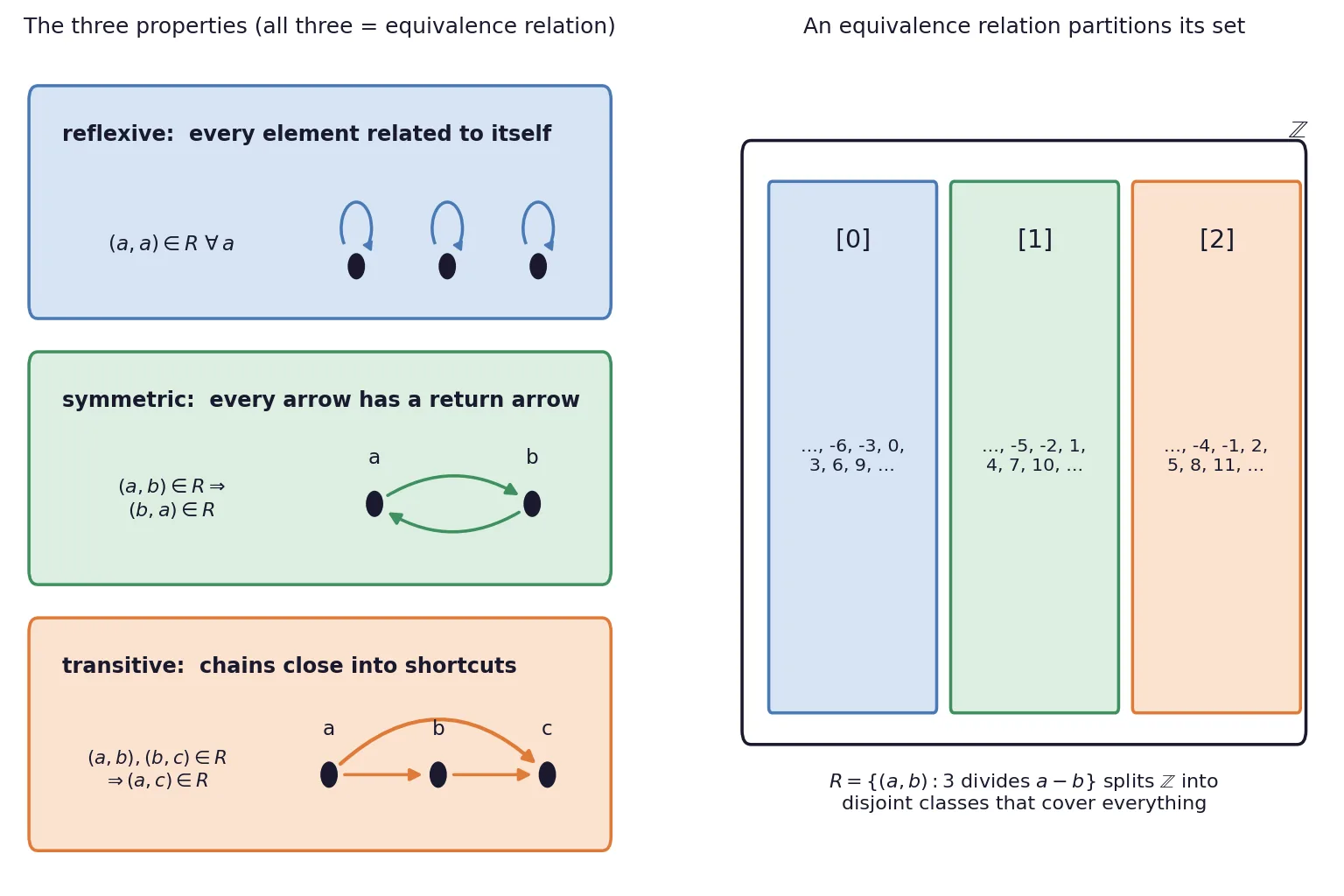
All three together make an equivalence relation, which partitions its set into disjoint equivalence classes covering everything — and conversely every partition defines an equivalence relation. Standard equivalences: congruence and similarity of triangles, "same remainder mod ", "same value of ". Standard non-examples: and divisibility (no symmetry), perpendicularity (symmetric only), (nothing at all).
Functions
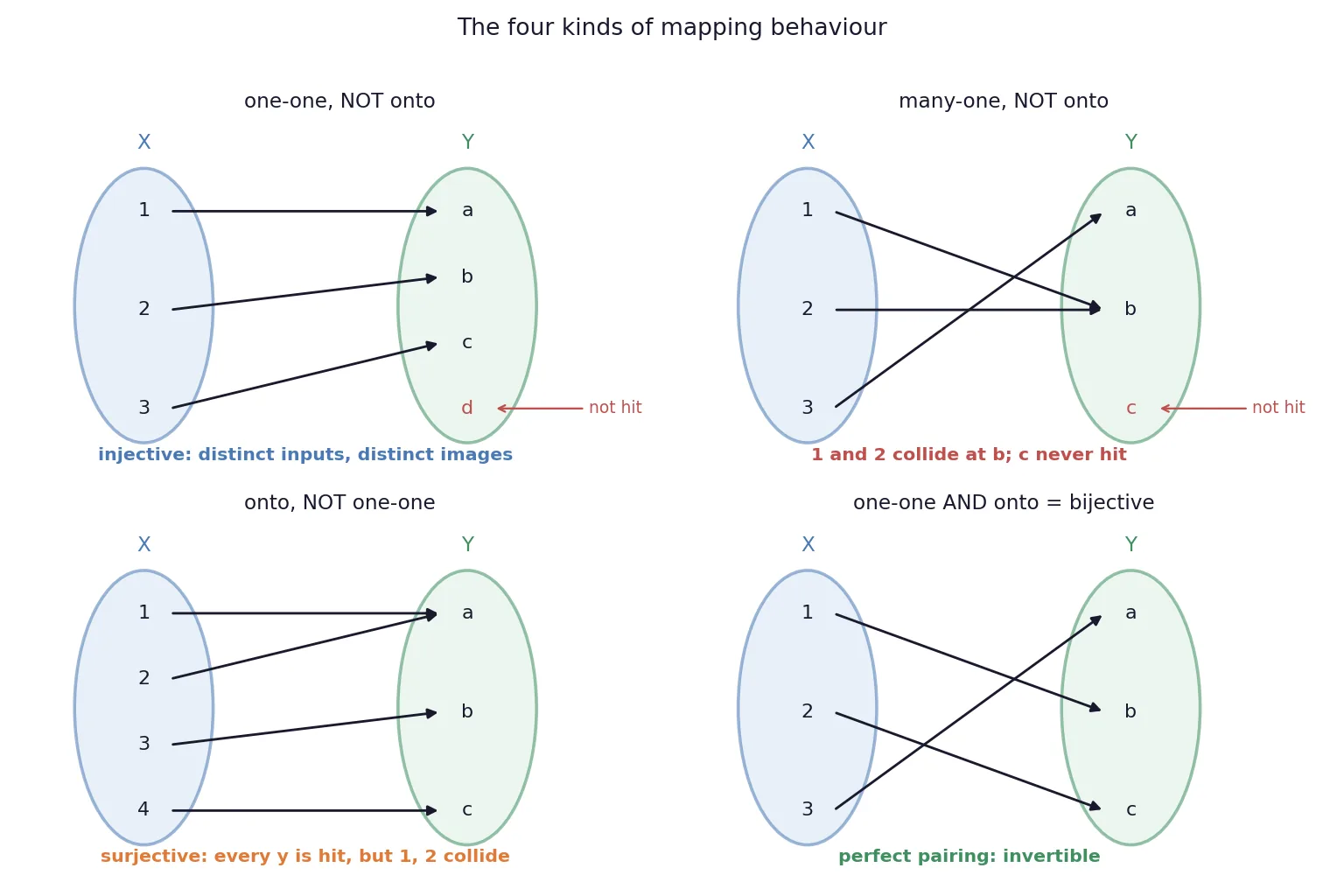
Proof templates: for one-one, run the algebra from ; for onto, solve and check the solution lies in the domain; to disprove either, one counterexample. The domain and co-domain are part of the function — is bijective on but not onto . On a finite set mapping to itself, one-one onto.
Composition and inverses
To compute : solve for , then verify both compositions equal the identity.
The JEE counting card
| What | Count |
|---|---|
| relations on -set | |
| reflexive | |
| symmetric | |
| equivalence relations | Bell numbers |
| functions | |
| one-one | ( if ) |
| onto | ; onto a 2-set; if |
| bijections of -set |
The mistake checklist (read before every exam)
Reflexivity needs every element — one failing (like for ) kills it; and symmetric + transitive does not imply reflexive.
Vacuous transitivity — a relation with no linking chains is transitive by default.
Proving vs disproving — properties are proved with arbitrary elements, disproved with one concrete counterexample; never "prove" by example.
Range vs co-domain — onto compares the range with the stated co-domain, and preimages must lie in the stated domain.
— the inverse function is not the reciprocal.
Composition order — applies first; and , undone in reverse.
Counting exponents — functions number (domain in the exponent); one-one is when , onto is when .