
विस्तृत हल: CBSE कक्षा 10 अंग्रेज़ी सैंपल पेपर 2027 – सेट 1
यहाँ प्रश्न पत्र के सारे प्रश्न क्रम से हल किए गए हैं। Reading और Grammar के हर उत्तर के साथ उसका कारण हिंदी में दिया गया है। Letter, paragraph और literature के उत्तरों के साथ अंग्रेज़ी में आदर्श उत्तर और अंक योजना है, और हिंदी में एक छोटा नोट कि प्रश्न क्या चाहता है और पूरे अंक कैसे मिलते हैं। जहाँ प्रश्न में विकल्प है, वहाँ हर विकल्प हल किया गया है। वस्तुनिष्ठ प्रश्न प्रश्न पत्र वाले पृष्ठ की क्विज़ में भी हैं।
Section A - Reading Skills (20 marks)
प्रश्न 1 (10 marks)
Read the following passage.
(1) Every neighbourhood in India once had its own quiet heroes: the man who mended pressure cookers under the peepal tree, the cobbler who gave tired chappals another year of life, and the radio mechanic whose tiny shop smelt of solder. Many of them have disappeared, and so has the habit they kept alive, the habit of mending what we own. Today, when a mixer grinder stops working, our first thought is rarely "Who can fix this?" It is usually "Which new one should I buy?"
(2) It is easy to see why. New products are cheap, attractive and only a click away. Repair asks for time, patience and some trust in a stranger's skill. Many companies make it harder still. Batteries are glued in, screws have unusual heads, and spare parts vanish from the market within a few years. Ask any repair-shop owner and you will hear the same complaint: things seem designed to be replaced, not repaired.
(3) Yet the cost of this throwaway habit is enormous. Every gadget carries within it metals that were mined, water that was used and fuel that was burnt to make it. When it is discarded after two or three years, all that effort is wasted. Worse, electronic waste in open dumps can leak lead and mercury into the soil. A repaired fan or chair, by contrast, keeps doing its job while the earth is spared the burden of making a new one.
(4) Repair also shapes the people who do it. A teenager who opens a broken table lamp to find the loose wire learns something no textbook teaches: that objects are not magic, and that problems can be solved one step at a time. There is patience in this, and a quiet pride when the bulb finally glows again. Such work also keeps lakhs of small repairers in business, many of whom learnt their trade by watching and helping, without any formal training.
(5) Governments in many parts of the world are now discussing rules that would require companies to sell spare parts and share repair guides. In some cities, volunteers hold monthly repair meet-ups where people bring broken toasters, torn bags and wobbly stools, and fix them together over tea.
(6) Of course, not everything should be repaired. Some old appliances waste so much electricity that replacing them is wiser. But the real question is one of habit. Before throwing something away, we could pause and ask whether it has truly reached the end of its life. That small pause, repeated in millions of homes, might do more for the planet than any single invention. Perhaps it is time to give the humble repairer, and the habit of mending, the respect they deserve.
Created for academic use / 448 words
Answer the following questions, based on the passage above.
(i) What does the writer mean by calling the local repairers "quiet heroes"? (Paragraph 1) (1 mark)
उत्तर।
- They did useful, valuable work, keeping people's things in use and saving them money, but without any fame or recognition. (1 mark)
ध्यान दीजिए: प्रश्न पूछता है कि स्थानीय मिस्त्रियों को 'quiet heroes' कहकर लेखक क्या कहना चाहता है। इस उत्तर में दोनों शब्दों का भाव आना चाहिए। 'Heroes' यानी उनका काम उपयोगी और कीमती था, और 'quiet' यानी उन्हें न नाम मिला, न पहचान। सिर्फ़ एक हिस्सा लिखेंगे तो पूरा अंक नहीं मिलेगा।
(ii) Complete the following with the correct option from the two given.
The writer mentions batteries that are glued in and screws with unusual heads to show that __. (Paragraph 2) (1 mark)
(a) some companies build their products in ways that shut out repair
(b) products have become too complex for ordinary repairers to understand
उत्तर।
पैराग्राफ़ 2 देखिए। ये बातें 'Many companies make it harder still' के ठीक बाद आती हैं, और पैराग्राफ़ मिस्त्रियों की इस शिकायत पर ख़त्म होता है कि चीज़ें बदलने के लिए बनी लगती हैं, मरम्मत के लिए नहीं। यानी चिपकी हुई बैटरी और अनोखे पेंच जटिलता की बात नहीं हैं। ये बनावट में लिए गए फ़ैसले हैं, जो किसी को भी सामान खोलने नहीं देते। दूसरा विकल्प ठीक लगता है, पर गद्यांश मिस्त्रियों के हुनर पर सवाल नहीं उठाता। दोष चीज़ों की बनावट का है।
सही उत्तर: (a) some companies build their products in ways that shut out repair।
(iii) The writer says that a repaired object keeps doing its job while "the earth is spared the burden of making a new one". Which of the following is the best example of this idea? (Paragraph 3) (1 mark)
(a) Buying a new energy-saving fan and storing the old one in the loft
(b) Selling a working phone to buy the latest model
(c) Getting an old ceiling fan rewound so that it runs for five more years
(d) Putting a broken table lamp in the dry-waste bin
उत्तर।
पैराग्राफ़ 3 का विचार यह है कि मरम्मत से नई चीज़ बनाने में लगने वाली धातु, पानी और ईंधन बच जाते हैं। केवल पुराने पंखे की rewinding में पहले से मौजूद चीज़ चलती रहती है, और कुछ नया नहीं बनाना पड़ता। नया पंखा ख़रीदना, फ़ोन बदलना और लैंप फेंक देना, इन तीनों में या तो नई चीज़ बनती है या पुरानी फेंकी जाती है। पुराने पंखे को अटारी (loft) में रख देने वाले विकल्प से सावधान रहिए। उसे रख लेने से नया पंखा बनना नहीं रुकता।
सही उत्तर: (c) Getting an old ceiling fan rewound so that it runs for five more years।
(iv) The writer claims that repair "shapes the people who do it". How does the example of the teenager and the broken table lamp support this claim? Answer in about 40 words. (Paragraph 4) (2 marks)
उत्तर।
आदर्श उत्तर:
While fixing the lamp, the teenager learns that objects are not mysterious and that a problem can be solved step by step. The task also builds patience and a quiet pride when the bulb glows. So repair develops the person's thinking and character, not just the object.
अंक योजना:
- Fixing the lamp teaches the teenager that objects are understandable and that a problem can be solved logically, one step at a time. (1 mark)
- It also builds patience and a quiet pride in one's own work, so repair develops character and confidence, not just a mended object. (1 mark)
ध्यान दीजिए: यहाँ लैंप वाले उदाहरण को लेखक के दावे से जोड़ना है। अंक योजना में दो बिंदु हैं। पहला, लैंप ठीक करते हुए किशोर सीखता है कि चीज़ें समझी जा सकती हैं और समस्या कदम-दर-कदम सुलझती है (1 अंक)। दूसरा, इससे धैर्य आता है और अपने काम पर एक शांत गर्व भी (1 अंक)। ज़्यादातर बच्चे यहाँ बस घटना दोहरा देते हैं और उसे दावे से नहीं जोड़ते। ऐसा मत कीजिए।
(v) State whether the following statement is True or False.
The writer believes that every broken appliance should be repaired rather than replaced. (Paragraph 6) (1 mark)
(a) True
(b) False
उत्तर।
लेखक मरम्मत के पक्ष में है, इसलिए 'True' चुनने का मन करता है। पर पैराग्राफ़ 6 ख़ुद मानता है कि हर चीज़ की मरम्मत ठीक नहीं। कुछ पुराने उपकरण इतनी बिजली खाते हैं कि उन्हें बदल देना ही समझदारी है। लेखक हर चीज़ ठीक कराने को नहीं कहता। वह बस इतना कहता है कि कुछ फेंकने से पहले एक पल रुककर सोचिए।
सही उत्तर: (b) False।
(vi) Complete the analogy by selecting the correct option.
discarded gadget : wasted effort :: _ : _ (Paragraph 3) (1 mark)
(a) energy-efficient new fan : saved resources
(b) repaired fan : spared resources
उत्तर।
पहली जोड़ी से शुरू कीजिए। इसमें एक चीज़ है और उसे बनाने में लगे साधनों का नतीजा, यानी फेंका गया gadget और उस पर लगी बेकार गई मेहनत। दूसरी जोड़ी में पैराग्राफ़ 3 के इसी विचार का उल्टा नतीजा चाहिए। मरम्मत किया गया पंखा, यानी नया पंखा नहीं बनाना पड़ा, और साधन बच गए। नया पंखा कितनी भी बिजली बचाए, उसे बनाने में धातु, पानी और ईंधन लगते ही हैं। इसलिए वह पैराग्राफ़ 3 वाली बचत नहीं दिखाता।
सही उत्तर: (b) repaired fan : spared resources।
(vii) Read the statements (1)-(5) given below and select the option that correctly classifies them as Facts (F) or Opinions (O).
(1) Some products have batteries that are glued in.
(2) Things seem to be designed to be replaced, not repaired.
(3) Electronic waste in open dumps can leak lead and mercury into the soil.
(4) Mending a lamp teaches a teenager something no textbook can.
(5) A short pause before throwing things away could help the planet more than any invention. (1 mark)
(a) (1) F (2) O (3) F (4) O (5) O
(b) (1) F (2) F (3) F (4) O (5) O
(c) (1) O (2) O (3) F (4) O (5) F
(d) (1) F (2) O (3) O (4) F (5) O
उत्तर।
हर कथन के बारे में सोचिए कि क्या इसे जाँचा जा सकता है। जाँचा जा सके तो वह तथ्य (fact) है। अगर वह कोई आकलन या धारणा है, जिससे लोग असहमत हो सकते हैं, तो राय (opinion)। (1) को सामान खोलकर और (3) को मिट्टी की जाँच करके परखा जा सकता है, इसलिए दोनों तथ्य हैं। (2) तथ्य जैसा लगता है, पर 'seem' शब्द पर ध्यान दीजिए। यह मिस्त्रियों की धारणा है, इसलिए राय है। (4) और (5) में लेखक आकलन कर रहा है कि किस बात का क्या मूल्य और असर है, तो ये भी राय हैं। इस तरह क्रम बनता है F, O, F, O, O।
सही उत्तर: (a) (1) F (2) O (3) F (4) O (5) O।
(viii) Why does the writer begin the passage with pictures of the pressure-cooker mender, the cobbler and the radio mechanic, instead of starting with facts about waste? Answer in about 40 words. (Paragraph 1) (2 marks)
उत्तर।
आदर्श उत्तर:
The writer starts with familiar people from every Indian neighbourhood to make the topic warm and personal. This touch of nostalgia pulls readers in and contrasts the old habit of mending with today's throwaway habit, so they are ready to accept the argument.
अंक योजना:
- These familiar, everyday Indian figures make the topic personal and draw the reader in with a touch of nostalgia. (1 mark)
- They set up a contrast between the old habit of mending and today's habit of replacing, which prepares the reader to accept the argument that follows. (1 mark)
ध्यान दीजिए: यह प्रश्न लेखक की तकनीक के बारे में है, यानी शुरुआत में यही लोग क्यों। एक अंक इस बात का है कि जाने-पहचाने लोग विषय को अपना-सा बना देते हैं और पाठक को खींच लेते हैं। दूसरा अंक इस बात का कि वे मरम्मत की पुरानी आदत और आज की फेंकने की आदत का अंतर खड़ा करते हैं, जिससे पाठक आगे के तर्क के लिए तैयार हो जाता है। सिर्फ़ 'to make it interesting' लिखने से ये अंक नहीं मिलेंगे।
प्रश्न 2 (10 marks)
Read the following passage.
(1) For decades, millets such as ragi, jowar and bajra were seen in many Indian cities as a "poor man's grain", eaten in villages but rarely served at city dinner tables. That picture is changing. A survey of 1,800 households across five cities suggests that millets are finding their way back into urban kitchens.
(2) According to the survey, 46% of the families now cook a millet dish at least once a week, compared with 19% five years ago. Ragi is the main grain for 58% of the millet-eating households, followed by jowar (27%) and bajra (15%). Breakfast is the favourite meal for millets, in the form of ragi dosas, jowar upma and millet porridge.
(3) Health is the main reason for the switch. Nearly seven in ten families (68%) said they chose millets because they are rich in fibre and keep them full for longer. Another 21% said they were following a doctor's or dietician's advice, while only 11% said they simply liked the taste.
(4) Price and habit remain hurdles. Millet flour costs roughly 20 to 30% more than wheat flour in city shops, and many cooks find millet rotis harder to roll. Among families that do not eat millets, 39% said they did not know what to cook with them. Food writers believe that simple recipes and ready-to-cook mixes could bring millets to many more plates.
Created for academic use (all figures are imaginary) / 225 words
Answer the following questions, based on the passage above.
(i) Complete the sentence by selecting the correct option.
The phrase "poor man's grain" suggests that millets were once thought of as __. (Paragraph 1) (1 mark)
(a) cheap, humble food
(b) grain that grows only on poor, dry land
उत्तर।
देखिए कि यह मुहावरा किसके सामने रखा गया है, शहर की खाने की मेज़ के। मोटे अनाज (millets) गाँवों में खाए जाते थे और शहरों में उन्हें मामूली समझा जाता था। इसलिए 'poor man's grain' बताता है कि लोग इस भोजन को कैसा मानते थे, यानी सस्ता और मामूली। यह किस मिट्टी में उगता है, उससे इसका कोई लेना-देना नहीं। हाँ, मोटे अनाज सूखी ज़मीन पर अच्छे उगते हैं, इसी वजह से दूसरा विकल्प लुभाता है।
सही उत्तर: (a) cheap, humble food।
(ii) What does the rise from 19% to 46% tell us about the use of millets in cities? (Paragraph 2) (1 mark)
उत्तर।
- The share of families cooking millets weekly has more than doubled in five years, so millets are fast becoming a regular part of city diets. (1 mark)
ध्यान दीजिए: प्रश्न आँकड़े का अर्थ पूछ रहा है, उसे दोहराने को नहीं कह रहा। पूरा अंक तब मिलेगा जब आप लिखें कि पाँच साल में हर हफ़्ते मोटे अनाज पकाने वाले परिवारों का हिस्सा दुगुने से भी ज़्यादा हो गया। यानी ये शहर के खाने का नियमित हिस्सा बन रहे हैं। केवल '19 से 46 हो गया' लिखकर रुक जाएँगे तो उत्तर अधूरा रहेगा।
(iii) Select the option that is true for the Assertion and Reason given below. (Paragraphs 3 and 4)
Assertion (A): Most millet-eating families chose millets for health reasons.
Reason (R): Millet flour costs roughly 20 to 30% more than wheat flour in city shops. (1 mark)
(a) Both the Assertion (A) and the Reason (R) are true, and the Reason is the correct explanation of the Assertion.
(b) Both the Assertion (A) and the Reason (R) are true, but the Reason is not the correct explanation of the Assertion.
(c) The Assertion (A) is true, but the Reason (R) is false.
(d) The Assertion (A) is false, but the Reason (R) is true.
उत्तर।
पहले Assertion परखिए। यह सही है, क्योंकि 68% परिवारों ने fibre और देर तक पेट भरा रहने के कारण मोटे अनाज चुने, और 21% ने डॉक्टर या dietician की सलाह पर। Reason भी सही है, पैराग्राफ़ 4 में कीमत का यह अंतर दिया गया है। अब सोचिए, क्या कीमत इस चुनाव का कारण है? नहीं। ऊँची कीमत तो ख़रीदने में रुकावट है। परिवारों ने सेहत के लिए मोटे अनाज इस वजह से नहीं चुने। इसलिए दोनों सही हैं, पर R, A की सही व्याख्या नहीं है।
सही उत्तर: (b) Both the Assertion (A) and the Reason (R) are true, but the Reason is not the correct explanation of the Assertion.।
(iv) Choose the correct option to complete the sentence.
All of the following are supported by paragraph 2 EXCEPT that __ (Paragraph 2) (1 mark)
(a) fewer than half the families surveyed cook a millet dish every week.
(b) jowar is the main grain for more households than bajra.
(c) ragi is the main grain for more than half of the millet-eating households.
(d) bajra is the grain most families use for breakfast.
उत्तर।
हर कथन को पैराग्राफ़ 2 के आँकड़ों से मिलाइए। 46% परिवार हर हफ़्ते मोटे अनाज पकाते हैं, जो आधे से कम है, तो यह कथन पैराग्राफ़ से मेल खाता है। ज्वार (27%) बाजरे (15%) से आगे है, यह भी मेल खाता है। रागी 58% परिवारों का मुख्य अनाज है, यानी आधे से ज़्यादा, यह भी ठीक है। अब नाश्ते की बात देखिए। नाश्ते के जो पकवान बताए गए हैं, वे हैं रागी डोसा, ज्वार उपमा और millet porridge। बाजरे को पैराग्राफ़ कहीं नाश्ते से नहीं जोड़ता। इसलिए बाजरे वाला कथन ही अपवाद है।
सही उत्तर: (d) bajra is the grain most families use for breakfast.।
(v) Only 11% of millet-eating families said they simply liked the taste. What challenge does this figure point to for anyone hoping to make millets more popular? Answer in about 40 words. (Paragraph 3) (2 marks)
उत्तर।
आदर्श उत्तर:
Nearly nine in ten families eat millets for health or on medical advice, not for pleasure. The challenge, then, is taste: food eaten only out of duty is easily dropped. Sellers and cooks must make millet dishes tasty and easy to enjoy.
अंक योजना:
- Almost nine in ten families (68% for fibre and fullness, 21% on medical advice) eat millets for health, not enjoyment. (1 mark)
- So the challenge is to make millets tasty and appealing; food eaten out of duty may be dropped when the health motive fades, which is why easy, tasty recipes matter. (1 mark)
ध्यान दीजिए: प्रश्न पूछता है कि 11% वाला आँकड़ा किस चुनौती की ओर इशारा करता है। पहले अंक के लिए दिखाइए कि लगभग दस में से नौ परिवार सेहत या डॉक्टर की सलाह के कारण मोटे अनाज खाते हैं, स्वाद के लिए नहीं (68% और 21%)। दूसरे अंक के लिए चुनौती लिखिए, यानी इन्हें स्वादिष्ट और आकर्षक बनाना। वरना सेहत की चिंता घटते ही लोग इन्हें छोड़ सकते हैं। गद्यांश से बाहर की बातें, जैसे विज्ञापन का ख़र्च, अंक नहीं दिलातीं।
(vi) Complete the sentence suitably.
One reason why many families do not eat millets is that __. (Paragraph 4) (1 mark)
उत्तर।
- they do not know what to cook with millets (39% said so). (Also accept: millet flour costs more and millet rotis are harder to roll.) (1 mark)
ध्यान दीजिए: वाक्य पूरा करके बताना है कि कई परिवार मोटे अनाज क्यों नहीं खाते। वाक्य पैराग्राफ़ 4 में दिए किसी कारण से ही पूरा कीजिए। सबसे साफ़ उत्तर है कि 39% परिवारों को पता नहीं कि मोटे अनाज से क्या पकाएँ। ऊँची कीमत या रोटी बेलने की कठिनाई लिखें, तो वह भी मान्य है। अपनी ओर से कोई ऐसा कारण मत जोड़िए जो गद्यांश में नहीं है, उससे अंक चला जाता है।
(vii) Identify the word from paragraph 4 which means "obstacles". (1 mark)
उत्तर।
- hurdles (1 mark)
ध्यान दीजिए: पैराग्राफ़ 4 में 'obstacles' (रुकावटें) के अर्थ वाला शब्द है 'hurdles'। बस यही एक शब्द लिखिए, ठीक उसी रूप में जैसा गद्यांश में है। पूरा वाक्य उतार देने से या कोई दूसरा पर्यायवाची लिखने से अंक कट सकता है।
(viii) A start-up wants to sell millet products to busy city families. Based on paragraph 4, suggest one product idea and say why it would help. (1 mark)
उत्तर।
- Any one suitable idea linked to paragraph 4, e.g. a ready-to-cook millet dosa or upma mix / a recipe card or app with simple millet dishes / ready-made millet rotis, because many families do not know what to cook with millets and find the rotis hard to roll. (1 mark)
ध्यान दीजिए: यहाँ गद्यांश की बात को एक नई स्थिति पर लागू करना है। एक उत्पाद सुझाइए और उसे पैराग्राफ़ 4 की किसी समस्या से जोड़िए। जैसे ready-to-cook millet dosa mix, क्योंकि कई परिवारों को पता नहीं कि मोटे अनाज से क्या पकाएँ। या बनी-बनाई रोटियाँ, क्योंकि इनकी रोटी बेलना कठिन है। कारण के बिना केवल उत्पाद का नाम लिखेंगे तो अंक नहीं मिलेगा।
(ix) A student proposes the heading "Millets Make a Comeback in City Kitchens" for this passage. Which word in the heading best captures paragraphs 1 and 2, and why? (1 mark)
उत्तर।
- 'Comeback': millets, once looked down on in cities as a poor man's grain, are returning to urban homes, with weekly use rising from 19% to 46%. (1 mark)
ध्यान दीजिए: शीर्षक के एक शब्द को पैराग्राफ़ 1 और 2 से जोड़ना है। 'Comeback' चुनिए और कारण दीजिए। जिन मोटे अनाज को कभी शहरों में 'poor man's grain' कहा जाता था, वे अब शहरी रसोई में लौट रहे हैं। हर हफ़्ते इन्हें पकाने वाले परिवार 19% से बढ़कर 46% हो गए हैं। शब्द लिखकर कारण छोड़ देंगे तो आधा ही उत्तर बनेगा।
Section B - Grammar and Creative Writing Skills (20 marks)
प्रश्न 3 (10 marks)
Complete any ten of the following twelve tasks, as directed.
(i) Select the correct option to complete the line from the school newsletter's report on Founders' Day.
By the time the chief guest arrived at the school, the new astronomy lab __ by the senior students. (1 mark)
(a) has been inaugurated
(b) had been inaugurated
(c) was inaugurated
(d) is inaugurated
उत्तर।
चारों विकल्प passive हैं, तो सवाल सिर्फ़ tense का है। यहाँ भूतकाल की दो घटनाएँ हैं, lab का उद्घाटन और मुख्य अतिथि का आना। 'By the time … arrived' बताता है कि अतिथि के आने से पहले उद्घाटन पूरा हो चुका था। भूतकाल की किसी घटना से पहले पूरी हुई घटना के लिए past perfect आता है, यानी 'had been inaugurated'। ज़्यादातर गलती 'was inaugurated' पर होती है, क्योंकि इससे पता नहीं चलता कि कौन-सी घटना पहले हुई। 'has been' और 'is' वर्तमान काल के रूप हैं, और बीते समय की रिपोर्ट में नहीं बैठते।
सही उत्तर: (b) had been inaugurated।
(ii) Report the coach's instruction to the players.
Coach: "Drink water every twenty minutes and don't skip the warm-up." (1 mark)
उत्तर।
- The coach instructed/told/advised the players to drink water every twenty minutes and not to skip the warm-up. (1 mark)
ध्यान दीजिए: आदेश को reported speech में बदलना है। 'instructed/told/advised the players' के बाद 'to drink' आएगा, और मना करने वाले हिस्से में 'not to skip'। दोनों हिस्सों को 'and' से जोड़िए। 'told that don't skip' या 'to don't skip' जैसे रूप लिखेंगे तो अंक नहीं मिलेगा।
(iii) Select the correct option to complete the notice.
NOTICE
__ student of Class 10 going on the Jaipur trip must submit the signed consent form by 20 November. (1 mark)
(a) Every
(b) All
(c) Many
(d) Few
उत्तर।
खाली जगह के बाद की संज्ञा देखिए, 'student', जो एकवचन है। 'All', 'Many' और 'Few' के साथ बहुवचन संज्ञा चाहिए (all students, many students, few students)। 'Every' एकवचन संज्ञा के साथ आता है, और हर एक विद्यार्थी पर लागू होने वाले नियम में ठीक बैठता है। इसलिए वाक्य बनेगा 'Every student … must submit'।
सही उत्तर: (a) Every।
(iv) Rohan said to the librarian, "I returned the book yesterday, but the system still shows it as due."
Report Rohan's statement by completing the sentence.
Rohan told the librarian that __. (1 mark)
उत्तर।
- he had returned the book the previous day / the day before, but the system still showed it as due. (Also accept 'still shows it as due', since the fact may still be true.) (1 mark)
ध्यान दीजिए: रोहन की बात को reported speech में बदलकर वाक्य पूरा करना है। Statement को reported speech में बदलते समय tense एक कदम पीछे जाता है, 'returned' से 'had returned'। 'yesterday' बदलकर 'the previous day' या 'the day before' हो जाता है, और 'I' को 'he' कीजिए। System अब भी किताब को due दिखा रहा है, यह बात अभी भी सच हो सकती है, इसलिए 'still shows' भी स्वीकार है। सबसे आम गलती है 'yesterday' को वैसे ही छोड़ देना।
(v) Identify the error and supply the correction in the following line from the robotics club's annual report.
The number of students in the robotics club have doubled over the last two years.
Write your answer in the format: Error – Correction. (1 mark)
उत्तर।
- Error: have – Correction: has (the subject is 'the number', which is singular) (1 mark)
ध्यान दीजिए: रिपोर्ट की इस पंक्ति में गलती ढूँढकर उसका सुधार लिखना है। कर्ता है 'The number of students', और इसका मुख्य शब्द 'number' एकवचन है। इसलिए क्रिया 'has' होगी। उत्तर Error और Correction के ढाँचे में लिखिए, गलत शब्द 'have' और सही शब्द 'has'। पास वाले बहुवचन शब्द 'students' को देखकर 'have' को सही मान लेना, यही सबसे आम गलती है।
(vi) Select the correct option to complete the line from a museum's rules for visitors.
Visitors __ not use flash photography inside the galleries, as strong light damages old paintings. (1 mark)
(a) need
(b) would
(c) must
(d) might
उत्तर।
यह नियम किसी काम से मना कर रहा है, इसलिए 'must not' चाहिए। 'need not' का मतलब है 'ज़रूरी नहीं', यानी flash photography की छूट मिल जाएगी, जो नियम का उल्टा है। 'would not' और 'might not' आदत या संभावना बताते हैं, नियम नहीं।
सही उत्तर: (c) must।
(vii) The following line from Tanya's diary has an error. Select the option that correctly identifies the error and the correction.
Last Sunday we visit the science museum and saw a robot that could play chess. (1 mark)
(a) Error: saw; Correction: see
(b) Error: could; Correction: can
(c) Error: play; Correction: played
(d) Error: visit; Correction: visited
उत्तर।
समय वाले शब्द से शुरू कीजिए। 'Last Sunday' बीता हुआ, पूरा हो चुका समय है, तो उस दिन के हर काम के लिए past tense आएगा। 'saw' पहले से past में है, और 'could play' रोबोट की बीते समय की क्षमता सही ढंग से बताता है। सिर्फ़ 'visit' वर्तमान काल में है, इसलिए इसे 'visited' होना चाहिए।
सही उत्तर: (d) Error: visit; Correction: visited।
(viii) Select the option that correctly reports Meera's question.
Meera said to the shopkeeper, "Do you have this shoe in a smaller size?" (1 mark)
(a) Meera asked the shopkeeper if he had that shoe in a smaller size.
(b) Meera asked the shopkeeper do he have that shoe in a smaller size.
(c) Meera asked the shopkeeper if he has had this shoe in a smaller size.
(d) Meera asked the shopkeeper whether did he have that shoe in a smaller size.
उत्तर।
हाँ या ना वाले प्रश्न को reported speech में 'if' या 'whether' से जोड़ते हैं। उसके बाद सामान्य वाक्य का क्रम आता है, पहले कर्ता फिर क्रिया, और 'do' या 'did' नहीं आता। साथ ही tense एक कदम पीछे जाता है (have से had), और 'this' बदलकर 'that' हो जाता है। जिस विकल्प में ये तीनों बदलाव सही हैं, वही उत्तर है। 'whether did he have' में प्रश्न वाला क्रम बचा रह गया है, और यही सबसे आम गलती है।
सही उत्तर: (a) Meera asked the shopkeeper if he had that shoe in a smaller size.।
(ix) Fill in the blank by choosing the correct option from the brackets.
Hurry up! We have __ (little / few) time before the bus leaves, so we cannot stop for snacks. (1 mark)
उत्तर।
- little ('time' is uncountable; 'little' means hardly any) (1 mark)
ध्यान दीजिए: कोष्ठक में से सही शब्द चुनकर खाली जगह भरनी है। 'time' अगणनीय (uncountable) संज्ञा है, इसलिए 'little' आएगा। 'few' उन बहुवचन संज्ञाओं के साथ आता है जिन्हें गिना जा सके। यहाँ 'little' का मतलब है 'बहुत कम', जो जल्दी करने की बात से मेल खाता है। 'few' चुनना आम गलती है, क्योंकि 'time' को गिना नहीं जाता।
(x) Identify the error and supply the correction in the following line from a trekking blog.
Twenty kilometres are a long distance to walk in this heat, so we started before sunrise.
Write your answer in the format: Error – Correction. (1 mark)
उत्तर।
- Error: are – Correction: is (a distance taken as one amount takes a singular verb) (1 mark)
ध्यान दीजिए: trekking blog की इस पंक्ति में गलती पकड़कर उसका सुधार लिखना है। दूरी को एक इकाई, यानी एक मात्रा, माना जाता है। इसलिए 'Twenty kilometres' के साथ एकवचन क्रिया 'is' आएगी। Error और Correction के ढाँचे में लिखिए, गलत शब्द 'are' और सही शब्द 'is'। 'kilometres' बहुवचन दिखता है, तो 'are' सही लगता है। गलती यहीं होती है।
(xi) Complete the weather update by choosing the correct option from the brackets.
The sky is clear now, but the forecast says it __ (may / must) rain in the evening, so carry an umbrella. (1 mark)
उत्तर।
- may (it shows possibility, not certainty or obligation) (1 mark)
ध्यान दीजिए: कोष्ठक में से सही modal चुनकर मौसम की सूचना पूरी करनी है। मौसम का पूर्वानुमान संभावना बताता है, निश्चितता या मजबूरी नहीं। इसलिए 'may' सही है। 'must' से पक्की बात या आदेश का भाव आएगा, जो पूर्वानुमान में ठीक नहीं बैठता। 'must' चुनना यहाँ की आम गलती है।
(xii) Fill in the blank with the correct form of the verb given in brackets, for the given line from a news report.
Ever since the new bridge opened, the travel time between the two villages __ (fall) from an hour to fifteen minutes. (1 mark)
उत्तर।
- has fallen ('ever since' + a result that continues to the present needs the present perfect) (1 mark)
ध्यान दीजिए: कोष्ठक में दी गई क्रिया 'fall' का सही रूप भरना है। 'Ever since' बताता है कि बदलाव पुल खुलने से शुरू हुआ और उसका असर आज तक बना हुआ है। इसलिए present perfect आएगा, 'has fallen'। 'fell' या 'had fallen' लिखना आम गलती है, क्योंकि ये बात को अतीत में ही ख़त्म कर देते हैं।
प्रश्न 4 (5 marks)
Note: All details presented in the questions in the writing section are imaginary and created for assessment purposes.
Attempt any one of the following, (A) or (B), in about 120 words.
(A) You are Aarav/Anika Mehta, a student of Class 10-B, Sunrise Public School, Bhopal. Many of your classmates find it hard to study at home because of noise and lack of space. Write a letter to your Principal requesting that the school library remain open for one extra hour after school for Class 10 students from November to February. Mention why it is needed, how the library will be supervised, and assure the Principal that rules will be followed.
उत्तर।
आदर्श उत्तर:
Class 10-B
Sunrise Public School
Bhopal
5 October 2026
The Principal
Sunrise Public School
Bhopal
Subject: Request to keep the library open for an extra hour for Class 10 students
Sir/Madam
With the board examinations approaching, I request you to keep the school library open for one extra hour after school, from 3:00 to 4:00 pm, for Class 10 students between November and February.
Many of us do not have a quiet place to study at home. Some live in small flats with younger siblings, while others face constant noise. The library, with its reference books and calm atmosphere, would help us revise with focus. Our class teachers have kindly offered to supervise by turns, and we promise to keep silence and handle the books with care.
I hope you will consider this request favourably.
Yours truly
Aarav Mehta
Class 10-B
अंक योजना:
- Format: sender's address, date, receiver's address, subject, salutation, complimentary close with name (1 mark)
- Content: request stated clearly with timing and period; need explained (no quiet space at home, reference books, calm atmosphere); supervision arrangement and assurance of discipline (2 marks)
- Organisation: clear paragraphs (issue, details and suggestions, closing request), logical flow (1 mark)
- Accuracy: correct grammar, spelling and formal tone (1 mark)
ध्यान दीजिए: यहाँ प्रधानाचार्य को पत्र लिखकर अनुरोध करना है कि नवंबर से फ़रवरी तक Class 10 के लिए library स्कूल के बाद एक घंटा ज़्यादा खुली रहे। Format का 1 अंक तभी मिलेगा जब ये सब हों: भेजने वाले का पता, तारीख़, प्राप्तकर्ता का पता, subject, संबोधन 'Sir/Madam' और अंत में 'Yours truly' के साथ नाम। Content के 2 अंक तीन बातों पर हैं। पहली, समय और अवधि के साथ अनुरोध। दूसरी, उसकी ज़रूरत का कारण। तीसरी, निगरानी की व्यवस्था के साथ अनुशासन का भरोसा। अनुरोध पहले पैराग्राफ़ में ही लिखिए, आख़िर तक मत रोकिए, और मुख्य भाग 100 से 120 शब्दों में रखिए।
OR
(B) You are Kabir/Kavya Sharma, 14, Lake View Road, Udaipur. In your city, footpaths have been taken over by parked two-wheelers, vendors' stalls and construction material, forcing pedestrians onto busy roads. Write a letter to the Editor of a national daily drawing attention to the danger this causes, especially to children and the elderly, and suggesting measures the authorities and citizens can take.
उत्तर।
आदर्श उत्तर:
14, Lake View Road
Udaipur
5 October 2026
The Editor
The Daily Courier
New Delhi
Subject: Footpaths in Udaipur taken over by vehicles and stalls
Sir/Madam
Through the columns of your newspaper, I wish to draw attention to the footpaths of our city, which have almost disappeared.
Parked scooters, vendors' stalls and heaps of construction material now occupy most footpaths, forcing pedestrians to walk on busy roads. Schoolchildren, elderly people and wheelchair users are at constant risk, and minor accidents have become common near markets.
The Municipal Corporation should mark separate parking spaces and vending zones, remove construction debris, and fine those who block footpaths. Regular checks by the traffic police would also help. Citizens, too, must stop parking on walkways.
I hope the authorities will act before a serious accident occurs.
Yours truly
Kavya Sharma
अंक योजना:
- Format: sender's address, date, receiver's address, subject, salutation, complimentary close with name (1 mark)
- Content: problem described (vehicles, stalls, debris on footpaths); dangers to children, elderly, wheelchair users; measures (parking and vending zones, clearing debris, fines, police checks, citizens' responsibility); appeal to authorities (2 marks)
- Organisation: clear paragraphs (issue, details and suggestions, closing request), logical flow (1 mark)
- Accuracy: correct grammar, spelling and formal tone (1 mark)
ध्यान दीजिए: यह Editor को लिखा पत्र है, फ़ुटपाथों पर कब्ज़े से पैदल चलने वालों को होने वाले ख़तरे के बारे में। इसका मकसद अख़बार के ज़रिए अधिकारियों और जनता का ध्यान एक समस्या की ओर खींचना है। Format में भेजने वाले का पता, तारीख़, 'The Editor' और अख़बार का नाम, subject, 'Sir/Madam' और 'Yours truly' के साथ नाम आते हैं। Subject एक छोटा वाक्यांश रखिए, पूरा वाक्य नहीं, और उसमें समस्या और जगह दोनों का नाम हो। Content के 2 अंक समस्या के वर्णन, उससे बच्चों और बुज़ुर्गों को होने वाले ख़तरे, और अधिकारियों और नागरिकों के लिए ठोस सुझावों पर हैं। भाषा विनम्र पर दृढ़ रखिए। किसी व्यक्ति या विभाग के लिए कठोर शब्द लिखेंगे तो tone और accuracy के अंक कटेंगे।
प्रश्न 5 (5 marks)
Attempt any one of the following, (A) or (B), in about 120 words.
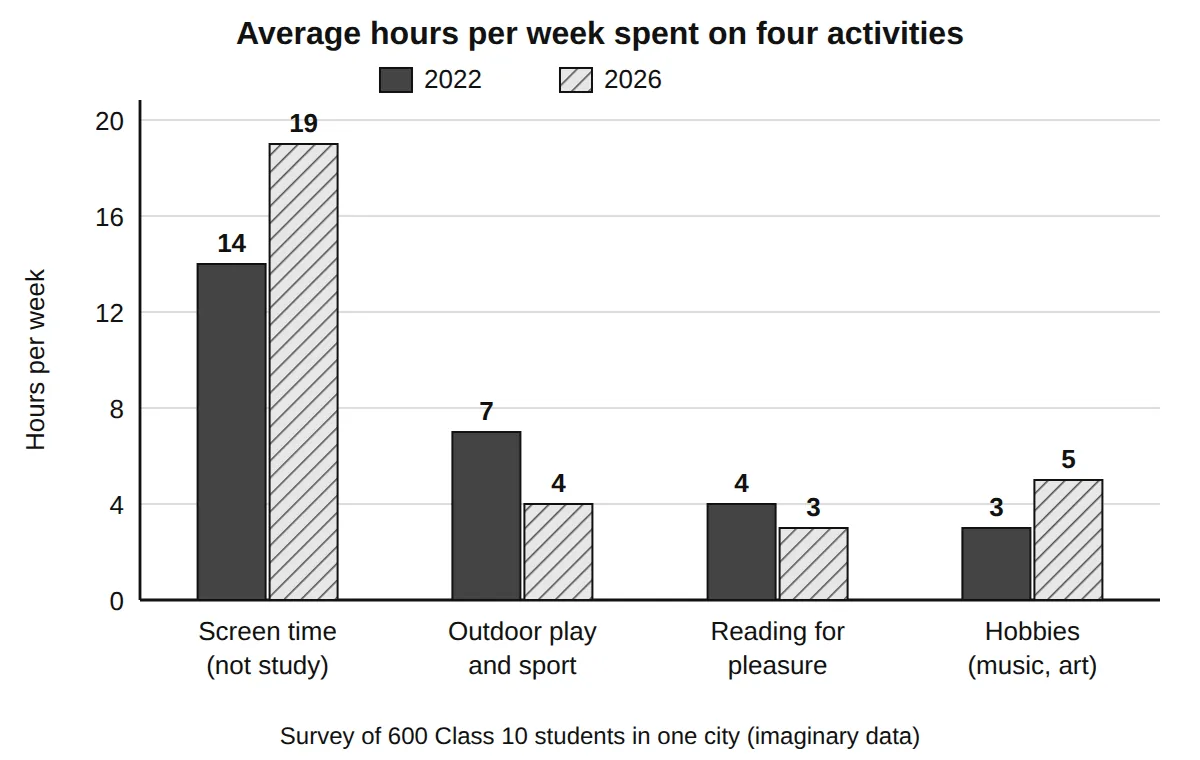
(A) A school surveyed 600 Class 10 students in a city about how many hours a week they spend on four activities outside school. The bar chart compares the results for 2022 and 2026. Write an analytical paragraph in 100-120 words describing the main changes, comparing the activities and drawing a conclusion.
उत्तर।
आदर्श उत्तर:
The bar chart shows a clear shift in how Class 10 students spent their free time between 2022 and 2026. Screen time for entertainment rose from 14 to 19 hours a week, an increase of about one-third, and now takes up more time than the other three activities put together. In contrast, outdoor play and sport fell steeply from 7 to 4 hours, almost halving. Reading for pleasure also slipped slightly, from 4 hours to 3. The only other gain was in hobbies such as music and art, which rose from 3 to 5 hours. Overall, the data suggests that screens are replacing physical activity and reading. Schools and parents may need to encourage outdoor games to restore the balance.
अंक योजना:
- Content: correct figures for all four activities; key comparisons (screen time up 14 to 19, outdoor play down 7 to 4, reading down 4 to 3, hobbies up 3 to 5); a reasoned conclusion (2 marks)
- Organisation: an opening overview, points grouped logically with linkers (in contrast, although, overall), and a concluding judgement; no title (2 marks)
- Accuracy: correct grammar, spelling and figures (1 mark)
ध्यान दीजिए: यहाँ bar chart देखकर 2022 और 2026 के बीच चार गतिविधियों में आए बदलाव पर analytical paragraph लिखना है, तुलना और निष्कर्ष के साथ। Analytical paragraph में शीर्षक नहीं लिखते। Content के 2 अंक चारों गतिविधियों के सही आँकड़ों, मुख्य तुलनाओं (जैसे screen time 14 से 19 घंटे, outdoor play 7 से 4 घंटे) और एक तर्कसंगत निष्कर्ष के लिए हैं। Organisation के 2 अंक शुरुआती सार, 'in contrast' और 'overall' जैसे linkers, और अंतिम निर्णय के लिए। हर bar का आँकड़ा एक-एक करके पढ़ देना वर्णन है, विश्लेषण नहीं। बदलावों की आपस में तुलना कीजिए।
OR
(B) Read the product details of a folding bicycle given on a shopping website.
- Lightweight aluminium frame: weighs only 11 kg
- Folds in 15 seconds to fit under a desk or in a car boot
- Puncture-resistant tyres
- LED front light powered by pedalling, no batteries needed
- Seat height adjustable for riders aged 12 to 18
- Front basket and rear carrier included
- Price ₹ 8,500, with a 2-year warranty
Analyse whether this bicycle would be a good purchase for a school student living in a crowded city. Write an analytical paragraph in 100-120 words, considering its convenience, safety, practicality and value for money.
उत्तर।
आदर्श उत्तर:
The folding bicycle appears to be a smart choice for a school student in a crowded city. Its light 11 kg aluminium frame and 15-second folding make it easy to carry up stairs or keep under a classroom desk, solving the common problem of parking. Puncture-resistant tyres and a pedal-powered LED light add to its reliability and safety, especially on early winter mornings. The adjustable seat suits riders from 12 to 18 years, so it will not be outgrown quickly. Practical extras such as a front basket and rear carrier allow students to carry books and sports kit. Although ₹ 8,500 is a large sum for a student, the two-year warranty and daily use make it good value for money.
अंक योजना:
- Content: features linked to a student's needs (portability and parking, safety features, adjustable seat, carrying capacity); cost weighed against warranty and use; a clear final judgement (2 marks)
- Organisation: an opening overview, points grouped logically with linkers (in contrast, although, overall), and a concluding judgement; no title (2 marks)
- Accuracy: correct grammar, spelling and figures (1 mark)
ध्यान दीजिए: यहाँ परखना है कि यह folding bicycle शहर में रहने वाले विद्यार्थी के लिए अच्छी ख़रीद है या नहीं। Content के अंक तब मिलेंगे जब आप हर feature को विद्यार्थी की ज़रूरत से जोड़ें, जैसे 11 kg का हल्का frame सीढ़ियों और parking की समस्या हल करता है। फिर कीमत को warranty के साथ तौलिए और एक साफ़ निर्णय दीजिए। सबसे आम गलती है features की सूची को वाक्यों में दोहरा देना। शीर्षक मत लिखिए।
Section C - Literature (40 marks)
प्रश्न 6 (5 marks)
Answer the questions on ANY ONE of the two, (A) or (B).
(A) Read the context and answer the questions that follow.
Here Mandela traces how his understanding of freedom deepened over the years. As a child in his village, he felt free enough within the limits that his family and community set for him. Growing up, he realised that this childhood sense of liberty had never been real, and only then did he begin to want freedom for himself: first small personal liberties as a student, and later, as a young man in Johannesburg, the right to build a decent life and support a family. Gradually he saw that every Black South African around him was denied these same rights. This understanding led him to join the African National Congress, and his private wish became a cause he shared with his whole people.
(Nelson Mandela: Long Walk to Freedom)
(i) Select the correct option to complete the sentence.
As a child, Mandela did not long for freedom because __. (1 mark)
(a) his family had shielded him from the harsh laws of the country
(b) he had not yet understood that the liberty he felt was not real
उत्तर।
प्रसंग कहता है कि जब उन्हें समझ आया कि बचपन की आज़ादी कभी असली थी ही नहीं, तभी उनके मन में आज़ादी की चाह जागी। मतलब, बचपन में उन्हें आज़ादी की कमी इसलिए नहीं खली क्योंकि उन्हें पता ही नहीं था कि वह उनके पास नहीं है। परिवार के बचाकर रखने वाला विकल्प सच-सा लगता है। पर प्रसंग कहीं नहीं कहता कि परिवार ने उन्हें देश के कठोर कानूनों से बचाकर रखा। वह बस इतना कहता है कि परिवार और समाज की बनाई सीमाओं के भीतर वे ख़ुद को आज़ाद महसूस करते थे।
सही उत्तर: (b) he had not yet understood that the liberty he felt was not real।
(ii) Mandela describes his idea of freedom at different stages of life: as a child, as a student and as a young man. This step-by-step structure mainly helps the reader to __. (1 mark)
(a) compare the schools and colleges he studied in
(b) feel that he regretted ever leaving his village
(c) see how his understanding of freedom grew from a personal wish into a shared cause
(d) follow how each stage of his life brought him greater personal comfort
उत्तर।
पड़ावों को क्रम से देखिए। पहले बच्चे की बिना सोचे-समझे मिली आज़ादी, फिर विद्यार्थी की निजी इच्छाएँ, फिर नौजवान की इज़्ज़त की ज़िंदगी की चाह, और अंत में अपने पूरे समाज की आज़ादी। हर पड़ाव पर आज़ादी का अर्थ पिछले से बड़ा होता जाता है। यानी यह ढाँचा समझ के बढ़ने को दिखाता है। आराम वाले विकल्प से सावधान रहिए। ये पड़ाव उन्हें ज़्यादा आराम नहीं देते, उलटे यह गहरी समझ देते हैं कि उनके और उनके लोगों के पास क्या नहीं है।
सही उत्तर: (c) see how his understanding of freedom grew from a personal wish into a shared cause।
(iii) Complete the sentence suitably.
Mandela's decision to join the African National Congress suggests that he had come to believe __. (1 mark)
उत्तर।
- that his own freedom could not be separated from the freedom of all his people, and that it could be won only by working together with them. (1 mark)
ध्यान दीजिए: वाक्य पूरा करते हुए वह सोच दिखाइए जिसके कारण वे अफ़्रीकी नेशनल कांग्रेस (African National Congress) में शामिल हुए। उनकी अपनी आज़ादी उनके सब लोगों की आज़ादी से अलग नहीं हो सकती, और वह सबके साथ मिलकर ही पाई जा सकती है। 'वे राजनीति में आना चाहते थे' जैसा सामान्य उत्तर अंक नहीं दिलाता।
(iv) What does Mandela's shift from wanting freedom for himself to wanting it for all his people show about him? Answer in about 40 words. (2 marks)
उत्तर।
आदर्श उत्तर:
It shows that Mandela was selfless and deeply aware of others' suffering. He understood that his freedom meant nothing while his people were oppressed. This marks his growth from a young man with private wishes into a leader willing to sacrifice his own comfort for everyone.
अंक योजना:
- It shows his selflessness and empathy: he saw his own lack of freedom as part of his people's suffering. (1 mark)
- It marks his growth from a young man with private wishes into a leader ready to sacrifice personal comfort for a larger cause. (1 mark)
ध्यान दीजिए: प्रश्न पूछता है कि अपनी आज़ादी से सबकी आज़ादी तक का यह बदलाव मंडेला के बारे में क्या बताता है। पहला अंक उनके निःस्वार्थ स्वभाव और दूसरों का दुख समझने की क्षमता के लिए है। दूसरा अंक उनके विकास के लिए, कि निजी इच्छाओं वाला नौजवान एक ऐसा नेता बना जो बड़े उद्देश्य के लिए अपना आराम छोड़ने को तैयार था। घटनाएँ गिनाकर रुक मत जाइए। गुण का नाम ज़रूर लीजिए।
OR
(B) Read the context and answer the questions that follow.
Hari Singh, a fifteen-year-old thief, has been working for Anil, a young writer who trusts him and has been teaching him to write. One night Hari steals the bundle of notes Anil has just been paid for a book and hurries to the railway station, meaning to board the Lucknow Express. As the train pulls out, he somehow fails to jump on, and he walks slowly back through the bazaar with nowhere to go. He pictures Anil discovering the loss and knows that Anil's face will show only a little sadness, and no anger. Later, sheltering from heavy rain under the clock tower, he sees that by running away he is giving up his chance of becoming an educated man.
(The Thief's Story)
(i) Select the correct option to complete the sentence.
Hari's failure to board the moving train suggests that __. (1 mark)
(a) something within him was already resisting the theft
(b) he was afraid of being caught at the next station
उत्तर।
पहले सोचिए कि हरि कौन है। वह अनुभवी चोर है, जल्दी भाग निकलने का आदी, और प्रसंग में कहीं नहीं दिखता कि उसे पुलिस का डर था। वह बस ख़ुद को गाड़ी में चढ़ा नहीं पाता। थोड़ी देर बाद, पहले बाज़ार में और फिर घंटाघर के नीचे, उसके विचार अनिल और अपनी पढ़ाई की ओर मुड़ जाते हैं। इन सबको साथ रखकर देखिए, तो साफ़ है कि स्टेशन पर ही उसका मन उसे चोरी से रोकने लगा था।
सही उत्तर: (a) something within him was already resisting the theft।
(ii) The story is told by Hari himself. In this part of the story, the first-person narration mainly allows the reader to __. (1 mark)
(a) judge Hari from Anil's point of view
(b) follow Hari's inner struggle from within
(c) learn the history of the Lucknow Express
(d) feel that Hari is boasting about his skill
उत्तर।
कहानी हरि ख़ुद सुनाता है, इसलिए उसकी शंकाएँ हम सीधे उसी से सुनते हैं। वह अनिल के उदास चेहरे की कल्पना करता है और अपनी पढ़ाई छूटने की चिंता करता है। मतलब, हम उसके मन के भीतर रहकर उसकी उलझन देखते हैं। बाकी विकल्प यहाँ नहीं बैठते। अनिल का नज़रिया इस हिस्से में दिया ही नहीं गया, लखनऊ एक्सप्रेस केवल पृष्ठभूमि है, और इस समय हरि डींग हाँकने की हालत में बिल्कुल नहीं है।
सही उत्तर: (b) follow Hari's inner struggle from within।
(iii) Complete the sentence suitably.
Hari is sure that Anil will feel sad rather than angry about the theft because __. (1 mark)
उत्तर।
- Anil had trusted Hari completely, so what would sadden him is the broken trust, not the lost notes; he cares little for money anyway. (Award the mark for the broken trust as the reason.) (1 mark)
ध्यान दीजिए: वाक्य पूरा करके बताना है कि हरि को क्यों लगता है कि अनिल गुस्सा नहीं, दुखी होगा। उत्तर में कारण चाहिए, सिर्फ़ अनिल की तारीफ़ नहीं। मुख्य बात टूटा भरोसा है। अनिल ने हरि पर पूरा भरोसा किया था, इसलिए उसे दुख उस भरोसे के टूटने का होगा, खोए नोटों का नहीं। वह पैसों की ज़्यादा परवाह नहीं करता, यह बात इसे और पक्का करती है। 'अनिल अच्छा आदमी है' जैसा उत्तर कारण नहीं बताता।
(iv) What does Hari's thought about losing the chance to become an educated man reveal about the change taking place in him? Answer in about 40 words. (2 marks)
उत्तर।
आदर्श उत्तर:
It shows that Hari's values are changing. Earlier he cared only about easy money, but now he sees that education, which Anil gave him freely, is worth far more. Anil's kindness has awakened his conscience, and this prepares us for his return.
अंक योजना:
- His values are shifting from quick money through stealing to long-term self-improvement through learning. (1 mark)
- It shows that Anil's kindness and teaching have touched him; his conscience is awakening, which prepares for his return. (1 mark)
ध्यान दीजिए: प्रश्न हरि के मन में हो रहे बदलाव के बारे में है। एक अंक इस बात का है कि उसकी प्राथमिकता चोरी के आसान पैसे से हटकर पढ़-लिखकर आगे बढ़ने पर आ रही है। दूसरा अंक इस बात का कि अनिल की दयालुता और उसकी सिखाई पढ़ाई ने हरि का विवेक जगा दिया है, और यही उसके लौटने की तैयारी है। बदलाव अपने शब्दों में समझाइए, केवल घटनाएँ मत दोहराइए।
प्रश्न 7 (5 marks)
Answer the questions on ANY ONE of the two, (A) or (B).
(A) Read the extract and answer the questions that follow.
The fog comes
on little cat feet.
It sits looking
over harbour and city
on silent haunches
and then moves on.
(Fog)
(i) Complete the sentence suitably.
The words "little cat feet" suggest that the fog arrives __. (1 mark)
उत्तर।
- silently and softly, without anyone noticing (like a cat moving on padded feet). (1 mark)
ध्यान दीजिए: 'little cat feet' कोहरे के आने के ढंग के बारे में है। उत्तर में 'चुपचाप, धीरे से, बिना किसी के ध्यान में आए' वाला भाव आना चाहिए, जैसे बिल्ली गद्देदार पंजों पर चलती है। 'कोहरा छोटा है' लिखना सिर्फ़ शब्दों का शाब्दिक अर्थ है, इससे अंक नहीं मिलेगा।
(ii) The fog "sits looking / over harbour and city". Which quality of the fog does this image bring out? (1 mark)
(a) its hidden threat, like a cat about to pounce
(b) its restless, drifting movement
(c) its dull, sleepy heaviness
(d) its calm, watchful stillness
उत्तर।
पिछले पैरों पर बैठी बिल्ली की तस्वीर मन में लाइए। वह शांत रहती है और चुपचाप चौकन्नी भी। कोहरा भी बंदरगाह और शहर पर इसी तरह ठहर जाता है, मानो उन्हें देख रहा हो। झपटने वाला विकल्प फँसाता है। बिल्ली झपट सकती है, पर यह कोहरा केवल बैठता है और फिर चला जाता है, इसलिए किसी ख़तरे का संकेत नहीं है। बैठे हुए वह बेचैनी से हिल भी नहीं रहा। और 'looking' चौकन्नेपन को दिखाता है, नींद को नहीं।
सही उत्तर: (d) its calm, watchful stillness।
(iii) Choose the correct option to complete the sentence.
The words "and then moves on" suggest that the fog __. (1 mark)
(a) leaves of its own accord, as a cat does
(b) is driven away by the morning wind and sun
उत्तर।
कविता में कोई चीज़ कोहरे को धकेलकर नहीं हटाती। वह जब चाहता है, उठकर चल देता है, जैसे बिल्ली अपनी मर्ज़ी से चली जाती है। दूसरा विकल्प असल ज़िंदगी में कोहरा छँटने का तरीका है, इसीलिए लुभाता है। पर कविता में हवा या धूप का ज़िक्र ही नहीं है।
सही उत्तर: (a) leaves of its own accord, as a cat does।
(iv) The poem compares the fog to a cat throughout, without using "like" or "as", and is written in short, unrhymed lines. How do these two features suit the subject of the poem? Answer in about 40 words. (2 marks)
उत्तर।
आदर्श उत्तर:
The extended metaphor gives the fog a cat's nature: it arrives silently, sits watching, and leaves when it likes. The short, unrhymed lines are brief and hushed, just like the fog's quiet visit, so the form of the poem matches its subject.
अंक योजना:
- Extended metaphor: the fog takes on a cat's qualities: silent arrival, watchful sitting, independent departure. (1 mark)
- Short, unrhymed free-verse lines are brief and quiet, like the fog's visit, with no sound or fuss. (1 mark)
ध्यान दीजिए: प्रश्न पूछता है कि बिल्ली वाली extended metaphor और छोटी, बिना तुक वाली पंक्तियाँ कविता के विषय से कैसे मेल खाती हैं। दो बातें चाहिए, हर एक का 1 अंक। पहली बात extended metaphor का असर है। कोहरे को बिल्ली के गुण मिलते हैं, यानी चुपचाप आना, चौकन्ना होकर बैठना और अपनी मर्ज़ी से जाना। दूसरी बात free verse की छोटी, बिना तुक वाली पंक्तियों का असर है। ये पंक्तियाँ कोहरे की तरह छोटी और शांत हैं। इसे simile मत कहिए, क्योंकि कविता में 'like' या 'as' नहीं है।
OR
(B) Read the context and answer the questions that follow.
In this comic poem, Belinda shares a small white house with four pets: a kitten, a mouse, a yellow dog and a pet dragon called Custard. The poet calls Belinda and the other pets brave, and they make fun of Custard as a coward, since he keeps crying for a secure cage. Then one day, without warning, a pirate climbs in through the window, armed with pistols and a cutlass. Belinda cries for help, and the kitten, the mouse and the dog all run and hide. Custard, however, leaps forward, snorting fiercely, and attacks the pirate, who fires at him but misses.
(The Tale of Custard the Dragon)
(i) Complete the sentence suitably.
The other pets' behaviour during the attack shows that the bravery the poet praised them for was __. (1 mark)
उत्तर।
- hollow / empty / false: they were not really brave, since they ran and hid at the first sign of danger. (1 mark)
ध्यान दीजिए: खाली जगह में 'hollow', 'empty' या 'false' जैसा शब्द चाहिए, और साथ में कारण। ख़तरा आते ही बाकी पालतू जानवर भागकर छिप गए, इसलिए उनकी बहादुरी बस नाम की थी। एक बात ध्यान रखिए। लड़ाई से पहले उन्हें बहादुर कवि कहता है। डींगें तो वे लड़ाई के बाद ख़ुद हाँकते हैं।
(ii) Custard's attack on the pirate mainly shows that __. (1 mark)
(a) dragons are naturally fiercer than dogs and kittens
(b) real courage shows itself in action at a moment of danger
(c) Custard wanted Belinda to praise him
(d) the pirate was weak and easy to defeat
उत्तर।
देखिए कि ख़तरा आने पर आगे कौन बढ़ता है। जिसे डरपोक कहकर चिढ़ाया जाता था, वही अकेला आगे आता है, जबकि जिन्हें बहादुर कहा गया था वे भागकर छिप जाते हैं। कविता यही कहती है कि बहादुरी काम से साबित होती है, बातों से नहीं। समुद्री डाकू हथियारों से लैस और ख़तरनाक है, इसलिए वह 'easy' नहीं है। और कविता कहीं नहीं कहती कि कस्टर्ड तारीफ़ चाहता था।
सही उत्तर: (b) real courage shows itself in action at a moment of danger।
(iii) Choose the correct option to complete the sentence.
The poet's tone while describing the fearsome pirate and the fight is __. (1 mark)
(a) tense and full of suspense
(b) light-hearted and playful
उत्तर।
हथियारों वाला डाकू डरावना लगता है, इसलिए 'tense' चुनने का मन करता है। पर देखिए कि लड़ाई कैसे सुनाई गई है। पालतू जानवर इधर-उधर भाग जाते हैं, और एक छोटा पालतू ड्रैगन सीधे हथियारबंद डाकू पर टूट पड़ता है। कवि लड़ाई को भी मज़ाकिया ढंग से सुनाता है, और उछलती तुकबंदी माहौल को हल्का रखती है। इसलिए स्वर हँसी-मज़ाक वाला है, तनाव और रहस्य वाला नहीं।
सही उत्तर: (b) light-hearted and playful।
(iv) The poem tells an exciting adventure in simple rhyming couplets with a sing-song rhythm, and some words are deliberately misspelt to fit the rhyme. How do these features affect the reader's response to the story? Answer in about 40 words. (2 marks)
उत्तर।
आदर्श उत्तर:
The bouncy couplets, sing-song rhythm and playful misspellings make the poem sound like a comic ballad, so even the pirate's attack feels funny rather than frightening. Readers laugh at the 'brave' pets, yet remember the lesson that real courage lies in action.
अंक योजना:
- The couplets, bouncy rhythm and funny misspellings make the poem light and humorous, like a nursery ballad, so even danger becomes fun (mock-heroic effect). (1 mark)
- The reader laughs at the so-called brave pets and enjoys the adventure, while the lesson about true courage is delivered gently and memorably. (1 mark)
ध्यान दीजिए: प्रश्न पूछता है कि couplets, उछलती लय और जान-बूझकर बदली गई वर्तनी का पाठक पर क्या असर होता है। पहला अंक इस बात का है कि ये कविता को हल्की और मज़ेदार बनाते हैं, यहाँ तक कि डाकू का हमला भी हँसी का दृश्य लगता है। दूसरा अंक इस बात का कि पाठक हँसते हुए भी सच्चे साहस का संदेश याद रखता है। Devices के नाम गिना दिए और उनका असर नहीं बताया, तो उत्तर आधा ही रहेगा।
प्रश्न 8 (12 marks)
Answer any four of the following five questions, in about 40-50 words each.
(i) Frost discusses the end of the world in a calm, almost casual tone, and closes with the understatement that ice "would suffice". How does this light tone make the poem's warning stronger?
(Fire and Ice) (3 marks)
उत्तर।
आदर्श उत्तर:
Frost links fire with desire and ice with hatred. Instead of sounding alarmed, he weighs the two like everyday choices and simply says ice "would suffice". This cool understatement suggests that cold hatred can easily destroy everything, and its quietness shocks the reader more than loud warnings would.
अंक योजना:
- Content: fire stands for desire and ice for hatred; the calm, understated manner makes hatred sound quietly but fully capable of destroying the world, which unsettles the reader more than a dramatic warning (2 marks)
- Expression: clear, connected answer in about 40-50 words (deduct up to 1 mark overall for inaccuracy) (1 mark)
ध्यान दीजिए: प्रश्न पूछता है कि दुनिया के अंत की बात हल्के, शांत स्वर में कहने से कविता की चेतावनी और गहरी कैसे हो जाती है। उत्तर में तीन बातें आनी चाहिए। Fire इच्छा (desire) का और ice नफ़रत (hate) का प्रतीक है। कवि दुनिया के अंत की बात शांत, लगभग साधारण स्वर में करता है। और 'would suffice' वाला understatement नफ़रत की ताकत को और डरावना बना देता है। Content के 2 अंक इन्हीं बिंदुओं पर हैं, और Expression का 1 अंक 40-50 शब्दों के साफ़, जुड़े हुए उत्तर पर। सबसे महँगी गलती है प्रतीकों को उलट देना, यानी fire को नफ़रत कह देना।
(ii) At the end of the poem, alone in his cage at night, the tiger stares up at the stars. What does this closing image suggest about the tiger?
(A Tiger in the Zoo) (3 marks)
उत्तर।
आदर्श उत्तर:
At night the last sound he hears is the cars on patrol, part of the human world that locks him up. His bright eyes stare at the distant stars. This suggests that his wild spirit is not broken; behind the bars he still silently longs for open space and freedom.
अंक योजना:
- Content: the last sound he hears at night is the cars on patrol, part of the human world that keeps him locked up; his bright eyes fixed on the bright, distant stars suggest that his wild spirit is alive and that he longs for a freedom he cannot reach (2 marks)
- Expression: clear, connected answer in about 40-50 words (deduct up to 1 mark overall for inaccuracy) (1 mark)
ध्यान दीजिए: प्रश्न कविता के अंतिम दृश्य का अर्थ पूछता है। पहले लिखिए कि रात में बाघ जो आख़िरी आवाज़ सुनता है, वह गश्त करती गाड़ियों की है। ये गाड़ियाँ उसी इंसानी दुनिया का हिस्सा हैं जो उसे बंद रखती है। फिर यह कि उसकी चमकती आँखें दूर के तारों पर टिकी हैं। तारों को उस आज़ादी के रूप में पढ़िए जिस तक वह पहुँच नहीं सकता, पर इसे 'this suggests' कहकर व्याख्या की तरह लिखिए। कविता की पंक्तियाँ मत उतारिए, अपने शब्दों में लिखिए।
(iii) Soon after Mijbil arrives, Maxwell describes the otter's wild joy in the bath and his games with a rubber ball. What do these details reveal about Mijbil, and about Maxwell as an observer?
(Mijbil the Otter) (3 marks)
उत्तर।
आदर्श उत्तर:
Mijbil dives, rolls and splashes in the bath and plays with a rubber ball for hours, so he is clearly playful, intelligent and full of energy, and needs water to be happy. Maxwell notes every habit closely and with humour, which shows his patience and deep affection for the otter.
अंक योजना:
- Content: Mij is playful, intelligent and full of energy, and needs water; Maxwell watches him closely, patiently and lovingly, recording every habit with affection and humour (2 marks)
- Expression: clear, connected answer in about 40-50 words (deduct up to 1 mark overall for inaccuracy) (1 mark)
ध्यान दीजिए: प्रश्न पूछता है कि नहाने और गेंद वाले खेल की ये बातें मिज और मैक्सवेल, दोनों के बारे में क्या बताती हैं। उत्तर के दो हिस्से हैं। पहला, नहाने और गेंद के खेल से मिज के बारे में क्या पता चलता है, कि वह खिलंदड़ा, समझदार, ऊर्जा से भरा और पानी का दीवाना है। दूसरा, observer के रूप में मैक्सवेल कैसे हैं, यानी धैर्यवान, ध्यान से देखने वाले और हर आदत स्नेह और हास्य के साथ दर्ज करने वाले। एक हिस्सा छोड़ेंगे तो content के आधे अंक चले जाएँगे।
(iv) Why does the writer give the information about tea mainly through talk (between Rajvir and his classmate Pranjol, and with Mr Barua) instead of as a plain description?
(Glimpses of India: Tea from Assam) (3 marks)
उत्तर।
आदर्श उत्तर:
The dialogue makes the lesson lively instead of dry. Facts about tea, such as how many crore cups are drunk daily, the legends and the second flush, come out naturally through Rajvir's excited questions and answers. Young readers learn along with the boys and enjoy the journey too.
अंक योजना:
- Content: dialogue makes the lesson lively and natural; facts (over eighty crore cups drunk in the world every day, the legends, the second flush) come through Rajvir's curiosity and enthusiasm, so young readers learn along with the boys; it also shows the value of reading before travelling (2 marks)
- Expression: clear, connected answer in about 40-50 words (deduct up to 1 mark overall for inaccuracy) (1 mark)
ध्यान दीजिए: यह प्रश्न पाठ के रूप के बारे में है, कि जानकारी बातचीत के ज़रिए क्यों दी गई। लिखिए कि संवाद पाठ को जीवंत बनाता है। चाय के तथ्य (रोज़ अस्सी करोड़ से ज़्यादा कप, किंवदंतियाँ, second flush) राजवीर की जिज्ञासा से अपने-आप सामने आते हैं, और युवा पाठक लड़कों के साथ-साथ सीखते जाते हैं। सिर्फ़ तथ्य दोहराएँगे और बातचीत के असर की बात नहीं करेंगे, तो पूरे अंक नहीं मिलेंगे।
(v) On her way back home from the town, Valli no longer wants to look out of the window of the bus. Why? What does this change show about her?
(Madam Rides the Bus) (3 marks)
उत्तर।
आदर्श उत्तर:
On the way to town Valli had laughed at a young cow running in front of the bus. Coming back, she sees the same cow lying dead by the road. This first sight of death shocks her, and her joy fades. It shows she is growing up and becoming thoughtful.
अंक योजना:
- Content: on the way home she sees the young cow that had run comically in front of the bus earlier, now lying dead by the road; the sight of death shocks her; she becomes quiet and thoughtful, a sign of her growing maturity (2 marks)
- Expression: clear, connected answer in about 40-50 words (deduct up to 1 mark overall for inaccuracy) (1 mark)
ध्यान दीजिए: प्रश्न के दो हिस्से हैं। वल्ली लौटते समय बाहर क्यों नहीं देखना चाहती, और इससे उसके बारे में क्या पता चलता है। पहले हिस्से के लिए लिखिए कि जो युवा गाय जाते समय बस के आगे दौड़ रही थी, वह अब सड़क किनारे मरी पड़ी है। दूसरे के लिए लिखिए कि मौत की इस पहली झलक से वह चुप और गंभीर हो जाती है, यानी बड़ी हो रही है। दूसरा हिस्सा छोड़ दिया तो उत्तर अधूरा रह जाएगा।
प्रश्न 9 (6 marks)
Answer any two of the following three questions, in about 40-50 words each.
(i) Herriot took Tricki away to his surgery and gave him no medicine at all. Why did he think this was the only way to cure the dog, and what does it show about Herriot?
(A Triumph of Surgery) (3 marks)
उत्तर।
आदर्श उत्तर:
Tricki had no disease; overfeeding and too little exercise made him ill. At home Mrs Pumphrey would keep spoiling him. So Herriot took him away, kept food from him at first and let him run with other dogs. It shows his sound judgement and gentle tact.
अंक योजना:
- Content: Tricki was ill from overfeeding and too little exercise, not from disease; at home Mrs Pumphrey would go on spoiling him, so he had to be taken away; plain diet, no food at first, play with other dogs cured him; shows Herriot's good judgement, honesty and tact (2 marks)
- Expression: clear, connected answer in about 40-50 words (deduct up to 1 mark overall for inaccuracy) (1 mark)
ध्यान दीजिए: प्रश्न पूछता है कि हेरियट को बिना दवा वाला यही इलाज क्यों ठीक लगा, और इससे उनके बारे में क्या पता चलता है। उत्तर में दिखाइए कि ट्रिकी को कोई रोग नहीं था। बहुत ज़्यादा खाने और कम कसरत से वह बीमार पड़ा था, और घर पर मिसेज़ पम्फ़्री उसे लाड़ में बिगाड़ती ही रहतीं। इसलिए हेरियट उसे अपनी surgery ले गए, पहले खाना बंद किया और फिर दूसरे कुत्तों के साथ खेलने दिया। आख़िर में हेरियट के गुणों का नाम ज़रूर लीजिए, जैसे समझदारी और सधा हुआ व्यवहार।
(ii) At Iping, Griffin had a warm room at the inn and a chance to work in peace. How did his own behaviour turn the village against him?
(Footprints without Feet) (3 marks)
उत्तर।
आदर्श उत्तर:
Griffin was rude and secretive with Mrs Hall. When his money ran out, the clergyman was robbed and Griffin suddenly had cash. Odd events in his room frightened everyone. Instead of explaining, he lost his temper, threw off his disguise and fought the constable, so the village turned against him.
अंक योजना:
- Content: he was rude, secretive and bad-tempered with Mrs Hall; when his money ran out, the clergyman's house was robbed and he suddenly had cash, so he was suspected; his strange doings (empty room, furniture that seemed alive) frightened people; when questioned he lost his temper, threw off his disguise and fought the constable (2 marks)
- Expression: clear, connected answer in about 40-50 words (deduct up to 1 mark overall for inaccuracy) (1 mark)
ध्यान दीजिए: प्रश्न पूछता है कि ग्रिफ़िन के अपने व्यवहार ने गाँव को उसके ख़िलाफ़ कैसे किया। इसलिए घटनाएँ क्रम से रखिए। पहले मिसेज़ हॉल से रूखा और रहस्यमय बर्ताव, फिर पैसे ख़त्म होने के बाद पादरी के घर चोरी और अचानक उसके पास नकदी। उसके बाद कमरे की अजीब घटनाएँ, और आख़िर में पूछे जाने पर गुस्से में भेस उतारकर सिपाही से लड़ाई। ध्यान दीजिए, कहानी ख़ुद नहीं कहती कि चोर कौन था, इसलिए इसे शक के रूप में ही लिखिए।
(iii) When the necklace was lost, the Loisels chose to replace it secretly instead of telling Mme Forestier the truth. How did this single decision shape the next ten years of their life?
(The Necklace) (3 marks)
उत्तर।
आदर्श उत्तर:
To hide the loss, the Loisels bought a diamond necklace for 36,000 francs, using Loisel's inheritance and heavy loans. They sent away their servant, moved to an attic and worked hard for ten years to repay. Matilda lost her beauty, only to learn the original necklace was fake.
अंक योजना:
- Content: they bought a similar diamond necklace for 36,000 francs, using Loisel's inheritance and heavy loans; they dismissed the servant, moved to an attic and slaved for ten years to repay; Matilda lost her youth and beauty, and the original was only imitation (2 marks)
- Expression: clear, connected answer in about 40-50 words (deduct up to 1 mark overall for inaccuracy) (1 mark)
ध्यान दीजिए: प्रश्न पूछता है कि हार खोने पर सच न बताकर चुपचाप नया हार लौटाने के फ़ैसले ने पति-पत्नी के अगले दस साल कैसे बदल दिए। इस फ़ैसले के नतीजे उत्तर में क्रम से आने चाहिए। पहले 36,000 फ़्रैंक का हूबहू वैसा हार, जिसके लिए पिता से मिली रकम और भारी कर्ज़ लगे। फिर नौकरानी को हटाना, अटारी के कमरों में जाना और दस साल कड़ी मेहनत। और अंत में मटिल्डा की खोई सुंदरता और यह सच कि उधार लिया हार नकली था। केवल अंत का मोड़ लिखकर दस सालों की कीमत छोड़ देना आम कमी है।
प्रश्न 10 (6 marks)
Answer any one of the following two questions, in about 100-120 words.
(A) Kisa Gotami in 'The Sermon at Benares' and the young boy in 'The Ball Poem' both have to face loss. Compare how each of them comes to accept it, and the part played by the Buddha and by the speaker of the poem.
उत्तर।
आदर्श उत्तर:
Both Kisa Gotami and the boy in 'The Ball Poem' face loss, though on very different scales. Kisa loses her only son and carries his body from house to house, begging for medicine. The boy loses only a ball, which bounces into the water, yet for him it is the first real loss of his life.
In both texts, a wise figure refuses false comfort. The Buddha sends Kisa for mustard seed from a house untouched by death, and her search teaches her that death visits everyone. The silent speaker will not offer money for a new ball, since money cannot buy back a loss; the boy must learn to bear it and stand up. Accepting loss brings them strength.
अंक योजना:
- Content: Kisa's loss (only son) and her desperate search for medicine; the boy's small loss (ball) as his first lesson in loss (1 mark)
- Content: the Buddha's method: mustard seed from a house where no one has died, so Kisa discovers that death is universal (1 mark)
- Content: the speaker, a silent onlooker, will not offer money for a new ball, since money cannot buy back what is lost; the boy must learn to bear the loss and stand up again; conclusion: acceptance brings strength (1 mark)
- Expression: well-organised answer with a clear comparison/argument, linkers and a conclusion, in 100-120 words (2 marks)
- Accuracy: correct grammar, spelling and details of the text(s) (1 mark)
ध्यान दीजिए: प्रश्न पूछता है कि किसा गौतमी और 'The Ball Poem' का बच्चा अपने नुकसान को कैसे स्वीकार करते हैं, और इसमें बुद्ध और कविता के वक्ता की क्या भूमिका है। यह तुलना वाला लंबा उत्तर है, इसलिए दोनों पाठ साथ-साथ चलने चाहिए। Content के तीन अंक तीन बिंदुओं पर हैं। पहला, किसा गौतमी का बड़ा दुख और बच्चे का छोटा पर पहला सच्चा नुकसान। दूसरा, बुद्ध का तरीका, जिससे किसा ख़ुद समझती है कि मृत्यु हर घर में आती है। तीसरा, कविता का वक्ता, जो चुपचाप देखता रहता है और नई गेंद के लिए पैसे नहीं देता, क्योंकि पैसा खोई चीज़ वापस नहीं ला सकता। बच्चे को नुकसान सहना और फिर सँभलना ख़ुद सीखना है। Expression के 2 अंक साफ़ तुलना और linkers पर हैं। दोनों पाठों पर अलग-अलग छोटे निबंध लिख देंगे तो ये अंक कटेंगे।
OR
(B) Anne in 'From the Diary of Anne Frank' and the girl in 'Amanda!' both long to be heard and understood by the adults around them. Compare how each of them finds a way to express herself, and how the adults respond.
उत्तर।
आदर्श उत्तर:
Both Anne and Amanda are young girls who feel that the adults around them do not really listen. Anne, lacking a true friend, pours her thoughts into her diary, Kitty, since she can confide in paper more easily than in people. Punished by Mr Keesing for talking, she answers his punishments with witty essays and finally a funny poem.
Amanda's only outlet is silent daydreaming. She is nagged endlessly about posture, homework and chocolate, and answers only with silence, escaping into dreams where she is a mermaid, an orphan or Rapunzel, free and alone.
The difference lies in the adults. Mr Keesing takes Anne's joke well and lets her talk, but Amanda's nagging elder never listens.
अंक योजना:
- Content: Anne feels she has no true friend and confides in her diary, Kitty; turns Mr Keesing's punishments into clever essays and a poem (1 mark)
- Content: Amanda, constantly nagged, answers with silence and escapes into daydreams (mermaid, orphan, Rapunzel) (1 mark)
- Content: contrast in the adults: Mr Keesing enjoys the joke and lets Anne talk; the adult in 'Amanda!' never listens (1 mark)
- Expression: well-organised answer with a clear comparison/argument, linkers and a conclusion, in 100-120 words (2 marks)
- Accuracy: correct grammar, spelling and details of the text(s) (1 mark)
ध्यान दीजिए: यहाँ दो लड़कियों की तुलना करनी है, कि वे अपनी बात कैसे कहती हैं और बड़े लोग कैसे जवाब देते हैं। ऐन अपने मन की बात डायरी, यानी किटी, को लिखती है। मिस्टर कीसिंग की सज़ाओं को वह चतुर निबंधों और एक मज़ेदार कविता में बदल देती है। अमांडा चुप रहकर दिवास्वप्नों में भाग जाती है। तीसरा अंक बड़ों के अंतर पर है। मिस्टर कीसिंग मज़ाक को अच्छे ढंग से लेते हैं और ऐन को बोलने देते हैं, जबकि अमांडा को टोकने वाला व्यक्ति कभी सुनता ही नहीं। यह अंतर छोड़ देना सबसे आम कमी है।
प्रश्न 11 (6 marks)
Answer any one of the following two questions, in about 100-120 words.
(A) Horace Danby believed his thefts did little harm: he robbed only one safe a year, took only from people who had plenty, and spent the money on rare books. Do you think the story supports his belief that his crimes were harmless? Give a reasoned answer.
(A Question of Trust)
उत्तर।
आदर्श उत्तर:
No, the story does not support Horace's view. He saw himself as a respectable craftsman who harmed no one, since he robbed only one safe a year to buy rare books. Yet a crime does not become harmless because it is rare or neatly planned. He planned the Shotover Grange robbery carefully to steal jewels that belonged to someone else.
The story exposes his self-deception through irony. The thief who fooled others is himself fooled by a charming young woman who pretends to own the house. Horace feels exactly what his victims would feel: trust betrayed and helplessness. Carelessly opening the safe without gloves lands him in prison.
In the end, his 'harmless' habit costs him his respectability and freedom.
अंक योजना:
- Content: clear stand with reason: a crime remains a crime however rare or carefully planned (careful planning, jewels belonging to others) (1 mark)
- Content: irony: the thief is deceived by another thief (the young woman posing as the lady of the house) and feels a victim's helplessness (1 mark)
- Content: consequence: his carelessness (opening the safe without gloves) sends him to prison; his 'harmless' habit costs him respectability and freedom (1 mark)
- Expression: well-organised answer with a clear comparison/argument, linkers and a conclusion, in 100-120 words (2 marks)
- Accuracy: correct grammar, spelling and details of the text(s) (1 mark)
ध्यान दीजिए: प्रश्न पूछता है कि क्या कहानी हॉरेस डैनबी की इस सोच का साथ देती है कि उसकी चोरियाँ हानिरहित थीं। 'Do you think' वाले प्रश्न में शुरू में ही साफ़ पक्ष लीजिए, फिर कहानी से तीन कारण दीजिए। पहला, अपराध कम या सोच-समझकर करने से हानिरहित नहीं हो जाता। दूसरा, विडंबना यह कि चोर को एक दूसरी चोर ने ठग लिया और उसे वही बेबसी झेलनी पड़ी। तीसरा, दस्ताने उतारकर safe खोलने की लापरवाही, जो उसे जेल ले गई। दोनों पक्षों के बीच झूलते रहेंगे और कोई निष्कर्ष नहीं देंगे, तो Expression के अंक कटेंगे।
OR
(B) Noodle is only Think-Tank's apprentice, yet he often seems wiser than his master. Do you think Noodle is the real 'brain' of Mars? Give a reasoned answer.
(The Book that Saved the Earth)
उत्तर।
आदर्श उत्तर:
Yes, in all but power, Noodle is the real brain of Mars. Think-Tank is so proud of his huge head that he cannot admit ignorance, so he calls books sandwiches and orders the crew to listen to them. Noodle, though only an apprentice, is humble and observant. He offers each correction as a small detail he happens to remember: books are for communication, they are for the eye, and the vitamins will help the crew read.
Yet Think-Tank takes the credit for every idea and makes every decision, so Noodle has wisdom without power.
The ending settles it. The Historian tells us that Noodle later becomes the wise ruler of Mars, and Mars and Earth become friends.
अंक योजना:
- Content: Think-Tank's vanity and blunders (e.g. books taken for sandwiches, never admits error), which show a big brain without wisdom (1 mark)
- Content: Noodle's humility and good sense: he offers his corrections as small details he happens to remember (books are for communication, for the eye; the vitamins), and gently steers Think-Tank towards the truth (1 mark)
- Content: reasoned conclusion: Noodle has the wisdom but not the power, since Think-Tank takes the credit and makes every decision; the ending, with Noodle as the wise ruler of Mars and friend of Earth, shows that the play rewards humble good sense. (Another clear stand, for example that Think-Tank holds the power and so remains the real ruler, earns this mark if it is supported from the play.) (1 mark)
- Expression: well-organised answer with a clear comparison/argument, linkers and a conclusion, in 100-120 words (2 marks)
- Accuracy: correct grammar, spelling and details of the text(s) (1 mark)
ध्यान दीजिए: प्रश्न पूछता है कि क्या नूडल ही मंगल का असली 'दिमाग' है। यहाँ भी साफ़ पक्ष चाहिए, जैसे कि नूडल के पास समझ है पर सत्ता नहीं। फिर तीन बिंदु दीजिए। पहला, थिंक-टैंक का घमंड और उसकी भूलें, जैसे किताबों को sandwich समझना। दूसरा, नूडल की विनम्रता और समझ, जो अपना हर सुधार ऐसे रखता है मानो कोई छोटी-सी बात याद आ गई हो। तीसरा, अंत, जहाँ इतिहासकार बताती है कि नूडल आगे चलकर मंगल का समझदार शासक बनता है। ध्यान रखिए कि आपका उत्तर अपने ही तर्क के ख़िलाफ़ न चला जाए।