
CBSE Class 10 English Sample Paper 2027 – Set 1
Time allowed: 3 hours · Maximum marks: 80
General Instructions
- This question paper comprises 11 questions. All questions are compulsory.
- The question paper contains three sections: Section A - Reading Skills; Section B - Grammar and Creative Writing Skills; Section C - Literature.
- Attempt questions based on the specific instructions given for each part.
- Internal choices are given in Questions 3 (any ten of twelve), 4, 5, 6, 7, 8 (any four of five), 9 (any two of three), 10 and 11.
- Keep to the word limits given with the questions.
How to use this paper: set a 3-hour timer and write all your answers on paper, as you would in the board exam. When you finish, take the quiz at the end of this page to score your objective answers. Then open the Detailed Solutions and mark the rest against the model answers and the marking scheme.
Section A - Reading Skills (20 marks)
This section has two unseen passages. Answer all the questions on each passage.
1. Read the following passage.
(1) Every neighbourhood in India once had its own quiet heroes: the man who mended pressure cookers under the peepal tree, the cobbler who gave tired chappals another year of life, and the radio mechanic whose tiny shop smelt of solder. Many of them have disappeared, and so has the habit they kept alive, the habit of mending what we own. Today, when a mixer grinder stops working, our first thought is rarely "Who can fix this?" It is usually "Which new one should I buy?"
(2) It is easy to see why. New products are cheap, attractive and only a click away. Repair asks for time, patience and some trust in a stranger's skill. Many companies make it harder still. Batteries are glued in, screws have unusual heads, and spare parts vanish from the market within a few years. Ask any repair-shop owner and you will hear the same complaint: things seem designed to be replaced, not repaired.
(3) Yet the cost of this throwaway habit is enormous. Every gadget carries within it metals that were mined, water that was used and fuel that was burnt to make it. When it is discarded after two or three years, all that effort is wasted. Worse, electronic waste in open dumps can leak lead and mercury into the soil. A repaired fan or chair, by contrast, keeps doing its job while the earth is spared the burden of making a new one.
(4) Repair also shapes the people who do it. A teenager who opens a broken table lamp to find the loose wire learns something no textbook teaches: that objects are not magic, and that problems can be solved one step at a time. There is patience in this, and a quiet pride when the bulb finally glows again. Such work also keeps lakhs of small repairers in business, many of whom learnt their trade by watching and helping, without any formal training.
(5) Governments in many parts of the world are now discussing rules that would require companies to sell spare parts and share repair guides. In some cities, volunteers hold monthly repair meet-ups where people bring broken toasters, torn bags and wobbly stools, and fix them together over tea.
(6) Of course, not everything should be repaired. Some old appliances waste so much electricity that replacing them is wiser. But the real question is one of habit. Before throwing something away, we could pause and ask whether it has truly reached the end of its life. That small pause, repeated in millions of homes, might do more for the planet than any single invention. Perhaps it is time to give the humble repairer, and the habit of mending, the respect they deserve.
Created for academic use / 448 words
Answer the following questions, based on the passage above.
(i) What does the writer mean by calling the local repairers "quiet heroes"? (Paragraph 1) (1 mark)
(ii) Complete the following with the correct option from the two given.
The writer mentions batteries that are glued in and screws with unusual heads to show that __. (Paragraph 2) (1 mark)
(a) some companies build their products in ways that shut out repair
(b) products have become too complex for ordinary repairers to understand
(iii) The writer says that a repaired object keeps doing its job while "the earth is spared the burden of making a new one". Which of the following is the best example of this idea? (Paragraph 3) (1 mark)
(a) Buying a new energy-saving fan and storing the old one in the loft
(b) Selling a working phone to buy the latest model
(c) Getting an old ceiling fan rewound so that it runs for five more years
(d) Putting a broken table lamp in the dry-waste bin
(iv) The writer claims that repair "shapes the people who do it". How does the example of the teenager and the broken table lamp support this claim? Answer in about 40 words. (Paragraph 4) (2 marks)
(v) State whether the following statement is True or False.
The writer believes that every broken appliance should be repaired rather than replaced. (Paragraph 6) (1 mark)
(a) True
(b) False
(vi) Complete the analogy by selecting the correct option.
discarded gadget : wasted effort :: _ : _ (Paragraph 3) (1 mark)
(a) energy-efficient new fan : saved resources
(b) repaired fan : spared resources
(vii) Read the statements (1)-(5) given below and select the option that correctly classifies them as Facts (F) or Opinions (O).
(1) Some products have batteries that are glued in.
(2) Things seem to be designed to be replaced, not repaired.
(3) Electronic waste in open dumps can leak lead and mercury into the soil.
(4) Mending a lamp teaches a teenager something no textbook can.
(5) A short pause before throwing things away could help the planet more than any invention. (1 mark)
(a) (1) F (2) O (3) F (4) O (5) O
(b) (1) F (2) F (3) F (4) O (5) O
(c) (1) O (2) O (3) F (4) O (5) F
(d) (1) F (2) O (3) O (4) F (5) O
(viii) Why does the writer begin the passage with pictures of the pressure-cooker mender, the cobbler and the radio mechanic, instead of starting with facts about waste? Answer in about 40 words. (Paragraph 1) (2 marks)
2. Read the following passage.
(1) For decades, millets such as ragi, jowar and bajra were seen in many Indian cities as a "poor man's grain", eaten in villages but rarely served at city dinner tables. That picture is changing. A survey of 1,800 households across five cities suggests that millets are finding their way back into urban kitchens.
(2) According to the survey, 46% of the families now cook a millet dish at least once a week, compared with 19% five years ago. Ragi is the main grain for 58% of the millet-eating households, followed by jowar (27%) and bajra (15%). Breakfast is the favourite meal for millets, in the form of ragi dosas, jowar upma and millet porridge.
(3) Health is the main reason for the switch. Nearly seven in ten families (68%) said they chose millets because they are rich in fibre and keep them full for longer. Another 21% said they were following a doctor's or dietician's advice, while only 11% said they simply liked the taste.
(4) Price and habit remain hurdles. Millet flour costs roughly 20 to 30% more than wheat flour in city shops, and many cooks find millet rotis harder to roll. Among families that do not eat millets, 39% said they did not know what to cook with them. Food writers believe that simple recipes and ready-to-cook mixes could bring millets to many more plates.
Created for academic use (all figures are imaginary) / 225 words
Answer the following questions, based on the passage above.
(i) Complete the sentence by selecting the correct option.
The phrase "poor man's grain" suggests that millets were once thought of as __. (Paragraph 1) (1 mark)
(a) cheap, humble food
(b) grain that grows only on poor, dry land
(ii) What does the rise from 19% to 46% tell us about the use of millets in cities? (Paragraph 2) (1 mark)
(iii) Select the option that is true for the Assertion and Reason given below. (Paragraphs 3 and 4)
Assertion (A): Most millet-eating families chose millets for health reasons.
Reason (R): Millet flour costs roughly 20 to 30% more than wheat flour in city shops. (1 mark)
(a) Both the Assertion (A) and the Reason (R) are true, and the Reason is the correct explanation of the Assertion.
(b) Both the Assertion (A) and the Reason (R) are true, but the Reason is not the correct explanation of the Assertion.
(c) The Assertion (A) is true, but the Reason (R) is false.
(d) The Assertion (A) is false, but the Reason (R) is true.
(iv) Choose the correct option to complete the sentence.
All of the following are supported by paragraph 2 EXCEPT that __ (Paragraph 2) (1 mark)
(a) fewer than half the families surveyed cook a millet dish every week.
(b) jowar is the main grain for more households than bajra.
(c) ragi is the main grain for more than half of the millet-eating households.
(d) bajra is the grain most families use for breakfast.
(v) Only 11% of millet-eating families said they simply liked the taste. What challenge does this figure point to for anyone hoping to make millets more popular? Answer in about 40 words. (Paragraph 3) (2 marks)
(vi) Complete the sentence suitably.
One reason why many families do not eat millets is that __. (Paragraph 4) (1 mark)
(vii) Identify the word from paragraph 4 which means "obstacles". (1 mark)
(viii) A start-up wants to sell millet products to busy city families. Based on paragraph 4, suggest one product idea and say why it would help. (1 mark)
(ix) A student proposes the heading "Millets Make a Comeback in City Kitchens" for this passage. Which word in the heading best captures paragraphs 1 and 2, and why? (1 mark)
Section B - Grammar and Creative Writing Skills (20 marks)
This section has a grammar question (attempt ten of twelve tasks), a formal letter and an analytical paragraph, each with an internal choice.
3. Complete any ten of the following twelve tasks, as directed.
(i) Select the correct option to complete the line from the school newsletter's report on Founders' Day.
By the time the chief guest arrived at the school, the new astronomy lab __ by the senior students. (1 mark)
(a) has been inaugurated
(b) had been inaugurated
(c) was inaugurated
(d) is inaugurated
(ii) Report the coach's instruction to the players.
Coach: "Drink water every twenty minutes and don't skip the warm-up." (1 mark)
(iii) Select the correct option to complete the notice.
NOTICE
__ student of Class 10 going on the Jaipur trip must submit the signed consent form by 20 November. (1 mark)
(a) Every
(b) All
(c) Many
(d) Few
(iv) Rohan said to the librarian, "I returned the book yesterday, but the system still shows it as due."
Report Rohan's statement by completing the sentence.
Rohan told the librarian that __. (1 mark)
(v) Identify the error and supply the correction in the following line from the robotics club's annual report.
The number of students in the robotics club have doubled over the last two years.
Write your answer in the format: Error – Correction. (1 mark)
(vi) Select the correct option to complete the line from a museum's rules for visitors.
Visitors __ not use flash photography inside the galleries, as strong light damages old paintings. (1 mark)
(a) need
(b) would
(c) must
(d) might
(vii) The following line from Tanya's diary has an error. Select the option that correctly identifies the error and the correction.
Last Sunday we visit the science museum and saw a robot that could play chess. (1 mark)
(a) Error: saw; Correction: see
(b) Error: could; Correction: can
(c) Error: play; Correction: played
(d) Error: visit; Correction: visited
(viii) Select the option that correctly reports Meera's question.
Meera said to the shopkeeper, "Do you have this shoe in a smaller size?" (1 mark)
(a) Meera asked the shopkeeper if he had that shoe in a smaller size.
(b) Meera asked the shopkeeper do he have that shoe in a smaller size.
(c) Meera asked the shopkeeper if he has had this shoe in a smaller size.
(d) Meera asked the shopkeeper whether did he have that shoe in a smaller size.
(ix) Fill in the blank by choosing the correct option from the brackets.
Hurry up! We have __ (little / few) time before the bus leaves, so we cannot stop for snacks. (1 mark)
(x) Identify the error and supply the correction in the following line from a trekking blog.
Twenty kilometres are a long distance to walk in this heat, so we started before sunrise.
Write your answer in the format: Error – Correction. (1 mark)
(xi) Complete the weather update by choosing the correct option from the brackets.
The sky is clear now, but the forecast says it __ (may / must) rain in the evening, so carry an umbrella. (1 mark)
(xii) Fill in the blank with the correct form of the verb given in brackets, for the given line from a news report.
Ever since the new bridge opened, the travel time between the two villages __ (fall) from an hour to fifteen minutes. (1 mark)
4. Note: All details presented in the questions in the writing section are imaginary and created for assessment purposes.
Attempt any one of the following, (A) or (B), in about 120 words.
(A) You are Aarav/Anika Mehta, a student of Class 10-B, Sunrise Public School, Bhopal. Many of your classmates find it hard to study at home because of noise and lack of space. Write a letter to your Principal requesting that the school library remain open for one extra hour after school for Class 10 students from November to February. Mention why it is needed, how the library will be supervised, and assure the Principal that rules will be followed. (5 marks)
OR
(B) You are Kabir/Kavya Sharma, 14, Lake View Road, Udaipur. In your city, footpaths have been taken over by parked two-wheelers, vendors' stalls and construction material, forcing pedestrians onto busy roads. Write a letter to the Editor of a national daily drawing attention to the danger this causes, especially to children and the elderly, and suggesting measures the authorities and citizens can take.
5. Attempt any one of the following, (A) or (B), in about 120 words.
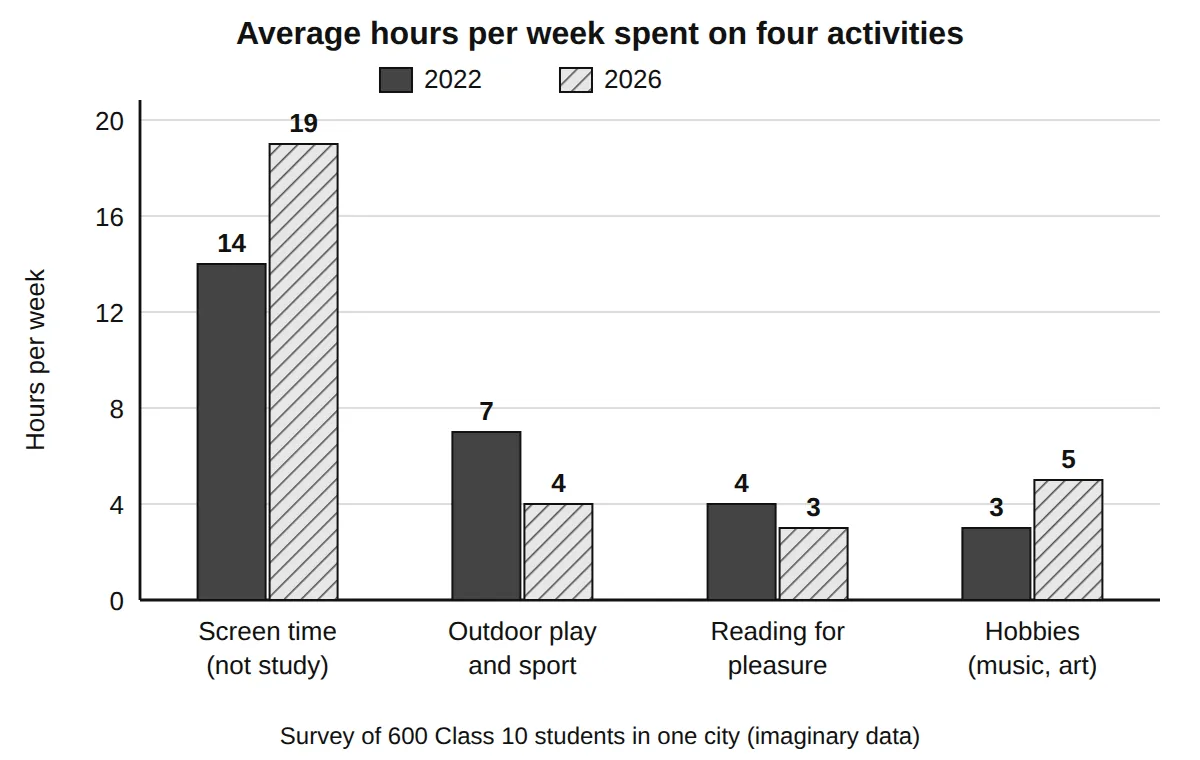
(A) A school surveyed 600 Class 10 students in a city about how many hours a week they spend on four activities outside school. The bar chart compares the results for 2022 and 2026. Write an analytical paragraph in 100-120 words describing the main changes, comparing the activities and drawing a conclusion. (5 marks)
OR
(B) Read the product details of a folding bicycle given on a shopping website.
- Lightweight aluminium frame: weighs only 11 kg
- Folds in 15 seconds to fit under a desk or in a car boot
- Puncture-resistant tyres
- LED front light powered by pedalling, no batteries needed
- Seat height adjustable for riders aged 12 to 18
- Front basket and rear carrier included
- Price ₹ 8,500, with a 2-year warranty
Analyse whether this bicycle would be a good purchase for a school student living in a crowded city. Write an analytical paragraph in 100-120 words, considering its convenience, safety, practicality and value for money.
Section C - Literature (40 marks)
This section is based on the textbooks First Flight and Footprints without Feet. Follow the internal choice given in each question.
6. Answer the questions on ANY ONE of the two, (A) or (B).
(A) Read the context and answer the questions that follow.
Here Mandela traces how his understanding of freedom deepened over the years. As a child in his village, he felt free enough within the limits that his family and community set for him. Growing up, he realised that this childhood sense of liberty had never been real, and only then did he begin to want freedom for himself: first small personal liberties as a student, and later, as a young man in Johannesburg, the right to build a decent life and support a family. Gradually he saw that every Black South African around him was denied these same rights. This understanding led him to join the African National Congress, and his private wish became a cause he shared with his whole people.
(Nelson Mandela: Long Walk to Freedom)
(i) Select the correct option to complete the sentence.
As a child, Mandela did not long for freedom because __. (1 mark)
(a) his family had shielded him from the harsh laws of the country
(b) he had not yet understood that the liberty he felt was not real
(ii) Mandela describes his idea of freedom at different stages of life: as a child, as a student and as a young man. This step-by-step structure mainly helps the reader to __. (1 mark)
(a) compare the schools and colleges he studied in
(b) feel that he regretted ever leaving his village
(c) see how his understanding of freedom grew from a personal wish into a shared cause
(d) follow how each stage of his life brought him greater personal comfort
(iii) Complete the sentence suitably.
Mandela's decision to join the African National Congress suggests that he had come to believe __. (1 mark)
(iv) What does Mandela's shift from wanting freedom for himself to wanting it for all his people show about him? Answer in about 40 words. (2 marks)
OR
(B) Read the context and answer the questions that follow.
Hari Singh, a fifteen-year-old thief, has been working for Anil, a young writer who trusts him and has been teaching him to write. One night Hari steals the bundle of notes Anil has just been paid for a book and hurries to the railway station, meaning to board the Lucknow Express. As the train pulls out, he somehow fails to jump on, and he walks slowly back through the bazaar with nowhere to go. He pictures Anil discovering the loss and knows that Anil's face will show only a little sadness, and no anger. Later, sheltering from heavy rain under the clock tower, he sees that by running away he is giving up his chance of becoming an educated man.
(The Thief's Story)
(i) Select the correct option to complete the sentence.
Hari's failure to board the moving train suggests that __. (1 mark)
(a) something within him was already resisting the theft
(b) he was afraid of being caught at the next station
(ii) The story is told by Hari himself. In this part of the story, the first-person narration mainly allows the reader to __. (1 mark)
(a) judge Hari from Anil's point of view
(b) follow Hari's inner struggle from within
(c) learn the history of the Lucknow Express
(d) feel that Hari is boasting about his skill
(iii) Complete the sentence suitably.
Hari is sure that Anil will feel sad rather than angry about the theft because __. (1 mark)
(iv) What does Hari's thought about losing the chance to become an educated man reveal about the change taking place in him? Answer in about 40 words. (2 marks)
7. Answer the questions on ANY ONE of the two, (A) or (B).
(A) Read the extract and answer the questions that follow.
The fog comes
on little cat feet.
It sits looking
over harbour and city
on silent haunches
and then moves on.
(Fog)
(i) Complete the sentence suitably.
The words "little cat feet" suggest that the fog arrives __. (1 mark)
(ii) The fog "sits looking / over harbour and city". Which quality of the fog does this image bring out? (1 mark)
(a) its hidden threat, like a cat about to pounce
(b) its restless, drifting movement
(c) its dull, sleepy heaviness
(d) its calm, watchful stillness
(iii) Choose the correct option to complete the sentence.
The words "and then moves on" suggest that the fog __. (1 mark)
(a) leaves of its own accord, as a cat does
(b) is driven away by the morning wind and sun
(iv) The poem compares the fog to a cat throughout, without using "like" or "as", and is written in short, unrhymed lines. How do these two features suit the subject of the poem? Answer in about 40 words. (2 marks)
OR
(B) Read the context and answer the questions that follow.
In this comic poem, Belinda shares a small white house with four pets: a kitten, a mouse, a yellow dog and a pet dragon called Custard. The poet calls Belinda and the other pets brave, and they make fun of Custard as a coward, since he keeps crying for a secure cage. Then one day, without warning, a pirate climbs in through the window, armed with pistols and a cutlass. Belinda cries for help, and the kitten, the mouse and the dog all run and hide. Custard, however, leaps forward, snorting fiercely, and attacks the pirate, who fires at him but misses.
(The Tale of Custard the Dragon)
(i) Complete the sentence suitably.
The other pets' behaviour during the attack shows that the bravery the poet praised them for was __. (1 mark)
(ii) Custard's attack on the pirate mainly shows that __. (1 mark)
(a) dragons are naturally fiercer than dogs and kittens
(b) real courage shows itself in action at a moment of danger
(c) Custard wanted Belinda to praise him
(d) the pirate was weak and easy to defeat
(iii) Choose the correct option to complete the sentence.
The poet's tone while describing the fearsome pirate and the fight is __. (1 mark)
(a) tense and full of suspense
(b) light-hearted and playful
(iv) The poem tells an exciting adventure in simple rhyming couplets with a sing-song rhythm, and some words are deliberately misspelt to fit the rhyme. How do these features affect the reader's response to the story? Answer in about 40 words. (2 marks)
8. Answer any four of the following five questions, in about 40-50 words each.
(i) Frost discusses the end of the world in a calm, almost casual tone, and closes with the understatement that ice "would suffice". How does this light tone make the poem's warning stronger?
(Fire and Ice) (3 marks)
(ii) At the end of the poem, alone in his cage at night, the tiger stares up at the stars. What does this closing image suggest about the tiger?
(A Tiger in the Zoo) (3 marks)
(iii) Soon after Mijbil arrives, Maxwell describes the otter's wild joy in the bath and his games with a rubber ball. What do these details reveal about Mijbil, and about Maxwell as an observer?
(Mijbil the Otter) (3 marks)
(iv) Why does the writer give the information about tea mainly through talk (between Rajvir and his classmate Pranjol, and with Mr Barua) instead of as a plain description?
(Glimpses of India: Tea from Assam) (3 marks)
(v) On her way back home from the town, Valli no longer wants to look out of the window of the bus. Why? What does this change show about her?
(Madam Rides the Bus) (3 marks)
9. Answer any two of the following three questions, in about 40-50 words each.
(i) Herriot took Tricki away to his surgery and gave him no medicine at all. Why did he think this was the only way to cure the dog, and what does it show about Herriot?
(A Triumph of Surgery) (3 marks)
(ii) At Iping, Griffin had a warm room at the inn and a chance to work in peace. How did his own behaviour turn the village against him?
(Footprints without Feet) (3 marks)
(iii) When the necklace was lost, the Loisels chose to replace it secretly instead of telling Mme Forestier the truth. How did this single decision shape the next ten years of their life?
(The Necklace) (3 marks)
10. Answer any one of the following two questions, in about 100-120 words.
(A) Kisa Gotami in 'The Sermon at Benares' and the young boy in 'The Ball Poem' both have to face loss. Compare how each of them comes to accept it, and the part played by the Buddha and by the speaker of the poem. (6 marks)
OR
(B) Anne in 'From the Diary of Anne Frank' and the girl in 'Amanda!' both long to be heard and understood by the adults around them. Compare how each of them finds a way to express herself, and how the adults respond.
11. Answer any one of the following two questions, in about 100-120 words.
(A) Horace Danby believed his thefts did little harm: he robbed only one safe a year, took only from people who had plenty, and spent the money on rare books. Do you think the story supports his belief that his crimes were harmless? Give a reasoned answer.
(A Question of Trust) (6 marks)
OR
(B) Noodle is only Think-Tank's apprentice, yet he often seems wiser than his master. Do you think Noodle is the real 'brain' of Mars? Give a reasoned answer.
(The Book that Saved the Earth)