Detailed Solutions: CBSE Class 10 Science Sample Paper 2027 – Set 1
Every written question from the paper (2, 3, 4 and 5 marks) is solved here in order, with the marks given for each step, so you can check your answer sheet the way an examiner would. Where a question has an internal choice (OR), both options are solved. The 1-mark questions are answered, with explanations, in the quiz on the Question Paper page.
Section A - Biology (30 marks)
Question 10 (2 marks)
Answer the following:
(a) In a small herb, water keeps moving up through the xylem even at night, when the stomata are closed and transpiration is very low. What moves the water up at such times? Explain briefly. (1 mark)
Answer.
- Root pressure — 0.5 marks
- The root cells take in ions from the soil actively, so water keeps entering the root and the column of water in the xylem is steadily pushed upwards — 0.5 marks
(b) Why do veins have valves while arteries do not? (1 mark)
Answer.
- Blood in the veins flows under low pressure — 0.5 marks
- The valves make sure that it flows in one direction only, towards the heart; arteries carry blood from the heart under high pressure, so they do not need valves — 0.5 marks
Question 11 (2 marks)
Attempt either option (A) or (B).
(A) A health survey in a hill district of Uttarakhand found many people with a swelling in the front of the neck (goitre). Doctors asked every family to switch to iodised salt. Name the gland that is affected and the hormone it makes. What does this hormone do in the body, and how does iodised salt help?
Answer.
- Iodine is needed by the thyroid gland to make the hormone thyroxin — 1 mark
- Thyroxin regulates carbohydrate, protein and fat metabolism for balanced growth; iodised salt supplies the iodine, so the thyroid can make enough thyroxin and does not swell — 1 mark
OR
(B) A 12-year-old boy is much shorter than other children of his age. His doctor says that one hormone is not being made in enough amount. Name the hormone and the gland that makes it. What is the main job of this hormone?
Answer.
- Growth hormone (0.5), made by the pituitary gland (0.5) — 1 mark
- It regulates the growth and development of the body; its lack in childhood leads to dwarfism — 1 mark
Question 12 (2 marks)
Every month, the inner lining of the uterus becomes thick and spongy, with a rich supply of blood. Why does the uterus prepare itself in this way? What happens to this lining if the egg released is not fertilised?
Answer.
- The thick, blood-rich lining is needed to receive and nourish the embryo if fertilisation takes place — 1 mark
- If the egg is not fertilised, the lining is not needed; it breaks down slowly and comes out through the vagina as blood and mucus (menstruation), roughly once a month — 1 mark
Question 13 (3 marks)
Answer the following:
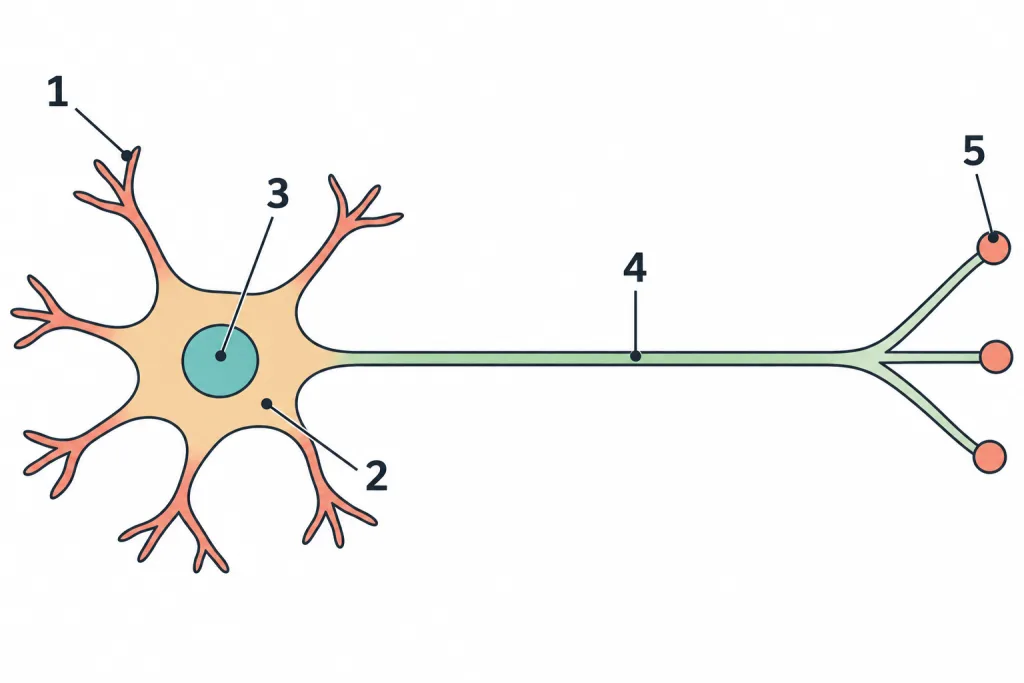
(a) Draw a neat diagram of a neuron and label any four of these parts: dendrite, cell body, nucleus, axon, nerve ending. (2 marks)
Answer.
- Correct diagram of a neuron — 1 mark
- Any four parts correctly labelled, 0.25 each (in the figure: 1 dendrite, 2 cell body, 3 nucleus, 4 axon, 5 nerve ending) — 1 mark
(b) How is the electrical impulse passed on from one neuron to the next? (1 mark)
Answer.
- At the end of the axon, the electrical impulse sets off the release of some chemicals — 0.5 marks
- These chemicals cross the gap (synapse) and start a similar electrical impulse in a dendrite of the next neuron — 0.5 marks
Question 14 (3 marks)
The figure shows a food web in a grassland near Jaipur. The letters stand for: A - grass, B - grasshopper, C - rabbit, D - frog, E - snake, F - hawk. Each arrow points from the organism that is eaten to the organism that eats it.
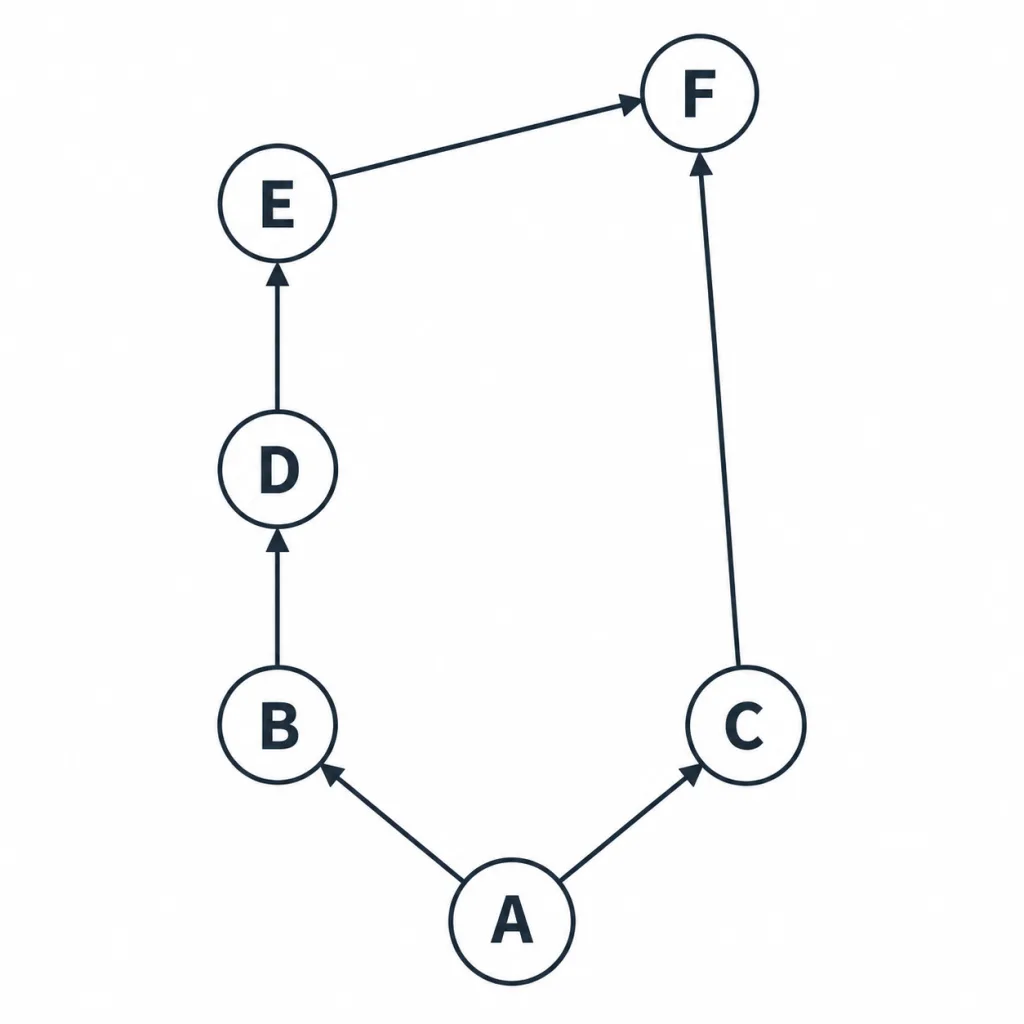
(a) Write the longest food chain in this web, using the names of the organisms, and state the trophic level of the snake in it. (1 mark)
Answer.
- Grass → grasshopper → frog → snake → hawk — 0.5 marks
- The snake is at the fourth trophic level (tertiary consumer) — 0.5 marks
(b) Suppose the grass in each chain holds 20,000 kJ of energy. Using the 10 per cent law, find the energy that reaches the hawk (i) through the rabbit and (ii) through the longest chain. (1 mark)
Answer.
- (i) 20,000 → 2,000 → 200 kJ — 0.5 marks
- (ii) 20,000 → 2,000 → 200 → 20 → 2 kJ — 0.5 marks
(c) A disease wipes out most of the frogs in this area. What will happen to the number of grasshoppers, and then to the grass? Give a reason. (1 mark)
Answer.
- Grasshoppers will increase, since few frogs are left to eat them — 0.5 marks
- More grasshoppers will eat more grass, so the grass will decrease — 0.5 marks
Question 15 (4 marks)
Sameer, a Class 10 student from Nashik, grew pea plants for his science project. He crossed a pure-breeding tall plant that had round seeds (TTRR) with a pure-breeding dwarf plant that had wrinkled seeds (ttrr). All the plants of the F1 generation were tall with round seeds. He then let the F1 plants self-pollinate and raised 800 plants of the F2 generation from the seeds he collected.
(a) What does the appearance of the F1 plants tell us about the traits 'tall' and 'round'? (1 mark)
Answer.
- Tall and round are dominant traits; dwarf and wrinkled are recessive, so they do not show in F1 — 1 mark
(b) How many of the 800 F2 plants are expected to be dwarf with round seeds? Show how you got the number. (1 mark)
Answer.
- The F2 ratio is 9 : 3 : 3 : 1, and dwarf-round plants are 3 out of every 16; plants — 1 mark
(c) Out of the 800 F2 plants, how many are expected to be tall? How many of these tall plants will be pure-breeding for tallness (TT)? Explain using the cross for height. (2 marks)
Answer.
- For height, Tt × Tt gives TT : Tt : tt = 1 : 2 : 1 — 1 mark
- Tall plants (0.5); pure tall (TT) (0.5) — 1 mark
OR
(c) Sameer's friend crossed one of the tall F1 plants (Tt) with a dwarf plant (tt). What ratio of tall to dwarf plants is expected among the offspring? Show the cross. (2 marks)
Answer.
- Gametes: the Tt plant gives T and t; the tt plant gives only t — 1 mark
- Offspring: Tt (tall) and tt (dwarf) in equal numbers, so tall : dwarf = 1 : 1 — 1 mark
Question 16 (5 marks)
Attempt either option (A) or (B).
(A) Rakesh, a Class 10 student in Kota, noticed that after two hours of football on a hot afternoon, with little to drink, he passed only a small amount of dark yellow urine. On a cool day when he drank plenty of water, he passed a large amount of pale urine.
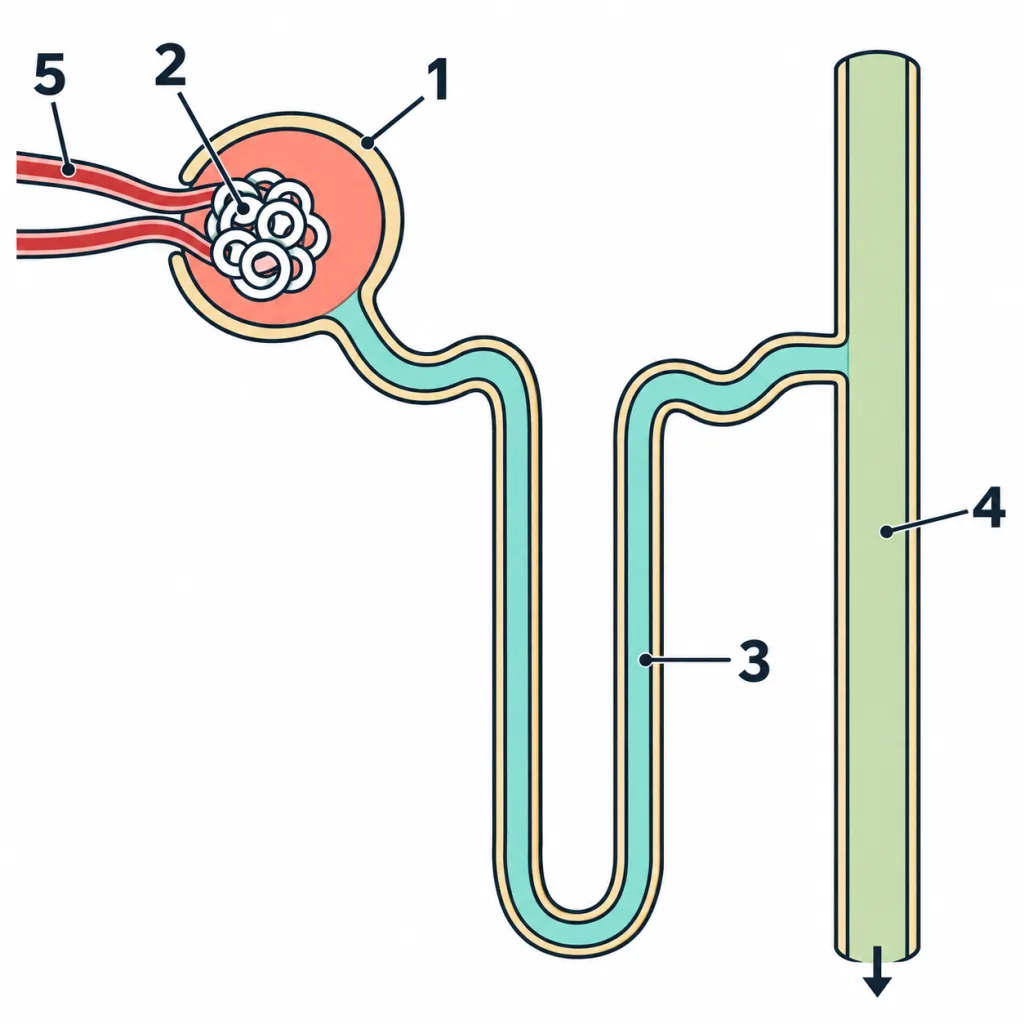
(i) Draw a neat diagram of a nephron and label Bowman's capsule, glomerulus, tubule and collecting duct. In which part is the blood filtered? (3 marks)
Answer.
- Correct diagram of a nephron — 1 mark
- Four parts correctly labelled, 0.25 each (in the figure: 1 Bowman's capsule, 2 glomerulus, 3 tubule, 4 collecting duct, 5 branch of the renal artery) — 1 mark
- Blood is filtered in the glomerulus, and the filtrate collects in Bowman's capsule — 1 mark
(ii) Explain why Rakesh passed less and darker urine on the hot day. What decides how much water is reabsorbed in the kidneys? (2 marks)
Answer.
Model answer:
The filtrate formed in Bowman's capsule contains a lot of water along with glucose, amino acids, salts and urea. As it moves along the tubule, the useful substances and water are selectively taken back into the blood. How much water is taken back depends on how much excess water the body has and how much dissolved waste has to be thrown out. On the hot day Rakesh lost much water as sweat and drank very little, so his body had no water to spare. The tubules reabsorbed more water, and only a small amount of concentrated, dark urine was left. On the cool day, with plenty of extra water, less was reabsorbed and he passed a lot of pale urine.
Marking scheme:
- As the filtrate flows along the tubule, useful substances and water are selectively reabsorbed; the amount of water reabsorbed depends on how much excess water there is in the body and how much dissolved waste has to be removed — 1 mark
- On the hot day he lost a lot of water as sweat and drank little, so there was no excess water: more water was reabsorbed from the tubules, leaving a small volume of concentrated (dark) urine — 1 mark
OR
(B) Kabir had a lunch of rice, dal and ghee.
(i) Trace the digestion of the starch in the rice, from the mouth until it is absorbed into the blood. Name the juice or enzyme that acts at each stage. (3 marks)
Answer.
Model answer:
In the mouth, the saliva mixes with the chewed rice. Its enzyme, salivary amylase, starts breaking the starch down into simple sugar. In the stomach the food is made acidic and no further starch digestion takes place. In the small intestine, pancreatic juice (with pancreatic amylase) carries on breaking down the starch, and the intestinal juice from the walls finally converts the carbohydrates into glucose. The inner lining of the small intestine has thousands of finger-like villi. They give a huge surface area, and their rich blood supply takes the glucose into the blood.
Marking scheme:
- Mouth: salivary amylase in the saliva breaks starch down into simple sugar — 1 mark
- Stomach: the medium is acidic and starch is not digested further; small intestine: pancreatic juice (pancreatic amylase) continues the breakdown of starch, and the enzymes of the intestinal juice finally convert the carbohydrates into glucose — 1 mark
- Glucose is absorbed into the blood through the villi of the small intestine, which give a very large surface area — 1 mark
(ii) In a certain person, the gastric glands secrete much less mucus than normal. What problem is this person likely to face, and why? (2 marks)
Answer.
Model answer:
The gastric glands release hydrochloric acid along with the enzyme pepsin and mucus. Mucus coats the inner lining of the stomach and protects it from the acid. If too little mucus is made, the acid acts on the lining itself. This can damage it, causing pain and sores (ulcers) in the stomach.
Marking scheme:
- The inner lining of the stomach may get damaged by the hydrochloric acid, causing pain and ulcers — 1 mark
- because the mucus normally protects the inner lining of the stomach from the action of the acid — 1 mark
Section B - Chemistry (25 marks)
Question 25 (2 marks)
Answer the following:
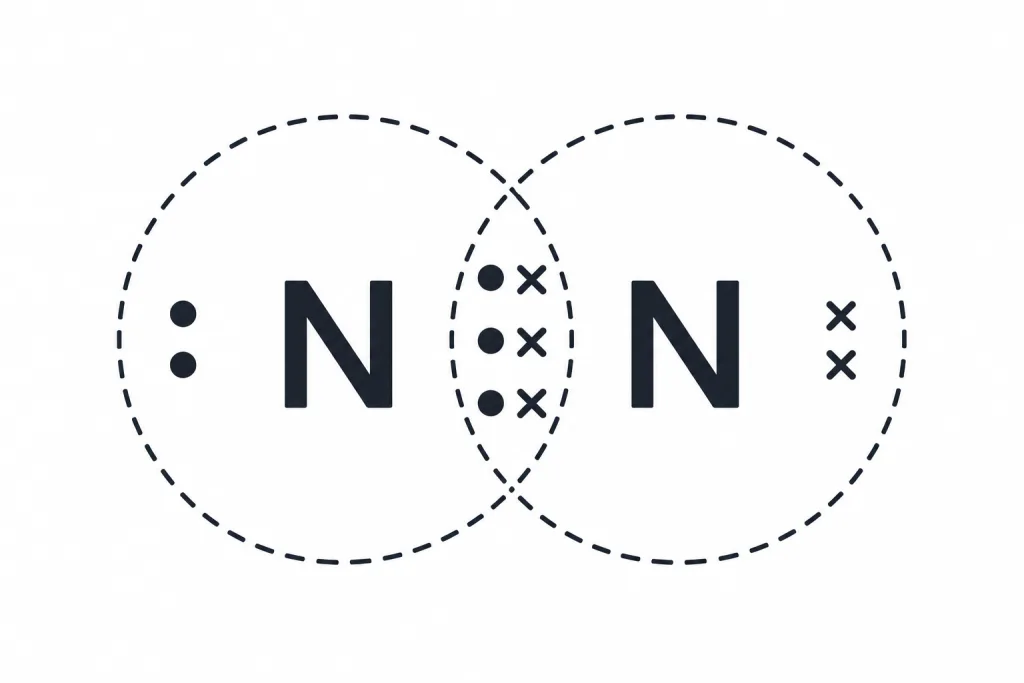
(a) Draw the electron dot structure of a nitrogen molecule, . (Atomic number of nitrogen = 7) (1 mark)
Answer.
- Correct structure: three shared pairs of electrons between the two atoms and one lone pair on each atom — 1 mark
(b) A molecule of nitrogen has a triple bond, but a molecule of oxygen has a double bond. Why? (1 mark)
Answer.
- A nitrogen atom (2, 5) needs three more electrons to complete its octet, so two nitrogen atoms share three pairs — 0.5 marks
- An oxygen atom (2, 6) needs only two more electrons, so two oxygen atoms share two pairs — 0.5 marks
Question 26 (3 marks)
Attempt either option (A) or (B).
(A) Meera added a pinch of sodium hydrogencarbonate to 2 mL of ethanoic acid in a test tube.
(i) What will she observe? (1 mark)
Answer.
- Brisk effervescence: bubbles of a colourless gas are given off — 1 mark
(ii) Write the balanced chemical equation for the reaction. (1 mark)
Answer.
- — 1 mark
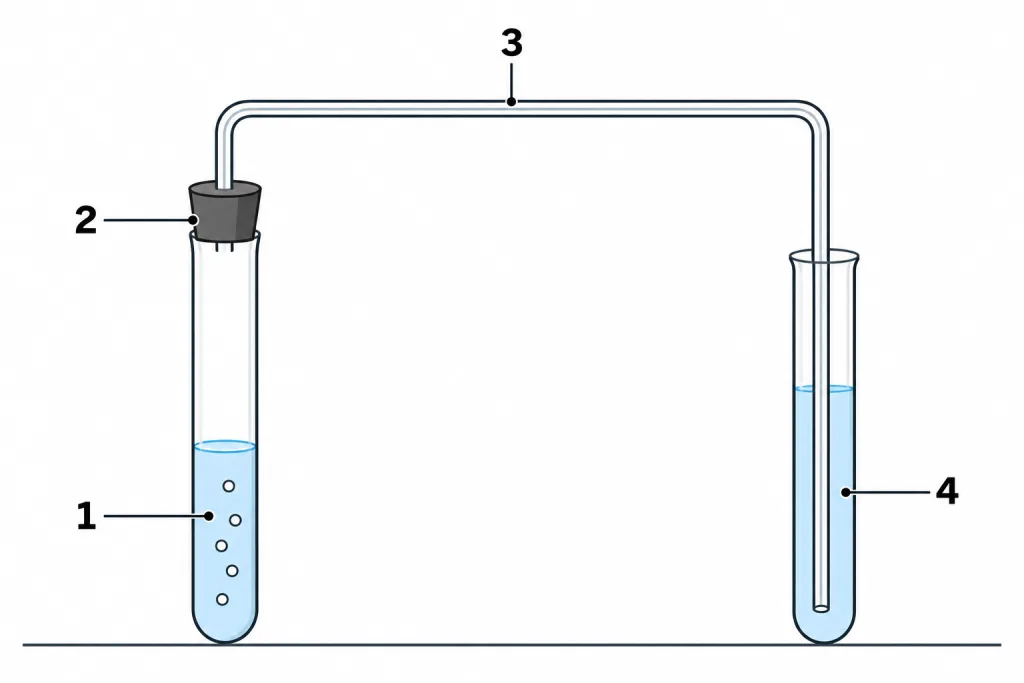
(iii) Draw a labelled diagram of the set-up she can use to show that the gas given off turns lime water milky. (1 mark)
Answer.
- Correct set-up: the test tube closed with a cork, and a delivery tube dipping into lime water in a second test tube — 0.5 marks
- Labels (in the figure: 1 ethanoic acid with sodium hydrogencarbonate, 2 cork, 3 delivery tube, 4 lime water) — 0.5 marks
OR
(B) Answer the following:
(i) What is saponification? (1 mark)
Answer.
- The reaction of an ester with a base, such as sodium hydroxide, that gives back the alcohol and the sodium salt of the acid; it is used to make soap — 1 mark
(ii) Ethyl ethanoate is heated with sodium hydroxide solution. Write the chemical equation for the reaction and name the two products formed. (2 marks)
Answer.
- — 1 mark
- Ethanol (0.5) and sodium ethanoate (0.5) — 1 mark
Question 27 (3 marks)
Give reasons for the following:
(a) Old copper vessels kept in a temple in Varanasi slowly lose their shine and get a green coating. (1 mark)
Answer.
- Copper reacts with moist carbon dioxide in the air and forms a green layer of basic copper carbonate on its surface — 1 mark
(b) Solid sodium chloride does not conduct electricity, but its solution in water does. (1 mark)
Answer.
- In the solid, the ions are held in a rigid structure and cannot move — 0.5 marks
- In the solution, the ions are free to move and carry the current — 0.5 marks
(c) A galvanised iron bucket does not rust even when its zinc coating gets scratched in places. (1 mark)
Answer.
- Zinc is more reactive than iron, so it reacts with air and moisture first and goes on protecting the iron, even at the scratch — 1 mark
Question 28 (4 marks)
Kavya took 10 mL of dilute sodium hydroxide solution in a conical flask and added two drops of phenolphthalein. The solution turned pink. She then added dilute hydrochloric acid from a dropper, a little at a time, swirling the flask after each addition. The pink colour disappeared just when she had added 8 mL of the acid. She added 2 mL more of the acid, and the solution stayed colourless.
(a) Why did the pink colour disappear when 8 mL of the acid had been added? (1 mark)
Answer.
- The acid neutralised all the sodium hydroxide, so the solution was no longer basic; phenolphthalein is colourless in a neutral or acidic solution — 1 mark
(b) If Kavya had used methyl orange instead of phenolphthalein, what colour would the solution have been (i) at the start and (ii) after 10 mL of the acid had been added? (1 mark)
Answer.
- (i) Yellow — 0.5 marks
- (ii) Red — 0.5 marks
(c) Write the balanced chemical equation for the reaction in the flask. What is the pH of the solution at the moment the pink colour just disappears? Give a reason. (2 marks)
Answer.
- — 1 mark
- pH 7: the acid and the base have exactly neutralised each other, leaving only sodium chloride (salt of a strong acid and a strong base) and water — 1 mark
OR
(c) Kavya repeats the experiment with 10 mL of a sodium hydroxide solution that is twice as concentrated. How much of the same acid will she need to make the pink colour disappear? Will the flask become warm or cool during the reaction? Give reasons. (2 marks)
Answer.
- 16 mL, because twice the amount of base needs twice the amount of acid to neutralise it — 1 mark
- The flask becomes warm, because neutralisation is an exothermic reaction — 1 mark
Question 29 (5 marks)
Attempt either option (A) or (B).
(A)
(i) Three students make these statements about a strip of magnesium ribbon that their teacher burnt in class.
Ishaan: "The ribbon burns with a dazzling white flame and leaves a white powder, which is magnesium oxide."
Pooja: "The ribbon has to be rubbed with sandpaper first, to remove the dull layer of oxide on its surface."
Farhan: "This is a decomposition reaction, because the solid ribbon breaks down into a powder."
Who is correct and who is not? Justify your answer and write the balanced chemical equation for the reaction. (3 marks)
Answer.
Model answer:
Ishaan and Pooja are correct, and Farhan is not. Magnesium burns with a dazzling white flame and the white powder left behind is magnesium oxide. The ribbon is cleaned with sandpaper first because its surface has a dull layer of oxide that stops the metal from reacting readily. Farhan is wrong because two substances, magnesium and oxygen, combine to give one product; nothing is broken down. So this is a combination reaction: .
Marking scheme:
- Ishaan is correct: magnesium burns with a dazzling white flame and forms white magnesium oxide — 0.5 marks
- Pooja is correct: the oxide layer must be removed so that the metal can react with oxygen — 0.5 marks
- Farhan is not correct: magnesium and oxygen combine to form a single product, so this is a combination reaction, not decomposition — 1 mark
- — 1 mark
(ii) Rohit wrote the following in his notebook. Identify the error in each and rewrite it correctly.
(I) ; this is a displacement reaction.
(II) ; this is a decomposition reaction in which heat is absorbed. (2 marks)
Answer.
Model answer:
(I) The equation is not balanced; there are two sodium and two chlorine atoms on the left, so it should be . Also, the two compounds exchange ions and a white precipitate of barium sulphate forms, so it is a double displacement (precipitation) reaction. (II) The equation is balanced, but quicklime and water combine to form one product, slaked lime, with the release of a lot of heat. So it is a combination reaction and an exothermic one.
Marking scheme:
- (I) The equation is not balanced, and the type is wrong: is a double displacement (precipitation) reaction — 1 mark
- (II) The equation is correct, but it is a combination reaction in which heat is given out, i.e. an exothermic reaction — 1 mark
OR
(B)
(i) Vivek performed three activities:
P: He mixed lead nitrate solution with potassium iodide solution, and a yellow precipitate formed.
Q: He left some white silver chloride in a china dish in sunlight, and it turned grey.
R: He heated some calcium carbonate strongly, and a gas that turns lime water milky was given off.
For each activity, write the balanced chemical equation and name the type of reaction. (3 marks)
Answer.
Model answer:
P: . The two compounds exchange ions and yellow lead iodide separates out, so it is a double displacement (precipitation) reaction. Q: . Sunlight breaks silver chloride into grey silver and chlorine, so it is a decomposition reaction caused by light. R: . Heat breaks calcium carbonate into quicklime and carbon dioxide, the gas that turns lime water milky, so it is a thermal decomposition reaction.
Marking scheme:
- P: (0.5); double displacement (precipitation) reaction (0.5) — 1 mark
- Q: (0.5); decomposition reaction caused by light (0.5) — 1 mark
- R: (0.5); thermal decomposition reaction (0.5) — 1 mark
(ii) In a blast furnace at a steel plant in Bhilai, iron ore is heated with carbon monoxide: . Identify the substance oxidised and the substance reduced. Justify your answer in terms of gain or loss of oxygen. (2 marks)
Answer.
Model answer:
Carbon monoxide takes oxygen from the iron oxide and becomes carbon dioxide. Gain of oxygen is oxidation, so carbon monoxide is oxidised. Iron(III) oxide loses its oxygen and is left as iron. Loss of oxygen is reduction, so iron(III) oxide is reduced. Both happen together, so this is a redox reaction.
Marking scheme:
- Carbon monoxide is oxidised, because it gains oxygen to form carbon dioxide — 1 mark
- Iron(III) oxide is reduced, because it loses oxygen to form iron — 1 mark
Section C - Physics (25 marks)
Question 33 (2 marks)
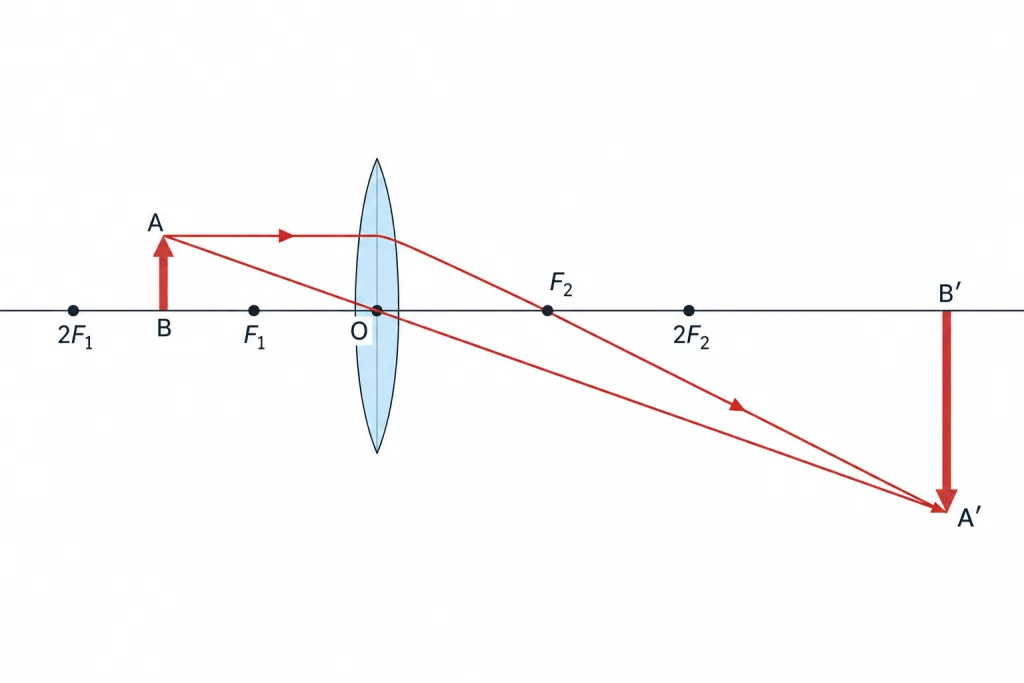
An object 2 cm tall is placed 16 cm in front of a convex lens of focal length 12 cm.
(a) Draw a ray diagram to show the formation of the image. (1 mark)
Answer.
- A ray parallel to the principal axis passing through F2 after refraction, and a ray through the optical centre going straight (0.25 + 0.25) — 0.5 marks
- The rays meeting beyond 2F2 to give a real, inverted, enlarged image — 0.5 marks
(b) Use the lens formula to find the image distance and the height of the image. (1 mark)
Answer.
- , so cm on the other side of the lens — 0.5 marks
- cm: the image is 6 cm tall and inverted — 0.5 marks
Question 34 (2 marks)
Attempt either option (A) or (B).
(A) The Verma family in Lucknow uses an electric geyser rated 1.5 kW for 40 minutes every day.
(I) How many joules make one kilowatt hour (1 kWh)? (1 mark)
Answer.
- 1 kWh = 1000 W × 3600 s J — 1 mark
(II) Find the electrical energy used by the geyser in 30 days, and its cost at ₹ 6 per kWh. (1 mark)
Answer.
- Energy kWh — 0.5 marks
- Cost = 30 × ₹ 6 = ₹ 180 — 0.5 marks
OR
(B) A wire of resistance 8 Ω is stretched uniformly until its length becomes double.
(I) Find the new resistance of the wire. (1 mark)
Answer.
- The volume stays the same, so the area of cross-section becomes half: , i.e. 32 Ω — 1 mark
(II) Does the resistivity of the wire change? Give a reason. (1 mark)
Answer.
- No — 0.5 marks
- Resistivity depends on the material (and temperature), not on the length or thickness of the wire — 0.5 marks
Question 35 (3 marks)
A dentist holds a small concave mirror of focal length 4 cm at a distance of 3 cm from a tooth.
(a) Find the position of the image. (1 mark)
Answer.
- cm, cm; , so cm: the image is 12 cm behind the mirror — 1 mark
(b) Find the magnification, and state the nature of the image. (1 mark)
Answer.
- — 0.5 marks
- The image is virtual, erect and four times enlarged — 0.5 marks
(c) Why does the dentist not use a convex mirror for this purpose? (1 mark)
Answer.
- A convex mirror always forms a diminished image, but the dentist needs an enlarged image of the tooth — 1 mark
Question 36 (3 marks)
A long solenoid is connected to a battery through a key, and the key is closed.
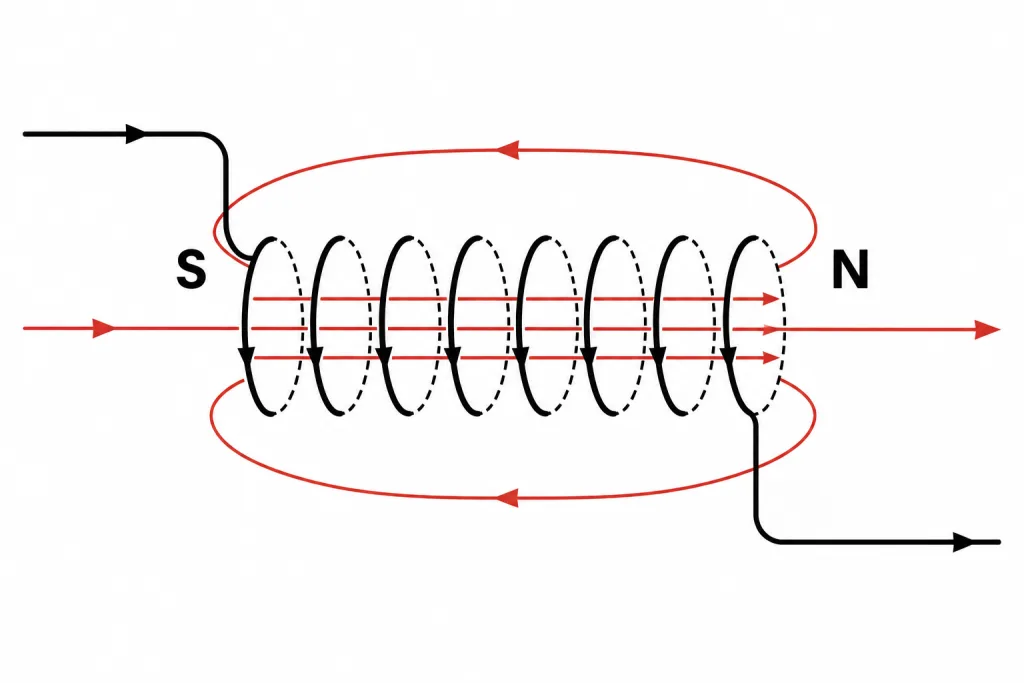
(a) Draw the pattern of magnetic field lines in and around the solenoid. Show the direction of the current in the coil and mark the north and south poles. (2 marks)
Answer.
- Field lines: parallel straight lines inside, and closed curves outside like those of a bar magnet — 1 mark
- Direction of current and of field lines shown correctly, with the N pole at the end from which the field lines come out (right-hand thumb rule) — 1 mark
(b) What does the pattern of field lines inside the solenoid tell you about the magnetic field there? State one use of this. (1 mark)
Answer.
- The field is the same at all points inside (uniform) — 0.5 marks
- It can be used to magnetise a piece of soft iron placed inside, making an electromagnet — 0.5 marks
Question 37 (3 marks)
Study the circuit shown. The key K is closed.
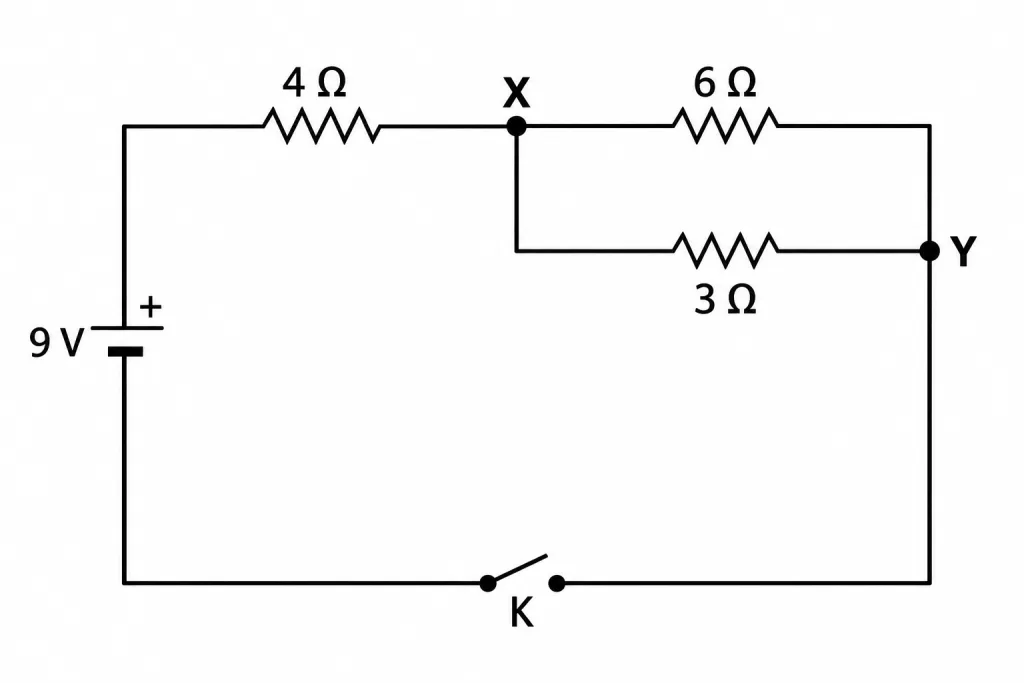
(a) Find the total resistance of the circuit and the current drawn from the battery. (2 marks)
Answer.
- Parallel part: , so Ω — 1 mark
- Total resistance Ω (0.5); current A (0.5) — 1 mark
(b) Find the potential difference between X and Y, and the current through the 6 Ω resistor. (1 mark)
Answer.
- V — 0.5 marks
- Current through the 6 Ω resistor A — 0.5 marks
Question 38 (4 marks)
During frequent power cuts in summer, the Mishra family in Patna uses an inverter. Its 12 V battery stores energy and gives direct current (DC). When the mains supply fails, the inverter changes this DC into alternating current (AC) of 220 V and 50 Hz, the same as the mains supply, and feeds it into the house wiring. In the house, the fans, the lights and the fridge are all connected in parallel, and each circuit is protected by an MCB (miniature circuit breaker).
(a) What does '50 Hz' tell us about the alternating current? (1 mark)
Answer.
- The current reverses its direction again and again, completing 50 cycles every second; it changes direction after every s — 1 mark
(b) State one advantage of AC over DC. (1 mark)
Answer.
- AC can be transmitted over long distances without much loss of energy — 1 mark
(c) The inverter can supply a current of at most 5 A at 220 V. During a power cut the family runs the fridge (300 W), four fans (75 W each) and five LED bulbs (20 W each). Can they also switch on an electric iron of 750 W? Show your working. (2 marks)
Answer.
- Largest power the inverter can supply W — 1 mark
- Load already on = 300 + 300 + 100 = 700 W; with the iron it would be 1450 W, which is more than 1100 W, so they cannot use the iron (only up to 400 W more can be added) — 1 mark
OR
(c) In the kitchen circuit, which is protected by a 10 A MCB, an electric oven of 2 kW and an electric kettle of 1.3 kW are switched on together on the 220 V supply. Find the total current drawn. What will the MCB do, and why? (2 marks)
Answer.
- Total power W; A — 1 mark
- 15 A is more than 10 A, so the MCB switches off (trips) the circuit and protects the wiring from overheating due to overloading — 1 mark
Question 39 (5 marks)
Attempt either option (A) or (B).
(A) Sunita, a Class 10 student in Shimla, reads her textbook easily, but the writing on the blackboard looks blurred from the last bench. Her eye doctor prescribes spectacles of power -0.5 D.
(i) What does the negative sign of the power tell you about the lens? Which defect of vision does Sunita have? (1 mark)
Answer.
- The lens is concave (diverging) — 0.5 marks
- Myopia (near-sightedness) — 0.5 marks
(ii) Find the far point of Sunita's eye. (1 mark)
Answer.
- m; the lens makes rays from a distant object seem to come from its focus, 2 m away, so her far point is 2 m from the eye — 1 mark
(iii) Sunita's cousin has the same defect, but his far point is 4 m from his eye. Will he need a lens of greater or smaller power than Sunita? Give a reason. (1 mark)
Answer.
- Smaller power: his lens needs m, so D; the farther the far point, the less the rays need to be spread out — 1 mark
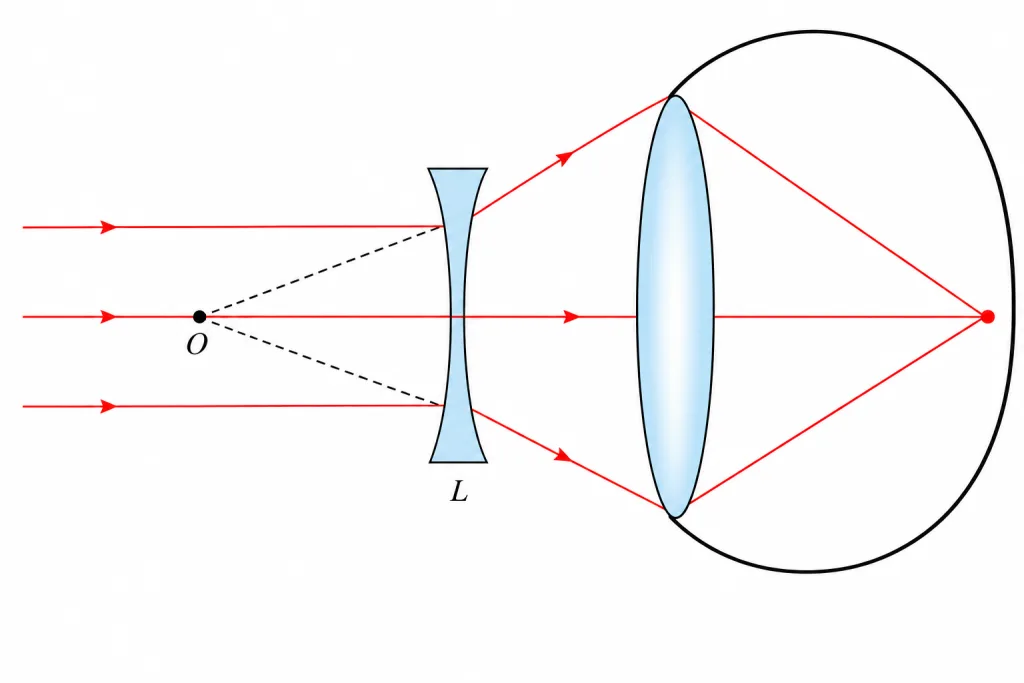
(iv) Draw a ray diagram to show how Sunita's spectacle lens lets her see a distant object clearly. Mark her far point. (2 marks)
Answer.
- Parallel rays from a distant object falling on a concave lens L placed in front of the eye, and diverging as if they come from the far point O (marked) — 1 mark
- The eye lens focusing these rays on the retina — 1 mark
OR
(B) Light is bent as it passes through the Earth's atmosphere and through glass.
(i) We can see the Sun about two minutes before it actually rises above the horizon. Explain why. (1 mark)
Answer.
- Atmospheric refraction: light from the Sun, still just below the horizon, bends towards the normal as it passes into the denser lower layers of air, and so reaches our eyes — 1 mark
(ii) If the Earth had no atmosphere, would a day (sunrise to sunset) be longer or shorter than now? Give a reason. (1 mark)
Answer.
- Shorter, by about four minutes: without atmospheric refraction we would lose the two minutes gained at sunrise and the two minutes gained at sunset — 1 mark
(iii) Why do stars twinkle? (1 mark)
Answer.
- Starlight passes through layers of air whose optical density keeps changing, so it is refracted by different amounts; the apparent position of the star and the light reaching the eye keep changing — 1 mark
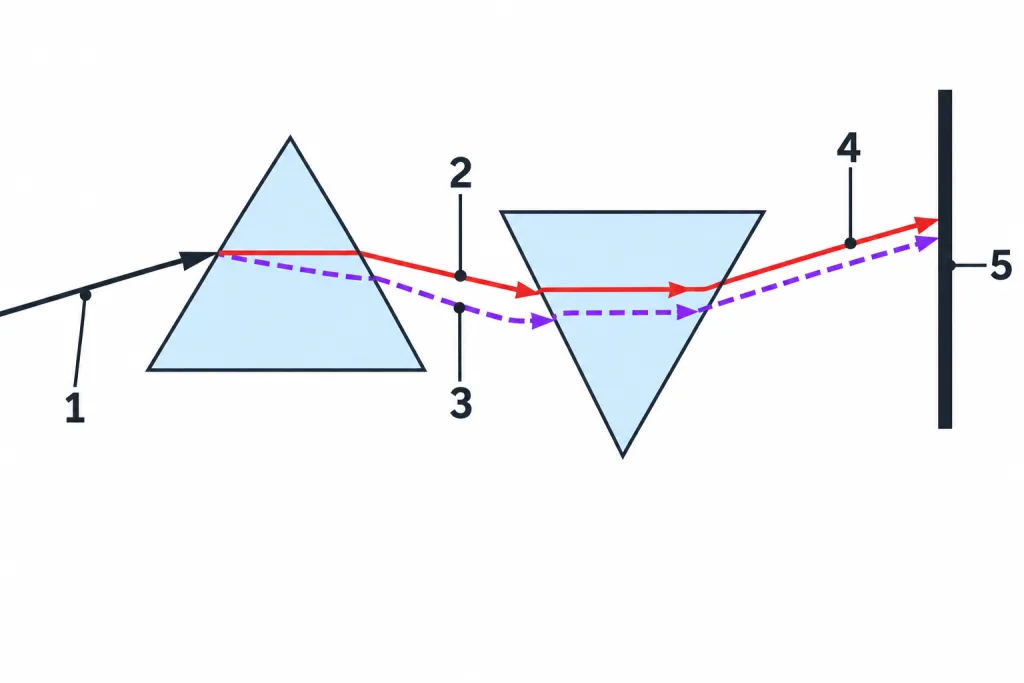
(iv) Draw a labelled diagram of the arrangement of two identical glass prisms by which the colours of white light can be combined to give white light again. (2 marks)
Answer.
- Two identical prisms, the second placed upside down with respect to the first — 1 mark
- Correct paths: white light split by the first prism and recombined by the second, coming out as white light (in the figure: 1 white light, 2 red, 3 violet, 4 white light, 5 screen) — 1 mark