
Detailed Solutions: CBSE Class 10 Science Sample Paper 2027 – Set 4
Every written question from the paper (2, 3, 4 and 5 marks) is solved here in order, with the marks given for each step, so you can check your answer sheet the way an examiner would. Where a question has an internal choice (OR), both options are solved. The 1-mark questions are answered, with explanations, in the quiz on the Question Paper page.
Section A - Biology (30 marks)
Question 10 (2 marks)
Answer the following:
(a) During one complete round of the body, blood passes through the heart only once in a fish, but twice in a human being. Trace the path of the blood in each, starting from the heart. (1 mark)
Answer.
- Fish: heart → gills (where it takes up oxygen) → rest of the body → back to the heart — 0.5 marks
- Human: heart (right side) → lungs → heart (left side) → rest of the body → back to the heart — 0.5 marks
(b) Mehak says, "A fish heart has only two chambers, so oxygen-rich and oxygen-poor blood must get mixed in it." Is she right? Explain. (1 mark)
Answer.
- No — 0.5 marks
- The fish heart receives only oxygen-poor blood from the body and pumps it to the gills; the oxygen-rich blood from the gills goes straight to the body without coming back to the heart, so the two kinds never meet in the heart — 0.5 marks
Question 11 (2 marks)
Attempt either option (A) or (B).
(A) Mr Gill's blood tests show that the sugar level in his blood stays high long after his meals, and his doctor says that he has diabetes. Name the hormone whose shortage causes this, and the gland that makes it. How does the body normally keep the amount of this hormone right, by a feedback mechanism?
Answer.
- Insulin (0.5), made by the pancreas (0.5) — 1 mark
- When the blood sugar level rises, the cells of the pancreas detect it and release more insulin; as the sugar level falls, the release of insulin is reduced — 1 mark
OR
(B) A nine-year-old boy is growing very slowly. Tests show that his pituitary gland is healthy, but the part of the brain that signals it to release growth hormone is not working properly. Name this part of the brain. How does it normally get the pituitary to release growth hormone?
Answer.
- The hypothalamus — 1 mark
- When the level of growth hormone in the body is low, the hypothalamus releases a growth hormone releasing factor, which stimulates the pituitary gland to release growth hormone — 1 mark
Question 12 (2 marks)
The body cells of a human being have 46 chromosomes, which include one pair of sex chromosomes.
(a) Write the chromosome make-up, in the form 'autosomes + sex chromosomes', of (I) a liver cell of a man and (II) an egg cell. (1 mark)
Answer.
- (I) 44 + XY — 0.5 marks
- (II) 22 + X — 0.5 marks
(b) A zygote has the make-up 44 + XX. What was the make-up of the sperm that fertilised the egg? Will the child be a boy or a girl? (1 mark)
Answer.
- The sperm was 22 + X — 0.5 marks
- The child will be a girl — 0.5 marks
Question 13 (3 marks)
While gardening, Tara's finger was pricked by a rose thorn, and she pulled her hand back at once, even before she felt the pain.
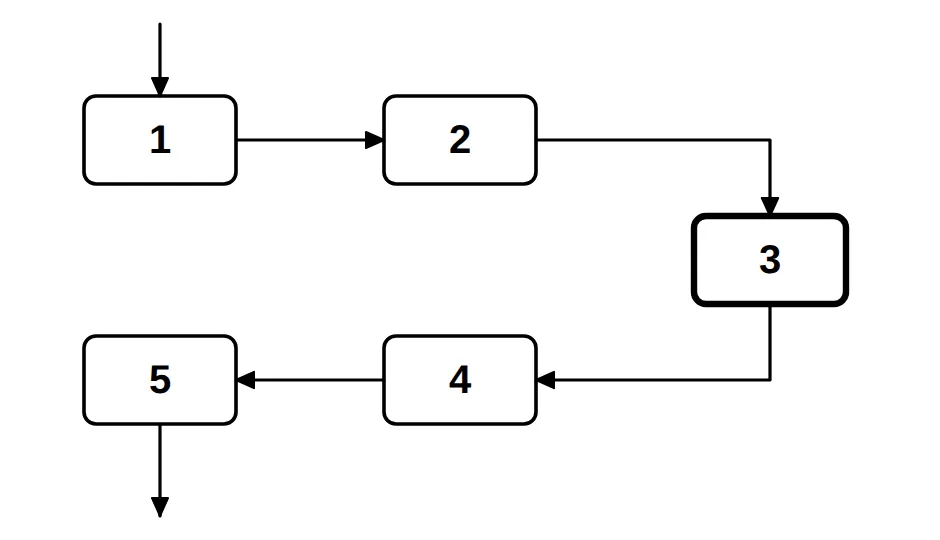
(a) Show, as a flow chart of numbered boxes, the route taken by the message in Tara's body from the thorn prick to the pulling back of her hand. Why is this action handled by the spinal cord and not left to the brain? (2 marks)
Answer.
- Flow chart in the correct order (in the figure: 1 receptors in the skin, 2 sensory neuron, 3 relay neuron in the spinal cord, 4 motor neuron, 5 effector: muscles of the arm) — 1 mark
- The spinal cord passes the message from the sensory nerve straight on to the motor nerve; thinking in the brain takes longer, and the hand must be moved at once to avoid harm — 1 mark
(b) Suppose the motor nerve that carries messages from Tara's spinal cord to the muscles of that arm is damaged, but the sensory nerve is working. Will she still feel the prick? Will she pull her hand back? Give a reason. (1 mark)
Answer.
- Yes, she will feel the prick, because the message still reaches the spinal cord and goes on to the brain — 0.5 marks
- No, she will not pull her hand back, because no message can reach the muscles of the arm — 0.5 marks
Question 14 (3 marks)
The figure shows the pyramid of energy for a food chain in a forest: P is grass, Q is deer and R is tiger.
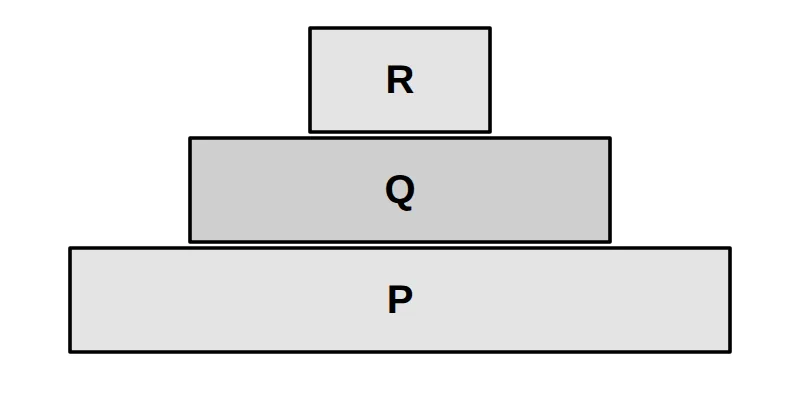
(a) Why is each level of the pyramid narrower than the level below it? (1 mark)
Answer.
- At each trophic level, a large part of the energy taken in is used up by the organisms for their own life processes and lost as heat — 0.5 marks
- Only about 10 per cent is stored in their bodies and passes on to the next level — 0.5 marks
(b) The grass in this area traps 50,000 kJ of energy. Using the 10 per cent law, find the energy that reaches R. (1 mark)
Answer.
- Deer (Q): 10 per cent of 50,000 kJ = 5,000 kJ — 0.5 marks
- Tiger (R): 10 per cent of 5,000 kJ = 500 kJ — 0.5 marks
(c) Poachers kill most of the deer in this forest. What will happen to (I) the grass and (II) the tigers? Give a reason for each. (1 mark)
Answer.
- (I) The grass will grow more (increase), since few deer are left to eat it — 0.5 marks
- (II) The tigers will decrease, since they lose their food; many may starve or move away — 0.5 marks
Question 15 (4 marks)
Ananya, a Class 10 student in Varanasi, placed a few twigs of the water plant Hydrilla in a beaker of water under an inverted glass funnel, with a test tube full of water over the stem of the funnel. She placed a lamp at different distances from the beaker and, after waiting two minutes each time, counted the gas bubbles that came out of the cut ends of the twigs in one minute. Her results are given below.
| Distance of the lamp (cm) | 10 | 20 | 30 | 40 |
|---|---|---|---|---|
| Bubbles per minute | 40 | 24 | 14 | 8 |
(a) Which gas collects in the test tube? How can Ananya test it? (1 mark)
Answer.
- Oxygen — 0.5 marks
- A glowing splinter brought to the mouth of the test tube bursts into flame — 0.5 marks
(b) What will happen to the bubbling if she switches off the lamp and covers the beaker with a black cloth? Give a reason. (1 mark)
Answer.
- The bubbling will almost stop — 0.5 marks
- because photosynthesis needs light energy, so no oxygen is produced in the dark — 0.5 marks
(c) What do her results show about the effect of light intensity on the rate of photosynthesis? Explain why the number of bubbles falls as the lamp is moved away. (2 marks)
Answer.
- The brighter the light (the closer the lamp), the faster the rate of photosynthesis; as the lamp moves away, the light reaching the plant becomes weaker — 1 mark
- With less light energy absorbed by the chlorophyll, less carbon dioxide and water are turned into carbohydrate, so less oxygen is given out and fewer bubbles form — 1 mark
OR
(c) Keeping the lamp at 30 cm, Ananya dissolved a pinch of sodium hydrogencarbonate (baking soda) in the water, and the count rose from 14 to about 22 bubbles per minute. Explain this result, and write the balanced equation for photosynthesis. (2 marks)
Answer.
- Sodium hydrogencarbonate supplies more dissolved carbon dioxide, a raw material of photosynthesis; with more carbon dioxide available, the plant photosynthesises faster and gives out more oxygen — 1 mark
- , in the presence of chlorophyll and sunlight (the word equation, carbon dioxide + water → glucose + oxygen, with these conditions, also gets full credit) — 1 mark
Question 16 (5 marks)
Attempt either option (A) or (B).
(A) In her school garden near Coimbatore, Meena chose three sets of flower buds on a plant with bisexual flowers, just before they opened. She covered the buds of set P with paper bags. From the buds of set Q she removed all the stamens and then covered them with bags. From the buds of set R she cut off the stigma and style, and left them uncovered.
(i) Which set of flowers is likely to form seeds? Give a reason for each set. (1 mark)
Answer.
- Only set P: the flowers are bisexual, so pollen from their own stamens can fall on the stigma inside the bag (self-pollination) — 0.5 marks
- Q has no stamens, and the bag keeps out pollen from other flowers; R has no stigma for pollen to land on and no style for a pollen tube to grow through — 0.5 marks
(ii) What should Meena do to get seeds from the flowers of set Q? What kind of pollination will this be? (1 mark)
Answer.
- Open the bags and dust pollen from the flowers of another plant of the same kind on the stigmas, then cover them again — 0.5 marks
- Cross-pollination — 0.5 marks
(iii) What do (I) the ovary and (II) the ovules develop into after fertilisation? (1 mark)
Answer.
- (I) The ovary grows and ripens into the fruit — 0.5 marks
- (II) The ovules develop into seeds — 0.5 marks
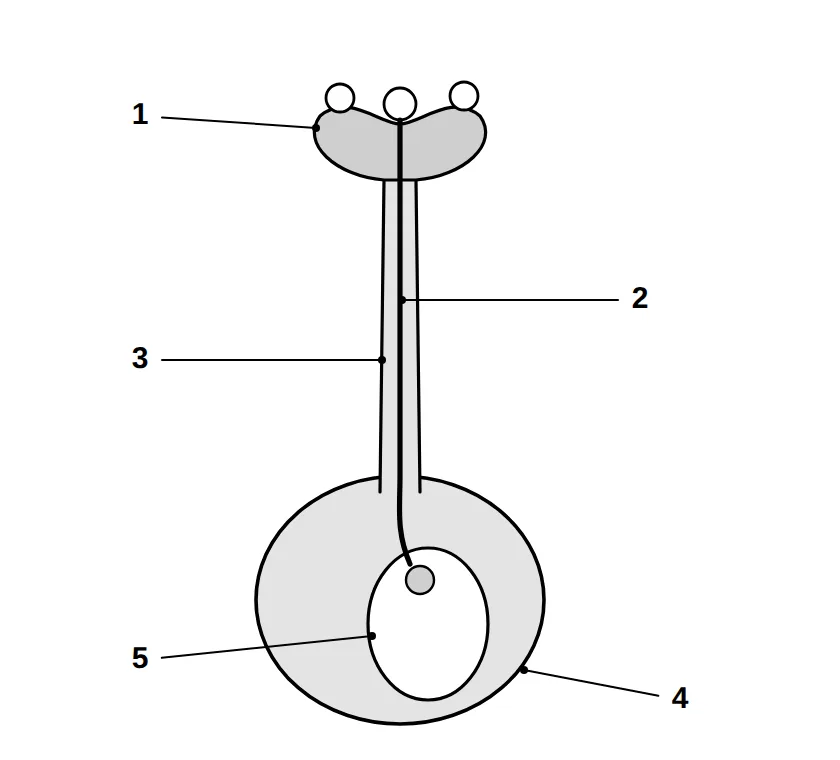
(iv) Draw a longitudinal section of a pistil showing a pollen tube that has reached the ovule. Label any four of these: stigma, style, pollen tube, ovary, ovule. (2 marks)
Answer.
- Correct diagram of the pistil with the pollen tube running from the stigma, through the style, into the ovule — 1 mark
- Any four parts correctly labelled, 0.25 each (in the figure: 1 stigma, 2 pollen tube, 3 style, 4 ovary, 5 ovule with the female germ-cell) — 1 mark
OR
(B) At a health talk for Class 10, the school doctor explained the human male reproductive system and the methods couples use to avoid pregnancy.
(i) (I) Why are the testes located outside the abdominal cavity, in the scrotum? (II) What is the role of the vas deferens? (III) Name two glands that add their secretions to the sperms, and state how these secretions help. (3 marks)
Answer.
Model answer:
(I) The testes make the sperms, and sperm formation needs a temperature lower than the normal body temperature. So the testes lie outside the abdominal cavity, in the scrotum, where it is a little cooler. (II) The vas deferens carries the sperms away from the testes. It joins the tube coming from the urinary bladder, so the urethra is a common passage for both the sperms and urine. (III) On the way, the prostate gland and the seminal vesicles add their secretions. The sperms are now in a fluid, which makes their transport easier and also provides them with nutrition.
Marking scheme:
- (I) The formation of sperms needs a temperature lower than the normal body temperature — 1 mark
- (II) It carries the sperms from the testes; it joins the tube coming from the urinary bladder, so the urethra is a common passage for sperms and urine — 1 mark
- (III) The prostate gland and the seminal vesicles (0.5); their secretions put the sperms in a fluid, which makes their transport easier and also gives them nutrition (0.5) — 1 mark
(ii) (I) Give two reasons why contraception is important. (II) Which contraceptive method both prevents pregnancy and protects against sexually transmitted infections? Why do oral pills not give the second kind of protection? (2 marks)
Answer.
Model answer:
(I) Frequent pregnancies take a heavy toll on the mother's body and health. Contraception also lets a couple plan when to have children and how many, which helps to keep the population of the country in check. (II) The condom does both jobs. It is a mechanical barrier, so sperms cannot reach the egg, and the partners' body fluids, which can carry infections such as HIV-AIDS, do not come into contact. Oral pills work only by changing the hormonal balance so that eggs are not released; they put no barrier between the partners, so they give no protection against infections.
Marking scheme:
- (I) Any two: frequent pregnancies harm the health of the mother; it helps a couple plan the size of their family and so helps keep the population in check; barrier methods also prevent the spread of sexually transmitted diseases (0.5 each) — 1 mark
- (II) The condom (0.5); oral pills only change the hormonal balance so that eggs are not released, but they do not stop contact with the body fluids that carry the infections (0.5) — 1 mark
Section B - Chemistry (25 marks)
Question 25 (2 marks)
Karan knows that sodium, potassium and calcium cannot be obtained by heating their oxides with carbon, so they are extracted by electrolysis. He suggests passing a current through a solution of sodium chloride in water to get sodium.
(a) Why will Karan's method not give sodium metal? (1 mark)
Answer.
- Sodium is so reactive that any sodium formed would react at once with the water (giving sodium hydroxide and hydrogen); so the sodium chloride has to be electrolysed in the molten state, without water — 1 mark
(b) In the electrolysis of molten sodium chloride, write the equation for the change at the cathode, and name the product formed at the anode. (1 mark)
Answer.
- — 0.5 marks
- Chlorine gas is formed at the anode — 0.5 marks
Question 26 (3 marks)
Neha is revising decomposition reactions from her notebook.
(a) She has written the equation for heating lead nitrate as . What is wrong with it? Write the correct balanced equation. (1 mark)
Answer.
- The equation is not balanced: the nitrogen and oxygen atoms on the two sides are not equal — 0.5 marks
- — 0.5 marks
(b) Black-and-white photographic film is coated with pale yellow silver bromide, and it is sold in black packets. Why? Write the balanced equation for the change that the packet prevents. (1 mark)
Answer.
- Light decomposes silver bromide into silver and bromine, which would spoil the film; the black packet keeps light out — 0.5 marks
- — 0.5 marks
(c) Consider three decompositions: (I) of silver bromide into silver and bromine, (II) of lead nitrate on heating, and (III) of water into hydrogen and oxygen. Which of them could Neha carry out in a dark room that has a burner but no battery or other electric supply? Explain. (1 mark)
Answer.
- Only (II) — 0.5 marks
- All three absorb energy (they are endothermic), but in different forms: (I) needs light and (III) needs electricity, which are not available; (II) needs only heat, which the burner gives — 0.5 marks
Question 27 (3 marks)
Attempt either option (A) or (B).
(A) During a school picnic near Mysuru, Farah was stung by a honeybee. Her teacher washed the spot and put a paste of baking soda on it.
(i) Which acid does the bee sting inject? Why does the baking soda paste give relief? (1 mark)
Answer.
- Methanoic acid — 0.5 marks
- Baking soda (sodium hydrogencarbonate) is basic, so it neutralises the acid — 0.5 marks
(ii) Write the balanced chemical equation for the reaction between this acid and baking soda. (1 mark)
Answer.
- — 1 mark
(iii) One classmate suggests putting a little vinegar on the sting instead, and another suggests a paste of washing soda. Which suggestion could help? Give a reason for each. (1 mark)
Answer.
- Vinegar will not help: it contains acetic acid, and an acid cannot neutralise an acid — 0.5 marks
- Washing soda (sodium carbonate) could help, because it is basic and would neutralise the methanoic acid — 0.5 marks
OR
(B) Rekha's grandmother stored tamarind chutney in an old, dull brass pot. After two days the chutney tasted odd, and the inside of the pot looked bright and patchy.
(i) Why did the inside of the pot become bright in patches? Why did the chutney taste odd? (1 mark)
Answer.
- The acids in the tamarind reacted with the dull layer (basic oxides and carbonates) on the pot and with the zinc of the brass, dissolving them and exposing fresh, shiny metal — 0.5 marks
- The salts formed dissolved in the chutney, which gave it the odd taste and made it unsafe to eat — 0.5 marks
(ii) Brass contains zinc. Write the balanced chemical equation for the reaction of zinc with dilute hydrochloric acid, and give a test for the gas formed. (1 mark)
Answer.
- — 0.5 marks
- Hydrogen burns with a pop sound when a burning splinter is brought near it — 0.5 marks
(iii) Her neighbour suggests an aluminium container instead. Would that be a safe choice for the chutney? Give a reason. (1 mark)
Answer.
- No — 0.5 marks
- Aluminium is also a reactive metal and its oxide layer is amphoteric, so the acid in the chutney would react with it; a glass or ceramic jar would be safe — 0.5 marks
Question 28 (4 marks)
Joseph, a student in Visakhapatnam, set up three test tubes, as shown, to find the conditions under which iron rusts. In A he put clean iron nails in ordinary tap water and corked the tube. In B he put nails in water that had been boiled, poured a layer of oil over it and corked the tube. In C he put nails over some anhydrous calcium chloride and corked the tube. He left the tubes for a week.
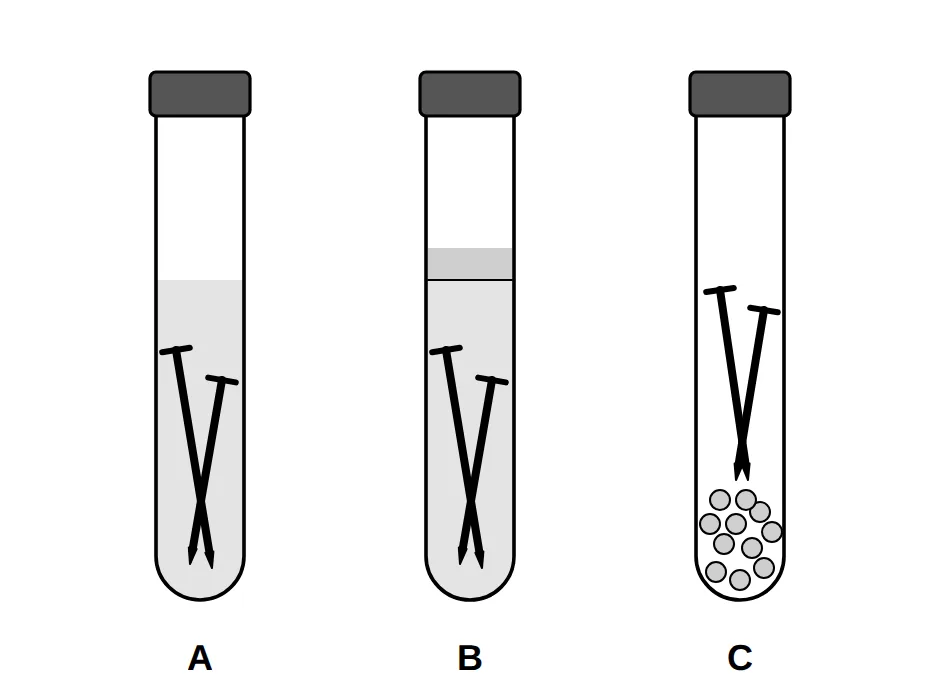
(a) In which test tube(s) will the nails rust? Give a reason. (1 mark)
Answer.
- Only in A — 0.5 marks
- because only there are both air and water present — 0.5 marks
(b) What is the role of (I) the layer of oil in B and (II) the anhydrous calcium chloride in C? (1 mark)
Answer.
- (I) The oil stops air from dissolving again in the boiled water, which has no dissolved air — 0.5 marks
- (II) Anhydrous calcium chloride absorbs moisture and keeps the air in the tube dry — 0.5 marks
(c) Suggest a suitable way to protect each of these from rusting, giving a reason: (I) the chain of a bicycle; (II) iron sheets for the roof of a shed. (2 marks)
Answer.
- (I) Oiling or greasing: the chain is a moving part, and a coat of oil or grease keeps out air and moisture without cracking or rubbing off as paint would — 1 mark
- (II) Galvanisation: coating the sheets with a thin layer of zinc, which keeps air and moisture away from the iron (painting, with the reason that the coat keeps out air and moisture, also gets full credit) — 1 mark
OR
(c) Joseph's father has bought a stainless-steel sink for the kitchen. (I) How is stainless steel made? (II) Give two ways in which it is better than pure iron for this use. (2 marks)
Answer.
- (I) By mixing iron with nickel and chromium (making an alloy) — 1 mark
- (II) It does not rust (0.5), and it is harder and stronger than pure iron, which is soft (0.5) — 1 mark
Question 29 (5 marks)
Attempt either option (A) or (B).
(A)
(i) Three students make these statements.
Anil: "When vegetable oil is heated with hydrogen in the presence of nickel, hydrogen atoms take the place of some atoms in the oil, so this is a substitution reaction."
Bhavna: "Methane and chlorine do not react in the dark, but in sunlight the chlorine atoms replace the hydrogen atoms of methane one by one."
Chetan: "Unsaturated hydrocarbons such as ethene burn with a clean blue flame, while saturated ones such as methane give a sooty flame."
Who is correct and who is not? Justify your answer, and write the chemical equation for the first step of the reaction described by Bhavna. (3 marks)
Answer.
Model answer:
Anil is not correct. In hydrogenation, hydrogen adds across the double bonds of the unsaturated vegetable oil in the presence of a nickel catalyst, and the oil becomes a saturated fat. Nothing is replaced, so it is an addition reaction. Bhavna is correct. In sunlight, chlorine replaces the hydrogen atoms of methane one by one, which is a substitution reaction. The first step is . Chetan has it the wrong way round. Saturated hydrocarbons such as methane burn with a clean blue flame, but unsaturated ones such as ethene burn with a yellow flame and a lot of black smoke, because much of their carbon is left unburnt.
Marking scheme:
- Anil is not correct: hydrogen adds across the double bonds of the unsaturated oil, turning it into a saturated fat; this is an addition reaction (hydrogenation), not substitution — 1 mark
- Bhavna is correct: it is a substitution reaction (0.5); , in the presence of sunlight (0.5) — 1 mark
- Chetan is not correct: it is the other way round; unsaturated compounds burn with a yellow, sooty flame, because their carbon does not burn completely, while saturated hydrocarbons give a clean flame — 1 mark
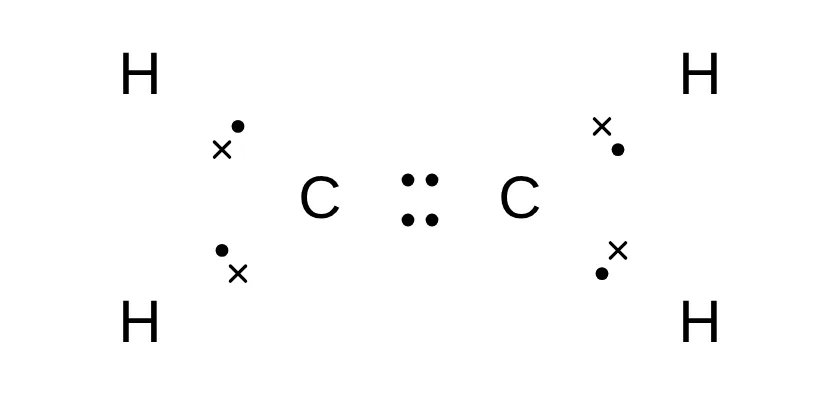
(ii) Draw the electron dot structure of ethene, . How many pairs of electrons are shared in all in one molecule? (2 marks)
Answer.
- Two shared pairs of electrons (a double bond) between the two carbon atoms — 1 mark
- One shared pair between each carbon atom and each of its two hydrogen atoms (0.25); six shared pairs in all (0.25) — 0.5 marks
- Structure neatly drawn, with each carbon atom having eight electrons around it — 0.5 marks
OR
(B)
(i) Two bottles, X and Y, have lost their labels. One contains ethanol and the other ethanoic acid. (I) Describe two tests, with their observations, that Arjun can use to find out which is which. (II) His friend suggests dropping a small piece of sodium into each liquid. Why is this not a good way to tell them apart? Support your answer with a chemical equation. (3 marks)
Answer.
Model answer:
(I) Arjun can dip blue litmus paper into a little of each liquid. The one that turns it red is ethanoic acid; ethanol leaves it blue. He can also add a pinch of sodium hydrogencarbonate to each. Ethanoic acid gives a brisk fizz of carbon dioxide, while ethanol shows no fizzing. (II) Sodium is not useful here, because it reacts with both liquids and gives off hydrogen in each case, for example . Ethanoic acid, like any acid, also gives hydrogen with sodium. Since both tubes fizz, the test cannot tell them apart.
Marking scheme:
- (I) Any two valid tests, 1 mark each (test 0.5, observations 0.5), for example: blue litmus turns red with ethanoic acid but not with ethanol; sodium hydrogencarbonate gives brisk effervescence of carbon dioxide with ethanoic acid but not with ethanol; ethanoic acid smells of vinegar — 2 marks
- (II) Both liquids react with sodium and give off hydrogen, so both fizz (0.5); for example (0.5) — 1 mark
(ii) (I) Give two reasons why carbon forms a very large number of compounds. (II) Write the structural formulae of the two isomers of butane, , and explain how they show one of these reasons at work. (2 marks)
Answer.
Model answer:
(I) Carbon is tetravalent, so each carbon atom can form bonds with four other atoms, which may be carbon or other elements such as hydrogen, oxygen, nitrogen or chlorine. Carbon also shows catenation: its atoms link with one another into long chains, branched chains and rings, because the carbon-carbon bond is very strong and stable. (II) The two isomers of butane are , a straight chain, and , a branched chain. Both have the formula , but the carbon atoms are joined differently. Because carbon chains can branch like this, one formula can stand for several compounds, which adds greatly to the number of carbon compounds.
Marking scheme:
- (I) Tetravalency: a carbon atom can bond with four other atoms, of carbon or of other elements such as hydrogen, oxygen, nitrogen and chlorine (0.5); catenation: carbon atoms link with one another to form long chains, branched chains and rings, because the carbon-carbon bond is very strong and stable (0.5) — 1 mark
- (II) and (0.5); the same four carbon atoms can link as a straight chain or a branched chain, so one formula gives two compounds (isomers), which is catenation at work (0.5) — 1 mark
Section C - Physics (25 marks)
Question 33 (2 marks)
Attempt either option (A) or (B).
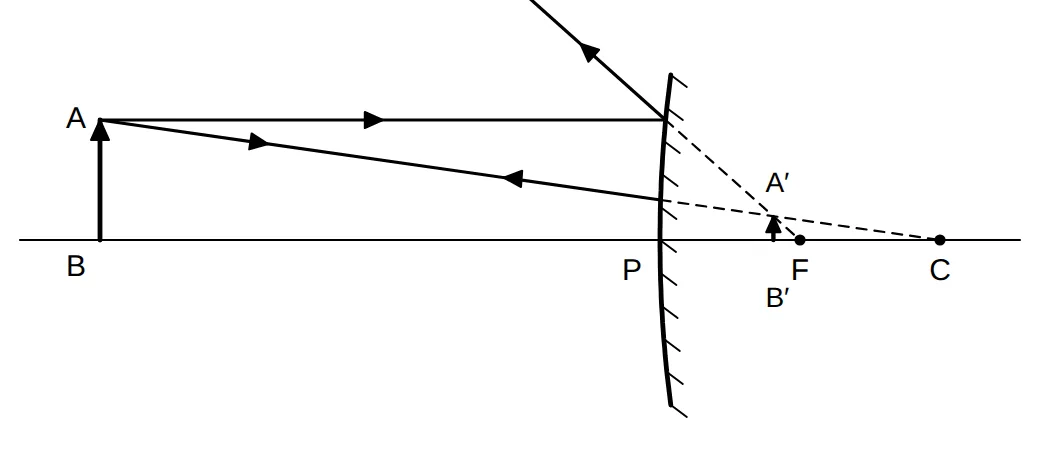
(A) The rear-view mirror of a bus is a convex mirror of focal length 1 m. A car is 4 m behind the mirror.
(a) Draw a ray diagram to show the formation of the image of the car AB in this mirror. (1 mark)
Answer.
- A ray parallel to the axis reflected as if coming from F, and a ray aimed at C reflected back along itself (0.25 + 0.25) — 0.5 marks
- Image A′B′ shown behind the mirror, between P and F, erect and diminished, with the backward extensions dashed — 0.5 marks
(b) Find the position of the image and the magnification. What does the value of the magnification tell the driver? (1 mark)
Answer.
- m, m; , so m, behind the mirror — 0.5 marks
- : the image is erect and one-fifth the size of the car, so a wide view fits in a small mirror — 0.5 marks
OR
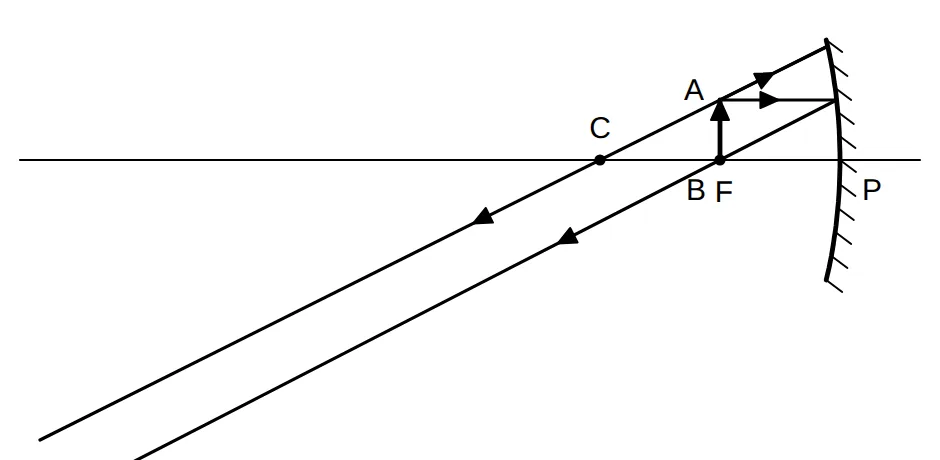
(B) An object AB is placed at the principal focus F of a concave mirror. Draw a ray diagram to show where its image is formed. State the position and nature of the image, and one use of placing a source of light at the focus of a concave mirror.
Answer.
- Ray diagram: a ray parallel to the axis reflected through F, and a ray along the line from C reflected back along itself; the two reflected rays are parallel — 1 mark
- The image is formed at infinity; it is real, inverted and highly enlarged — 0.5 marks
- A bulb at the focus of a concave reflector gives a parallel beam of light, as in torches, headlights and searchlights — 0.5 marks
Question 34 (2 marks)
Varun drew the circuit shown to study how the current through a resistor R changes with the potential difference across it. His teacher said that he had connected both meters wrongly.
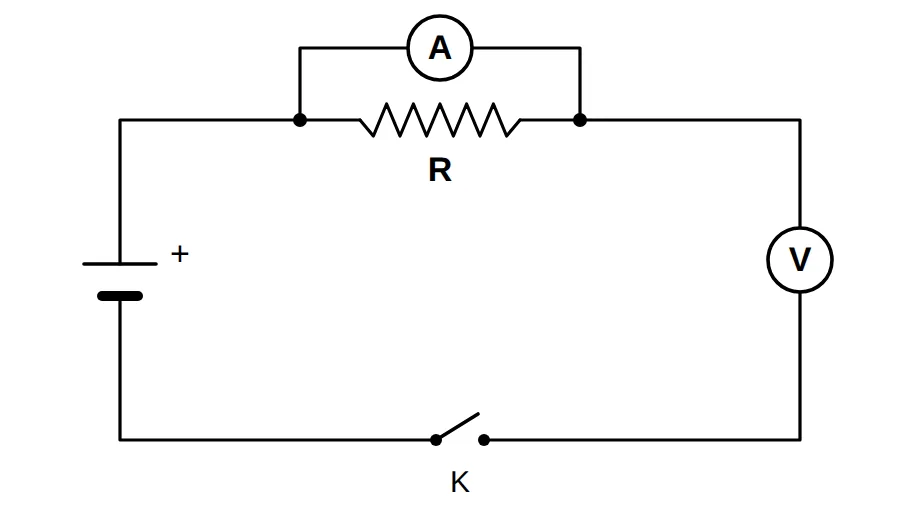
(a) What is wrong with the way each meter is connected? (1 mark)
Answer.
- The ammeter is connected in parallel with R — 0.5 marks
- The voltmeter is connected in series in the main circuit — 0.5 marks
(b) How should each meter be connected, and why? (1 mark)
Answer.
- The ammeter should be in series with R, so that the whole current through R flows through it — 0.5 marks
- The voltmeter should be in parallel across the ends of R, so that it measures the potential difference across R — 0.5 marks
Question 35 (3 marks)
Riya holds a concave lens of focal length 20 cm at a distance of 20 cm from a candle flame that is 4 cm tall. Her friend Dev says, "The flame is at the focus of the lens, so the image will be formed at infinity, just as it would be with a convex lens."
(a) Use the lens formula to find the position of the image. (1 mark)
Answer.
- cm, cm; , so cm: the image is 10 cm from the lens, on the same side as the flame — 1 mark
(b) Find the magnification and the height of the image, and state its nature. (1 mark)
Answer.
- , so the image is cm tall — 0.5 marks
- Virtual, erect and diminished — 0.5 marks
(c) Is Dev right? Explain. (1 mark)
Answer.
- No: a convex lens makes the rays from its focus parallel, but a concave lens always spreads rays out, so for any position of the object it forms a virtual, erect, diminished image between its focus and its optical centre — 1 mark
Question 36 (3 marks)
Priya passed a current through a circular loop of wire that goes through a sheet of cardboard, and sprinkled iron filings on the sheet.
(a) Draw the pattern of the magnetic field lines on the sheet, showing the direction of the current in the loop and the direction of the field lines. (2 marks)
Answer.
- Concentric circles around each point where the wire passes through the sheet, becoming larger away from the wire — 1 mark
- Near the centre of the loop the lines are nearly straight; directions of the current and the field lines consistent with the right-hand thumb rule — 1 mark
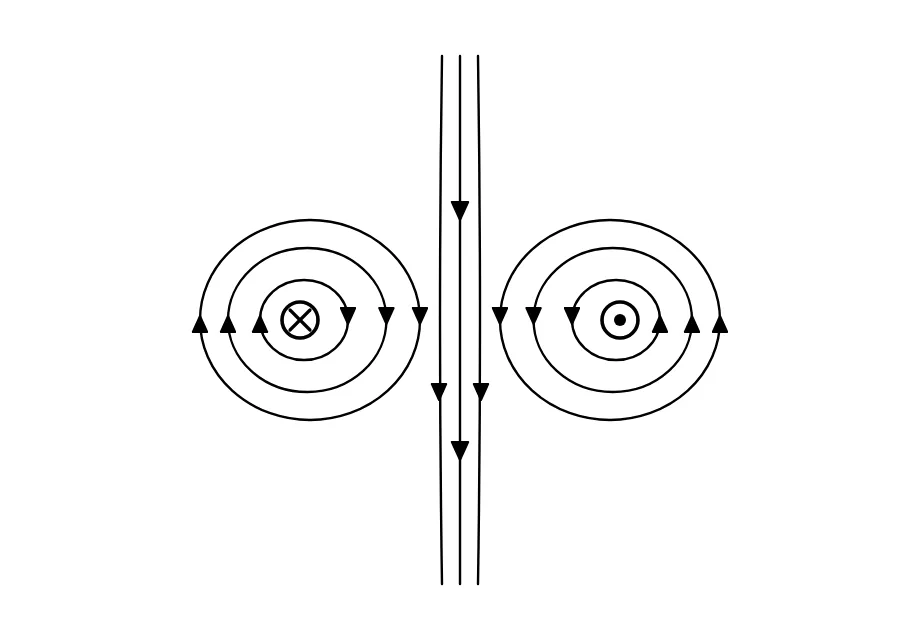
(b) Priya now reverses the connections of the battery. What change will she see in the field? What would change if she used a coil of 10 turns carrying the same current, in place of the single loop? (1 mark)
Answer.
- The direction of every field line is reversed; the pattern stays the same — 0.5 marks
- The field becomes about 10 times stronger, because the fields of the turns add up — 0.5 marks
Question 37 (3 marks)
The wiring in the Bose family's house has a live wire, a neutral wire and an earth wire, and each circuit is protected by an MCB (miniature circuit breaker) or a fuse.
(a) Name the most likely fault in each case. (I) The MCB of the bedroom trips the instant a single lamp is switched on, and a spark is seen at the switchboard. (II) The MCB of the bathroom circuit trips only when the geyser is switched on while the heater and the iron in that circuit are already running. (1 mark)
Answer.
- (I) Short-circuiting — 0.5 marks
- (II) Overloading — 0.5 marks
(b) Explain why the current becomes very large in each of these faults. (1 mark)
Answer.
- Short-circuiting: the live and neutral wires come into direct contact, so the resistance of the circuit becomes almost zero — 0.5 marks
- Overloading: the appliances are in parallel, each draws its own current, and the total current becomes more than the circuit can carry — 0.5 marks
(c) Why must a fuse be connected in the live wire? What would be the danger if the electrician put it in the neutral wire? (1 mark)
Answer.
- When a fuse in the live wire blows, the appliance is cut off from the high potential of the supply — 0.5 marks
- If the fuse were in the neutral wire, the current would stop when it blows, but the appliance would still be joined to the live wire; its parts would stay at a high potential, and touching them could give a shock — 0.5 marks
Question 38 (4 marks)
At a free eye camp in a village near Puri in Odisha, Dr Mohanty tested the eyesight of people of all ages. Ten-year-old Lipi could read small print held 25 cm from her eyes, and could also read a signboard far down the road. Her grandfather could see the distant fishing boats clearly, but had to hold the newspaper at arm's length to read it. The doctor explained that the eye lens changes its focal length to focus objects at different distances, and that this ability becomes weaker with age.
(a) What is this ability of the eye lens called? Which part of the eye brings it about? (1 mark)
Answer.
- Power of accommodation — 0.5 marks
- The ciliary muscles, which change the curvature of the eye lens — 0.5 marks
(b) Why can the grandfather still see the distant boats clearly, but not the newspaper held close? What is his defect of vision called? (1 mark)
Answer.
- To see far, the eye lens only has to stay thin with the ciliary muscles relaxed; to see near, it must become thicker, but with age the ciliary muscles have weakened and the lens has become less flexible, so it cannot — 0.5 marks
- Presbyopia (0.5); 'hypermetropia' or 'far-sightedness' gets 0.25, since the effect is the same but it does not name the age-related defect — 0.5 marks
(c) The doctor prescribes reading glasses of power +2 D, with which the grandfather can read a newspaper held 25 cm from his eyes. Find the focal length of the lens and the near point of his eye. (2 marks)
Answer.
- m cm, a convex lens — 1 mark
- The lens forms an image of the print at his near point: , so cm; his near point is 50 cm from the eye — 1 mark
OR
(c) A 62-year-old woman at the camp could see neither nearby nor distant objects clearly. The doctor gave her bifocal lenses whose upper part has a power of -0.4 D. Why does she need bifocal lenses, and what kind of lens is each part? Find the far point of her eye. (2 marks)
Answer.
- She has both myopia and hypermetropia; the upper part is a concave lens, for distant vision, and the lower part is a convex lens, for reading (0.5 + 0.5) — 1 mark
- m; the upper lens makes rays from far away seem to come from its focus, so her far point is 2.5 m from the eye — 1 mark
Question 39 (5 marks)
Attempt either option (A) or (B).
(A) In the circuit shown, the key K is closed. Treat the ammeter and the voltmeter as ideal meters.
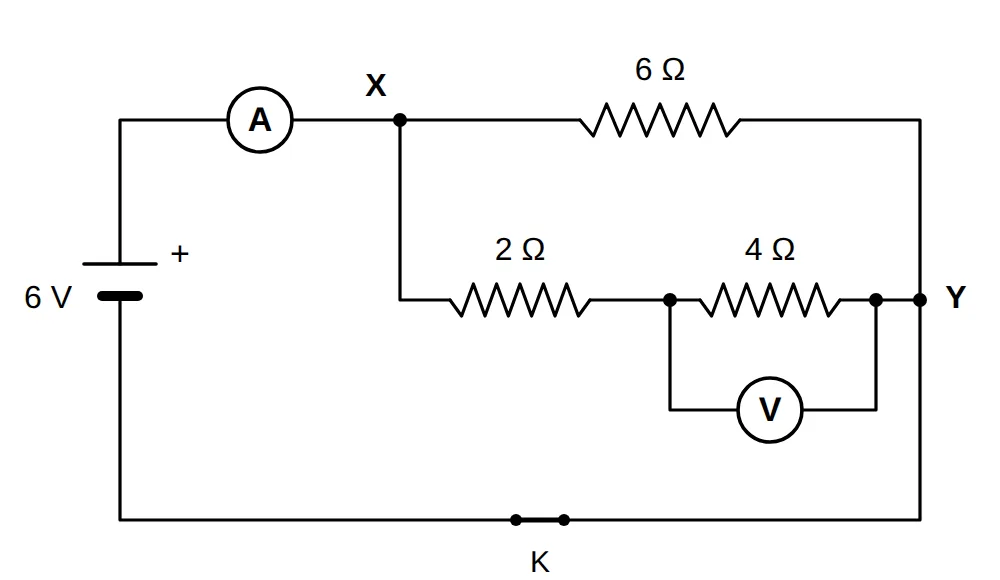
(i) Find (I) the total resistance between X and Y, (II) the reading of the ammeter and (III) the reading of the voltmeter. (3 marks)
Answer.
- (I) Lower branch: Ω; with the 6 Ω branch in parallel, , so Ω — 1 mark
- (II) Ammeter reading A — 1 mark
- (III) Current in the lower branch A; voltmeter reading V — 1 mark
(ii) (I) Find the power used in the 2 Ω resistor. (II) The 6 Ω resistor burns out and breaks. What will the ammeter and the voltmeter read now? Give a reason. (2 marks)
Answer.
- (I) W — 1 mark
- (II) Only the lower branch is left, with 6 V across it: the ammeter reads 1 A (0.5); the voltmeter still reads 4 V, because the current in the lower branch is unchanged (0.5) — 1 mark
OR
(B) The Iyer family uses these appliances every day: an air conditioner of 1.5 kW for 6 hours, four fans of 50 W each for 10 hours, and five LED bulbs of 20 W each for 10 hours. Electricity costs ₹ 7 per kWh.
(i) Find the electrical energy they use in a day, their bill for a month of 30 days, and how much they would save in that month by running the air conditioner for 2 hours less every day. (3 marks)
Answer.
- Energy per day kWh — 1 mark
- In 30 days: 12 × 30 = 360 kWh; bill = 360 × ₹ 7 = ₹ 2520 — 1 mark
- Saving kWh, i.e. 90 × ₹ 7 = ₹ 630 — 1 mark
(ii) Their electric iron is rated 1100 W, 220 V. Find the current it draws and the resistance of its element. When they take it to a place where the supply is only 110 V, what power will it use? (Take the resistance of the element to be unchanged.) (2 marks)
Answer.
Model answer:
The iron draws A, and the resistance of its element is Ω. On a 110 V supply the resistance is still 44 Ω, so the power is W. Halving the voltage halves the current as well, so the power falls to one-fourth, and the iron heats up much more slowly.
Marking scheme:
- A (0.5); Ω (0.5) — 1 mark
- On 110 V: W, one-fourth of its rated power, since halving the voltage halves the current too — 1 mark