
CBSE Class 10 Science Sample Paper 2027 – Set 4
Time allowed: 3 hours · Maximum marks: 80
General Instructions
- This question paper contains 39 questions. All questions are compulsory.
- The question paper is divided into THREE sections: Section A - Biology (30 marks), Section B - Chemistry (25 marks) and Section C - Physics (25 marks).
- The question paper has MCQs, VSAs, SAs, LAs and CBQs. Marks are given against each question.
- There are Case Based Questions (CBQs) with three sub-questions, of 4 marks each.
- Divide your answer sheet into three sections as per the question paper: Section A (Biology), Section B (Chemistry) and Section C (Physics). Answer each question in its own section, and do not mix answers of one section with another.
- Instructions are given with each section and question, wherever necessary.
- There is no overall choice in the question paper. However, an internal choice has been provided in a few questions. Only one of the choices in such questions must be attempted.
How to use this paper: set a 3-hour timer and write all your answers on paper, just like the board exam. When you finish, take the quiz at the end of this page to score your objective (MCQ) answers instantly, then open the Detailed Solutions and check the rest step by step, with the marks each step carries.
Section A - Biology (30 marks)
Questions 1 to 7 are multiple choice questions and questions 8 and 9 are Assertion-Reason questions, of 1 mark each. Questions 10 to 12 carry 2 marks each, questions 13 and 14 carry 3 marks each, question 15 is a case based question of 4 marks and question 16 is a long answer question of 5 marks.
1. A meal of paneer and butter has just reached Tenzin's small intestine, where pancreatic juice and bile are poured in. Which option correctly states the action of the two pancreatic enzymes named and the place where bile acts?
(a) Trypsin breaks down fats; lipase digests proteins; bile acts in the stomach.
(b) Trypsin digests proteins; lipase breaks down emulsified fats; bile acts in the stomach.
(c) Trypsin digests proteins; lipase breaks down emulsified fats; bile acts in the small intestine.
(d) Trypsin digests starch; lipase breaks down emulsified fats; bile acts in the small intestine.
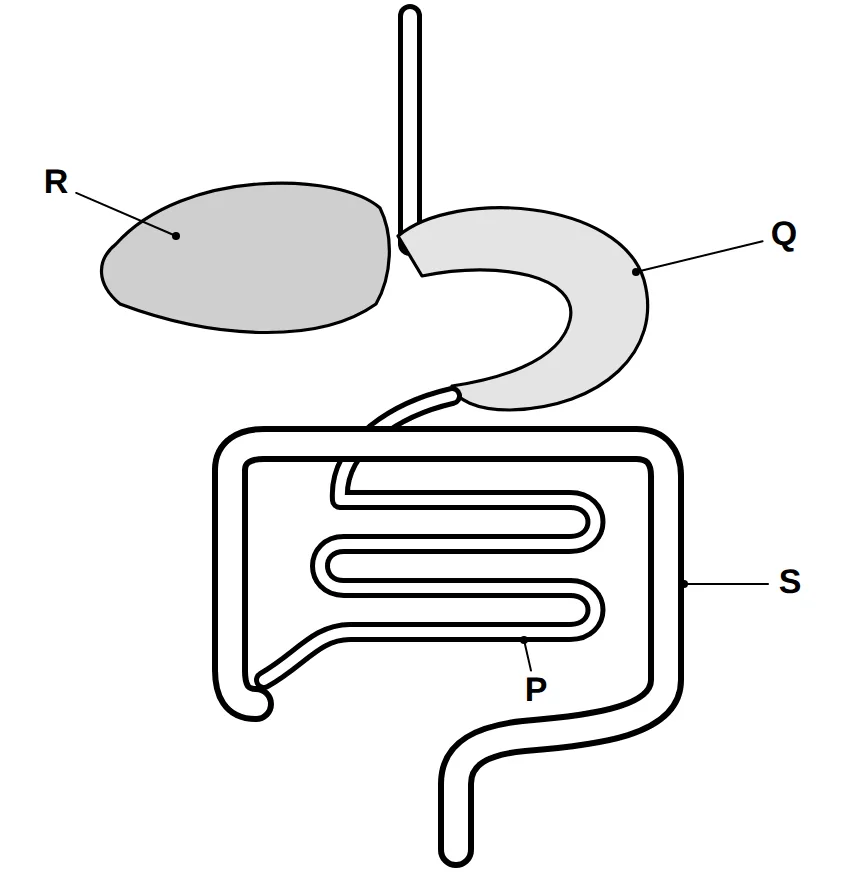
2. The figure shows an outline of the human alimentary canal, with four parts marked P, Q, R and S. Which part has thousands of finger-like villi on its inner lining and is also the part where the digestion of carbohydrates, proteins and fats is completed?
(a) P
(b) Q
(c) R
(d) S
3. Read these statements about human blood.
(i) Platelets help the blood to clot at the site of a cut, so that the loss of blood is stopped.
(ii) Haemoglobin is present in the plasma and mainly carries carbon dioxide.
(iii) Haemoglobin has a very high affinity for oxygen.
(iv) Carbon dioxide is more soluble in water than oxygen, so it is mostly carried in the dissolved form.
Which statements are correct?
(a) (i) and (ii)
(b) (ii) and (iii)
(c) (ii), (iii) and (iv)
(d) (i), (iii) and (iv)
4. A pure-breeding tall pea plant with violet flowers (TTVV) is crossed with a pure-breeding dwarf plant with white flowers (ttvv). Which option correctly describes the F1 plants and the phenotypic ratio expected in F2 when the F1 plants self-pollinate?
(a) All tall with violet flowers, genotype TTVV; F2 ratio 9 : 3 : 3 : 1
(b) All tall with violet flowers, genotype TtVv; F2 ratio 9 : 3 : 3 : 1
(c) All tall with violet flowers, genotype TtVv; F2 ratio 3 : 1
(d) Half tall-violet and half dwarf-white, genotype TtVv; F2 ratio 1 : 1
5. Two growth movements are described below.
(I) The roots of a tree in a school garden grow towards a leaking underground water pipe several metres away.
(II) Seedlings in a pot kept on a windowsill bend towards the window.
These are examples of
(a) (I) hydrotropism; (II) phototropism
(b) (I) chemotropism; (II) phototropism
(c) (I) hydrotropism; (II) geotropism
(d) (I) geotropism; (II) chemotropism
6. Each cell in the root tip of an onion has 16 chromosomes. How many chromosomes will there be in an egg cell of the onion plant, and in the zygote formed after fertilisation?
(a) 16 and 32
(b) 8 and 8
(c) 16 and 16
(d) 8 and 16
7. Nisha set up an aquarium with water plants, snails, small fish and a layer of gravel, and kept it near a sunny window. Which statement about her aquarium is correct?
(a) It is a natural ecosystem, because it has both living and non-living components.
(b) The fish are the producers in it, because they give out the carbon dioxide used by the plants.
(c) It is an artificial ecosystem, and it needs regular cleaning because it does not have enough decomposers to break down all the waste.
(d) Removing all the bacteria from it would keep its water clean for longer.
Directions: Questions 8, 9, 24 and 32 each consist of two statements, Assertion (A) and Reason (R). Answer these questions by selecting the appropriate option (a), (b), (c) or (d) given with each.
8. Assertion (A): When a pure-breeding tall pea plant is crossed with a pure-breeding dwarf pea plant, all the plants of the F1 generation are tall.
Reason (R): Pea plants normally reproduce by self-pollination.
(a) Both Assertion (A) and Reason (R) are true and Reason (R) is the correct explanation of Assertion (A).
(b) Both Assertion (A) and Reason (R) are true, but Reason (R) is not the correct explanation of Assertion (A).
(c) Assertion (A) is true, but Reason (R) is false.
(d) Assertion (A) is false, but Reason (R) is true.
9. Assertion (A): Non-biodegradable substances such as plastics and DDT remain in the environment for a long time.
Reason (R): Non-biodegradable substances are broken down quickly by bacteria and fungi.
(a) Both Assertion (A) and Reason (R) are true and Reason (R) is the correct explanation of Assertion (A).
(b) Both Assertion (A) and Reason (R) are true, but Reason (R) is not the correct explanation of Assertion (A).
(c) Assertion (A) is true, but Reason (R) is false.
(d) Assertion (A) is false, but Reason (R) is true.
10. Answer the following:
(a) During one complete round of the body, blood passes through the heart only once in a fish, but twice in a human being. Trace the path of the blood in each, starting from the heart. (1 mark)
(b) Mehak says, "A fish heart has only two chambers, so oxygen-rich and oxygen-poor blood must get mixed in it." Is she right? Explain. (1 mark)
11. Attempt either option (A) or (B).
(A) Mr Gill's blood tests show that the sugar level in his blood stays high long after his meals, and his doctor says that he has diabetes. Name the hormone whose shortage causes this, and the gland that makes it. How does the body normally keep the amount of this hormone right, by a feedback mechanism? (2 marks)
OR
(B) A nine-year-old boy is growing very slowly. Tests show that his pituitary gland is healthy, but the part of the brain that signals it to release growth hormone is not working properly. Name this part of the brain. How does it normally get the pituitary to release growth hormone?
12. The body cells of a human being have 46 chromosomes, which include one pair of sex chromosomes.
(a) Write the chromosome make-up, in the form 'autosomes + sex chromosomes', of (I) a liver cell of a man and (II) an egg cell. (1 mark)
(b) A zygote has the make-up 44 + XX. What was the make-up of the sperm that fertilised the egg? Will the child be a boy or a girl? (1 mark)
13. While gardening, Tara's finger was pricked by a rose thorn, and she pulled her hand back at once, even before she felt the pain.
(a) Show, as a flow chart of numbered boxes, the route taken by the message in Tara's body from the thorn prick to the pulling back of her hand. Why is this action handled by the spinal cord and not left to the brain? (2 marks)
(b) Suppose the motor nerve that carries messages from Tara's spinal cord to the muscles of that arm is damaged, but the sensory nerve is working. Will she still feel the prick? Will she pull her hand back? Give a reason. (1 mark)
14. The figure shows the pyramid of energy for a food chain in a forest: P is grass, Q is deer and R is tiger.
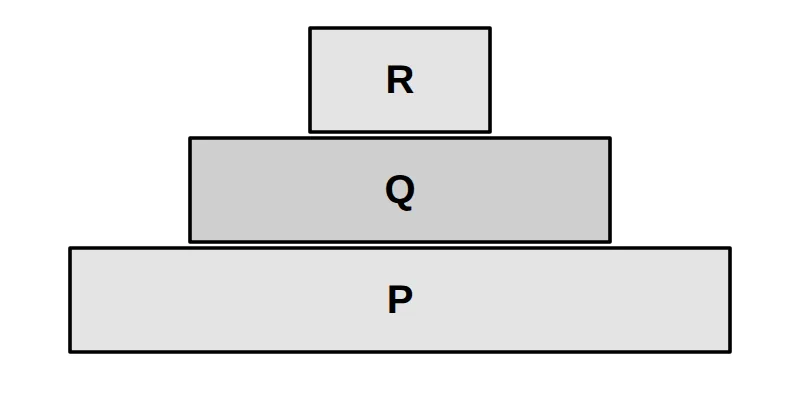
(a) Why is each level of the pyramid narrower than the level below it? (1 mark)
(b) The grass in this area traps 50,000 kJ of energy. Using the 10 per cent law, find the energy that reaches R. (1 mark)
(c) Poachers kill most of the deer in this forest. What will happen to (I) the grass and (II) the tigers? Give a reason for each. (1 mark)
15. Ananya, a Class 10 student in Varanasi, placed a few twigs of the water plant Hydrilla in a beaker of water under an inverted glass funnel, with a test tube full of water over the stem of the funnel. She placed a lamp at different distances from the beaker and, after waiting two minutes each time, counted the gas bubbles that came out of the cut ends of the twigs in one minute. Her results are given below.
| Distance of the lamp (cm) | 10 | 20 | 30 | 40 |
|---|---|---|---|---|
| Bubbles per minute | 40 | 24 | 14 | 8 |
(a) Which gas collects in the test tube? How can Ananya test it? (1 mark)
(b) What will happen to the bubbling if she switches off the lamp and covers the beaker with a black cloth? Give a reason. (1 mark)
(c) What do her results show about the effect of light intensity on the rate of photosynthesis? Explain why the number of bubbles falls as the lamp is moved away. (2 marks)
OR
(c) Keeping the lamp at 30 cm, Ananya dissolved a pinch of sodium hydrogencarbonate (baking soda) in the water, and the count rose from 14 to about 22 bubbles per minute. Explain this result, and write the balanced equation for photosynthesis. (2 marks)
16. Attempt either option (A) or (B).
(A) In her school garden near Coimbatore, Meena chose three sets of flower buds on a plant with bisexual flowers, just before they opened. She covered the buds of set P with paper bags. From the buds of set Q she removed all the stamens and then covered them with bags. From the buds of set R she cut off the stigma and style, and left them uncovered.
(i) Which set of flowers is likely to form seeds? Give a reason for each set. (1 mark)
(ii) What should Meena do to get seeds from the flowers of set Q? What kind of pollination will this be? (1 mark)
(iii) What do (I) the ovary and (II) the ovules develop into after fertilisation? (1 mark)
(iv) Draw a longitudinal section of a pistil showing a pollen tube that has reached the ovule. Label any four of these: stigma, style, pollen tube, ovary, ovule. (2 marks)
OR
(B) At a health talk for Class 10, the school doctor explained the human male reproductive system and the methods couples use to avoid pregnancy.
(i) (I) Why are the testes located outside the abdominal cavity, in the scrotum? (II) What is the role of the vas deferens? (III) Name two glands that add their secretions to the sperms, and state how these secretions help. (3 marks)
(ii) (I) Give two reasons why contraception is important. (II) Which contraceptive method both prevents pregnancy and protects against sexually transmitted infections? Why do oral pills not give the second kind of protection? (2 marks)
Section B - Chemistry (25 marks)
Questions 17 to 23 are multiple choice questions and question 24 is an Assertion-Reason question, of 1 mark each. Question 25 carries 2 marks, questions 26 and 27 carry 3 marks each, question 28 is a case based question of 4 marks and question 29 is a long answer question of 5 marks.
17. In the extraction of zinc, zinc oxide is heated with coke: . Consider these statements:
(i) Zinc oxide is reduced to zinc.
(ii) Carbon is oxidised to carbon monoxide.
(iii) Carbon acts as the oxidising agent.
(iv) Zinc oxide acts as the oxidising agent.
Which statements are correct?
(a) (i) and (iii)
(b) (i), (ii) and (iv)
(c) (ii) and (iii)
(d) (iii) and (iv)
18. Harsh added dilute hydrochloric acid to a few pieces of limestone in a test tube and passed the gas given off through lime water. The lime water turned milky, but when he went on passing the gas for a long time, the milkiness disappeared. Which option correctly explains these observations?
(a) The gas is hydrogen; the milkiness is due to calcium hydroxide, which dissolves in excess gas.
(b) The gas is carbon dioxide; the milkiness is due to calcium chloride, which dissolves in excess gas.
(c) The gas is chlorine; the milkiness is due to calcium carbonate, which is bleached by excess gas.
(d) The gas is carbon dioxide; the milkiness is due to insoluble calcium carbonate, which changes into soluble calcium hydrogencarbonate with excess gas.
19. Match the compounds in Column I with their functional groups in Column II.
Column I: (P) Bromoethane (Q) Pentanal (R) Butanone (S) Propanoic acid
Column II: (1) Ketone (2) Carboxylic acid (3) Aldehyde (4) Halo group
(a) P-4, Q-3, R-1, S-2
(b) P-4, Q-1, R-3, S-2
(c) P-3, Q-4, R-2, S-1
(d) P-2, Q-3, R-1, S-4
20. Sneha tested solutions of three salts, all of the same concentration, with universal indicator paper. The salts were ammonium chloride, sodium carbonate and sodium chloride. The pH values she noted were X: 7, Y: 10 and Z: 5. Which option identifies the salts correctly?
(a) X - ammonium chloride; Y - sodium chloride; Z - sodium carbonate
(b) X - sodium carbonate; Y - ammonium chloride; Z - sodium chloride
(c) X - sodium chloride; Y - sodium carbonate; Z - ammonium chloride
(d) X - sodium chloride; Y - ammonium chloride; Z - sodium carbonate
21. Consider these statements about soaps and detergents.
(i) Soaps are the sodium or potassium salts of long-chain sulphonic acids.
(ii) Soap does not work well in hard water, because the calcium and magnesium salts it forms are insoluble and separate out as scum.
(iii) In a micelle, the ionic ends of the soap molecules point inwards, towards the oily dirt.
(iv) Detergents are used in shampoos and in products for washing clothes.
Which statements are correct?
(a) (i) and (ii)
(b) (ii) and (iv)
(c) (i), (iii) and (iv)
(d) (ii), (iii) and (iv)
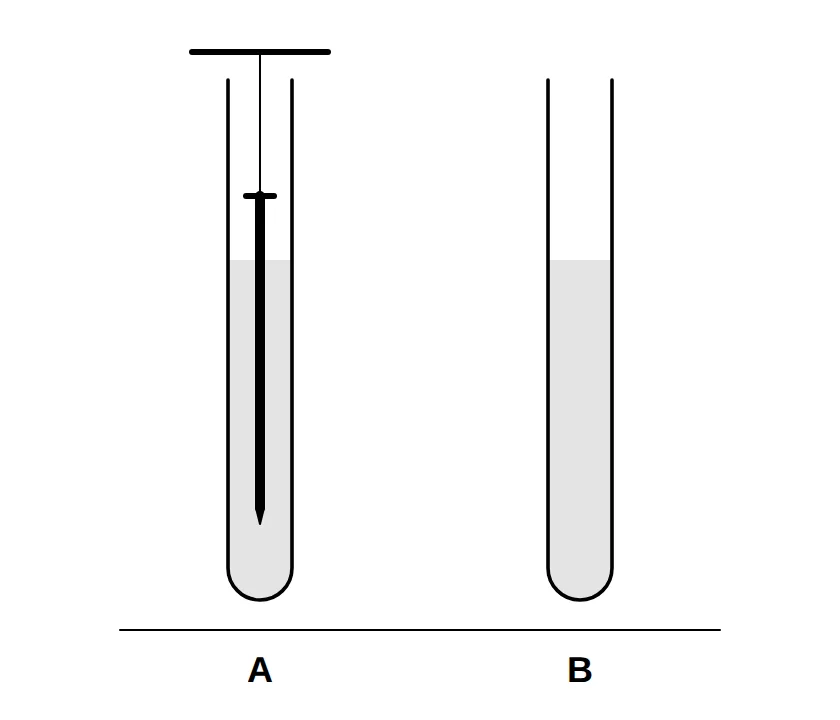
22. Pallavi took the same amount of copper sulphate solution in two test tubes, A and B. She hung a clean iron nail by a thread in A, as shown, and kept B aside for comparison. After about 20 minutes, what would she observe?
(a) The nail in A turns silvery white, and the solution in A becomes colourless.
(b) There is no change in the nail, and the solution in A turns green.
(c) A brown coating forms on the nail, and the blue colour of the solution in A becomes darker than that in B.
(d) A brown coating forms on the nail, and the blue colour of the solution in A fades compared with that in B.
23. Consider these statements about alloys.
(i) Solder, an alloy of lead and tin, has a low melting point, so it is used for welding electrical wires together.
(ii) Brass is an alloy of copper and tin.
(iii) The electrical conductivity and the melting point of an alloy are lower than those of the pure metals in it.
(iv) Pure gold is very soft, so it is mixed with a little silver or copper to make jewellery.
Which statements are correct?
(a) (i) and (ii)
(b) (ii) and (iii)
(c) (i), (iii) and (iv)
(d) (ii), (iii) and (iv)
24. Assertion (A): At the same concentration, dilute hydrochloric acid is a stronger acid than dilute acetic acid.
Reason (R): Hydrochloric acid ionises almost completely in water, so it produces more ions than acetic acid at the same concentration.
(a) Both Assertion (A) and Reason (R) are true and Reason (R) is the correct explanation of Assertion (A).
(b) Both Assertion (A) and Reason (R) are true, but Reason (R) is not the correct explanation of Assertion (A).
(c) Assertion (A) is true, but Reason (R) is false.
(d) Assertion (A) is false, but Reason (R) is true.
25. Karan knows that sodium, potassium and calcium cannot be obtained by heating their oxides with carbon, so they are extracted by electrolysis. He suggests passing a current through a solution of sodium chloride in water to get sodium.
(a) Why will Karan's method not give sodium metal? (1 mark)
(b) In the electrolysis of molten sodium chloride, write the equation for the change at the cathode, and name the product formed at the anode. (1 mark)
26. Neha is revising decomposition reactions from her notebook.
(a) She has written the equation for heating lead nitrate as . What is wrong with it? Write the correct balanced equation. (1 mark)
(b) Black-and-white photographic film is coated with pale yellow silver bromide, and it is sold in black packets. Why? Write the balanced equation for the change that the packet prevents. (1 mark)
(c) Consider three decompositions: (I) of silver bromide into silver and bromine, (II) of lead nitrate on heating, and (III) of water into hydrogen and oxygen. Which of them could Neha carry out in a dark room that has a burner but no battery or other electric supply? Explain. (1 mark)
27. Attempt either option (A) or (B).
(A) During a school picnic near Mysuru, Farah was stung by a honeybee. Her teacher washed the spot and put a paste of baking soda on it.
(i) Which acid does the bee sting inject? Why does the baking soda paste give relief? (1 mark)
(ii) Write the balanced chemical equation for the reaction between this acid and baking soda. (1 mark)
(iii) One classmate suggests putting a little vinegar on the sting instead, and another suggests a paste of washing soda. Which suggestion could help? Give a reason for each. (1 mark)
OR
(B) Rekha's grandmother stored tamarind chutney in an old, dull brass pot. After two days the chutney tasted odd, and the inside of the pot looked bright and patchy.
(i) Why did the inside of the pot become bright in patches? Why did the chutney taste odd? (1 mark)
(ii) Brass contains zinc. Write the balanced chemical equation for the reaction of zinc with dilute hydrochloric acid, and give a test for the gas formed. (1 mark)
(iii) Her neighbour suggests an aluminium container instead. Would that be a safe choice for the chutney? Give a reason. (1 mark)
28. Joseph, a student in Visakhapatnam, set up three test tubes, as shown, to find the conditions under which iron rusts. In A he put clean iron nails in ordinary tap water and corked the tube. In B he put nails in water that had been boiled, poured a layer of oil over it and corked the tube. In C he put nails over some anhydrous calcium chloride and corked the tube. He left the tubes for a week.
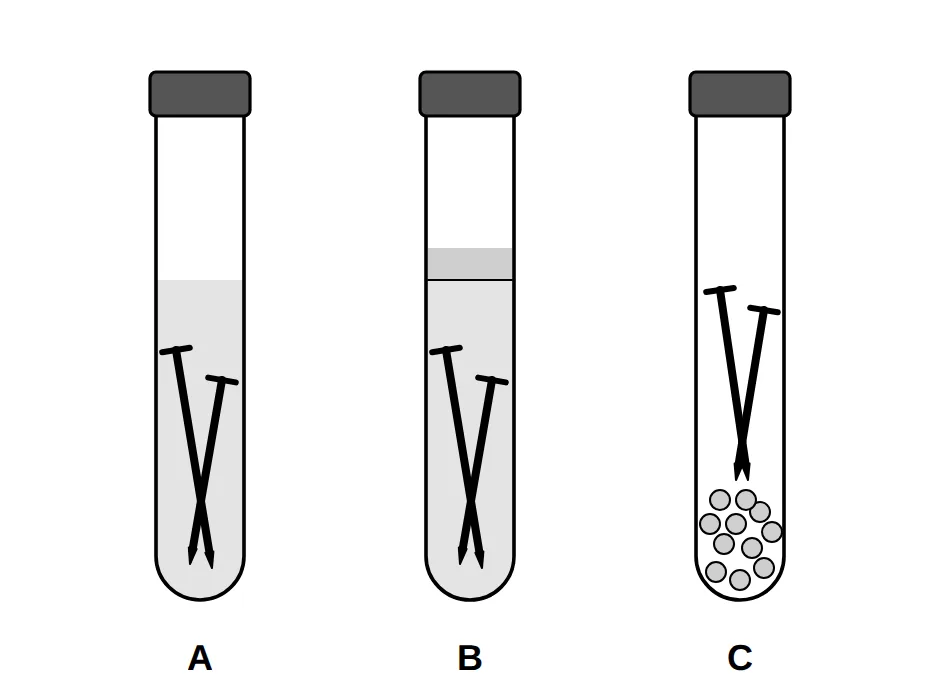
(a) In which test tube(s) will the nails rust? Give a reason. (1 mark)
(b) What is the role of (I) the layer of oil in B and (II) the anhydrous calcium chloride in C? (1 mark)
(c) Suggest a suitable way to protect each of these from rusting, giving a reason: (I) the chain of a bicycle; (II) iron sheets for the roof of a shed. (2 marks)
OR
(c) Joseph's father has bought a stainless-steel sink for the kitchen. (I) How is stainless steel made? (II) Give two ways in which it is better than pure iron for this use. (2 marks)
29. Attempt either option (A) or (B).
(A)
(i) Three students make these statements.
Anil: "When vegetable oil is heated with hydrogen in the presence of nickel, hydrogen atoms take the place of some atoms in the oil, so this is a substitution reaction."
Bhavna: "Methane and chlorine do not react in the dark, but in sunlight the chlorine atoms replace the hydrogen atoms of methane one by one."
Chetan: "Unsaturated hydrocarbons such as ethene burn with a clean blue flame, while saturated ones such as methane give a sooty flame."
Who is correct and who is not? Justify your answer, and write the chemical equation for the first step of the reaction described by Bhavna. (3 marks)
(ii) Draw the electron dot structure of ethene, . How many pairs of electrons are shared in all in one molecule? (2 marks)
OR
(B)
(i) Two bottles, X and Y, have lost their labels. One contains ethanol and the other ethanoic acid. (I) Describe two tests, with their observations, that Arjun can use to find out which is which. (II) His friend suggests dropping a small piece of sodium into each liquid. Why is this not a good way to tell them apart? Support your answer with a chemical equation. (3 marks)
(ii) (I) Give two reasons why carbon forms a very large number of compounds. (II) Write the structural formulae of the two isomers of butane, , and explain how they show one of these reasons at work. (2 marks)
Section C - Physics (25 marks)
Questions 30 and 31 are multiple choice questions and question 32 is an Assertion-Reason question, of 1 mark each. Questions 33 and 34 carry 2 marks each, questions 35 to 37 carry 3 marks each, question 38 is a case based question of 4 marks and question 39 is a long answer question of 5 marks.
30. Meghna's teacher gives her two lenses: L1 of power +2 D and L2 of power -4 D. Consider these statements:
(i) L1 is a converging lens.
(ii) The focal length of L2 has a magnitude of 25 cm, which is shorter than that of L1.
(iii) The focal length of L1 is 2 m.
(iv) L2 can form a real image of a distant tree on a screen.
Which statements are correct?
(a) (i) and (iii)
(b) (i) and (ii)
(c) (ii) and (iv)
(d) (i), (ii) and (iv)
31. Read these statements about a convex mirror.
(i) Its principal focus lies behind the mirror.
(ii) Rays parallel to the principal axis, after reflection, appear to diverge from the principal focus.
(iii) If its radius of curvature is 40 cm, its focal length is 20 cm.
(iv) Parallel rays of sunlight actually meet at its principal focus, so an image of the Sun can be formed on a screen.
Which statements are correct?
(a) (i), (ii) and (iii)
(b) (ii) and (iv)
(c) (i) and (iv)
(d) (i), (iii) and (iv)
32. Assertion (A): White light passing through a rectangular glass slab comes out split into a spectrum of seven colours.
Reason (R): Light of different colours travels at different speeds in glass.
(a) Both Assertion (A) and Reason (R) are true and Reason (R) is the correct explanation of Assertion (A).
(b) Both Assertion (A) and Reason (R) are true, but Reason (R) is not the correct explanation of Assertion (A).
(c) Assertion (A) is true, but Reason (R) is false.
(d) Assertion (A) is false, but Reason (R) is true.
33. Attempt either option (A) or (B).
(A) The rear-view mirror of a bus is a convex mirror of focal length 1 m. A car is 4 m behind the mirror.
(a) Draw a ray diagram to show the formation of the image of the car AB in this mirror. (1 mark)
(b) Find the position of the image and the magnification. What does the value of the magnification tell the driver? (1 mark)
OR
(B) An object AB is placed at the principal focus F of a concave mirror. Draw a ray diagram to show where its image is formed. State the position and nature of the image, and one use of placing a source of light at the focus of a concave mirror.
34. Varun drew the circuit shown to study how the current through a resistor R changes with the potential difference across it. His teacher said that he had connected both meters wrongly.
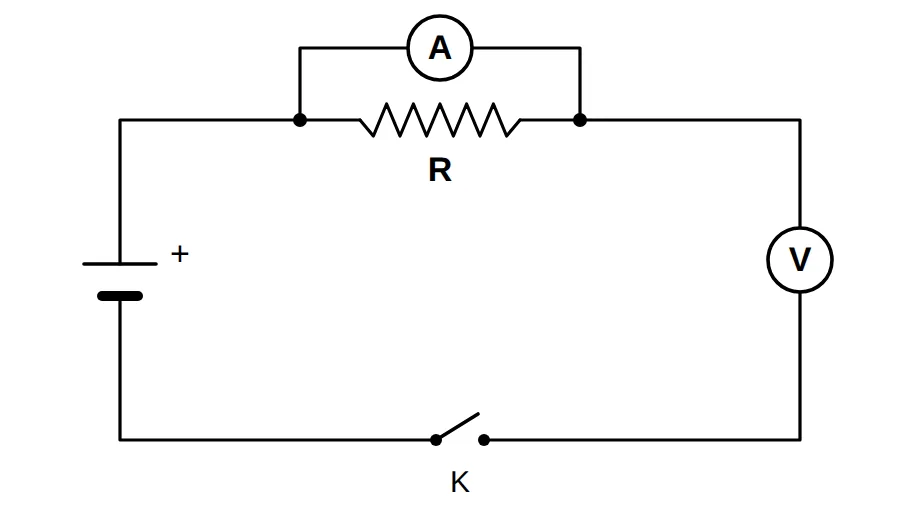
(a) What is wrong with the way each meter is connected? (1 mark)
(b) How should each meter be connected, and why? (1 mark)
35. Riya holds a concave lens of focal length 20 cm at a distance of 20 cm from a candle flame that is 4 cm tall. Her friend Dev says, "The flame is at the focus of the lens, so the image will be formed at infinity, just as it would be with a convex lens."
(a) Use the lens formula to find the position of the image. (1 mark)
(b) Find the magnification and the height of the image, and state its nature. (1 mark)
(c) Is Dev right? Explain. (1 mark)
36. Priya passed a current through a circular loop of wire that goes through a sheet of cardboard, and sprinkled iron filings on the sheet.
(a) Draw the pattern of the magnetic field lines on the sheet, showing the direction of the current in the loop and the direction of the field lines. (2 marks)
(b) Priya now reverses the connections of the battery. What change will she see in the field? What would change if she used a coil of 10 turns carrying the same current, in place of the single loop? (1 mark)
37. The wiring in the Bose family's house has a live wire, a neutral wire and an earth wire, and each circuit is protected by an MCB (miniature circuit breaker) or a fuse.
(a) Name the most likely fault in each case. (I) The MCB of the bedroom trips the instant a single lamp is switched on, and a spark is seen at the switchboard. (II) The MCB of the bathroom circuit trips only when the geyser is switched on while the heater and the iron in that circuit are already running. (1 mark)
(b) Explain why the current becomes very large in each of these faults. (1 mark)
(c) Why must a fuse be connected in the live wire? What would be the danger if the electrician put it in the neutral wire? (1 mark)
38. At a free eye camp in a village near Puri in Odisha, Dr Mohanty tested the eyesight of people of all ages. Ten-year-old Lipi could read small print held 25 cm from her eyes, and could also read a signboard far down the road. Her grandfather could see the distant fishing boats clearly, but had to hold the newspaper at arm's length to read it. The doctor explained that the eye lens changes its focal length to focus objects at different distances, and that this ability becomes weaker with age.
(a) What is this ability of the eye lens called? Which part of the eye brings it about? (1 mark)
(b) Why can the grandfather still see the distant boats clearly, but not the newspaper held close? What is his defect of vision called? (1 mark)
(c) The doctor prescribes reading glasses of power +2 D, with which the grandfather can read a newspaper held 25 cm from his eyes. Find the focal length of the lens and the near point of his eye. (2 marks)
OR
(c) A 62-year-old woman at the camp could see neither nearby nor distant objects clearly. The doctor gave her bifocal lenses whose upper part has a power of -0.4 D. Why does she need bifocal lenses, and what kind of lens is each part? Find the far point of her eye. (2 marks)
39. Attempt either option (A) or (B).
(A) In the circuit shown, the key K is closed. Treat the ammeter and the voltmeter as ideal meters.
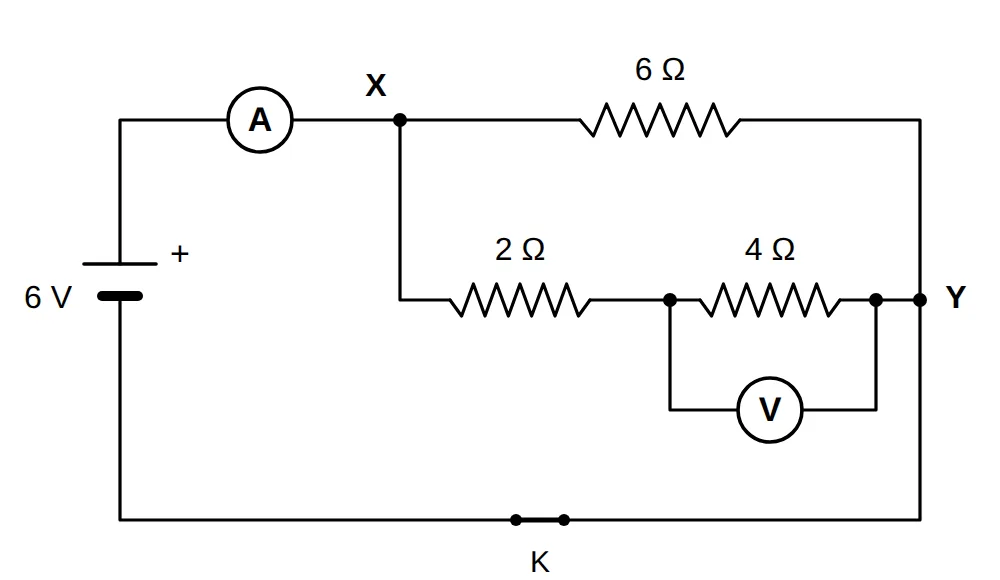
(i) Find (I) the total resistance between X and Y, (II) the reading of the ammeter and (III) the reading of the voltmeter. (3 marks)
(ii) (I) Find the power used in the 2 Ω resistor. (II) The 6 Ω resistor burns out and breaks. What will the ammeter and the voltmeter read now? Give a reason. (2 marks)
OR
(B) The Iyer family uses these appliances every day: an air conditioner of 1.5 kW for 6 hours, four fans of 50 W each for 10 hours, and five LED bulbs of 20 W each for 10 hours. Electricity costs ₹ 7 per kWh.
(i) Find the electrical energy they use in a day, their bill for a month of 30 days, and how much they would save in that month by running the air conditioner for 2 hours less every day. (3 marks)
(ii) Their electric iron is rated 1100 W, 220 V. Find the current it draws and the resistance of its element. When they take it to a place where the supply is only 110 V, what power will it use? (Take the resistance of the element to be unchanged.) (2 marks)