Detailed Solutions: CBSE Class 10 Science Sample Paper 2027 – Set 5
Every written question from the paper (2, 3, 4 and 5 marks) is solved here in order, with the marks given for each step, so you can check your answer sheet the way an examiner would. Where a question has an internal choice (OR), both options are solved. The 1-mark questions are answered, with explanations, in the quiz on the Question Paper page.
Section A - Biology (30 marks)
Question 10 (2 marks)
In a mustard field, honeybees carry pollen from the flowers of one plant to the flowers of other plants. In a pea flower, the pollen falls on the stigma of the same flower even before the flower opens. Name the kind of pollination in each case, and give two differences between them.
Answer.
- Mustard: cross-pollination (0.5); pea: self-pollination (0.5) — 1 mark
- Self-pollination: pollen reaches the stigma of the same flower (or another flower of the same plant); cross-pollination: pollen reaches a flower of a different plant (also credit: pollen transferred from one flower to another) (0.5) — 0.5 marks
- Self-pollination needs no outside agent; cross-pollination needs an agent such as insects, wind or water (or: cross-pollination brings in more variation) (0.5) — 0.5 marks
Question 11 (2 marks)
Answer the following:
(a) Urine is formed in the nephrons of the kidneys. Trace the path it takes from the nephron until it leaves the body. (1 mark)
Answer.
- Collecting duct of the nephron → ureter — 0.5 marks
- → urinary bladder → urethra, through which it is passed out — 0.5 marks
(b) Urine is formed all the time, yet we pass it only now and then, and can usually hold it back for a while. Explain how this is possible. (1 mark)
Answer.
- Urine is stored in the urinary bladder until it is passed out — 0.5 marks
- The bladder is muscular and under nervous control, so we can usually control the urge to urinate — 0.5 marks
Question 12 (2 marks)
Attempt either option (A) or (B).
(A) Thyroxin controls how every cell of the body uses carbohydrates, proteins and fats, day and night. Give two limitations of electrical impulses that make them unsuitable for such a job, and explain how a hormone overcomes each of them.
Answer.
- Electrical impulses reach only those cells that are connected by nervous tissue (0.5); a hormone is released into the blood and reaches every cell of the body (0.5) — 1 mark
- After an impulse, a cell needs time to reset before it can send another, so cells cannot keep sending impulses continuously (0.5); a hormone can act steadily over a long period (0.5) — 1 mark
OR
(B) In the early teenage years, a boy's voice starts to crack and a girl's breasts begin to develop. Name the hormone responsible for these changes in boys and in girls, and the gland that makes each of them.
Answer.
- Boys: testosterone (0.5), made by the testes (0.5) — 1 mark
- Girls: oestrogen (0.5), made by the ovaries (0.5) — 1 mark
Question 13 (3 marks)
Rhea pulls her hand back in a flash when it touches a hot tawa, yet the growth of her body from a child into a teenager has taken years. The first is brought about by the nervous system and the second by hormones.
(a) Compare the two kinds of coordination in the way the message travels. (1 mark)
Answer.
- Nervous: as electrical impulses along nerve fibres (with chemicals crossing each synapse) — 0.5 marks
- Hormonal: as chemicals (hormones) carried by the blood — 0.5 marks
(b) Compare them in how quickly the response comes and how long it lasts. (1 mark)
Answer.
- Nervous: very quick, and usually short-lived — 0.5 marks
- Hormonal: slower, but the effect lasts much longer — 0.5 marks
(c) Too much or too little of a hormone can harm the body. How is the amount of a hormone released kept right? Explain with one example. (1 mark)
Answer.
- By a feedback mechanism: the timing and amount of hormone released are regulated by the level of the substance it controls — 0.5 marks
- Example: when blood sugar rises, the pancreas detects it and releases more insulin; as the sugar level falls, insulin release is reduced — 0.5 marks
Question 14 (3 marks)
The residents of a housing society in Chennai have started putting their garbage into two separate bins. A resident has these items to throw away: vegetable peels, a broken plastic bucket, used tea leaves, an aluminium foil wrapper, old newspapers and a used battery.
(a) Sort these items into biodegradable and non-biodegradable waste. (1 mark)
Answer.
- Biodegradable: vegetable peels, used tea leaves, old newspapers — 0.5 marks
- Non-biodegradable: plastic bucket, aluminium foil wrapper, used battery — 0.5 marks
(b) Give two harmful effects of non-biodegradable waste if it is simply dumped. (1 mark)
Answer.
- It is not broken down by decomposers, so it stays in the environment for a very long time (e.g. blocks drains, spoils the soil) — 0.5 marks
- It harms members of the ecosystem, e.g. animals that swallow plastic, or harmful chemicals from batteries seeping into the soil and water — 0.5 marks
(c) One resident suggests burying all the garbage together in a pit in the park, to save the effort of sorting it. Do you agree? Give a reason. (1 mark)
Answer.
- No (0.5): only biodegradable waste will be broken down in the pit; plastic, foil and the battery will stay in the soil for years and harmful substances can leak into the soil and groundwater (0.5) — 1 mark
Question 15 (4 marks)
Mrs Deshpande, a science teacher in Nagpur, made a model of how the sex of a child is decided. She put 20 cards marked X in a pouch labelled 'Mother'. In a second pouch labelled 'Father' she put 10 cards marked X and 10 cards marked Y. Each group of students drew one card from each pouch without looking, noted the pair, and put the cards back. Each pair of cards stood for the sex chromosomes of one child.
(a) A card stands for the sex chromosome only. How many chromosomes in all does a human egg carry, and how many does a human sperm carry? (1 mark)
Answer.
- Egg: 23 chromosomes (0.5); sperm: 23 chromosomes (0.5) — 1 mark
(b) Why does the 'Father' pouch hold two kinds of cards while the 'Mother' pouch holds only one kind? What does this tell us about who decides the sex of the child? (1 mark)
Answer.
- A woman has XX, so all her eggs carry X; a man has XY, so half his sperms carry X and half carry Y — 0.5 marks
- So the sex of the child depends on which kind of sperm fertilises the egg, i.e. on the father — 0.5 marks
(c) Ritika's group made 40 draws and got 17 XX pairs and 23 XY pairs. Ritika says the model has failed, because it should give exactly 20 of each. Is she right? What result would you expect if the whole class pooled 400 draws? Explain. (2 marks)
Answer.
Model answer:
No, Ritika is not right. Every card from the mother's pouch is X, and half the cards in the father's pouch are X and half are Y. So each draw has an equal chance of giving XX (a girl) or XY (a boy), and the expected ratio is 1 : 1. But this is only a chance. In just 40 draws the numbers can easily come out as 17 and 23, just as tossing a coin 40 times rarely gives exactly 20 heads. If the class pools 400 draws, the numbers should come much closer to 200 XX and 200 XY. This is also why families do not always have equal numbers of boys and girls.
Marking scheme:
- Expected ratio XX : XY = 1 : 1, since every draw has a 50 per cent chance of an X card and a 50 per cent chance of a Y card from the father's pouch — 1 mark
- She is not right: chance gives only roughly equal numbers in a small number of draws; with 400 draws the result should come much closer to 200 : 200 — 1 mark
OR
(c) A student asks, "What would happen if each parent passed on all 46 of its chromosomes to the child?" Answer her, and explain how the number of chromosomes stays the same from one generation to the next. (2 marks)
Answer.
Model answer:
If each parent passed on all 46 chromosomes, the child would have 92, the grandchild 184, and so on; the amount of DNA would double in every generation. This does not happen because the germ cells (egg and sperm) carry only one set of chromosomes, i.e. half the number, 23. When a sperm fuses with an egg, the zygote gets 23 + 23 = 46 chromosomes again. So the number of chromosomes, and the DNA content, stays the same from one generation to the next.
Marking scheme:
- The child would have 92 chromosomes, and the number (and the DNA) would double in every generation — 1 mark
- Gametes (egg and sperm) get only one set, i.e. half the chromosomes (23); their fusion at fertilisation restores 46, so the number stays constant — 1 mark
Question 16 (5 marks)
Attempt either option (A) or (B).
(A) Tenzing, a Class 10 student in Leh, notices that visitors from the plains often feel short of breath for the first few days in the thin mountain air.
(i) The windpipe (trachea) is supported by rings of cartilage, and the nasal passage is lined with fine hairs and mucus. What is the job of each? (1 mark)
Answer.
- The rings of cartilage keep the air passage from collapsing, so air can always pass through it — 0.5 marks
- The hairs and mucus filter the air we breathe in, trapping dust and germs — 0.5 marks
(ii) Even when we breathe out as hard as we can, some air always stays behind in the lungs. Why is this useful? (1 mark)
Answer.
- Because the lungs always hold this residual air, there is enough time for oxygen to be absorbed into the blood and for carbon dioxide to be released, even between breaths — 1 mark
(iii) Tenzing's teacher says that in thin air each breath brings in less oxygen, so a red pigment in our blood has to do its job well. Name this pigment and state how it helps to carry oxygen. (1 mark)
Answer.
- Haemoglobin, present in the red blood corpuscles (0.5); it has a very high affinity for oxygen, takes it up in the lungs and gives it up in the tissues, where oxygen is low (0.5) — 1 mark
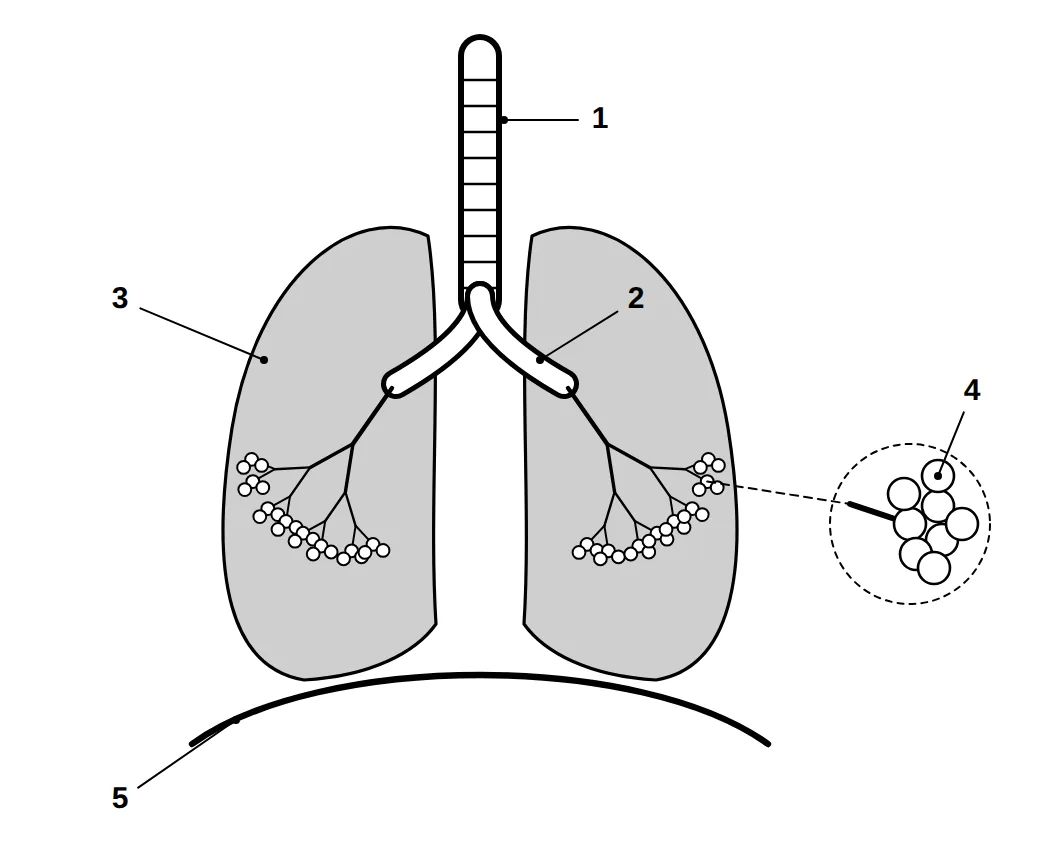
(iv) Draw a diagram of the human respiratory system and label any four of these: trachea, bronchus, lung, alveolar sac (alveoli), diaphragm. (2 marks)
Answer.
- Correct diagram of the respiratory system — 1 mark
- Any four parts correctly labelled, 0.25 each (in the figure: 1 trachea, 2 bronchus, 3 lung, 4 alveolar sac, 5 diaphragm) — 1 mark
OR
(B) Sahil watched a drop of pond water under the microscope in his school laboratory and saw an Amoeba moving towards a small food particle.
(i) Describe how the Amoeba takes in, digests and uses this food particle. How is this different from the way a mushroom growing on a rotting log and a tapeworm living in the human intestine get their food? (3 marks)
Answer.
Model answer:
The Amoeba pushes out temporary finger-like extensions of its cell surface, called pseudopodia. These surround the food particle and fuse over it, so the particle is enclosed in a food vacuole. Inside the vacuole, the complex food is broken down into simpler substances. These diffuse into the cytoplasm and are used by the cell. Whatever cannot be digested is moved to the surface and thrown out. A mushroom does not take in particles at all: it is a saprotroph, which breaks down dead matter such as the log outside its body and then absorbs it. A tapeworm is a parasite: it lives inside a living host and absorbs food from the host's intestine.
Marking scheme:
- Ingestion: finger-like extensions of the cell surface (pseudopodia) surround the food particle and fuse over it, forming a food vacuole — 1 mark
- Inside the food vacuole the food is broken down into simpler substances, which diffuse into the cytoplasm and are used; the undigested material is thrown out at the cell surface — 1 mark
- Mushroom: a saprotroph that breaks down dead matter outside its body and absorbs it (0.5); tapeworm: a parasite that absorbs food from its living host (0.5) — 1 mark
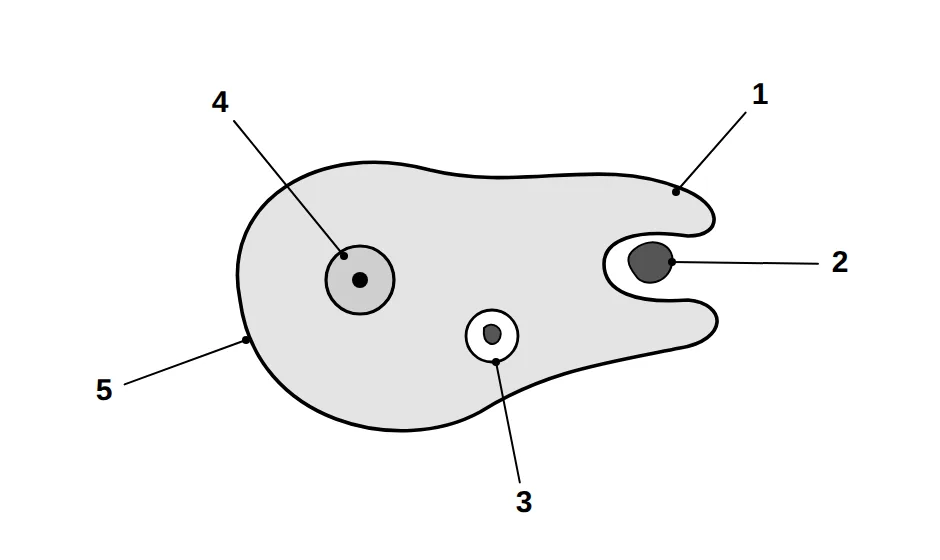
(ii) Draw a diagram of an Amoeba taking in a food particle and label any four of these: pseudopodium, food particle, food vacuole, nucleus, cell membrane. (2 marks)
Answer.
- Correct diagram with pseudopodia enclosing the food particle — 1 mark
- Any four parts correctly labelled, 0.25 each (in the figure: 1 pseudopodium, 2 food particle, 3 food vacuole, 4 nucleus, 5 cell membrane) — 1 mark
Section B - Chemistry (25 marks)
Question 25 (2 marks)
Answer the following:
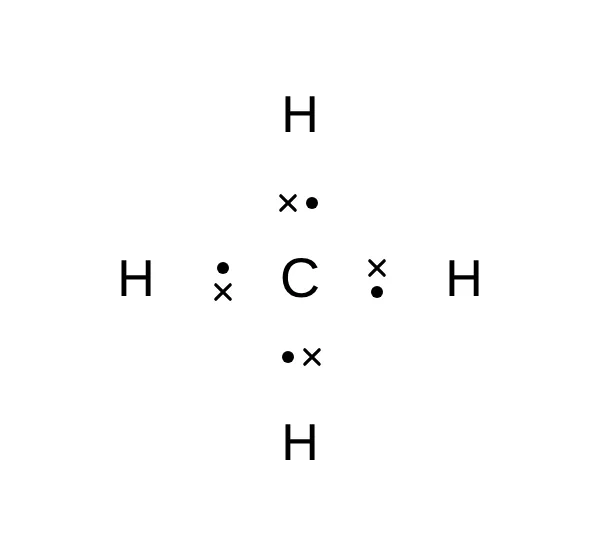
(a) Show the bonding in a molecule of methane, , with the help of its electron dot structure. (Atomic number of carbon = 6) (1 mark)
Answer.
- Correct structure: carbon in the centre sharing one pair of electrons with each of the four hydrogen atoms — 1 mark
(b) Carbon forms covalent bonds by sharing electrons. Give one reason why it does not form a ion and one reason why it does not form a ion. (1 mark)
Answer.
- : removing four electrons would need a very large amount of energy — 0.5 marks
- : a nucleus with only six protons cannot hold on to ten electrons — 0.5 marks
Question 26 (3 marks)
Karan half-filled two test tubes, A and B, with water from the hand pump in his village. He added a little soap solution to A and the same amount of detergent solution to B, and shook both tubes in the same way.
(a) In which test tube will a good lather form? What will he see in the other one? (1 mark)
Answer.
- A good lather forms in B (detergent) — 0.5 marks
- In A there is very little lather and a white curdy precipitate (scum) forms — 0.5 marks
(b) What is the scum formed in A? Give one reason why it is a nuisance for someone washing clothes with soap in this water. (1 mark)
Answer.
- An insoluble substance formed when the calcium and magnesium salts in the hard water react with the soap — 0.5 marks
- Much of the soap is wasted in forming scum, so more soap is needed (or: the scum sticks to the clothes) — 0.5 marks
(c) Karan now wants to find which of three samples (hand-pump water, tap water and distilled water) is the hardest, using only soap solution. How should he plan the test so that it is fair, and what will show him the hardest sample? (1 mark)
Answer.
- Take the same volume of each sample in similar test tubes, add soap solution drop by drop and shake each in the same way — 0.5 marks
- Count the drops needed to get a lasting lather; the sample that needs the most drops is the hardest (also credit: add the same number of drops and compare the height of the lather or the amount of scum) — 0.5 marks
Question 27 (3 marks)
Attempt either option (A) or (B).
(A) Tanvi writes in her notebook: "To get copper from copper glance (), we must first roast the ore and then reduce the oxide with carbon, just as we do for zinc."
(i) Where is Tanvi wrong? Give a reason. (1 mark)
Answer.
- No carbon is needed (0.5): copper is low in the activity series, so after part of the sulphide is roasted, the copper(I) oxide formed reacts with the rest of the sulphide to give copper (0.5) — 1 mark
(ii) Write the balanced equations for the two steps by which copper is actually obtained from copper glance. (1 mark)
Answer.
- — 0.5 marks
- — 0.5 marks
(iii) Mercury is also low in the activity series. Write the balanced equation for the final step in which mercury is obtained from its oxide, and state what is needed for it. (1 mark)
Answer.
- — 0.5 marks
- Only heating; no reducing agent is needed — 0.5 marks
OR
(B) Predict whether the metal will be obtained in each of the following cases. Give a reason in each case, and write the balanced equation for the cases in which the metal is obtained.
(I) Mercury(II) oxide is heated on its own.
(II) Zinc oxide is heated on its own.
(III) Iron(III) oxide is heated with aluminium powder.
(IV) Aluminium oxide is heated with carbon.
Answer.
Model answer:
(I) Yes. Mercury is very low in the activity series, so its oxide breaks down on heating alone: . (II) No. Zinc is in the middle of the series; zinc oxide does not break down on heating and has to be reduced with a reducing agent such as carbon. (III) Yes. Aluminium is more reactive than iron, so it takes the oxygen away: . (IV) No. Aluminium is more reactive than carbon and holds on to its oxygen more strongly, so carbon cannot reduce aluminium oxide.
Marking scheme:
- (I) Yes: mercury is so low in the activity series that its oxide breaks down on heating alone (0.5) — 0.5 marks
- (II) No: zinc is in the middle of the series; its oxide needs a reducing agent such as carbon (0.5) — 0.5 marks
- (III) Yes: aluminium is more reactive than iron and takes the oxygen away from iron(III) oxide (0.5) — 0.5 marks
- (IV) No: aluminium is more reactive than carbon (holds oxygen more strongly), so carbon cannot reduce aluminium oxide (0.5) — 0.5 marks
- Equations: (0.5); (0.5) — 1 mark
Question 28 (4 marks)
Gurpreet grows vegetables on his family's farm near Ludhiana, Punjab. A soil test showed that the soil in one field had a pH of 5.5, too low for the crop he wanted to sow. The agriculture officer advised him to spread a measured amount of slaked lime over the field and mix it into the soil. In the same week, Gurpreet's grandfather complained of acidity after a heavy meal, and the doctor told him to take a spoonful of milk of magnesia.
(a) Is the soil in the field acidic or basic? Why does slaked lime help? (1 mark)
Answer.
- Acidic, since its pH is less than 7 — 0.5 marks
- Slaked lime (calcium hydroxide) is a base; it neutralises the excess acid and raises the pH of the soil — 0.5 marks
(b) Name the chemical in milk of magnesia and explain how it relieves the grandfather's acidity. (1 mark)
Answer.
- Magnesium hydroxide — 0.5 marks
- It is a mild base and neutralises the excess hydrochloric acid in the stomach — 0.5 marks
(c) Gurpreet limed two fields, X and Y, whose soil had a pH of 5.5. A month later the pH of X was 6.8 and that of Y was 8.2. (I) Which field is now better suited to most crops, and what went wrong in the other? (II) Write the balanced equation for the reaction of slaked lime with an acid such as hydrochloric acid, and name the type of reaction. (2 marks)
Answer.
- (I) Field X, whose soil is now nearly neutral (0.5); too much lime was added to Y, which has made its soil basic (0.5) — 1 mark
- (II) (0.5); neutralisation (0.5) — 1 mark
OR
(c) Gurpreet has baking soda, slaked lime and common salt at home. (I) Which of these would be of no use for treating acidic soil? Why? (II) Write the balanced equation for the reaction by which milk of magnesia neutralises the acid in the stomach. (2 marks)
Answer.
- (I) Common salt (0.5): it is a neutral salt of a strong acid and a strong base, so it cannot neutralise acid (0.5) — 1 mark
- (II) — 1 mark
Question 29 (5 marks)
Attempt either option (A) or (B).
(A) Anjali weighed about 1 g of brown copper powder in a china dish and heated it over a burner. The powder slowly turned black, and its mass increased. She then passed hydrogen gas over the heated black powder until it turned brown again, and found that its mass had come back to what it was at the start.
(i) Name the black substance and write the balanced equations for both changes. Explain why the mass first increased and then decreased, and identify the oxidising agent and the reducing agent in the second reaction. (3 marks)
Answer.
Model answer:
When copper is heated in air, it combines with oxygen and black copper(II) oxide forms: . The powder gains the mass of the oxygen it has taken up, so its mass increases. When hydrogen is passed over the hot copper(II) oxide, the oxide loses its oxygen and brown copper is formed again: . The oxygen goes off with hydrogen as water vapour, so the mass falls back to that of the copper taken. In this reaction hydrogen gains oxygen, so it is oxidised and acts as the reducing agent. Copper(II) oxide loses oxygen, so it is reduced and acts as the oxidising agent.
Marking scheme:
- Copper(II) oxide; (0.5); the mass increased because copper took up oxygen from the air (0.5) — 1 mark
- (0.5); the mass decreased because the oxygen was removed and left the dish as water vapour (0.5) — 1 mark
- Hydrogen is the reducing agent, as it is oxidised (0.5); copper(II) oxide is the oxidising agent, as it is reduced (0.5) — 1 mark
(ii) Anjali's friend says, "The mass went up on heating, so mass is not conserved in chemical reactions." (I) Is she right? Explain. (II) Which law does a balanced chemical equation follow? Show that follows it. (2 marks)
Answer.
Model answer:
She is not right. The dish is open, so the copper takes oxygen from the air. That oxygen was not weighed at the start, which is why the mass seems to go up. If we add the mass of the oxygen used to the mass of the copper, it equals the mass of the copper(II) oxide formed. A balanced equation follows the law of conservation of mass: mass can neither be created nor destroyed in a chemical reaction, so each element must have the same number of atoms on both sides. Here the left side has 2 copper atoms and 2 oxygen atoms, and so does the right side (2CuO).
Marking scheme:
- (I) No: the extra mass is that of the oxygen taken from the air; the mass of copper plus the oxygen used equals the mass of copper(II) oxide formed — 1 mark
- (II) The law of conservation of mass: mass can neither be created nor destroyed in a chemical reaction (0.5); both sides have 2 copper atoms and 2 oxygen atoms (0.5) — 1 mark
OR
(B)
(i) Three students are discussing the energy changes in some everyday processes.
Tara: "When vegetable waste turns into compost, heat is given out, so it is an exothermic process."
Dev: "We have to light a candle with a matchstick, so the burning of wax takes in heat. It is an endothermic reaction."
Ali: "Respiration is exothermic, but it is not a chemical reaction at all. It is just breathing in and out."
Who is correct and who is not? Justify your answer in each case. (3 marks)
Answer.
Model answer:
Tara is correct. When vegetable matter decomposes into compost, heat is given out, which is why a compost heap feels warm inside; this is an exothermic process. Dev is not correct. The matchstick only supplies the heat needed to start the burning. Once the wax starts burning, it gives out much more heat and light than it took in, so combustion is exothermic. Ali is not correct either. Breathing is only the taking in of air and giving out of carbon dioxide. Respiration is the breakdown of glucose by oxygen inside our cells: + energy. New substances form, so it is a chemical reaction, and an exothermic one.
Marking scheme:
- Tara is correct: the decomposition of vegetable matter into compost gives out heat, so it is exothermic — 1 mark
- Dev is not correct: heat is needed only to start the burning; once it starts, burning gives out a lot of heat and light, so it is exothermic — 1 mark
- Ali is not correct: breathing is only the exchange of gases; respiration is the oxidation of glucose in the cells, + energy, which is a chemical reaction — 1 mark
(ii) Identify the error in each of the following and rewrite it correctly.
(I) ; this is a combination reaction.
(II) ; this is a double displacement reaction.
(III) ; this is a double displacement reaction. (2 marks)
Answer.
Model answer:
(I) There are two chlorine atoms on the right but only one on the left, so the equation is . Magnesium takes the place of hydrogen in the acid, so it is a displacement reaction, not a combination reaction. (II) The equation is balanced, but only one element (lead) pushes another (copper) out of its compound, so it is a displacement reaction, not double displacement. (III) Calling it double displacement is right, since the two compounds exchange ions and blue copper hydroxide separates out, but the sodium atoms are not balanced: .
Marking scheme:
- (I) Not balanced, and wrongly named: is a displacement reaction (0.5 + 0.5) — 1 mark
- (II) The equation is correct, but it is a displacement reaction: lead, being more reactive, displaces copper — 0.5 marks
- (III) The type is correct, but the equation is not balanced: — 0.5 marks
Section C - Physics (25 marks)
Question 33 (2 marks)
Kavita places a lighted candle between the centre of curvature C and the principal focus F of a concave mirror.
(a) Draw a ray diagram showing how the image of the candle is formed. (1 mark)
Answer.
- A ray parallel to the principal axis reflected through F, and a ray through F reflected parallel to the axis (0.25 + 0.25) — 0.5 marks
- The rays meeting beyond C to give a real, inverted, enlarged image — 0.5 marks
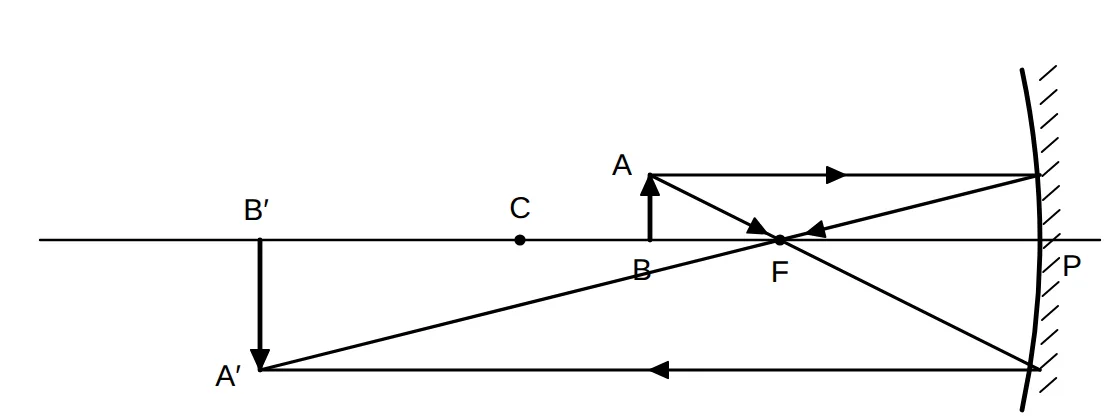
(b) State the position, nature and size of the image. If Kavita slowly moves the candle towards F, how will the image change? (1 mark)
Answer.
- Beyond C; real, inverted and enlarged — 0.5 marks
- The image moves farther away from the mirror and becomes larger (it goes to infinity when the candle reaches F) — 0.5 marks
Question 34 (2 marks)
Attempt either option (A) or (B).
(A) An electric kettle is rated 1100 W, 220 V. On the 220 V supply it boils a jug of water in 4 minutes.
(I) Find the current it draws and its resistance when working. (1 mark)
Answer.
- A (0.5); Ω (0.5) — 1 mark
(II) If it is used on a 110 V supply (take its resistance to stay the same), what power will it deliver, and about how long will it take to boil the same jug of water? (1 mark)
Answer.
- W, one-fourth of the rated power (0.5); it will take about four times as long, i.e. about 16 minutes (0.5) — 1 mark
OR
(B) In an electric room heater, the coiled element and the connecting cord are in series, so the same current flows through both. Yet after ten minutes the element is red-hot while the cord is barely warm.
(I) Use Joule's law of heating to account for this. (1 mark)
Answer.
- Heat produced ; for the same current and time it is proportional to the resistance: the element has a high resistance, the cord a very low one — 1 mark
(II) What would happen if the cord were replaced by a much thinner wire of the same material? Give a reason. (1 mark)
Answer.
- A thinner wire has a higher resistance (0.5), so more heat would be produced in it; the cord could overheat and its insulation could melt (0.5) — 1 mark
Question 35 (3 marks)
A watch-repairer uses a convex lens of focal length 12 cm as a magnifying glass. He holds a tiny screw 8 cm from the lens.
(a) Find the position of the image. (1 mark)
Answer.
- cm, cm; , so cm: the image is 24 cm from the lens, on the same side as the screw — 1 mark
(b) How many times larger than the screw is its image? Describe the image. (1 mark)
Answer.
- — 0.5 marks
- Virtual, erect and 3 times enlarged — 0.5 marks
(c) Why must the screw be closer to the lens than 12 cm? What would happen if he held it 18 cm from the lens? (1 mark)
Answer.
- Only an object within the focal length gives a virtual, erect, enlarged image that can be seen through the lens (0.5); at 18 cm (between F and 2F) the image would be real and inverted, formed 36 cm away on the other side of the lens (0.5) — 1 mark
Question 36 (3 marks)
Answer the following:
(a) Mohit wrote in his notebook: "Resistivity, , so its SI unit is Ω/m." Identify the errors and write the correct relation and unit. (1 mark)
Answer.
- The relation is , so — 0.5 marks
- The unit is Ω m (Ω × m² ÷ m), not Ω/m — 0.5 marks
(b) Silver has a resistivity of Ω m and copper Ω m, so silver is the better conductor. Why, then, are the wires in our houses made of copper and not silver? (1 mark)
Answer.
- Silver is far too costly to use in such large amounts — 0.5 marks
- Copper's resistivity is almost as low as that of silver, so it wastes very little energy as heat and is much cheaper — 0.5 marks
(c) Wires P and Q are made of the same metal. P is 2 m long with an area of cross-section of 1 mm²; Q is 3 m long with an area of cross-section of 2 mm². Which wire has the greater resistance? Find the ratio of their resistances. (1 mark)
Answer.
- : for P, ; for Q, — 0.5 marks
- P has the greater resistance; — 0.5 marks
Question 37 (3 marks)
The figure shows a circuit in which the key K is closed.
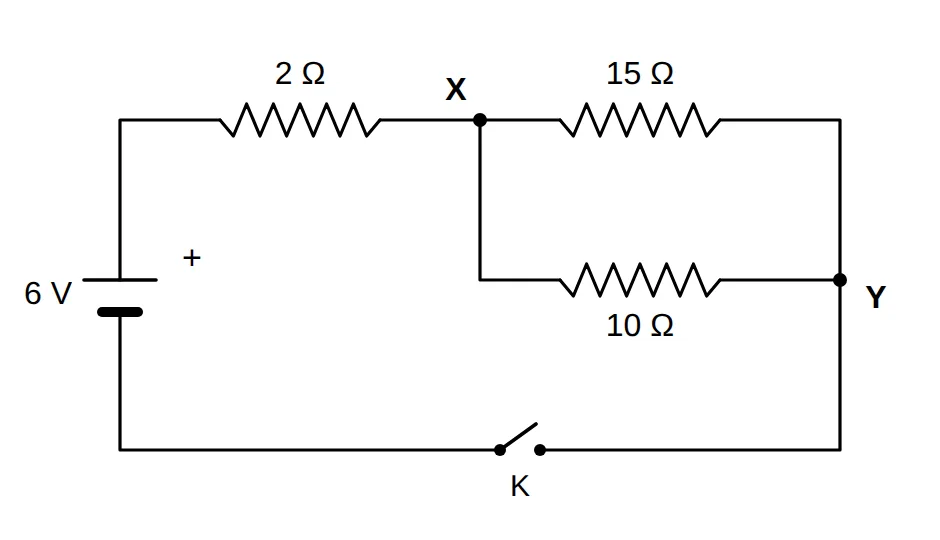
(a) Find the total resistance of the circuit. (1 mark)
Answer.
- , so Ω (0.5); total Ω (0.5) — 1 mark
(b) What current does the battery supply, and what is the potential difference across XY? (1 mark)
Answer.
- A — 0.5 marks
- V — 0.5 marks
(c) Kunal says, "More current flows through the 10 Ω resistor than through the 15 Ω resistor, so the potential difference across the 10 Ω resistor is also larger." Find the two currents and comment on his statement. (1 mark)
Answer.
- A and A — 0.5 marks
- The first half of his statement is right, but the potential difference is the same (4.5 V) across both, since they are in parallel — 0.5 marks
Question 38 (4 marks)
At a science exhibition in Indore, Aditya showed a model in which a light aluminium rod R rests across two horizontal copper rails P and Q. The rails pass between the poles of a strong horseshoe magnet, with the north pole above them and the south pole below, so the magnetic field between the poles points vertically downwards. The figure shows the view from above: the crosses show the field going into the page, and the arrow shows the direction of the current in the rod. When Aditya closes the key K, the rod rolls along the rails.
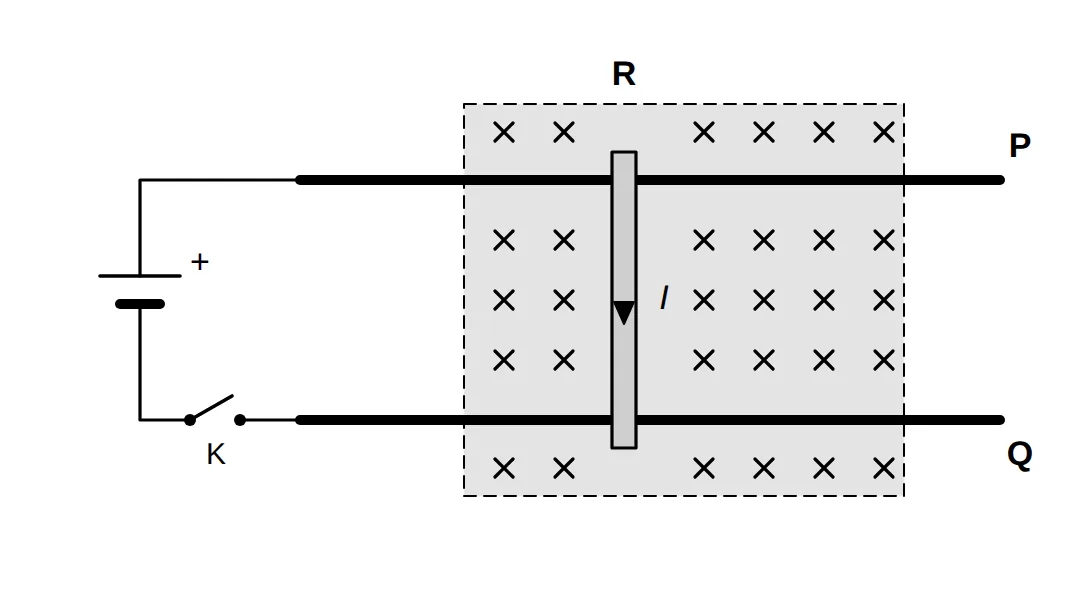
(a) Why does the rod move when the key is closed? Aluminium is not attracted by a magnet, so why is it still a good choice for the rod? (1 mark)
Answer.
- A current-carrying conductor placed in a magnetic field experiences a force — 0.5 marks
- The force acts because of the current in the rod, not because the rod is magnetic; aluminium is light and a good conductor — 0.5 marks
(b) State Fleming's left-hand rule and use it to find the direction in which the rod moves in the figure. (1 mark)
Answer.
- Stretch the thumb, forefinger and middle finger of the left hand mutually perpendicular: forefinger along the field, middle finger along the current; the thumb gives the direction of the force (motion) — 0.5 marks
- Field into the page, current down the page: the rod moves to the right (away from the battery) — 0.5 marks
(c) Aditya wants the rod to roll the other way. Suggest two ways of doing this. What will happen if he makes both changes at the same time? (2 marks)
Answer.
- Reverse the current by interchanging the battery connections (0.5); turn the magnet over so that the south pole is above and the north pole below (0.5) — 1 mark
- With both changes together, the force keeps its original direction and the rod rolls the same way as before — 1 mark
OR
(c) (I) Suggest two ways of making the force on the rod larger. (II) If the magnet were turned so that its field ran along the length of the rod, what would happen when the key is closed? Why? (2 marks)
Answer.
- (I) Any two, 0.5 each: increase the current in the rod; use a stronger magnet; use a longer rod, so that more of it lies in the field — 1 mark
- (II) The rod would not move (0.5): the force is zero when the current is parallel to the field and largest when it is at right angles to it (0.5) — 1 mark
Question 39 (5 marks)
Attempt either option (A) or (B).
(A) Meera, a college student, is reading a novel in the bright afternoon sun. Then she walks into a dimly lit room.
(i) What do the iris and the pupil of her eyes do when she walks into the dim room? (1 mark)
Answer.
- The iris controls the size of the pupil (0.5); the pupil becomes larger so that more light enters the eye (0.5) — 1 mark
(ii) Which part of the eye does most of the bending of the light that enters it? On which part is the image formed, and what does that part do? (1 mark)
Answer.
- The cornea (the outer surface of the eye) (0.5); the image forms on the retina, whose light-sensitive cells send electrical signals through the optic nerve to the brain (0.5) — 1 mark
(iii) When Meera brings her book to 10 cm from her eyes, the letters look blurred, though her eyesight is normal. Why? (1 mark)
Answer.
- For a young adult with normal vision, the least distance of distinct vision is about 25 cm: the ciliary muscles cannot make the eye lens thick enough (its focal length cannot be made any shorter) to focus so close an object on the retina — 1 mark
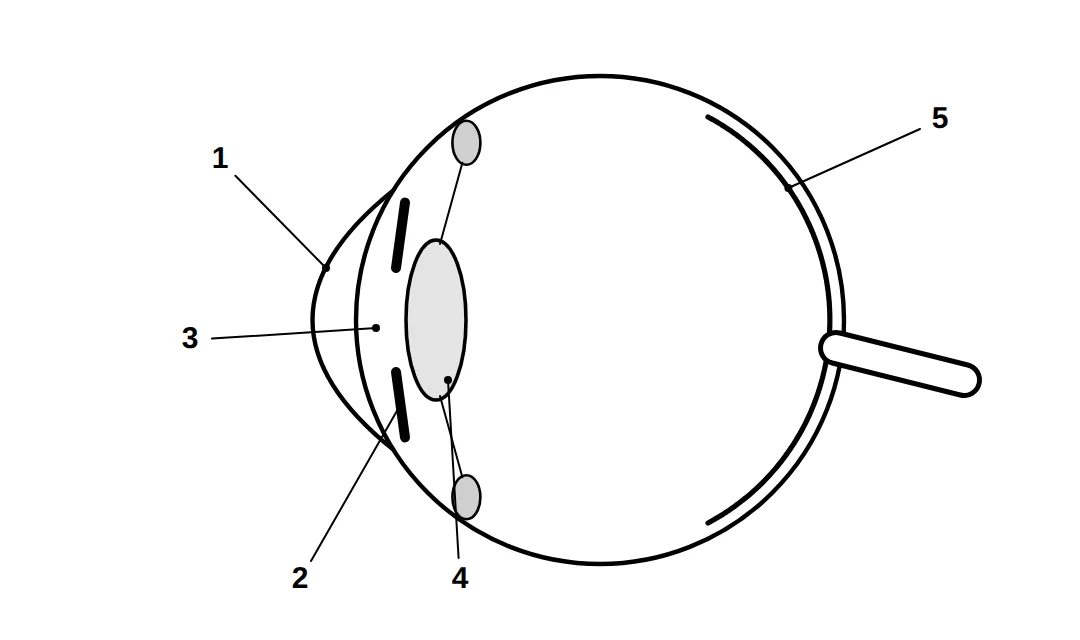
(iv) Draw a diagram of the human eye and label any four of these: cornea, iris, pupil, eye lens, retina. (2 marks)
Answer.
- Correct diagram of the human eye — 1 mark
- Any four parts correctly labelled, 0.25 each (in the figure: 1 cornea, 2 iris, 3 pupil, 4 eye lens, 5 retina) — 1 mark
OR
(B) Ishaan is studying how light behaves in his school laboratory.
(i) A ray that passes through a rectangular glass slab comes out parallel to the incident ray, but a ray that passes through a triangular glass prism does not. Why? (1 mark)
Answer.
- In a slab the two faces are parallel, so the bending at the second face is equal and opposite to that at the first (0.5); in a prism the faces are inclined, and the ray bends towards the base at both faces, so the bendings add up and the ray is deviated (0.5) — 1 mark
(ii) How does the colour of scattered light depend on the size of the scattering particles? Use this to explain why clouds look white. (1 mark)
Answer.
- Very fine particles scatter mainly blue light (shorter wavelengths), and larger particles scatter longer wavelengths as well (0.5); the water droplets in clouds are large enough to scatter all colours about equally, so the scattered light looks white (0.5) — 1 mark
(iii) A narrow beam of sunlight falling on the prism gives a band of colours on a screen, but a beam of red light from a laser pointer comes out red only. Why? (1 mark)
Answer.
- Sunlight is a mixture of colours, which the prism separates because each colour bends by a different amount (0.5); red light is a single colour, so there is nothing for the prism to split (0.5) — 1 mark
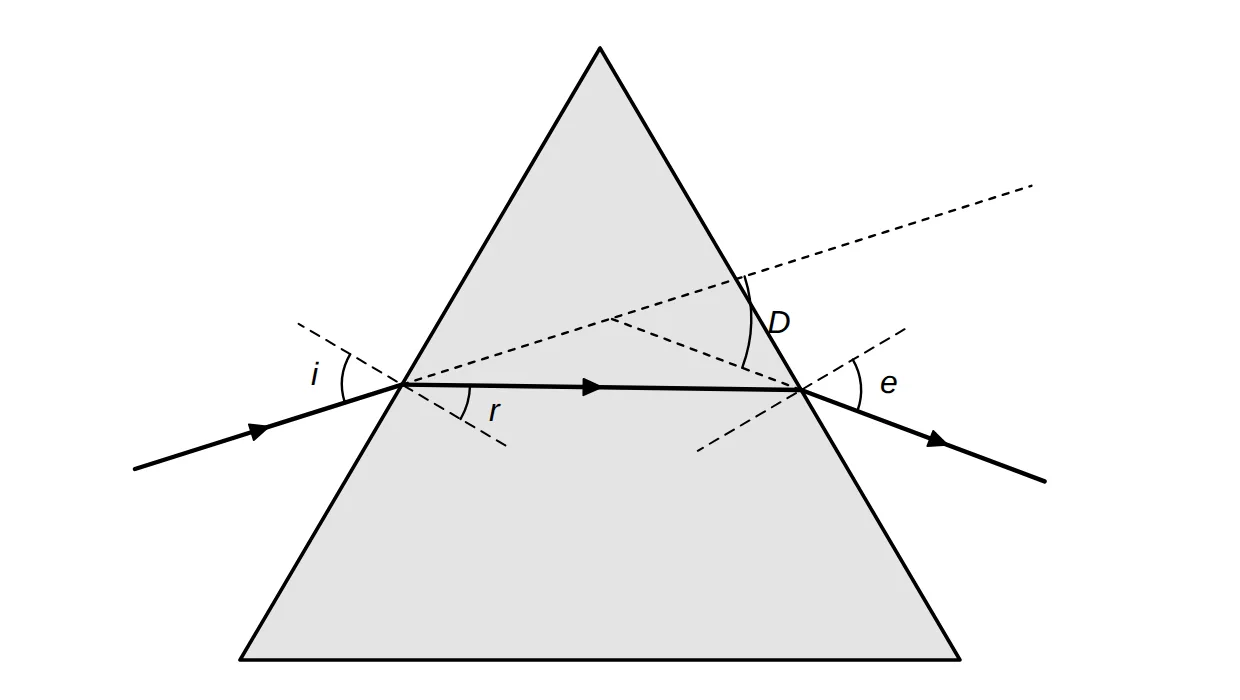
(iv) Draw the path of a ray of light passing through a triangular glass prism. Mark the angle of incidence, the angle of refraction, the angle of emergence and the angle of deviation. (2 marks)
Answer.
- Correct path: the ray bends towards the normal on entering and away from it on leaving, so it bends towards the base of the prism — 1 mark
- Four angles correctly marked, 0.25 each (in the figure: i angle of incidence, r angle of refraction, e angle of emergence, D angle of deviation) — 1 mark