
CBSE Class 10 Science Sample Paper 2027 – Set 5
Time allowed: 3 hours · Maximum marks: 80
General Instructions
- This question paper contains 39 questions. All questions are compulsory.
- The question paper is divided into THREE sections: Section A - Biology (30 marks), Section B - Chemistry (25 marks) and Section C - Physics (25 marks).
- The question paper has MCQs, VSAs, SAs, LAs and CBQs. Marks are given against each question.
- There are Case Based Questions (CBQs) with three sub-questions, of 4 marks each.
- Divide your answer sheet into three sections as per the question paper: Section A (Biology), Section B (Chemistry) and Section C (Physics). Answer each question in its own section, and do not mix answers of one section with another.
- Instructions are given with each section and question, wherever necessary.
- There is no overall choice in the question paper. However, an internal choice has been provided in a few questions. Only one of the choices in such questions must be attempted.
How to use this paper: set a 3-hour timer and write all your answers on paper, just like the board exam. When you finish, take the quiz at the end of this page to score your objective (MCQ) answers instantly, then open the Detailed Solutions and check the rest step by step, with the marks each step carries.
Section A - Biology (30 marks)
Questions 1 to 7 are multiple choice questions and questions 8 and 9 are Assertion-Reason questions, of 1 mark each. Questions 10 to 12 carry 2 marks each, questions 13 and 14 carry 3 marks each, question 15 is a case based question of 4 marks and question 16 is a long answer question of 5 marks.
1. Read the following statements about how some organisms obtain their food.
(i) Cuscuta (amar-bel) takes its food from the living host plant around which it grows, so it is a parasite.
(ii) Fungi such as bread mould break down food material outside their body and then absorb the simpler substances.
(iii) Like other green plants, Cuscuta makes its own food by photosynthesis and takes only water from its host.
(iv) A saprotroph gets its food from dead and decaying matter, whereas a parasite gets it from a living organism.
Which of these statements are correct?
(a) (i) and (iii)
(b) (i), (ii) and (iv)
(c) (ii) and (iv) only
(d) (i), (ii), (iii) and (iv)
2. Which of the following statements about the protection of our brain and spinal cord are correct?
(i) The brain sits inside a bony box, the skull (cranium).
(ii) Inside this box, the brain is held in a fluid-filled balloon that absorbs shocks.
(iii) The spinal cord is protected by the vertebral column (backbone).
(iv) The fluid around the brain carries nerve impulses from the brain to the spinal cord.
Choose the correct option.
(a) (i) and (iii) only
(b) (ii) and (iv)
(c) (i), (iii) and (iv)
(d) (i), (ii) and (iii)
3. The gardener of a plant nursery noted down the following observations. Which of them can be explained by transpiration?
(i) On a hot afternoon, the leaves of a well-watered plant stay cooler than the air around them.
(ii) Minerals taken in by the roots reach the topmost leaves of a tall plant.
(iii) Sugar made in the leaves reaches the roots and a growing fruit.
(iv) During the day, water keeps rising through the xylem of a tall tree to a height of many metres.
(a) (i), (ii) and (iv)
(b) (ii) and (iii) only
(c) (i), (iii) and (iv)
(d) (i), (ii), (iii) and (iv)
4. In a video shown in class, a Planaria was cut into three pieces, and a filament of Spirogyra was broken into small bits. After some days, every Planaria piece and every Spirogyra bit had grown into a complete organism. Which statement correctly explains the difference between the two cases?
(a) Both are examples of regeneration, since both organisms are simple animals.
(b) In Spirogyra, specialised cells in each bit form the different tissues; a Planaria piece only needs its cells to divide, as all its cells are alike.
(c) A Spirogyra bit is made of similar cells that simply go on dividing, whereas a Planaria piece needs specialised cells that divide and form the different tissues of the body.
(d) Planaria grows back only from the piece that has the head, and Spirogyra needs spores to form new filaments.
5. At a health-awareness session in a school, a doctor made the following statements about sexually transmitted diseases.
(i) These diseases can spread through sexual contact with an infected person.
(ii) Warts and HIV-AIDS are caused by viruses, while gonorrhoea and syphilis are caused by bacteria.
(iii) Of the methods used to prevent pregnancy, the condom (a barrier method) also lowers the chance of spreading these diseases.
(iv) Oral contraceptive pills protect against these diseases as well as against pregnancy.
Which statements are correct?
(a) (i), (ii) and (iii)
(b) (i) and (iv) only
(c) (ii), (iii) and (iv)
(d) (i), (ii), (iii) and (iv)
6. Two tall pea plants, both heterozygous (Tt), are crossed. What percentage of the offspring are expected to be dwarf, and what fraction of the TALL offspring will be heterozygous (Tt)?
(a) 25 per cent; one-half
(b) 25 per cent; two-thirds
(c) 50 per cent; two-thirds
(d) 75 per cent; one-third
7. In the food chain grass → grasshopper → lizard → hawk, the hawk gets 10 J of energy from its food. Using the 10 per cent law, how much energy was stored in the grass, and how much of it reached the lizard?
(a) 1,000 J; 100 J
(b) 10,000 J; 1,000 J
(c) 100,000 J; 100 J
(d) 10,000 J; 100 J
Directions: Questions 8, 9, 24 and 32 each consist of two statements, Assertion (A) and Reason (R). Answer these questions by selecting the appropriate option (a), (b), (c) or (d) given with each.
8. Assertion (A): Our heart keeps beating even while we are fast asleep.
Reason (R): The heartbeat is a voluntary action controlled by the forebrain.
(a) Both Assertion (A) and Reason (R) are true and Reason (R) is the correct explanation of Assertion (A).
(b) Both Assertion (A) and Reason (R) are true, but Reason (R) is not the correct explanation of Assertion (A).
(c) Assertion (A) is true, but Reason (R) is false.
(d) Assertion (A) is false, but Reason (R) is true.
9. Assertion (A): The ozone that shields life on Earth is found mainly at ground level, in the air we breathe.
Reason (R): Ozone molecules absorb most of the ultraviolet radiation coming from the Sun.
(a) Both Assertion (A) and Reason (R) are true and Reason (R) is the correct explanation of Assertion (A).
(b) Both Assertion (A) and Reason (R) are true, but Reason (R) is not the correct explanation of Assertion (A).
(c) Assertion (A) is true, but Reason (R) is false.
(d) Assertion (A) is false, but Reason (R) is true.
10. In a mustard field, honeybees carry pollen from the flowers of one plant to the flowers of other plants. In a pea flower, the pollen falls on the stigma of the same flower even before the flower opens. Name the kind of pollination in each case, and give two differences between them. (2 marks)
11. Answer the following:
(a) Urine is formed in the nephrons of the kidneys. Trace the path it takes from the nephron until it leaves the body. (1 mark)
(b) Urine is formed all the time, yet we pass it only now and then, and can usually hold it back for a while. Explain how this is possible. (1 mark)
12. Attempt either option (A) or (B).
(A) Thyroxin controls how every cell of the body uses carbohydrates, proteins and fats, day and night. Give two limitations of electrical impulses that make them unsuitable for such a job, and explain how a hormone overcomes each of them. (2 marks)
OR
(B) In the early teenage years, a boy's voice starts to crack and a girl's breasts begin to develop. Name the hormone responsible for these changes in boys and in girls, and the gland that makes each of them.
13. Rhea pulls her hand back in a flash when it touches a hot tawa, yet the growth of her body from a child into a teenager has taken years. The first is brought about by the nervous system and the second by hormones.
(a) Compare the two kinds of coordination in the way the message travels. (1 mark)
(b) Compare them in how quickly the response comes and how long it lasts. (1 mark)
(c) Too much or too little of a hormone can harm the body. How is the amount of a hormone released kept right? Explain with one example. (1 mark)
14. The residents of a housing society in Chennai have started putting their garbage into two separate bins. A resident has these items to throw away: vegetable peels, a broken plastic bucket, used tea leaves, an aluminium foil wrapper, old newspapers and a used battery.
(a) Sort these items into biodegradable and non-biodegradable waste. (1 mark)
(b) Give two harmful effects of non-biodegradable waste if it is simply dumped. (1 mark)
(c) One resident suggests burying all the garbage together in a pit in the park, to save the effort of sorting it. Do you agree? Give a reason. (1 mark)
15. Mrs Deshpande, a science teacher in Nagpur, made a model of how the sex of a child is decided. She put 20 cards marked X in a pouch labelled 'Mother'. In a second pouch labelled 'Father' she put 10 cards marked X and 10 cards marked Y. Each group of students drew one card from each pouch without looking, noted the pair, and put the cards back. Each pair of cards stood for the sex chromosomes of one child.
(a) A card stands for the sex chromosome only. How many chromosomes in all does a human egg carry, and how many does a human sperm carry? (1 mark)
(b) Why does the 'Father' pouch hold two kinds of cards while the 'Mother' pouch holds only one kind? What does this tell us about who decides the sex of the child? (1 mark)
(c) Ritika's group made 40 draws and got 17 XX pairs and 23 XY pairs. Ritika says the model has failed, because it should give exactly 20 of each. Is she right? What result would you expect if the whole class pooled 400 draws? Explain. (2 marks)
OR
(c) A student asks, "What would happen if each parent passed on all 46 of its chromosomes to the child?" Answer her, and explain how the number of chromosomes stays the same from one generation to the next. (2 marks)
16. Attempt either option (A) or (B).
(A) Tenzing, a Class 10 student in Leh, notices that visitors from the plains often feel short of breath for the first few days in the thin mountain air.
(i) The windpipe (trachea) is supported by rings of cartilage, and the nasal passage is lined with fine hairs and mucus. What is the job of each? (1 mark)
(ii) Even when we breathe out as hard as we can, some air always stays behind in the lungs. Why is this useful? (1 mark)
(iii) Tenzing's teacher says that in thin air each breath brings in less oxygen, so a red pigment in our blood has to do its job well. Name this pigment and state how it helps to carry oxygen. (1 mark)
(iv) Draw a diagram of the human respiratory system and label any four of these: trachea, bronchus, lung, alveolar sac (alveoli), diaphragm. (2 marks)
OR
(B) Sahil watched a drop of pond water under the microscope in his school laboratory and saw an Amoeba moving towards a small food particle.
(i) Describe how the Amoeba takes in, digests and uses this food particle. How is this different from the way a mushroom growing on a rotting log and a tapeworm living in the human intestine get their food? (3 marks)
(ii) Draw a diagram of an Amoeba taking in a food particle and label any four of these: pseudopodium, food particle, food vacuole, nucleus, cell membrane. (2 marks)
Section B - Chemistry (25 marks)
Questions 17 to 23 are multiple choice questions and question 24 is an Assertion-Reason question, of 1 mark each. Question 25 carries 2 marks, questions 26 and 27 carry 3 marks each, question 28 is a case based question of 4 marks and question 29 is a long answer question of 5 marks.
17. Read the following statements about respiration and photosynthesis.
(i) Respiration is an exothermic process: energy is released as glucose combines with oxygen in our cells.
(ii) Photosynthesis is an endothermic process: plants absorb energy from sunlight to make glucose.
(iii) In respiration, glucose is oxidised to carbon dioxide and water.
(iv) In photosynthesis, carbon dioxide is oxidised to glucose.
Which statements are correct?
(a) (i), (ii) and (iii)
(b) (i) and (iv) only
(c) (ii), (iii) and (iv)
(d) (i), (ii), (iii) and (iv)
18. Priya heated a few crystals of copper sulphate in a dry boiling tube. Drops of water appeared on the cooler, upper part of the tube and the crystals turned white. After the tube had cooled, she added two or three drops of water to the white powder. What will she observe, and why?
(a) The powder turns black, because it has changed into copper oxide.
(b) The powder stays white, because heating has changed it permanently.
(c) The blue colour comes back, because the salt takes up its water of crystallisation again.
(d) The powder gives a green solution of copper hydroxide.
19. Consider the following statements about ethanol.
(i) It is a liquid at room temperature and mixes with water in all proportions.
(ii) A small piece of sodium dropped into it gives off hydrogen gas.
(iii) It turns blue litmus red, because it is an acid.
(iv) It is the active ingredient of all alcoholic drinks and is also a good solvent.
Which statements are correct?
(a) (i) and (iii)
(b) (i), (ii) and (iv)
(c) (ii) and (iv) only
(d) (ii), (iii) and (iv)
20. Tanya cleaned strips of five metals P, Q, R, S and T with sandpaper and dropped each into a test tube containing the same volume of dilute hydrochloric acid. The metals were magnesium, aluminium, zinc, iron and copper, in some order. She noted:
P - bubbles form very rapidly
Q - no bubbles, even on warming
R - bubbles form slowly
S - bubbles form fast, but not as fast as with P
T - bubbles form steadily, faster than with R but slower than with S
Which option shows the metals in decreasing order of reactivity?
(a) P > T > S > R > Q
(b) Q > R > T > S > P
(c) P > S > R > T > Q
(d) P > S > T > R > Q
21. The structural formula of an organic compound is shown in the figure. Which option correctly gives the functional group present in it and the name of the compound?
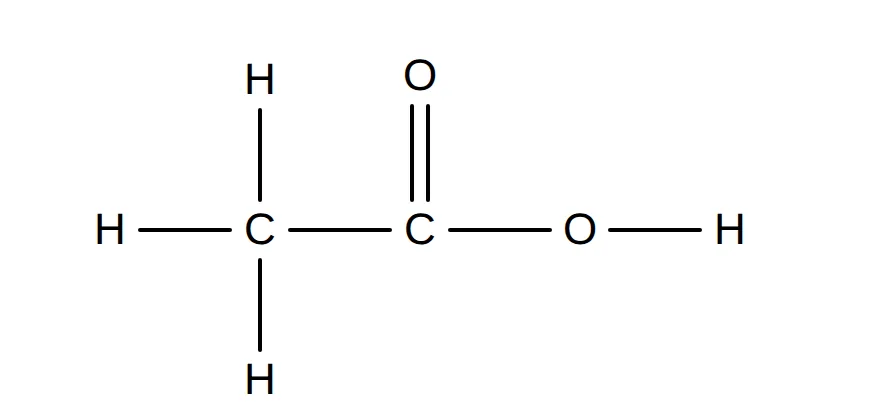
(a) Carboxylic acid group; ethanoic acid
(b) Aldehyde group; ethanal
(c) Carboxylic acid group; methanoic acid
(d) Alcohol (hydroxyl) group; ethanol
22. An eco-club tested rainwater collected at four places and recorded its pH: P - 6.0, Q - 7.0, R - 5.0, S - 5.8. Which option correctly picks out the acid rain and its effect on a lake that it drains into?
(a) P, R and S; the lake water becomes basic
(b) R and S; aquatic life is not affected
(c) R only; the pH of the lake water falls, which makes it hard for aquatic animals to survive
(d) All four; the lake water becomes neutral
23. A rock sample contains a copper compound mixed with a lot of sand and soil, and copper can be extracted from it profitably. Which statement about it is correct?
(a) It is a mineral but not an ore, because it contains sand and soil.
(b) It is an ore; the sand and soil in it are called gangue and are removed before the metal is extracted.
(c) It is an ore; the sand and soil are called gangue and are removed after the copper has been refined.
(d) Any rock that contains a copper compound is an ore, whether or not copper can be extracted from it profitably.
24. Assertion (A): The burning of coal in a brick kiln is an exothermic reaction.
Reason (R): Coal is obtained by mining it from under the ground.
(a) Both Assertion (A) and Reason (R) are true and Reason (R) is the correct explanation of Assertion (A).
(b) Both Assertion (A) and Reason (R) are true, but Reason (R) is not the correct explanation of Assertion (A).
(c) Assertion (A) is true, but Reason (R) is false.
(d) Assertion (A) is false, but Reason (R) is true.
25. Answer the following:
(a) Show the bonding in a molecule of methane, , with the help of its electron dot structure. (Atomic number of carbon = 6) (1 mark)
(b) Carbon forms covalent bonds by sharing electrons. Give one reason why it does not form a ion and one reason why it does not form a ion. (1 mark)
26. Karan half-filled two test tubes, A and B, with water from the hand pump in his village. He added a little soap solution to A and the same amount of detergent solution to B, and shook both tubes in the same way.
(a) In which test tube will a good lather form? What will he see in the other one? (1 mark)
(b) What is the scum formed in A? Give one reason why it is a nuisance for someone washing clothes with soap in this water. (1 mark)
(c) Karan now wants to find which of three samples (hand-pump water, tap water and distilled water) is the hardest, using only soap solution. How should he plan the test so that it is fair, and what will show him the hardest sample? (1 mark)
27. Attempt either option (A) or (B).
(A) Tanvi writes in her notebook: "To get copper from copper glance (), we must first roast the ore and then reduce the oxide with carbon, just as we do for zinc."
(i) Where is Tanvi wrong? Give a reason. (1 mark)
(ii) Write the balanced equations for the two steps by which copper is actually obtained from copper glance. (1 mark)
(iii) Mercury is also low in the activity series. Write the balanced equation for the final step in which mercury is obtained from its oxide, and state what is needed for it. (1 mark)
OR
(B) Predict whether the metal will be obtained in each of the following cases. Give a reason in each case, and write the balanced equation for the cases in which the metal is obtained.
(I) Mercury(II) oxide is heated on its own.
(II) Zinc oxide is heated on its own.
(III) Iron(III) oxide is heated with aluminium powder.
(IV) Aluminium oxide is heated with carbon.
28. Gurpreet grows vegetables on his family's farm near Ludhiana, Punjab. A soil test showed that the soil in one field had a pH of 5.5, too low for the crop he wanted to sow. The agriculture officer advised him to spread a measured amount of slaked lime over the field and mix it into the soil. In the same week, Gurpreet's grandfather complained of acidity after a heavy meal, and the doctor told him to take a spoonful of milk of magnesia.
(a) Is the soil in the field acidic or basic? Why does slaked lime help? (1 mark)
(b) Name the chemical in milk of magnesia and explain how it relieves the grandfather's acidity. (1 mark)
(c) Gurpreet limed two fields, X and Y, whose soil had a pH of 5.5. A month later the pH of X was 6.8 and that of Y was 8.2. (I) Which field is now better suited to most crops, and what went wrong in the other? (II) Write the balanced equation for the reaction of slaked lime with an acid such as hydrochloric acid, and name the type of reaction. (2 marks)
OR
(c) Gurpreet has baking soda, slaked lime and common salt at home. (I) Which of these would be of no use for treating acidic soil? Why? (II) Write the balanced equation for the reaction by which milk of magnesia neutralises the acid in the stomach. (2 marks)
29. Attempt either option (A) or (B).
(A) Anjali weighed about 1 g of brown copper powder in a china dish and heated it over a burner. The powder slowly turned black, and its mass increased. She then passed hydrogen gas over the heated black powder until it turned brown again, and found that its mass had come back to what it was at the start.
(i) Name the black substance and write the balanced equations for both changes. Explain why the mass first increased and then decreased, and identify the oxidising agent and the reducing agent in the second reaction. (3 marks)
(ii) Anjali's friend says, "The mass went up on heating, so mass is not conserved in chemical reactions." (I) Is she right? Explain. (II) Which law does a balanced chemical equation follow? Show that follows it. (2 marks)
OR
(B)
(i) Three students are discussing the energy changes in some everyday processes.
Tara: "When vegetable waste turns into compost, heat is given out, so it is an exothermic process."
Dev: "We have to light a candle with a matchstick, so the burning of wax takes in heat. It is an endothermic reaction."
Ali: "Respiration is exothermic, but it is not a chemical reaction at all. It is just breathing in and out."
Who is correct and who is not? Justify your answer in each case. (3 marks)
(ii) Identify the error in each of the following and rewrite it correctly.
(I) ; this is a combination reaction.
(II) ; this is a double displacement reaction.
(III) ; this is a double displacement reaction. (2 marks)
Section C - Physics (25 marks)
Questions 30 and 31 are multiple choice questions and question 32 is an Assertion-Reason question, of 1 mark each. Questions 33 and 34 carry 2 marks each, questions 35 to 37 carry 3 marks each, question 38 is a case based question of 4 marks and question 39 is a long answer question of 5 marks.
30. The figure shows the path of a ray of light as it passes from medium A into medium B and then into medium C. The dashed lines are the normals. Which medium is optically the densest, and which is the rarest?
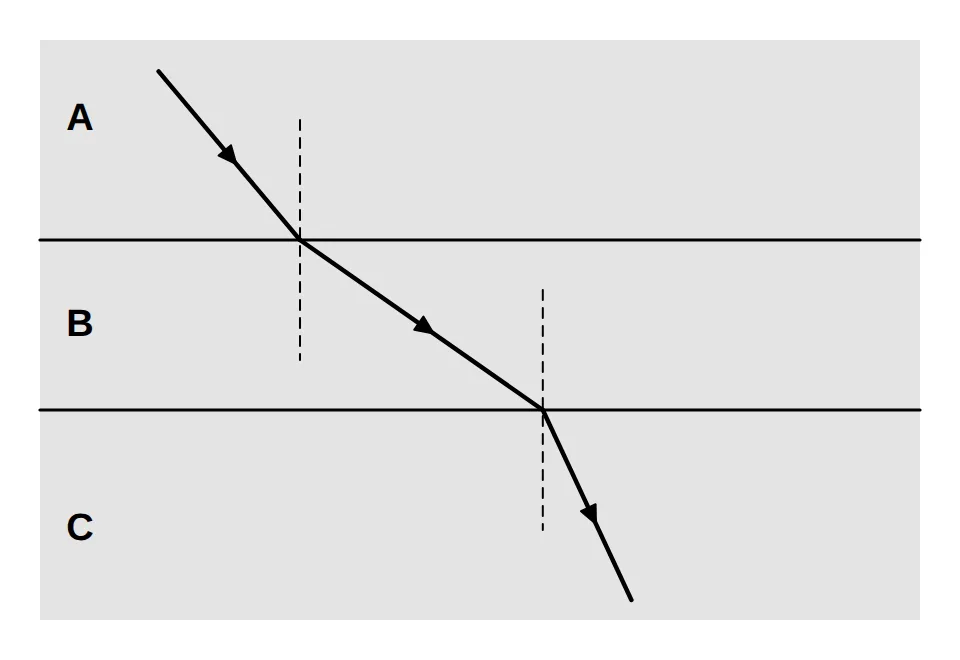
(a) Densest A; rarest C
(b) Densest B; rarest C
(c) Densest C; rarest B
(d) Densest A; rarest B
31. Neha's father is getting the wiring of their new house checked. Which option gives the colour code of the insulation used in our domestic wiring and the wire that is joined to the metal body of an electric iron?
(a) Live - red, neutral - black, earth - green; the neutral wire is joined to the metal body
(b) Live - black, neutral - red, earth - green; the earth wire is joined to the metal body
(c) Live - green, neutral - black, earth - red; the earth wire is joined to the metal body
(d) Live - red, neutral - black, earth - green; the earth wire is joined to the metal body
32. Assertion (A): A star seen near the horizon appears slightly higher in the sky than its actual position.
Reason (R): Starlight entering the Earth's atmosphere bends towards the normal as it passes into denser layers of air.
(a) Both Assertion (A) and Reason (R) are true and Reason (R) is the correct explanation of Assertion (A).
(b) Both Assertion (A) and Reason (R) are true, but Reason (R) is not the correct explanation of Assertion (A).
(c) Assertion (A) is true, but Reason (R) is false.
(d) Assertion (A) is false, but Reason (R) is true.
33. Kavita places a lighted candle between the centre of curvature C and the principal focus F of a concave mirror.
(a) Draw a ray diagram showing how the image of the candle is formed. (1 mark)
(b) State the position, nature and size of the image. If Kavita slowly moves the candle towards F, how will the image change? (1 mark)
34. Attempt either option (A) or (B).
(A) An electric kettle is rated 1100 W, 220 V. On the 220 V supply it boils a jug of water in 4 minutes.
(I) Find the current it draws and its resistance when working. (1 mark)
(II) If it is used on a 110 V supply (take its resistance to stay the same), what power will it deliver, and about how long will it take to boil the same jug of water? (1 mark)
OR
(B) In an electric room heater, the coiled element and the connecting cord are in series, so the same current flows through both. Yet after ten minutes the element is red-hot while the cord is barely warm.
(I) Use Joule's law of heating to account for this. (1 mark)
(II) What would happen if the cord were replaced by a much thinner wire of the same material? Give a reason. (1 mark)
35. A watch-repairer uses a convex lens of focal length 12 cm as a magnifying glass. He holds a tiny screw 8 cm from the lens.
(a) Find the position of the image. (1 mark)
(b) How many times larger than the screw is its image? Describe the image. (1 mark)
(c) Why must the screw be closer to the lens than 12 cm? What would happen if he held it 18 cm from the lens? (1 mark)
36. Answer the following:
(a) Mohit wrote in his notebook: "Resistivity, , so its SI unit is Ω/m." Identify the errors and write the correct relation and unit. (1 mark)
(b) Silver has a resistivity of Ω m and copper Ω m, so silver is the better conductor. Why, then, are the wires in our houses made of copper and not silver? (1 mark)
(c) Wires P and Q are made of the same metal. P is 2 m long with an area of cross-section of 1 mm²; Q is 3 m long with an area of cross-section of 2 mm². Which wire has the greater resistance? Find the ratio of their resistances. (1 mark)
37. The figure shows a circuit in which the key K is closed.
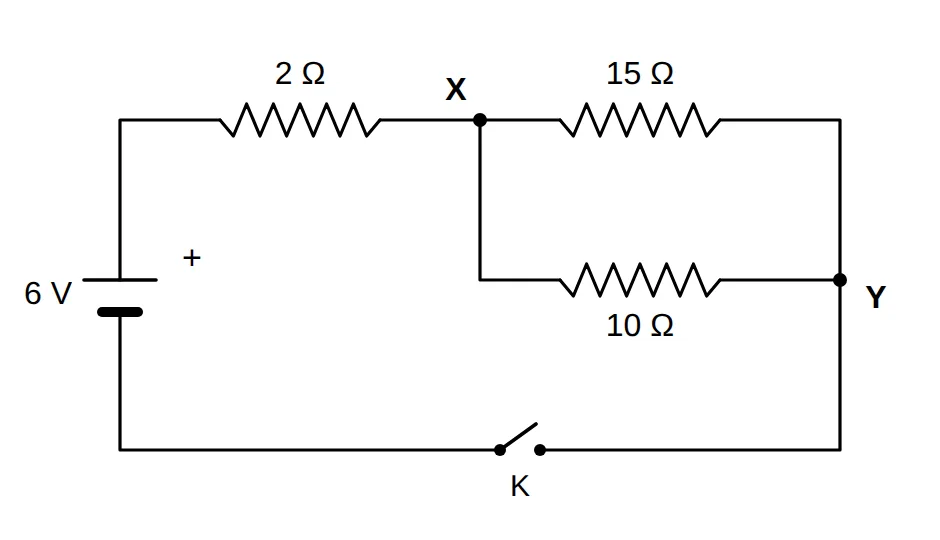
(a) Find the total resistance of the circuit. (1 mark)
(b) What current does the battery supply, and what is the potential difference across XY? (1 mark)
(c) Kunal says, "More current flows through the 10 Ω resistor than through the 15 Ω resistor, so the potential difference across the 10 Ω resistor is also larger." Find the two currents and comment on his statement. (1 mark)
38. At a science exhibition in Indore, Aditya showed a model in which a light aluminium rod R rests across two horizontal copper rails P and Q. The rails pass between the poles of a strong horseshoe magnet, with the north pole above them and the south pole below, so the magnetic field between the poles points vertically downwards. The figure shows the view from above: the crosses show the field going into the page, and the arrow shows the direction of the current in the rod. When Aditya closes the key K, the rod rolls along the rails.
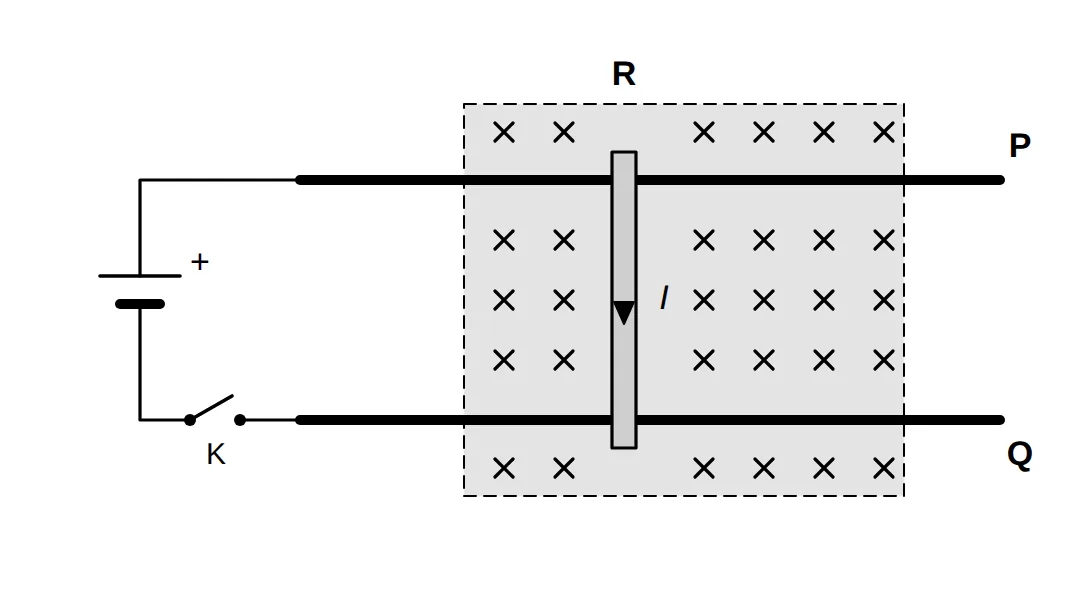
(a) Why does the rod move when the key is closed? Aluminium is not attracted by a magnet, so why is it still a good choice for the rod? (1 mark)
(b) State Fleming's left-hand rule and use it to find the direction in which the rod moves in the figure. (1 mark)
(c) Aditya wants the rod to roll the other way. Suggest two ways of doing this. What will happen if he makes both changes at the same time? (2 marks)
OR
(c) (I) Suggest two ways of making the force on the rod larger. (II) If the magnet were turned so that its field ran along the length of the rod, what would happen when the key is closed? Why? (2 marks)
39. Attempt either option (A) or (B).
(A) Meera, a college student, is reading a novel in the bright afternoon sun. Then she walks into a dimly lit room.
(i) What do the iris and the pupil of her eyes do when she walks into the dim room? (1 mark)
(ii) Which part of the eye does most of the bending of the light that enters it? On which part is the image formed, and what does that part do? (1 mark)
(iii) When Meera brings her book to 10 cm from her eyes, the letters look blurred, though her eyesight is normal. Why? (1 mark)
(iv) Draw a diagram of the human eye and label any four of these: cornea, iris, pupil, eye lens, retina. (2 marks)
OR
(B) Ishaan is studying how light behaves in his school laboratory.
(i) A ray that passes through a rectangular glass slab comes out parallel to the incident ray, but a ray that passes through a triangular glass prism does not. Why? (1 mark)
(ii) How does the colour of scattered light depend on the size of the scattering particles? Use this to explain why clouds look white. (1 mark)
(iii) A narrow beam of sunlight falling on the prism gives a band of colours on a screen, but a beam of red light from a laser pointer comes out red only. Why? (1 mark)
(iv) Draw the path of a ray of light passing through a triangular glass prism. Mark the angle of incidence, the angle of refraction, the angle of emergence and the angle of deviation. (2 marks)