
Outcomes of Democracy
Outcomes of Democracy carried 3 marks in the 2026-27 sample paper and in February 2026, and 5 marks in 2025, when it gave the Political Science 5-marker (bases for assessing the outcomes of democracy, OR values of democracy). The sample paper and February 2026 each set a cartoon MCQ and a 2-marker from it (citizens as stakeholders; democracy versus dictatorship), and May 2026 had an Assertion-Reason on legitimate government.
Marks are most often lost by writing that democracy brings faster economic growth, by mixing up accountable and responsive government, by treating majority rule as rule by the majority community, and by giving a one-sided answer when the question asks you to evaluate a claim.
Revise in 5 Minutes
How to judge democracy: against its real alternatives, not a perfect ideal. It creates conditions; citizens must use them. Values: equality, dignity, better decisions, peaceful settling of conflicts, room to correct mistakes.
Delivered well and fallen short
| Outcome | Delivered | Fallen short |
|---|---|---|
| Accountable, responsive, legitimate government | Regular and free elections; conditions for debate; transparency; people's own government, wide support | Elections not always fair to all; not every decision debated; information held back; slow to respond; corruption |
| Economic growth | Not far behind; poor countries: gap negligible | Dictatorships slightly faster on average |
| Inequality and poverty | Political equality: one person, one vote | A rich few hold a growing share; poor voters neglected; some poor countries need food from abroad |
| Social diversity | Differences settled peacefully | Needs constant adjusting |
| Dignity and freedom | Equal respect accepted; claims of women and disadvantaged castes stronger | Unfair treatment continues |
Democracy and dictatorship
| Democracy | Dictatorship | |
|---|---|---|
| Rulers | Chosen and removable by voters | Cannot be voted out |
| Decisions | Slower, debated, widely accepted | Quick, little debate |
| Mistakes, corruption | Can be exposed and corrected | Easily hidden; no less corrupt |
| Citizens | Equal vote; free to criticise | Criticism risky |
Growth depends on: population, the world economy, help from other countries, economic priorities.
Diversity: the majority works with the minority; majority rule is not rule by one community; nobody is shut out by birth.
The test never ends: each gain raises expectations; complaints show people are citizens, not subjects.
Traps
- Never write that democracy guarantees faster growth.
- Accountable (answers to voters) is not responsive (acts on needs).
- Equal votes do not mean equal incomes.
- Complaints are not proof of failure.
How to use this page: try each question on paper first, then read the answer. The marks against each step show what an examiner looks for. The 1-mark MCQs and Assertion-Reason questions are in the quiz at the end, together with questions that test how well you understand the chapter; every quiz answer comes with its explanation.
Short Answer Questions (2 and 3 Marks)
Question 1 (2 marks)
Anil gives democracy low marks because it has not removed all of his country's problems. Sara judges it by comparing it with how non-democratic governments have done. Whose method is fairer? Give two reasons.
Answer.
Model answer:
Sara's method is fairer.
- Every government leaves some problems unsolved, so democracy should be tested against the other forms of government that actually exist.
- On that test it does better on accountability, dignity and handling differences.
Marking scheme:
- Sara's method is fairer: every form of government leaves some problems unsolved, so democracy should be tested against the other forms that actually exist. — 1 mark
- Measured that way, democracy does better on accountable government, dignity of citizens or peaceful handling of differences, though it is not ahead on growth. (Accept any one such comparison.) — 1 mark
Question 2 (2 marks)
Countries A and B are both democracies, with constitutions, elections, parties and rights. Yet A has done far better than B in improving its people's lives. Give two reasons that can explain this.
Answer.
Model answer:
- The countries may differ in social situation, culture, population or economic priorities.
- Democracy only creates conditions for a better life; A's citizens and government may simply have used them better.
Marking scheme:
- The two countries may differ in their social situation, culture, population size, the world economic conditions they face or their economic priorities. (Accept any one.) — 1 mark
- Democracy only creates conditions for a better life; results depend on how well citizens and governments use them. — 1 mark
Question 3 (3 marks)
Tarvia is a democracy. Its neighbour Ostrel has been ruled by one man for twenty years. Compare how each country is likely to deal with:
(a) a policy that turns out to be wrong;
(b) a flood that ruins crops in a remote province;
(c) a big decision, such as building a new port.
Answer.
Model answer:
(a) In Tarvia, criticism can force a change; in Ostrel few dare question the ruler, so the mistake lasts.
(b) In Tarvia, representatives, the press and voters push for relief; in Ostrel it depends on the ruler's goodwill.
(c) Tarvia decides slowly after debate, and the decision is more accepted; Ostrel is quick but may face resentment.
Marking scheme:
- (a) In Tarvia, criticism in the legislature, the press and public meetings can force the policy to be changed; in Ostrel there are few safe ways to question the ruler, so the mistake may continue. — 1 mark
- (b) In Tarvia, the province's representatives, the press and voters can press the government for relief, and a party that fails may lose the next election; in Ostrel relief depends on the ruler's goodwill, and nothing forces him to act. (Accept: non-democracies have not shown themselves more responsive.) — 1 mark
- (c) Tarvia will take longer because of debate and bargaining, but the decision is more likely to be accepted and to work; Ostrel can decide quickly, but people may resent a decision they had no say in. — 1 mark
Question 4 (3 marks)
'Democracies have done well on some ways of keeping a government answerable, but less well on others.' Support the statement with three points.
Answer.
Model answer:
- Done well: most democracies hold regular and free elections, and people can debate public issues.
- Less well: elections do not always give everyone a fair chance, and not every big decision is openly debated.
- Less well: governments tell citizens less about their work than citizens need to know.
Marking scheme:
- Done well: most democracies hold regular and free elections, and allow conditions for public debate. — 1 mark
- Less well: elections do not always give every candidate and voter a fair chance, and not every major decision is put to public debate. — 1 mark
- Less well: governments share less information with citizens about their working than citizens need. (Accept: governments are not always responsive or free of corruption.) — 1 mark
Question 5 (2 marks)
Rohan, a college student, says, 'Politics is for politicians. Ordinary people like me have no stake in it.' Give two arguments to show him that citizens are stakeholders in a democracy.
Answer.
Model answer:
- Power comes from the people: citizens choose and can remove their rulers, and Rohan's vote counts as much as anyone's.
- Between elections he can influence decisions through debate, petitions, the right to information and ward meetings.
Marking scheme:
- Power comes from the people: citizens choose their rulers and can remove them, and Rohan's vote carries the same weight as anyone else's. — 1 mark
- Citizens can shape decisions between elections too, through public debate, petitions, the right to information, ward or gram sabha meetings and peaceful protest. (Accept: government decisions on fees, jobs or transport affect his own life.) — 1 mark
Question 6 (3 marks)
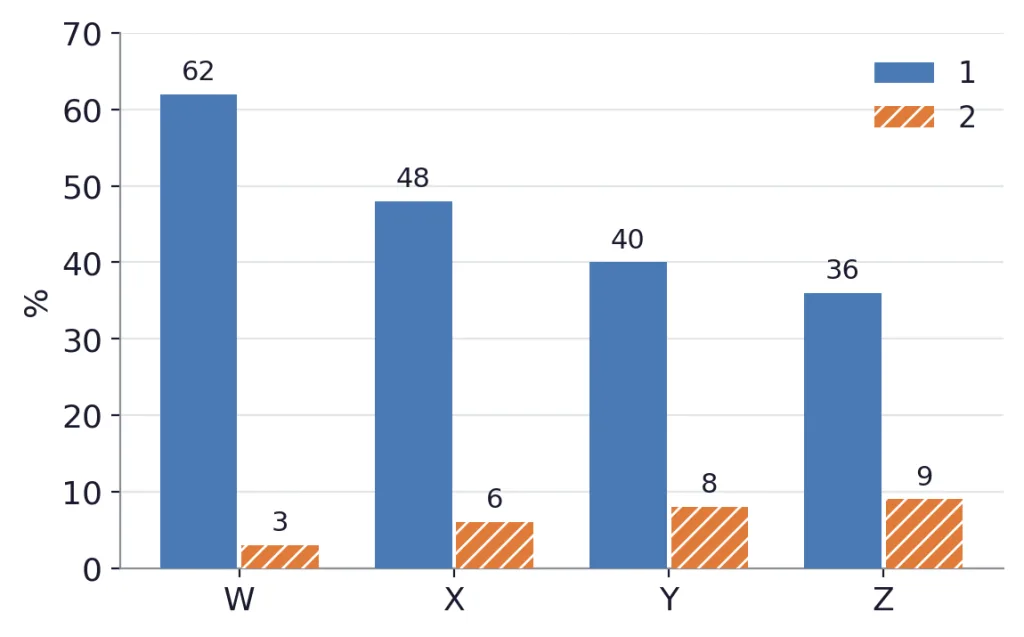
The graph shows the share of national income that goes to the richest 20 per cent of people (bar 1) and to the poorest 20 per cent (bar 2) in four imaginary democracies, W, X, Y and Z. The figures are hypothetical. In all four, every adult has one vote of equal value.
A student concludes: 'Since every adult has an equal vote, these democracies have also made their people economically equal.' Evaluate this conclusion with three points from the graph and the chapter.
Answer.
Model answer:
- The conclusion is wrong: in every country the richest 20% get far more than the poorest 20% (W: 62% against 3%).
- All four give equal votes, yet the gap runs from 4 times (Z) to about 20 times (W); political equality has not brought economic equality.
- Reducing inequality is one of democracy's weakest areas.
Marking scheme:
- The conclusion is wrong: in every country the richest 20% get far more than the poorest 20% (e.g. W: 62% against 3%, about 20 times). — 1 mark
- All four have the same political equality (one person, one vote), yet the gap varies widely, from 4 times in Z to about 20 times in W, so equal votes alone do not bring economic equality. — 1 mark
- Reducing economic inequality is one of democracy's weakest areas: a small, rich group holds a large share of income while the poorest have very little. — 1 mark
Question 7 (2 marks)
In many democracies the poor make up a large share of the voters. Give two reasons why a government may still neglect them.
Answer.
Model answer:
- Parties may promise the poor a lot to win their votes and forget the promises after the election.
- The rich have more influence through money, contacts and the media, while the poor are less organised.
Marking scheme:
- Parties may make big promises to the poor at election time to win their votes, and then forget them once in power. — 1 mark
- The rich have more influence between elections through money for campaigns, contacts and the media, while the poor are less organised. (Accept: the poor may be divided by caste, religion or region, or lack information.) — 1 mark
Question 8 (2 marks)
Distinguish between 'rule by the majority' and 'rule by the majority community' in a democracy, with one example of each.
Answer.
Model answer:
- Majority rule: the view with most votes wins and the majority changes, e.g. the party with most seats forms the government.
- Majority-community rule: one religious or language group always rules by its numbers, e.g. imposing its language.
Marking scheme:
- Rule by the majority: the government follows the view that wins most votes on an issue or in an election, and this majority changes; e.g. a party that wins most seats forms the government for five years. — 1 mark
- Rule by the majority community: one religious, racial or language group rules permanently because of its numbers, which is not democratic; e.g. making the majority's language the only official language. — 1 mark
Question 9 (3 marks)
Kamala works in a garment factory where women are paid less than men for the same work. Explain how living in a democracy helps her to fight this, and why the problem still exists.
Answer.
Model answer:
- Equal treatment of women is accepted in a democracy, and the law requires equal pay for equal work.
- So Kamala can join other workers, go to the labour office or court, and use the media and her vote.
- The problem continues because society was male dominated for long and old attitudes change slowly.
Marking scheme:
- In a democracy, treating women as equals is accepted as right, so paying Kamala less for the same work cannot be defended in law or in public. (Accept: the law requires equal pay for equal work, so she can take the employer to the labour office or the court.) — 1 mark
- She can act on this: join other women workers or a union, complain to the authorities, and use the media and her vote to press the demand. — 1 mark
- The problem remains because society was male dominated for a very long time, and old attitudes among employers and families change slowly. — 1 mark
Question 10 (2 marks)
A dalit family in a village still faces unfair treatment at times. In what two ways is its position under democracy different from what it was in a society built on caste hierarchy?
Answer.
Model answer:
- Its demand for equal status and equal chances in schooling and jobs is accepted as just.
- Unfair treatment is now a punishable offence most people see as wrong, so the family can go to the police or court.
Marking scheme:
- Its demand to be treated as an equal, and to get the same chances in schooling and jobs, is now accepted as just, and groups can organise to press it. — 1 mark
- Treating the family unfairly is now a punishable offence and most people see it as wrong, so the family can file a complaint with the police or go to court. — 1 mark
Long Answer and Case-Based Questions
Question 11 (5 marks)
A citizens' group in the imaginary democracy of Meravia collected five findings about its government. For each finding, say whether it shows the government to be accountable, responsive or legitimate, or whether it points to a shortfall, and give a reason.
(i) A minister who could not explain the long delay in a hospital project lost her seat at the next election.
(ii) Relief camps, food and medicines reached flood-hit villages within two days.
(iii) In a survey, most people said they preferred their elected government to any other kind, although they found it slow.
(iv) Farmers' demand for a canal to their area has been pending for eight years.
(v) A minister's relatives won three road contracts without open bidding, and no action has been taken.
Answer.
Model answer:
- (i) Accountable: voters removed a minister who could not answer for the delay.
- (ii) Responsive: the government saw an urgent need and met it quickly.
- (iii) Legitimate: people accept the government as their own even though it is slow.
- (iv) Shortfall: the government is slow to respond and has left a demand of many farmers pending for years.
- (v) Shortfall: this is corruption, and no one has been made to answer for it yet; democracies are not free of such problems.
Marking scheme:
- (i) Accountable: rulers must answer to the people, and voters removed a minister who could not explain her work. — 1 mark
- (ii) Responsive: the government noticed an urgent need and acted on it quickly. — 1 mark
- (iii) Legitimate: people accept the government as their own even though it is slow. — 1 mark
- (iv) Shortfall: the government is slow to respond and has ignored a demand of many people for years. — 1 mark
- (v) Shortfall: corruption, and a failure to hold a minister to account. (Accept: democracies are not free of corruption, though voters, the press and courts can still act.) — 1 mark
OR
Read the following situations from an imaginary democracy. For each, name the strength of democracy it shows and explain it briefly.
(i) A court orders a powerful minister to follow the same building rules as everyone else.
(ii) A street vendor who was insulted by an official files a complaint, and the official has to apologise.
(iii) A new law is passed only after months of debate, and several changes suggested by the opposition are accepted.
(iv) Two neighbouring villages disagree about where a new weekly market should be set up, and settle it through talks led by their elected panchayat members.
(v) The government withdraws a fee increase after students protest, and admits the decision was wrong.
Answer.
Model answer:
- (i) Equality among citizens: the same law binds a minister and an ordinary person.
- (ii) Dignity of the individual: even a street vendor has a right to respect, and an official can be made to apologise.
- (iii) Better decisions: long debate and the opposition's changes make the law more acceptable and effective.
- (iv) Peaceful handling of differences: the villages talk the matter through and agree on a site.
- (v) Correcting mistakes: protest and public discussion lead the government to reverse a wrong decision.
Marking scheme:
- (i) Equality among citizens: the same law applies to the powerful and to ordinary people. — 1 mark
- (ii) Dignity of the individual: every person, however poor, has a right to be treated with respect. — 1 mark
- (iii) Better quality of decisions: debate and bargaining take time but make the law more acceptable and effective. — 1 mark
- (iv) A peaceful method of dealing with differences and conflicts. — 1 mark
- (v) Room to correct mistakes: a wrong decision can be reversed after public discussion. — 1 mark
Question 12 (5 marks)
An opposition leader in the imaginary democracy of Kestria says, 'Thirty years of elections have not made us richer or more equal. A strong ruler would have done better.' Examine this claim with five points.
Answer.
Model answer:
The claim is only partly true.
- Growth: over long periods dictatorships have grown only slightly faster on average, so a strong ruler promises little.
- Other causes: growth also depends on the world economy, population, foreign help and economic priorities.
- Inequality: here the leader has a point; a small rich group takes a large, growing share of income.
- Poverty: the poor are many voters, yet governments have often been slow to help them.
- What growth cannot measure: a strong ruler would take away the right to change the government, free speech and equal dignity, which is why democracy is still preferred.
Marking scheme:
- Growth: taken over long periods, dictatorships have grown only a little faster than democracies on average, so a strong ruler offers no big gain. (Accept: among poor countries the gap is negligible.) — 1 mark
- Growth also depends on the world economy, the size of the population, help from other countries and the country's economic priorities, which no ruler fully controls. — 1 mark
- The claim is partly right on inequality: in many democracies a small, rich group takes a large and growing share of income. — 1 mark
- It is partly right on poverty too: the poor are many voters, but governments have often been slow to act for them. — 1 mark
- A strong ruler would take away the right to change the government, free speech and equal dignity, which growth figures do not measure; so democracy is still preferred. — 1 mark
OR
'People in a democracy are always complaining about their government. That proves democracy has failed.' Examine the statement with five points.
Answer.
Model answer:
The statement is not correct.
- Citizens: people complain because they expect the government to serve them; they no longer think of themselves as subjects.
- Awareness: complaints show that people follow public affairs and can judge those in power.
- Rising hopes: when one demand is met, people ask for more, so democracy keeps facing new tests.
- The next election: people expect to throw out a government that ignores them, so they speak up first.
- A route for complaints: the press, courts and elections carry complaints to the government, which often improves as a result.
Marking scheme:
- People complain because they expect the government to work for them; they see themselves as citizens with rights, not as subjects of a ruler. — 1 mark
- Complaints show that people follow public affairs and can judge those in power critically. — 1 mark
- Each time a demand is met, people raise the bar and ask for more, so a democracy is always facing a fresh test. — 1 mark
- People expect to be able to throw out a government that ignores them at the next election, so they voice their complaints loudly beforehand. — 1 mark
- Democracy gives complaints a route: the press, the courts, elected representatives and elections, and governments often improve because of them. (Accept: under non-democratic rule people may not be free to complain at all.) — 1 mark
Question 13 (4 marks)
Read the source given below and answer the questions that follow.
Sonapur Decides Its Budget
Last February the Sonapur town council drew up a plan to spend most of the year's money on a large flyover. Instead of passing it at once, the council put the draft budget on the notice board outside the town hall and on its website, along with the cost estimates. Open meetings were held in three wards. Shopkeepers asked why the drains, which overflow every monsoon, had been given nothing. A residents' group asked for the tender papers and received copies within a few weeks.
The debate went on for four months. In the end the council built a smaller flyover and spent the money it saved on repairing the drains. Some residents who had wanted the full flyover were still unhappy, but most of them said the same thing: 'We were heard, and we could see how the money was being spent.'
(a) Which right of citizens did the residents' group use when it asked for the tender papers? (1 mark)
Answer.
Model answer:
The right to information; it lets citizens check that the contract was given the proper way.
Marking scheme:
- The right to information, which lets citizens check that decisions follow the proper procedure. (Accept: transparency.) — 1 mark
(b) The drains had overflowed every monsoon, yet the first plan gave them nothing. Which weakness of democratic governments does this show? (1 mark)
Answer.
Model answer:
Democratic governments are not always responsive; a need the people had for years was ignored.
Marking scheme:
- They are not always responsive: a long-standing need of the people was ignored until people raised it. — 1 mark
(c) Give two ways in which the council showed that it was accountable to the people of Sonapur. (2 marks)
Answer.
Model answer:
- It put its plans and costs before the public and handed over the tender papers.
- It held open meetings, answered questions and changed the plan to repair the drains.
Marking scheme:
- It made its plans and costs public and handed over the tender papers, so it had to answer for how the money was spent. — 1 mark
- It held open meetings, answered residents' questions and changed the plan to include the drains. (Accept any other sensible point from the source.) — 1 mark
Question 14 (4 marks)
Read the source given below and answer the questions that follow.
Growth Is Not the Whole Story
A page from Meera's school project
Meera collected figures on five imaginary countries. The figures are hypothetical.
| Country | Form of government | Average yearly growth, 2000-2020 (%) | Can citizens vote out the ruler? |
|---|---|---|---|
| Amarna | Democracy | 6.1 | Yes |
| Belor | Dictatorship | 7.0 | No |
| Cassin | Democracy | 2.4 | Yes |
| Dorvak | Dictatorship | 1.1 | No |
| Elmor | Democracy | 4.2 | Yes |
Her classmate glanced at the table and said, 'Belor is the fastest. That settles it: strong rulers bring growth.' Meera wrote in the margin: 'Read the whole table first.'
(a) Which country grew the fastest and which grew the slowest? What form of government does each have? (1 mark)
Answer.
Model answer:
Belor was fastest (7.0%) and Dorvak slowest (1.1%); both are dictatorships.
Marking scheme:
- Belor grew fastest (7.0%) and Dorvak slowest (1.1%); both are dictatorships. — 1 mark
(b) What does your answer to (a) suggest about the classmate's claim? (1 mark)
Answer.
Model answer:
Dictatorships are at both ends of the table, so the form of government alone does not decide growth.
Marking scheme:
- Dictatorships appear at both the top and the bottom, and the democracies are spread out too, so the form of government alone does not decide growth. — 1 mark
(c) Belor has grown the fastest. Give two things about the lives of its people that the growth figure cannot tell you. (2 marks)
Answer.
Model answer:
- Whether people can change their rulers; the table shows they cannot vote them out.
- Whether the gains of growth are shared fairly or go to a few rich people.
Marking scheme:
- Any two, 1 mark each: whether they can change or question their rulers (the table shows they cannot vote them out); whether they can speak and organise freely; whether they are treated with dignity; whether the gains are shared fairly or go to a few. — 2 marks