
CBSE Class 10 Social Science Sample Paper 2027 – Set 2
Time allowed: 3 hours · Maximum marks: 80
General Instructions
- This question paper has 38 questions. All questions are compulsory.
- The paper has four sections: Section A History (20 marks), Section B Geography (20 marks), Section C Political Science (20 marks) and Section D Economics (20 marks).
- Multiple choice questions (MCQs) carry 1 mark each.
- Very Short Answer (VSA) questions carry 2 marks each. Answer each in not more than 40 words.
- Short Answer (SA) questions carry 3 marks each. Answer each in not more than 60 words.
- Long Answer (LA) questions carry 5 marks each. Answer each in not more than 120 words.
- Case-based questions (CBQ) have three sub-questions and carry 4 marks each. Answer each question in not more than 100 words.
- The map-based questions carry 5 marks in two parts: Question 9 in Section A (2 marks) and Question 19 in Section B (3 marks). Mark your answers on a printed outline map of India.
- There is no overall choice in the question paper. However, an internal choice has been provided in a few questions. Attempt only one of the choices in such questions.
- A separate question has been provided for Visually Impaired candidates in lieu of questions having visual inputs or maps. Such questions are to be attempted by Visually Impaired candidates only.
How to use this paper: set a 3-hour timer and write all your answers on paper, just like the board exam. When you finish, take the quiz at the end of this page to score your objective (MCQ) answers instantly, then open the Detailed Solutions and check the rest step by step, with the marks each step carries.
Section A - History (20 marks)
Questions 1 to 9. Questions 1 to 4 are MCQs of 1 mark each; Question 9 is map-based.
Directions: In Questions 1, 15 and 20, a statement of Assertion (A) is followed by a statement of Reason (R). Choose the correct option.
1. Assertion (A): Johann Gutenberg's printing press was built largely out of machines and skills that already existed in his time.
Reason (R): Presses used for squeezing grapes and olives gave him the model for his machine, and the metal-work he had learnt as a goldsmith let him cast letters in moulds.
(a) Both Assertion (A) and Reason (R) are true, and Reason (R) is the correct explanation of Assertion (A).
(b) Both Assertion (A) and Reason (R) are true, but Reason (R) is not the correct explanation of Assertion (A).
(c) Assertion (A) is true, but Reason (R) is false.
(d) Assertion (A) is false, but Reason (R) is true.
2. Look at the picture given below. Scenes like this were seen in many Indian towns in 1921 and 1922. Which one of the following was also a part of the same movement in the towns?
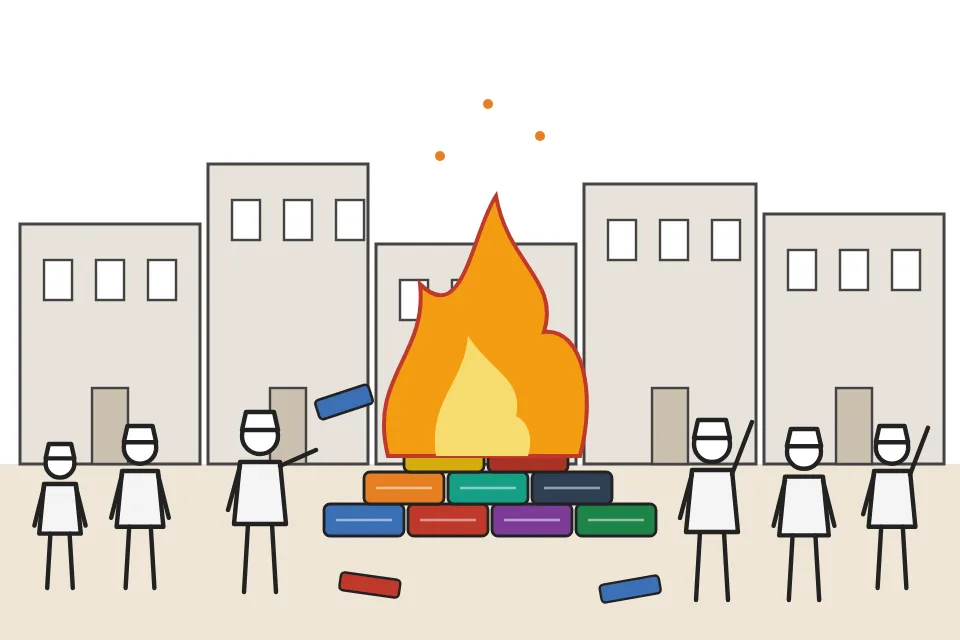
(a) Crowds gathered on the seashore to make salt in open defiance of the law
(b) Peasants refused to pay the chaukidari tax, and forest people broke the forest laws
(c) Students left government-controlled schools, and lawyers gave up their practice
(d) People took up the call to 'do or die' after their leaders had been arrested
3. A traveller's diary, said to have been written around the year 1400, has been found. Which of the following entries in it could be genuine?
I. 'Our caravan carried fine porcelain bowls from China towards the lands of the west.'
II. 'In the market at Calicut I ate a stew made hot with red chillies.'
III. 'At the port, sacks of pepper and bales of Indian cotton cloth were loaded onto ships bound for the west.'
IV. 'The merchants paid for the silk with coins made from the silver of the mines of Mexico.'
Choose the correct option:
(a) Only I and II
(b) Only II and IV
(c) Only I, III and IV
(d) Only I and III
4. Arrange the following events in chronological order, from the earliest to the latest.
I. Popular books began to be sold in England in a cheap series priced at one shilling.
II. The Roman Catholic Church began to keep a list of books that its followers were forbidden to read.
III. Rammohun Roy began to bring out the Sambad Kaumudi.
IV. The Grimm Brothers of Germany published the folk tales they had gathered from peasants.
Choose the correct option:
(a) II, III, IV, I
(b) IV, II, III, I
(c) II, IV, I, III
(d) II, IV, III, I
5. 'The sixteenth century was a turning point for the pre-modern world.' Justify the statement with two points. (2 marks)
6. Explain how the knowledge of printing reached Europe, and how books were produced there before Gutenberg's press came into use. Give three points. (3 marks)
OR
Explain three ways in which the printing press changed the making and spread of books in Europe in the hundred years after 1450.
7. Examine how the French Revolution and Napoleon's conquests first carried the idea of the nation across Europe, and then stirred up national feeling against French rule. (5 marks)
OR
After 1815, the rulers of Europe tried to crush every demand for liberty and national unity. Examine how liberal-nationalists and revolutionaries such as Giuseppe Mazzini kept their cause alive in these years.
8. Read the source given below and answer the questions that follow.
A Teacher's Notebook, March 1930
(An imagined account of a village on the road to the sea, written for this question)
The whole village was awake before dawn. Word had come that Gandhiji and his marchers would pass along our road today. They set out from Sabarmati more than a week ago, and they still have many days of walking before they reach the sea.
When they came, I counted fewer than a hundred walkers, most of them young, each with a small cloth bag. Gandhiji spoke for a few minutes under the banyan tree. He did not talk about councils or constitutions. He talked about salt: the poorest labourer and the richest merchant both need it in every meal, yet the government taxes it and does not let us make it ourselves. The old women nodded as if he had named their own complaint.
The newspapers say that he had first written to the Viceroy with a long list of demands, some for mill-owners, some for peasants and some for everyone, and that the Viceroy would not negotiate.
Among those who listened were the biggest landowner of our village and a mill-owner from the town, men who had kept away from the Congress ten years ago.
8.1 Why did Gandhiji speak to the villagers about salt rather than about councils or constitutions? (1 mark)
8.2 Why might Gandhiji have included demands for mill-owners as well as for peasants in his letter to the Viceroy? (1 mark)
8.3 The landowner and the mill-owner had kept away from the Congress ten years earlier. Explain two ways in which the movement that began with this march differed from the Non-Cooperation Movement, in its aims or in the groups that took part. (2 marks)
9. On the outline map of India given below, two places are shown as A and B. Use the clues to identify each place and write its name.
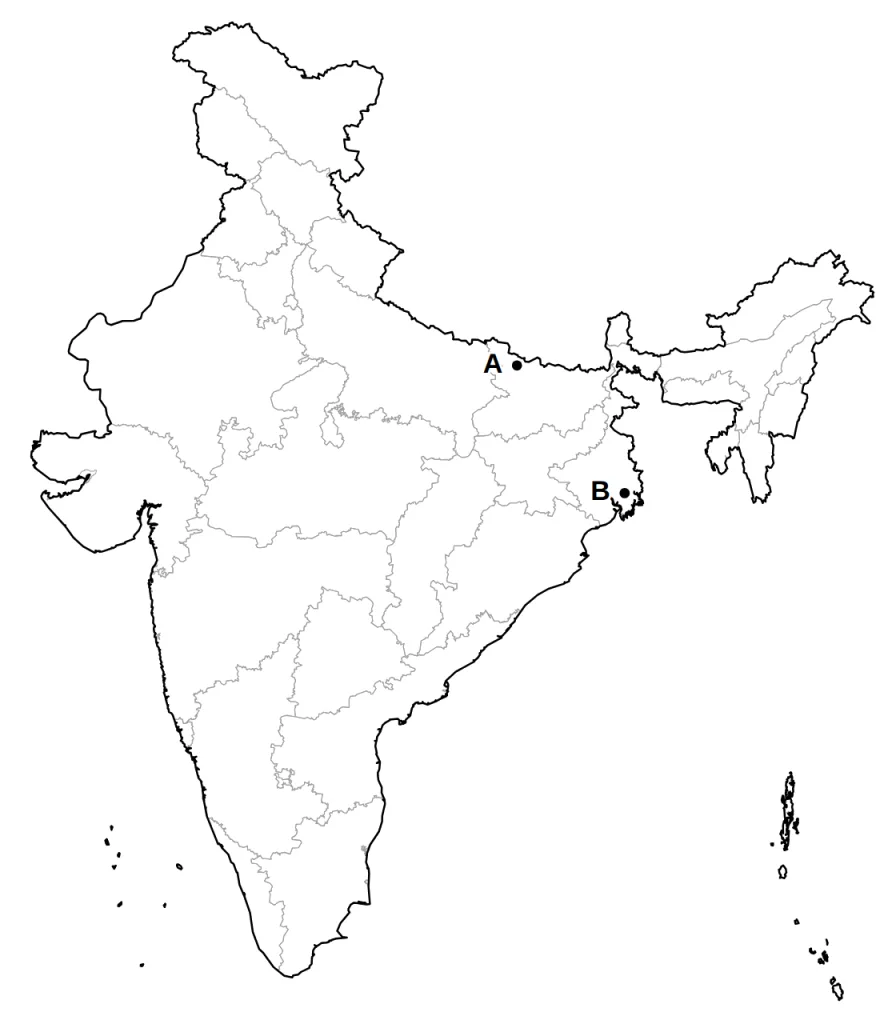
A The place in Bihar where peasants complained that European planters forced them to grow indigo on their land, and where Gandhiji went to take up their cause. (1 mark)
B The city whose special Congress session of September 1920 first backed Gandhiji's plan to join the Khilafat issue with the demand for swaraj through non-cooperation. (1 mark)
Section B - Geography (20 marks)
Questions 10 to 19. Questions 10 to 15 are MCQs of 1 mark each; Question 19 is map-based.
10. A fishing fleet catches tuna in the open ocean about 700 km (over 370 nautical miles) from the coast of the nearest country. On the basis of ownership, to which category does the tuna of this part of the ocean belong?
(a) A national resource of the coastal country nearest to the fleet
(b) An international resource, which can be used only with the agreement of international institutions
(c) An individual resource of the fleet's owner, since his boats caught the fish first
(d) A community resource, which all the fishing villages of that coast may share freely
11. Match Column I (type of soil) with Column II (a region where it is typically found) and choose the correct option.
| Column I | Column II |
|---|---|
| 1. Black soil | P. The hot, dry west of Rajasthan |
| 2. Red and yellow soil | Q. The lava plateaus of Maharashtra, Saurashtra and Malwa |
| 3. Arid soil | R. Parts of Odisha and Chhattisgarh, and the foothill zone of the Western Ghats |
| 4. Alluvial soil | S. The great northern plains and the deltas of the east coast |
(a) 1-Q, 2-R, 3-P, 4-S
(b) 1-R, 2-Q, 3-P, 4-S
(c) 1-Q, 2-P, 3-R, 4-S
(d) 1-S, 2-R, 3-P, 4-Q
12. Which of the following is NOT an example of local people conserving forests or wildlife through their own effort?
(a) Villagers cling to the trees on their hillside to stop a contractor's men from felling them
(b) A village leaves a patch of old forest untouched, and no one may cut a tree there because it is held sacred
(c) The Forest Department declares a forest reserved and bans grazing and felling inside it
(d) Villagers draw up their own rules for the forest near them and keep hunters and outsiders out
13. In a group of villages, many small farmers who own only one or two cows now pour their milk into a cooperative society twice a day. The society chills the milk and sells it in the cities, and the farmers' incomes have risen. Which strategy for improving Indian agriculture does this reflect?
(a) The Green Revolution, based on high-yielding seeds, fertilisers and assured irrigation
(b) The White Revolution, also known as Operation Flood
(c) The Bhoodan-Gramdan movement, in which landowners gave land to the landless
(d) Consolidation of holdings, in which a farmer's scattered plots were joined into one
14. Most of India's jute mills stand in a narrow belt along the banks of the Hugli river. Which of the following best explains this location?
(a) Nearness to the coal and iron ore of the Chotanagpur plateau, which supply fuel and machines to the mills
(b) Nearness to jute fields, cheap water transport, plenty of water for processing and cheap labour
(c) A dry climate in the delta, which lets raw jute be stored for months without rotting
(d) Cheap hydroelectricity from dams on the Himalayan rivers that flow into the Hugli
15. Assertion (A): Sugar mills and cotton textile mills are grouped as agro-based industries, because their main raw materials come from farms.
Reason (R): Agro-based industries need no transport, because they process crops at the very place where the crops are grown.
(a) Both Assertion (A) and Reason (R) are true, and Reason (R) is the correct explanation of Assertion (A).
(b) Both Assertion (A) and Reason (R) are true, but Reason (R) is not the correct explanation of Assertion (A).
(c) Assertion (A) is true, but Reason (R) is false.
(d) Assertion (A) is false, but Reason (R) is true.
16. Harish farms a small plot of sandy land in a dry district of north Gujarat. The rains are short and uncertain, and he has no means of irrigation. Suggest one millet and one pulse that he could grow, giving a reason for each. (2 marks)
17. The government of an imaginary State in north India plans a new power station next to a large, crowded city. The city is far from both the coalfields and the gas fields. The planners must choose between coal and natural gas as the fuel.
(a) Compare coal and natural gas as the fuel for this power station on any three points. (3 marks)
(b) Which fuel would you recommend for this power station? Support your choice with two reasons. (2 marks)
OR
An old iron ore mine in a hill district has to dig deeper every year; the ore it now gets is poorer, and each tonne costs more to produce. Answer the following.
(a) Using this example, explain three reasons why minerals need to be conserved. (3 marks)
(b) Suggest two ways in which minerals can be conserved. (2 marks)
18. Read the source given below and answer the questions that follow.
A Town With Two Kinds of Morning
(A report from an imaginary town, written for this question)
Sonpur stands on the bank of a wide river and gets good rain every monsoon. The town's water works says that it pumps enough water each day for every resident. Yet mornings in Sonpur look very different from ward to ward.
In the new colonies near the highway, overhead tanks fill up from the pipeline every day, and many houses water their lawns. In the old market wards, the taps run for one hour at dawn, and families fill every bucket and drum before the supply stops.
In Ward 9, a settlement of brick-kiln workers at the edge of the town, there is no pipeline at all. Women and girls queue at a single handpump. Its water tastes of salt and leaves a yellow stain on cooking pots, so the families who can afford it buy drinking water from a tanker that comes twice a week.
18.1 What kind of water scarcity do the families of Ward 9 face at the handpump? (1 mark)
18.2 The water works says that it pumps enough water for every resident. Explain two reasons why Ward 9 still faces water scarcity. (2 marks)
18.3 Suggest one step the town could take to ease the water scarcity in Ward 9. (1 mark)
19. On the outline map of India given for this question, locate and label any three of the following with suitable symbols.
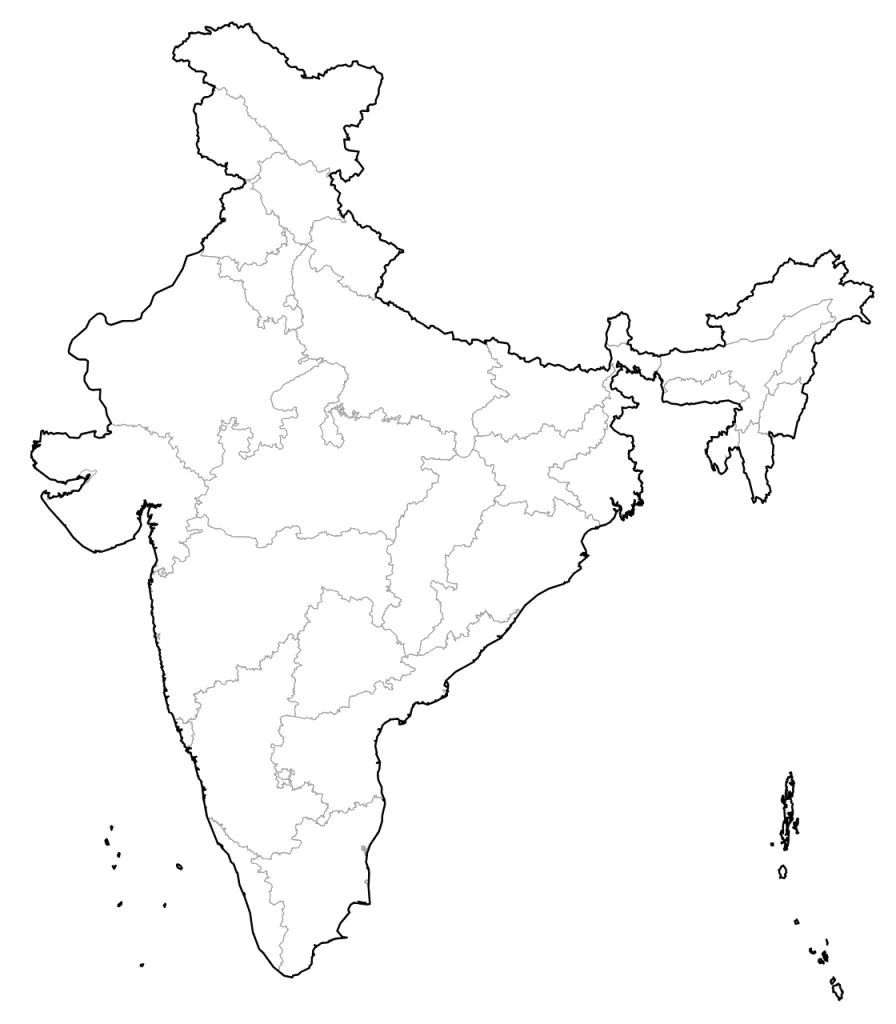
(i) Bhilai - an iron and steel plant (1 mark)
(ii) Rana Pratap Sagar Dam (1 mark)
(iii) The state that leads India in the production of coffee (1 mark)
(iv) Rajiv Gandhi International Airport (1 mark)
Section C - Political Science (20 marks)
Questions 20 to 28. Questions 20 to 23 are MCQs of 1 mark each.
20. Assertion (A): In Belgium, the regional governments can decide matters in their own fields without waiting for approval from the Central Government.
Reason (R): Belgium's Central Government must have as many Dutch-speaking ministers as French-speaking ones.
(a) Both Assertion (A) and Reason (R) are true, and Reason (R) is the correct explanation of Assertion (A).
(b) Both Assertion (A) and Reason (R) are true, but Reason (R) is not the correct explanation of Assertion (A).
(c) Assertion (A) is true, but Reason (R) is false.
(d) Assertion (A) is false, but Reason (R) is true.
21. In the imaginary country of Sarvabhoomi, the national government decides on defence and currency, the provincial governments run hospitals and colleges, and elected district councils look after village roads and primary schools. A student says that only the division between the national and the provincial governments is a vertical division of power. Which statement is correct?
(a) The student is right, since the district councils are part of the horizontal division among the organs of government
(b) The student is right, since the district councils only carry out orders and have no work of their own
(c) The student is wrong, since the district councils show power being shared among social groups
(d) The student is wrong, since the district councils form a third, lower level of the same vertical division
22. In the Assembly election of the imaginary State of Nandpur, no party wins a majority. Parties P, Q and R together have a majority and form the government, with ministers from all three. A year later, Party R announces that it will no longer support the government. What is the most likely result?
(a) The government may lose its majority and have to resign, unless it finds support elsewhere
(b) Nothing changes, since ministers, once they have taken the oath, stay in office until the next election
(c) The Election Commission will now decide which of the three parties should run the government
(d) Party P will rule alone, since the biggest partner in a coalition can govern without the others
23. Study the two-panel cartoon given below. Which outcome of democracy does it highlight?
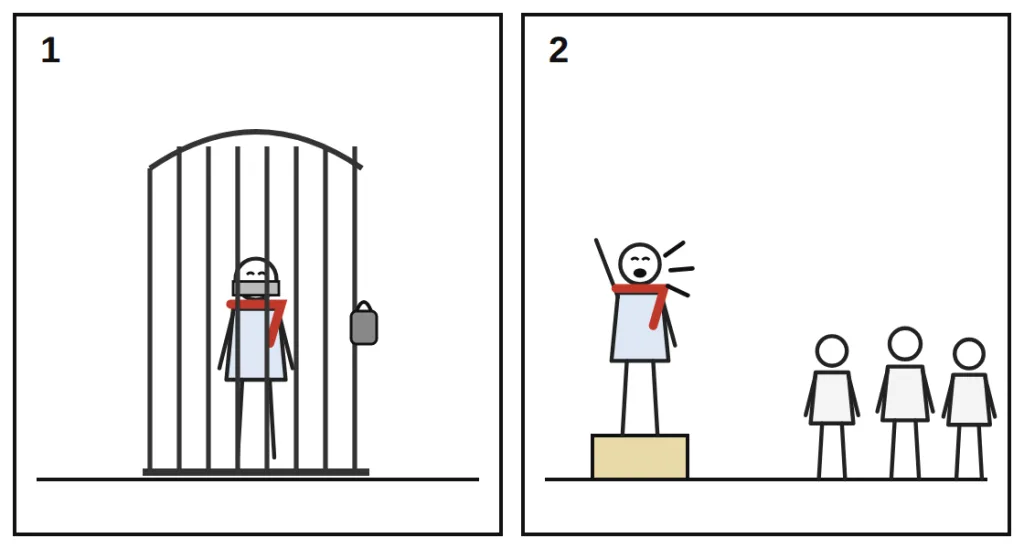
(a) Faster economic growth than under dictatorships
(b) Reduction of economic inequality among citizens
(c) Dignity and freedom of the individual citizen
(d) Quick decisions by a small group of leaders
24. In the imaginary State of Sundergarh, the same party has won every Assembly election for twenty years. A student concludes that power is no longer shared in the State. Explain two ways in which power is still shared there. (2 marks)
25. In the imaginary democracy of Solavia, any party that wins a majority of seats may form the government, but a law says that the Prime Minister must always belong to the country's largest language community. Explain two reasons why this law makes Solavia's democracy less able to accommodate social diversity. (2 marks)
26. In the imaginary town of Kesarpur, girls are kept at home more often than boys to help with housework; women who work on the farms are called 'helpers' and are paid less; and the town's traders' association has never had a woman office-bearer. Explain three ways in which the sexual division of labour lies behind these facts. (3 marks)
27. Answer the following about two reforms that now apply to elected members and candidates in India.
(a) Evaluate the anti-defection law: the problem it was meant to solve, what it has achieved, and one drawback. (3 marks)
(b) Evaluate the rule that every candidate must file an affidavit: what it aims to do, and one limitation. (2 marks)
OR
Some reforms of political parties have been suggested but not yet made into law. Answer the following.
(a) Give one advantage and one difficulty of a law to regulate the internal working of political parties. (2 marks)
(b) Give one advantage and one difficulty of state funding of elections. (2 marks)
(c) Explain one way in which ordinary citizens can help to reform political parties without a new law. (1 mark)
28. Read the source given below and answer the questions that follow.
A Ward Meeting in Devnagar
(A newspaper report from an imaginary city, written for this question)
Thirty years ago Devnagar was a small town. Today it is a city of fifteen lakh people, run by an elected municipal corporation of eighty wards, each of which chooses its own councillor.
Last Sunday, the councillor of Ward 12, a schoolteacher elected from a seat reserved for women, held an open meeting in the community hall. More than two hundred residents came. Within an hour they had listed every choked drain, broken streetlight and overflowing garbage point in the ward. Some residents also complained that the river embankment near the ward had cracked; the councillor said that the embankment is built and repaired by a department of the State government, and promised to pass the complaint on.
The mayor, who presides over the corporation, visited the ward on Tuesday. By Friday the drains had been cleared, but the crack in the embankment was still there.
28.1 To which tier of government in India's federal system does the Devnagar corporation belong? (1 mark)
28.2 Suppose the residents of Ward 12 feel that their councillor is not acting on their complaints. Explain two ways in which they can hold her to account. (2 marks)
28.3 Why could the councillor not get the embankment repaired as quickly as the drains? (1 mark)
Section D - Economics (20 marks)
Questions 29 to 38. Questions 29 to 34 are MCQs of 1 mark each.
29. In an imaginary town of 12,000 people, 2,000 are children below 7 years of age. Of the 10,000 people aged 7 and above, 7,500 can read and write with understanding. What is the literacy rate of the town?
(a) 62.5 per cent, since literacy is measured against the whole population of the town
(b) 83 per cent, since everyone aged 7 and above is taken to be literate
(c) 25 per cent, since the rate shows the people aged 7 and above who cannot read
(d) 75 per cent, since only people aged 7 and above are counted
30. Why is the sector that includes farming, fishing and mining called the 'primary' sector?
(a) Its natural products, such as grain, cotton and ores, are the base for goods the other sectors make
(b) It employs the largest share of workers in every country of the world, whether rich or poor
(c) It was the first sector whose output the government measured when it began to count GDP
(d) It still produces the largest share of India's GDP, more than industry and services combined
31. In a village that trades only by barter, a potter wants rice. What must be true for him to exchange his pots directly with a rice farmer?
(a) The potter must first sell his pots to someone else for money
(b) The rice farmer must want pots at the same time
(c) The village headman must fix how many pots equal one sack of rice
(d) The pots must be worth exactly as many rupees as the rice
32. Rukhsana took a bank loan to buy a second auto-rickshaw for her transport business and pledged her gold jewellery as collateral. She has now paid the last instalment of the loan, with interest. What happens to the jewellery?
(a) The bank keeps it as its fee for giving the loan
(b) The bank sells it and hands her the money left after taking its interest
(c) It stays with the bank as security for any loan she may take later
(d) It is returned to her, since the bank could have sold it only if she had failed to repay
33. Read the following statements about the sustainability of development.
I. Water in a village tank that fills every monsoon can still run dry before the next rains if it is drawn out faster than it is filled.
II. Scientists, economists, philosophers and other social scientists work together to study the sustainability of development.
III. Using up a non-renewable resource today affects only the present generation.
IV. Development is sustainable only if it also takes care of the needs of the generations that come after us.
Which of these statements are correct?
(a) Only I, II and IV
(b) Only II and III
(c) I, II, III and IV
(d) Only I and III
34. Which one of the following links India with another country mainly through the movement of services, rather than of goods or investment?
(a) A shop in Kochi imports olive oil from Spain
(b) A Dutch company buys a share in a solar power plant in Rajasthan
(c) Students in Nepal pay fees for an online course taught from Hyderabad
(d) A mill in Surat sells cotton yarn to buyers in Bangladesh
35. In the imaginary village of Kalyanpur, the school register shows that almost every child aged 14 and 15 is enrolled. A visiting officer finds that on most days only about six in ten of these children are in class. Many boys work at a brick kiln during the season, and many girls stay at home to look after younger children.
(i) Which indicator used to compare development would show what the officer found? Give a reason. (1 mark)
(ii) Explain two reasons why low attendance at this age matters for Kalyanpur's development, even if family incomes are rising. (2 marks)
36. A student says, 'A bank is just a safe locker where people keep their money.' Explain three points to show why this view is wrong. (3 marks)
37. People, like goods and money, sometimes move from one country to another.
(i) Why do people usually move from one country to another? (1 mark)
(ii) In the last few decades, goods and investment have moved between countries far more than people have. Explain why. (2 marks)
38. The table shows the share of each sector in the GDP and in the workforce of the imaginary country of Nandia. Study the table and answer the questions that follow. (The data are hypothetical, for practice only.)
| Sector | Share of GDP, 2000 (%) | Share of GDP, 2020 (%) | Share of workers, 2000 (%) | Share of workers, 2020 (%) |
|---|---|---|---|---|
| Primary | 32 | 16 | 64 | 54 |
| Secondary | 26 | 28 | 14 | 20 |
| Tertiary | 42 | 56 | 22 | 26 |
(i) Between 2000 and 2020, by how many percentage points did the tertiary sector's share of GDP rise, and by how many did its share of workers rise? (1 mark)
(ii) Compare these two rises. What can you infer from them about the kind of service jobs that grew in Nandia? Give two points. (2 marks)
(iii) The secondary sector's share of workers rose by 6 points, but its share of GDP by only 2. What can you infer from this about the new jobs in this sector? Give two points. (2 marks)
OR
Study the same table and answer the following.
(i) By how many percentage points did the secondary sector's share of workers change between 2000 and 2020? (1 mark)
(ii) Suggest two steps that would help workers who leave farming to find jobs in Nandia's growing service sector. (2 marks)
(iii) Many of the new secondary-sector jobs in Nandia are in small workshops and on construction sites. Explain one benefit and one risk of such jobs for workers who have moved off the farms. (2 marks)