
CBSE Class 10 Social Science Sample Paper 2027 – Set 3
Time allowed: 3 hours · Maximum marks: 80
General Instructions
- This question paper has 38 questions. All questions are compulsory.
- The paper has four sections: Section A History (20 marks), Section B Geography (20 marks), Section C Political Science (20 marks) and Section D Economics (20 marks).
- Multiple choice questions (MCQs) carry 1 mark each.
- Very Short Answer (VSA) questions carry 2 marks each. Answer each in not more than 40 words.
- Short Answer (SA) questions carry 3 marks each. Answer each in not more than 60 words.
- Long Answer (LA) questions carry 5 marks each. Answer each in not more than 120 words.
- Case-based questions (CBQ) have three sub-questions and carry 4 marks each. Answer each question in not more than 100 words.
- The map-based questions carry 5 marks in two parts: Question 9 in Section A (2 marks) and Question 19 in Section B (3 marks). Mark your answers on a printed outline map of India.
- There is no overall choice in the question paper. However, an internal choice has been provided in a few questions. Attempt only one of the choices in such questions.
- A separate question has been provided for Visually Impaired candidates in lieu of questions having visual inputs or maps. Such questions are to be attempted by Visually Impaired candidates only.
How to use this paper: set a 3-hour timer and write all your answers on paper, just like the board exam. When you finish, take the quiz at the end of this page to score your objective (MCQ) answers instantly, then open the Detailed Solutions and check the rest step by step, with the marks each step carries.
Section A - History (20 marks)
Questions 1 to 9. Questions 1 to 4 are MCQs of 1 mark each; Question 9 is map-based.
1. Match the situations in Column I with the terms in Column II and choose the correct option.
| Column I (Situation) | Column II (Term) |
|---|---|
| P. The people of a region vote directly on whether their region should join a neighbouring kingdom. | 1. Utopian |
| Q. A poet dreams of a world without kings, where free peoples live side by side as brothers, though nobody expects it to come true soon. | 2. Suffrage |
| R. A group of people feel bound together by a shared origin, shared customs and a common way of life. | 3. Plebiscite |
| S. After the revolt of 1848 in France, every adult man is given the right to vote. | 4. Ethnic |
(a) P-3, Q-4, R-1, S-2
(b) P-1, Q-3, R-4, S-2
(c) P-3, Q-1, R-4, S-2
(d) P-2, Q-1, R-4, S-3
2. Study the picture given below. It is drawn after a famous painting made in Bengal during the Swadeshi movement. What idea of the nation does the figure express?
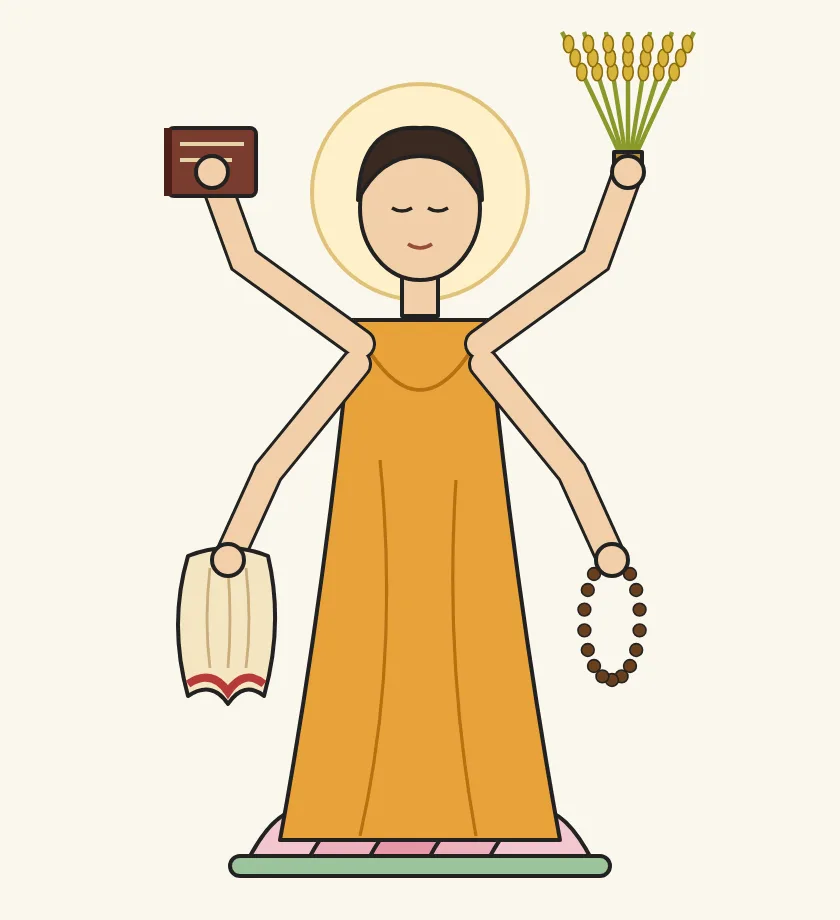
(a) The nation as a caring mother who meets her children's needs of mind and body
(b) The nation as a warrior queen who leads an army against foreign rulers
(c) The British Empire as a caring mother who looks after her Indian subjects
(d) The spirit of the Bengal countryside, painted to celebrate a good harvest
3. Read the statements given below and choose the correct option.
Statement I: For more than two centuries after Columbus's voyage of 1492, India and China remained great centres of wealth, and much of Asia's commerce still passed through their hands.
Statement II: When China cut down its overseas contacts from the fifteenth century onwards, the centre of world trade moved to the ports of the Indian Ocean.
(a) Statement I is correct and Statement II is incorrect.
(b) Statement I is incorrect and Statement II is correct.
(c) Both Statements I and II are correct.
(d) Both Statements I and II are incorrect.
4. Arrange the following events in chronological order, from the earliest to the latest.
I. Kashibaba, a mill worker of Kanpur, wrote a book on how caste and class exploitation were linked.
II. Erasmus, a Latin scholar, warned that the flood of new printed books could do harm.
III. Jyotiba Phule wrote about the injustices of the caste system in Gulamgiri.
IV. Books and cartoons that mocked the royal family of France were passed around in secret.
Choose the correct option:
(a) II, III, IV, I
(b) IV, II, III, I
(c) II, IV, I, III
(d) II, IV, III, I
5. Historians still argue about where many everyday foods, such as noodles and pasta, first came from. What do such debates tell us about the pre-modern world? Give two points. (2 marks)
6. Explain three ways in which a nation-state, as it took shape in nineteenth-century Europe, was different from the dynastic empires that had ruled much of the continent before. (3 marks)
OR
'In the middle of the nineteenth century, many women took an active part in the liberal and national movements of Europe, yet they were denied political rights.' Support this statement with three points.
7. Imagine three people in a Punjab town in April 1919: a cloth merchant, a worker in a railway workshop, and a lawyer who had followed the debates of the Imperial Legislative Council. Answer the following.
(a) Explain why each of them had reason to join the protests that Gandhiji called for in April 1919. (3 marks)
(b) The protests of April 1919 were strong in towns like theirs, but they reached few villages. Give two reasons for this. (2 marks)
OR
Satyagraha asked a great deal of the people who took part in it. Answer the following.
(a) Explain three things that satyagraha demanded of its followers. (3 marks)
(b) Show, with two examples from the satyagrahas of 1917-18, what these demands meant for ordinary people in practice. (2 marks)
8. Read the source given below and answer the questions that follow.
Two Pamphlets and a Printer
In the 1830s, a small printing press stood near the river ghat of a Bengal town we shall call Nabagram. Its owner, Haripada, printed almanacs, school primers and shop bills. One spring, a group of young reformers brought him a short pamphlet in plain, everyday Bengali. It argued that a long-standing custom had no basis in the old scriptures and should be given up. Two weeks later, a group of elders who wanted the custom kept came with a reply, just as sharply worded. Haripada printed both, and both sold out.
Most people in Nabagram could not read, yet by the end of the month everyone seemed to have an opinion. The schoolmaster read the pamphlets aloud at the ghat every evening, and his listeners argued late into the night. Merchants carried copies to the villages upriver. Later in the century, presses in the cities of the north were printing sacred texts in Hindi and Urdu in small, cheap editions that a pilgrim could carry in a cloth bag. (Nabagram and Haripada are imaginary.)
8.1 How did the arguments in the pamphlets reach people in Nabagram who could not read? (1 mark)
8.2 Why was Haripada willing to print the pamphlets of both sides? (1 mark)
8.3 Explain two ways in which cheap printed pamphlets and religious texts in Indian languages changed religious life and debate in nineteenth-century India. (2 marks)
9. On the political outline map of India given for this question, two places are marked as A and B. Identify them with the help of the information given below and write their correct names.
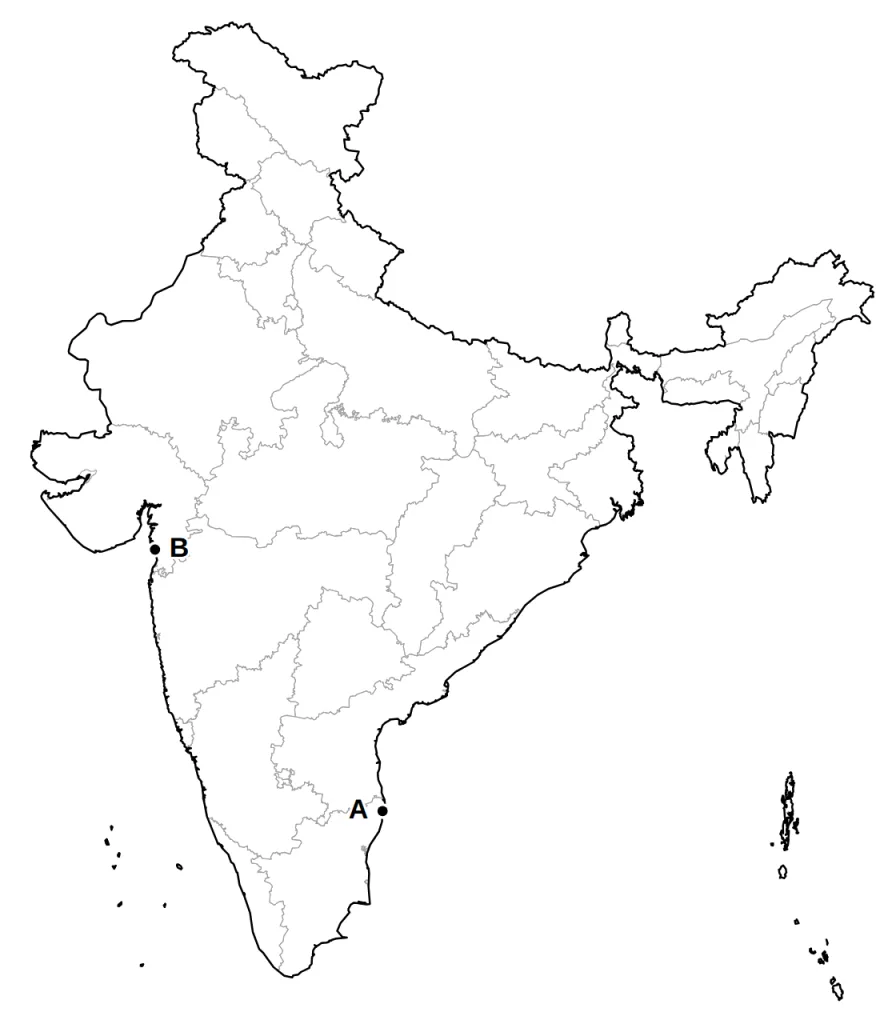
A The city where, at its session of December 1927, the Indian National Congress decided to boycott the all-British commission sent to review the working of India's system of government. (1 mark)
B The seaside village where the Civil Disobedience Movement began, when the government's salt law was openly broken in April 1930. (1 mark)
Section B - Geography (20 marks)
Questions 10 to 19. Questions 10 to 15 are MCQs of 1 mark each; Question 19 is map-based.
10. Read the clues given below and identify the category of forest land.
- It includes wastelands as well as forests.
- Much of it belongs to village communities and private owners, not only to the government.
- In the north-eastern states, most of the forest land falls under it.
(a) Reserved forests
(b) Unclassed forests
(c) Protected forests
(d) Permanent forest estates
11. Match the dams in Column I with the river basins in Column II and choose the correct option.
| Column I (Dam) | Column II (River basin) |
|---|---|
| 1. Bhakra Nangal | X. Mahanadi |
| 2. Hirakud | Y. Narmada |
| 3. Sardar Sarovar | Z. Satluj-Beas |
(a) 1-X, 2-Z, 3-Y
(b) 1-Y, 2-X, 3-Z
(c) 1-Z, 2-X, 3-Y
(d) 1-Z, 2-Y, 3-X
12. Which of the following statements about rubber and cotton in India are correct?
I. Besides Kerala, Tamil Nadu and Karnataka, rubber is grown in the Garo hills of Meghalaya and in the Andaman and Nicobar Islands.
II. Most of the rubber grown in India is used by industry, for example to make tyres.
III. Cotton needs high temperatures, bright sunshine and a long growing period of about 210 days without frost.
IV. Cotton is a rabi crop that ripens within about three months of sowing.
Choose the correct option:
(a) Only I, II and III
(b) Only I and IV
(c) Only II and IV
(d) I, II, III and IV
13. A power company wants to build a thermal power station right next to a deposit of soft, brown, low-grade coal that holds a lot of moisture, so that the fuel does not have to be carried far. Which of the following places would suit it?
(a) Jharia
(b) Raniganj
(c) Talcher
(d) Neyveli
14. Kerala gets plenty of rain, yet hardly any wheat is grown there. Which of the following best explains this?
(a) Wheat needs well over 200 cm of rain, which even Kerala does not get
(b) Wheat grows only on black soil, and there is no black soil in Kerala
(c) Wheat needs a cool growing season, and Kerala stays warm all year
(d) Wheat is a kharif crop, and Kerala's monsoon ends too early for it
Directions: In Questions 15, 20 and 34, a statement of Assertion (A) is followed by a statement of Reason (R). Choose the correct option.
15. Assertion (A): Seed-saving movements such as the Beej Bachao Andolan in Tehri and Navdanya help to conserve biodiversity.
Reason (R): They keep many traditional crop varieties in use, so that these varieties and the genes they carry are not lost.
(a) Both Assertion (A) and Reason (R) are true, and Reason (R) is the correct explanation of Assertion (A).
(b) Both Assertion (A) and Reason (R) are true, but Reason (R) is not the correct explanation of Assertion (A).
(c) Assertion (A) is true, but Reason (R) is false.
(d) Assertion (A) is false, but Reason (R) is true.
16. Your school has changed to LED lights and makes sure that fans and computers are switched off in empty rooms. Explain two ways in which such steps help the country, and not just the school's electricity bill. (2 marks)
17. The government of a State wants a large cement plant to be set up in one of its backward districts. The district has hills of limestone. Answer the following.
(a) Explain three conditions that such a plant needs, which the district must either offer or arrange. (3 marks)
(b) Explain two ways in which the plant could help the district. (2 marks)
OR
A coal-based thermal power station stands beside a river and a farming village. The villagers complain of smoke and dust in the air, of warm, dirty water flowing into the river, and of heaps of ash spreading over nearby fields. Answer the following.
(a) Explain how the power station is polluting the air, the water and the land around it. (3 marks)
(b) Suggest two measures, of the kind that NTPC has taken at its power stations, that would reduce this harm. (2 marks)
18. Read the source given below and answer the questions that follow.
A Hill Town Writes Its Own Plan
Thirty years after world leaders met at Rio de Janeiro, the municipal council of Devpur, a small hill town, set out to write a plan for its own future. Its team first counted what the town had: a spring-fed lake, patches of oak forest, terraced fields on the slopes and the groundwater under the valley.
The count brought bad news. Hotels had pushed their buildings to the very edge of the lake, and sewage from new colonies was draining into it. The oak forest was being cut for firewood by families of the Bhimnagar colony, who had no gas connections and no steady work.
The council's plan tied the two problems together. Families of the colony would be trained to run a tree nursery and a waste-sorting centre, and would get cooking gas at a lower price; in return, the forest would be closed to cutting. Before the plan was adopted, officials checked it against the State's schemes for forests, housing and water supply. (Devpur is an imaginary town.)
18.1 Name one resource of Devpur that the source shows being used in a way that cannot last. (1 mark)
18.2 The plan links saving the forest with work and cheaper fuel for the families of the colony. Explain how this reflects the aims agreed upon at the Earth Summit of 1992. (2 marks)
18.3 Why did the officials check the town's plan against the State's schemes before adopting it? (1 mark)
19. Attempt any three of the following. Show each place with a suitable symbol on the outline map of India given for this question, and write its name beside it.
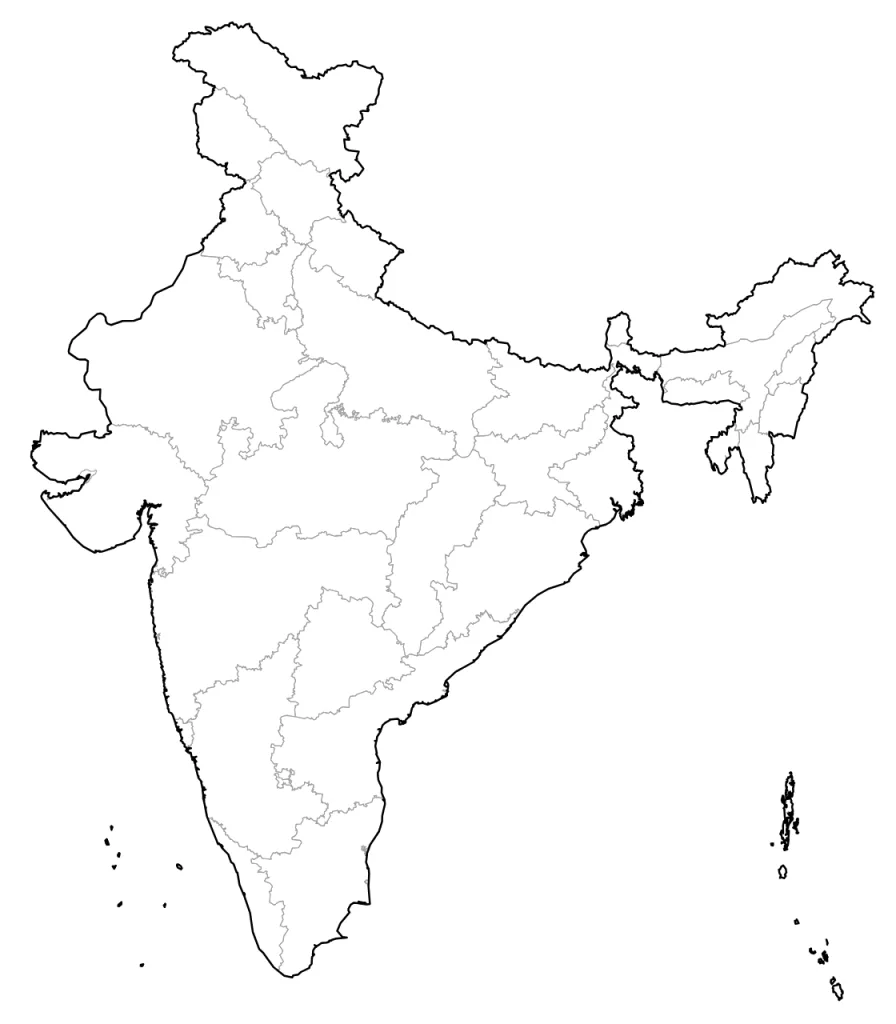
(i) Nagarjuna Sagar Dam (1 mark)
(ii) Narora Nuclear Power Plant (1 mark)
(iii) Durgapur - an iron and steel plant (1 mark)
(iv) Chhatrapati Shivaji Maharaj International Airport (1 mark)
Section C - Political Science (20 marks)
Questions 20 to 28. Questions 20 to 23 are MCQs of 1 mark each.
20. Assertion (A): In India, disputes between the Union and the States about their powers are settled by the courts.
Reason (R): Under the Constitution, the Union Government has the final say whenever it disagrees with a State about their powers.
(a) Both Assertion (A) and Reason (R) are true, and Reason (R) is the correct explanation of Assertion (A).
(b) Both Assertion (A) and Reason (R) are true, but Reason (R) is not the correct explanation of Assertion (A).
(c) Assertion (A) is true, but Reason (R) is false.
(d) Assertion (A) is false, but Reason (R) is true.
21. The constitution of the imaginary country of Tarangdesh contains the following provisions. Which one of them does NOT fit a federal system?
(a) The national and the provincial governments both get their powers from the constitution
(b) Each level of government raises its own taxes from sources named in the constitution
(c) The provincial governments are elected by the people of each province and answer to them
(d) The national parliament may take away any power of a province by passing an ordinary law
22. In the imaginary country of Rendova, anyone may form a political party, and eight parties took part in the last general election. Yet for the last fifty years, every government has been formed by one of the same two parties, each winning a majority on its own. Which option best describes Rendova's party system?
(a) A multi-party system, because eight parties take part in its elections
(b) A two-party system, because power usually changes between the two main parties
(c) A one-party system, because only one party governs the country at a time
(d) An alliance system, because several parties join hands to form each government
23. Study the cartoon given below. Which issue does it raise?
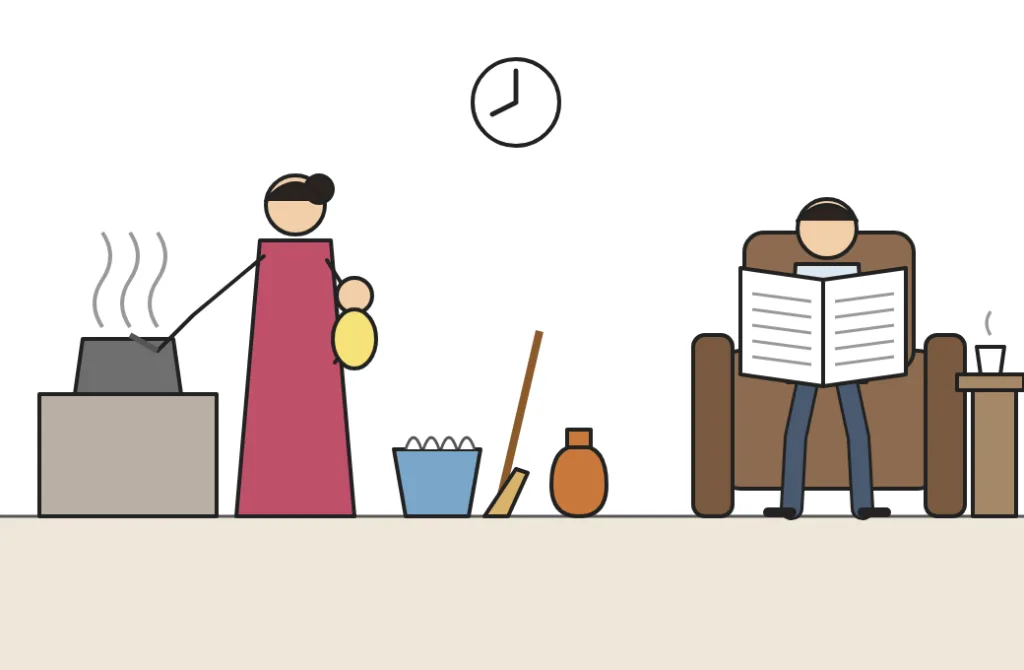
(a) Housework is left to women, even when a man at home is free to share it
(b) Women are paid less than men for doing the same work outside the home
(c) Very few women are elected to the Lok Sabha and the State Assemblies
(d) Families prefer sons, so the number of girls in the population falls
24. Education is on the Concurrent List of the Indian Constitution. Explain two reasons why it makes sense for both the Union Government and the State governments to be able to make laws on it. (2 marks)
25. In many democracies, the main political parties now differ very little from one another in their policies. Explain two reasons why this is a challenge for democracy, even when elections are free and fair. (2 marks)
26. Explain three forms in which caste can be seen in Indian politics. (3 marks)
27. The imaginary democracy of Anvara has three language communities and two large religious groups. Answer the following.
(a) Explain three conditions that Anvara's democracy must meet if it is to accommodate this social diversity. (3 marks)
(b) Explain two reasons why a democracy usually handles such social differences better than a non-democratic government. (2 marks)
OR
In the imaginary country of Varsa, the hill peoples were long treated as inferior: officials spoke to them rudely, and their languages were not used in schools or government offices. Varsa has now been a democracy for twenty years. Answer the following.
(a) Explain three ways in which democracy is likely to have improved the dignity and freedom of the hill peoples. (3 marks)
(b) Explain two reasons why the hill peoples may still face unequal treatment at times. (2 marks)
28. Read the source given below and answer the questions that follow.
'Better Slow than Broken'
Anna, a retired teacher in Belgium, often talks to her grandchildren about the country she grew up in. 'When I was young,' she says, 'our two big language groups hardly trusted each other. My Dutch-speaking neighbours felt that the French speakers had long kept the better jobs and the bigger say, though there were fewer of them. The French speakers feared that the larger group would soon outvote them on everything. A quarrel over a school or a street sign could become a fight about who owned the country.
'So our leaders bargained for years, and in the end nobody got everything. The larger group gave up the right to fill most seats in the national cabinet: ministers now come from the two groups in equal numbers. The smaller group gave up its old hold on the country's top posts. Each group votes for its own parties, and each region runs many of its own affairs.
'Yes, it is slow. Forming a national government can take many months. But better slow than broken. We are still one country, and nobody is afraid of the other any more.' (Anna is an imaginary person.)
28.1 Anna says that 'nobody got everything'. Give one example from the source of something that one of the groups gave up. (1 mark)
28.2 The system is slow for everyone. Explain two reasons why the smaller, French-speaking group would still accept it. (2 marks)
28.3 Using the source, explain why forming a national government in Belgium can take many months. (1 mark)
Section D - Economics (20 marks)
Questions 29 to 38. Questions 29 to 34 are MCQs of 1 mark each.
29. Study the table given below for two imaginary districts (hypothetical data) and answer the question that follows.
| District | Babies born alive during the year | Of these, babies who died before their first birthday |
|---|---|---|
| K | 2,00,000 | 5,000 |
| L | 60,000 | 2,100 |
Which conclusion does the table support?
(a) L does better on child health, since far fewer of its babies died
(b) K's infant mortality rate is 50, twice as high as L's rate of 25
(c) The two cannot be compared, since K has far more births than L
(d) K lost more babies but has the lower infant mortality rate
30. Rekha has a permanent post in a factory that makes medicines and is owned by the State government. She gets a monthly salary, provident fund and paid leave. Which option correctly classifies her work?
(a) Tertiary sector; public sector; organised sector
(b) Secondary sector; public sector; organised sector
(c) Secondary sector; private sector; organised sector
(d) Secondary sector; public sector; unorganised sector
31. In an imaginary country, the output of registered factories and offices doubled over fifteen years, but the number of jobs they offered rose only a little. In the same years, many more young people began to look for work. What most likely happened in those years?
(a) Wages in its registered units fell below those paid in small unregistered units
(b) Most new workers took low-paid, insecure work in small units or as casual labour
(c) Its registered units had to give a job to everyone who applied, as the law requires
(d) Most young people went back to farming, so farming's share of output rose sharply
32. Read the following statements about money.
I. Long before coins came into use, grain and cattle were used as money in India.
II. In India today, currency notes are issued by the Reserve Bank of India on behalf of the central government.
III. Coins and currency notes are the only forms of money in use in India today.
IV. Money kept in a savings account cannot be used to make a payment until it is withdrawn as cash.
Which of these statements are correct?
(a) Only I and III
(b) Only II and IV
(c) Only I and II
(d) Only I, II and IV
33. Read the statements given below and choose the correct option.
Statement I: Information and communication technology helps only the trade in services, because goods still have to be carried by ships, trains and planes.
Statement II: A garment maker in Tiruppur can take an order from a store in Spain, agree on the price and follow the shipment until it arrives, all over the internet, so this technology helps the trade in goods too.
(a) Statement I is correct and Statement II is incorrect.
(b) Statement I is incorrect and Statement II is correct.
(c) Both Statements I and II are correct.
(d) Both Statements I and II are incorrect.
34. Assertion (A): In India, the tertiary sector gives work to more people than any other sector.
Reason (R): The tertiary sector has become the largest producing sector in India.
(a) Both Assertion (A) and Reason (R) are true, and Reason (R) is the correct explanation of Assertion (A).
(b) Both Assertion (A) and Reason (R) are true, but Reason (R) is not the correct explanation of Assertion (A).
(c) Assertion (A) is true, but Reason (R) is false.
(d) Assertion (A) is false, but Reason (R) is true.
35. In an imaginary country that is rich today, most people worked on farms in 1850, and by 1950 more people worked in factories than in any other sector. Answer the following.
(i) Which sector was the most important in this country in 1950? (1 mark)
(ii) Explain two ways in which the growth of factories would also have helped the farms of this country. (2 marks)
36. Five years ago, a large modern hospital opened in the main town of the imaginary district of Ratanpur. Yet the district's life expectancy at birth has hardly changed. Explain three possible reasons for this. (3 marks)
37. Salma weaves fine woollen shawls in a remote hill district. A new highway and an airport nearby now link the district to the big cities within a few hours. Answer the following.
(i) Which factor of globalisation do the highway and the airport stand for? (1 mark)
(ii) Explain two reasons why Salma may still be unable to sell her shawls to buyers in other countries. (2 marks)
38. The table shows the loans taken in one year by households of Amrapur, an imaginary rural block. Study the table and answer the questions that follow. (The data are hypothetical, for practice only.)
| Group of households | Households that took a loan during the year (%) | Share of their loans from banks and cooperatives (%) | Share of their loans from moneylenders, traders and landowners (%) | Average rate of interest paid (% a year) |
|---|---|---|---|---|
| Landless workers | 62 | 15 | 85 | 42 |
| Small farmers | 55 | 45 | 55 | 24 |
| Large farmers | 40 | 90 | 10 | 9 |
(i) Which group of households depends most on informal lenders? Quote the figure that shows it. (1 mark)
(ii) Using figures from the table, explain two ways in which this dependence harms these households. (2 marks)
(iii) Suggest two ways in which formal credit could reach more of these households, with a reason for each. (2 marks)
OR
Study the same table and answer the following.
(i) Which group took loans most often during the year, and which group least often? (1 mark)
(ii) Explain two reasons why landless workers keep borrowing from informal lenders, even though the table shows that they pay far more for these loans. (2 marks)
(iii) Small farmers get about half of their loans from formal sources. Apart from the rate of interest, explain two ways in which the terms of a bank loan are likely to differ from those of a loan from a moneylender. (2 marks)