
Detailed Solutions: CBSE Class 10 Social Science Sample Paper 2027 – Set 4
Every written question from the paper (2, 3, 4 and 5 marks) is solved here in order, with the marks given for each step, so you can check your answer sheet the way an examiner would. Where a question has an internal choice (OR), both options are solved. The 1-mark questions are answered, with explanations, in the quiz on the Question Paper page.
Section A - History (20 marks)
Question 5 (2 marks)
Compare the trade links of the silk routes with the links that grew between Europe and the Americas after 1492, on two points.
Answer.
Model answer:
First, the silk routes grew over centuries through trade among many peoples; the Atlantic links came quickly, through conquest. Second, the silk routes joined lands long in contact; the Atlantic links joined Europe to a continent long cut off.
Marking scheme:
- How they came about: the silk routes grew slowly over many centuries, through trade among merchants of many lands between China and the Mediterranean; the links with the Americas were made within about a century, through conquest and colonisation by Spain and Portugal — 1 mark
- The lands they joined: the silk routes joined lands of Asia, Europe and northern Africa that had long been in touch; the Atlantic links joined Europe to a continent that had been cut off from regular contact with the rest of the world for a very long time (accept: what they carried, such as silk, pottery, spices and religions compared with American crops like potatoes and maize, and precious metals; any other relevant point) — 1 mark
Question 6 (3 marks)
In the late nineteenth and early twentieth centuries, printed books began to reach poor people in India who had never owned a book before. Explain three ways in which this happened.
Answer.
Model answer:
First, very cheap small books were sold at crossroads in the towns of nineteenth-century Madras, so even the poor could buy them. Second, from the early twentieth century public libraries opened in cities, towns and some prosperous villages. Third, mill workers in Bombay, and later Bangalore, set up their own libraries, helped by social reformers.
Marking scheme:
- Very cheap books: small, very cheap books were brought to the markets of nineteenth-century Madras towns and sold at crossroads, so that even poor people could buy them — 1 mark
- Public libraries: from the early twentieth century, public libraries were set up, mostly in cities and towns and sometimes in prosperous villages; rich local patrons set them up, partly to gain prestige, and people could read there without buying books — 1 mark
- Workers' own libraries: mill workers in Bombay set up libraries to educate themselves, and in the 1930s the cotton millworkers of Bangalore followed them, with support from social reformers who wanted to spread literacy (any other relevant point) — 1 mark
OR
In the seventeenth century, as city life grew in China, printed books began to reach new kinds of readers. Explain three ways in which the readership of print in China changed.
Answer.
Model answer:
First, merchants began to use print in daily life, since they needed information about trade. Second, reading became a leisure activity, and new readers enjoyed stories, poetry, autobiographies, collections of great writing and romantic plays. Third, rich women began to read, and many published their own poetry and plays.
Marking scheme:
- Merchants: merchants began to use print in their everyday life, since they needed information about trade (accept: until then the imperial state had been the main producer of printed matter, such as textbooks for the civil service examinations) — 1 mark
- Reading for pleasure: reading became a leisure activity, and the new readers liked stories, poetry, autobiographies, collections of great literary works and romantic plays — 1 mark
- Women: rich women began to read, and many women began to publish their own poetry and plays; the wives of scholar-officials, for example, published their works (any other relevant point) — 1 mark
Question 7 (5 marks)
In 1815, after the defeat of Napoleon, representatives of Britain, Russia, Prussia and Austria met at Vienna, hosted by the Austrian Chancellor Duke Metternich, to draw up a settlement for Europe. Answer the following.
(a) Explain three changes that the Treaty of Vienna made to the rulers and the map of Europe. (3 marks)
Answer.
Model answer:
First, the Bourbon kings were restored in France, and France lost the lands it had taken under Napoleon. Second, states were set up on France's borders to stop it expanding: the Netherlands, with Belgium, in the north and Piedmont, with Genoa, in the south. Third, Prussia gained land in the west, Austria got northern Italy and Russia part of Poland.
Marking scheme:
- France: the Bourbon dynasty, which had been deposed during the French Revolution, was restored to power, and France lost the territories it had annexed under Napoleon — 1 mark
- A ring of states around France: a series of states was set up on France's borders to stop it from expanding again, such as the Kingdom of the Netherlands, which now included Belgium, in the north, and Piedmont, to which Genoa was added, in the south — 1 mark
- Gains for the big powers: Prussia was given important new territories on its western frontiers, Austria was given control of northern Italy, and Russia was given part of Poland (accept: Prussia was also given a part of Saxony) — 1 mark
(b) Explain two ways in which this settlement stood in the way of German and Italian unity. (2 marks)
Answer.
Model answer:
First, the confederation of 39 German states was left untouched, so the German lands stayed divided among many rulers. Second, northern Italy was handed to Austria, so Italians stayed split among separate rulers, some of them foreign.
Marking scheme:
- German lands: the confederation of 39 German states set up by Napoleon was left as it was, so the German lands stayed divided among many rulers, each keen to keep his own state — 1 mark
- Italy: northern Italy was placed under Austria, a foreign dynasty, while the rest of Italy stayed split into separate states, so Italians remained under different rulers, some of them foreign (accept: the settlement brought back rulers who opposed liberal and national ideas; any other relevant point) — 1 mark
OR
Italy became a single state only in 1861. Answer the following.
(a) An English caricature of the time shows Garibaldi helping King Victor Emmanuel II to pull on a boot shaped like Italy. The caption reads: 'If it won't go on, sire, try a little more powder.' Explain three things that this caricature suggests about the unification of Italy. (3 marks)
Answer.
Model answer:
First, the king of Sardinia-Piedmont is putting Italy on, so the new state was a monarchy, not the republic revolutionaries wanted. Second, Garibaldi appears as the king's helper, since the lands his volunteers won went to the king. Third, the boot needs 'more powder', a hint at gunpowder: the regions did not join easily, and force was needed.
Marking scheme:
- A kingdom, not a republic: Italy is being worn by the king of Sardinia-Piedmont, so the new state was a monarchy under Victor Emmanuel II, not the unified republic that revolutionaries such as Mazzini had wanted — 1 mark
- The revolutionary served the king: Garibaldi, the leader of armed volunteers, is shown as the king's helper, since the lands his men won were handed over to the king and did not become a separate state — 1 mark
- Unity did not fit easily: the boot will not go on without 'more powder', a play on gunpowder, suggesting that the regions of Italy did not readily join together and that unity had to be pushed through by force and war (accept: the caricaturist is an outsider mocking the effort; any other relevant point) — 1 mark
(b) Why did the rulers of Sardinia-Piedmont take up the cause of a united Italy after 1848? Give two reasons. (2 marks)
Answer.
Model answer:
First, a united Italy promised the kingdom's ruling elite economic development, with a larger market. Second, it promised them political dominance, since their kingdom and king would lead the new state.
Marking scheme:
- Economic gain: for the ruling elite of the kingdom, a united Italy offered the chance of economic development, with a larger market and more resources — 1 mark
- Political dominance: it offered them political dominance, since their kingdom and its king would lead the new state (accept: the popular risings of 1831 and 1848 had failed, so the task passed to the monarchy; any other relevant point) — 1 mark
Question 8 (4 marks)
Read the source given below and answer the questions that follow.
Salt from the Creek
Sarala was sixteen in April 1930, when the news reached Lavanpur, a small town near the sea, that Gandhiji had broken the salt law. Within a week her aunt, a widow who had rarely stepped out of the house, was leading a line of women down to the creek. They carried earthen pots, boiled sea water over wood fires and held up the grey crystals for the police to see. In the afternoons they sat outside the liquor shop and the shop that sold foreign cloth, and asked each customer to turn back. Her aunt spent six weeks in jail.
Most of the marchers came from the landowning and lawyers' families of the town. The washerwomen by the river watched from their doorsteps; they could not afford to lose a day's earnings.
When the protests slowed down, Sarala asked a local Congress leader whether a woman could become secretary of the town committee. He smiled and said that the women had already done their part. At home, her father praised her courage, but reminded her that the house still came first. (Lavanpur and Sarala are imaginary.)
8.1 Which law did the women of Lavanpur openly break, and how? (1 mark)
Answer.
Model answer:
The salt law: they boiled sea water and made salt in front of the police.
Marking scheme:
- The salt law: they made salt by boiling sea water, in front of the police — 1 mark
8.2 Why did the washerwomen by the river not join the march? (1 mark)
Answer.
Model answer:
They were poor and lived on each day's earnings, so they could not stop work; the marchers came mostly from well-off families.
Marking scheme:
- They were poor and lived on each day's earnings, so they could not afford to stop work; the women who marched came mostly from well-off families (accept either idea) — 1 mark
8.3 The movement brought women like Sarala's aunt into public life, but changed their position in the Congress and at home only a little. Using the source and your own knowledge, explain two reasons for this. (2 marks)
Answer.
Model answer:
First, the Congress did not want women in posts of authority; it valued their presence only as a symbol, as the leader's smile shows. Second, Gandhiji and many nationalists held that a woman's first duty was her home and family, so her public role was not seen as a new status, as the father's reminder shows.
Marking scheme:
- The Congress was reluctant to let women hold positions of authority and was satisfied with their symbolic presence, as the leader's reply shows — 1 mark
- Gandhiji, like many nationalists, believed that a woman's first duty was to look after the home as a good wife and mother, so her public role was seen as a service to the nation for a time, not a new status (the father's words) — 1 mark
Question 9 (2 marks)
Two places, A and B, are marked on the outline map of India given for this question. Use the clues below to identify each place, and write its correct name.
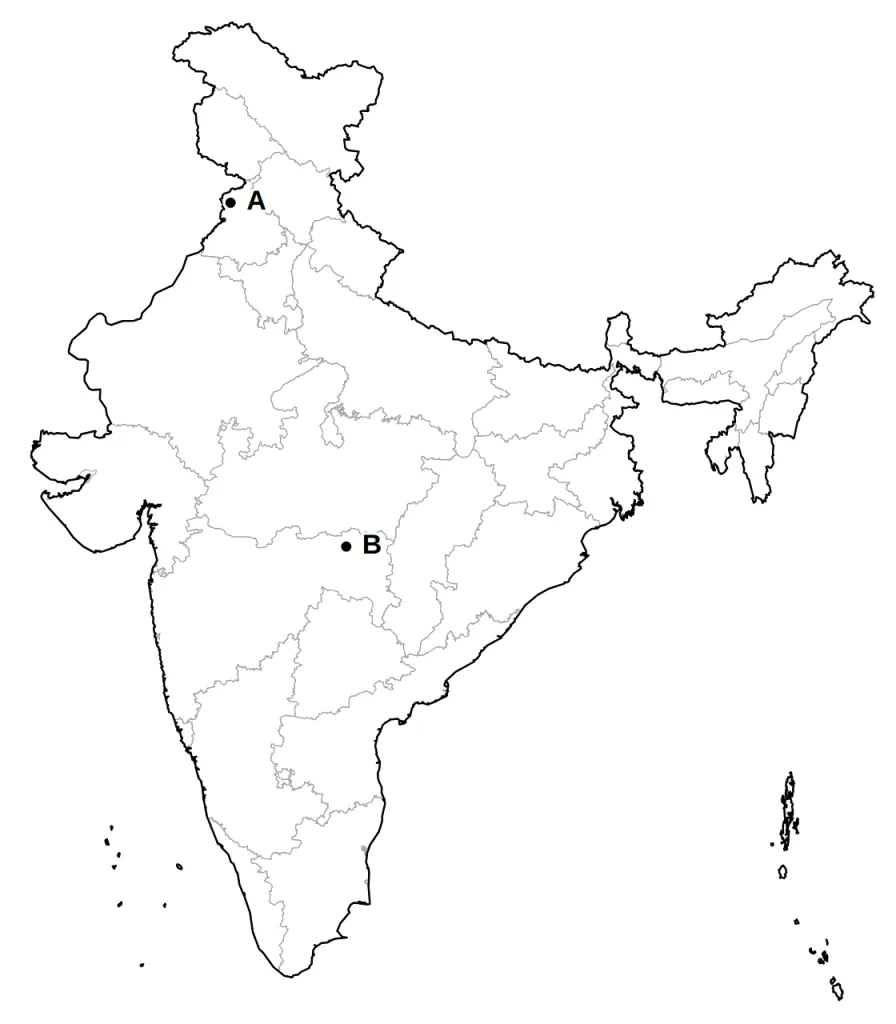
A The city where, on 13 April 1919, General Dyer's troops fired on a crowd gathered in an enclosed ground, many of whom were villagers who had come to town for a fair. (1 mark)
Answer.
- A: Amritsar (Punjab) — 1 mark
B The city in central India where the Congress met in December 1920 and, after its leaders had worked out a compromise, adopted the programme of non-cooperation. (1 mark)
Answer.
- B: Nagpur (Maharashtra) — 1 mark
Section B - Geography (20 marks)
Question 16 (2 marks)
In a fruit-growing valley, heavy spraying of pesticides killed most of the bees and many of the birds that used to eat insects. Explain two ways in which this could harm the farms of the valley.
Answer.
Model answer:
First, with fewer bees to carry pollen, fewer flowers turn into fruit, so harvests fall. Second, the birds kept insect pests in check; without them pests multiply and damage more crops, pushing up spending on pesticide.
Marking scheme:
- Fewer bees: bees carry pollen from flower to flower; with fewer of them, fewer flowers set fruit, so the harvest falls — 1 mark
- Fewer birds: the birds kept insect pests in check; without them the pests multiply, damage more crops and push farmers to spend on still more pesticide (accept: the poisons also harm the soil and water; any other relevant point) — 1 mark
Question 17 (5 marks)
Ramesh farms on the plain of the Ganga in Uttar Pradesh. Savita farms on the lava plateau of western Maharashtra. Answer the following.
(a) Compare the soils of their farms on three points. (3 marks)
Answer.
Model answer:
First, Ramesh's alluvial soil was laid down by rivers, while Savita's black soil formed from lava rocks. Second, alluvial soil ranges from sandy to clayey, with bangar and khadar; black soil is fine and clayey, holds moisture, turns sticky when wet and cracks when dry. Third, alluvial soil is rich in potash, phosphoric acid and lime; black soil is rich in lime, potash and magnesium but poor in phosphorus.
Marking scheme:
- How it formed: Ramesh's alluvial soil was laid down by rivers of the Indus, Ganga and Brahmaputra systems; Savita's black soil formed from lava rocks, with the climate also playing a part — 1 mark
- Texture and moisture: alluvial soil varies from sand to loam to clay, with old alluvium (bangar, with kankar nodules) and new alluvium (khadar, finer and more fertile); black soil is made of very fine clayey material, holds moisture well, turns sticky when wet and develops deep cracks when dry — 1 mark
- Nutrients: alluvial soil is rich in potash, phosphoric acid and lime; black soil is rich in calcium carbonate, magnesium, potash and lime, but generally poor in phosphoric content (accept a comparison of where each is found: the northern plains and the eastern deltas; the Deccan trap region of Maharashtra, Malwa and parts of Madhya Pradesh and Chhattisgarh) — 1 mark
(b) A soil test shows that Savita's field has plenty of lime and potash but very little of one important nutrient. Ramesh's yields have been falling after many years of growing rice and wheat on the same land. Suggest one step each should take, giving a reason from the soil. (2 marks)
Answer.
Model answer:
Savita should add a phosphate fertiliser, since black soil is generally poor in phosphorus though rich in lime and potash. Ramesh should add manure or fertiliser, since years of cropping have used up the nutrients even of fertile alluvium.
Marking scheme:
- Savita: add a phosphate fertiliser, or manure rich in phosphorus; black soil is rich in calcium carbonate, magnesium, potash and lime, but it is generally poor in phosphoric content — 1 mark
- Ramesh: add manure or fertiliser (accept: grow a pulse between cereal crops) to put back the nutrients that years of cropping have taken out; even fertile alluvium loses its potash, phosphoric acid and lime when crops are taken from it year after year — 1 mark
OR
The table shows how the land of an imaginary district was used in 2000 and in 2020 (hypothetical data). Study it and answer the following.
| Land use | 2000 (% of area) | 2020 (% of area) |
|---|---|---|
| Forests | 24 | 17 |
| Net sown area | 50 | 44 |
| Land under non-agricultural uses (houses, roads, factories) | 6 | 15 |
| Barren and waste land | 8 | 9 |
| Current fallow | 5 | 8 |
| Permanent pastures | 7 | 7 |
(a) Explain three changes in land use shown in the table, giving a likely reason for each. (3 marks)
Answer.
Model answer:
First, forests fell from 24 to 17 per cent, probably cleared for farms, roads and towns. Second, land under non-agricultural uses rose from 6 to 15 per cent as houses, roads and factories spread. Third, net sown area fell from 50 to 44 per cent as some farmland was built on, and fallow land grew.
Marking scheme:
- Forests fell from 24 to 17 per cent of the area, most likely because trees were cleared for farms, roads, towns, mining or timber — 1 mark
- Land under non-agricultural uses rose from 6 to 15 per cent, as towns, houses, roads and factories spread — 1 mark
- Net sown area fell from 50 to 44 per cent, as some farmland was built upon, while current fallow rose from 5 to 8 per cent, perhaps because farmers lacked water or found farming unprofitable (accept any three changes, each with a sensible reason) — 1 mark
(b) Explain two reasons why the fall in the district's forest cover is a cause for concern. (2 marks)
Answer.
Model answer:
First, forests hold the soil and help rain soak in, so their loss means more erosion and floods and less groundwater. Second, local people lose fuel, fodder and timber, and wildlife loses its home.
Marking scheme:
- Soil and water: forests hold the soil and help rain soak in, so their loss brings more soil erosion and floods and less water in the ground — 1 mark
- People and wildlife: forests give local people fuel, fodder, timber and other produce, and are home to wild plants and animals, so both lose (accept: 17 per cent is far below the one-third of the area that India's forest policy considers desirable for ecological balance; any other relevant point) — 1 mark
Question 18 (4 marks)
Read the source given below and answer the questions that follow.
A Tank under Every Roof
Neelpur, a growing city on the Deccan plateau, gets a fair amount of rain each monsoon. Yet by April most of its borewells run dry, and water tankers queue outside its housing colonies. Almost all the rain that falls on the city lands on concrete roofs and roads and rushes into the drains. Very little of it soaks into the ground to refill the water that thousands of borewells pump out every day.
Five years ago, the families of Shanti Colony decided to try something different. Each house fitted pipes that carry rain from its roof through a simple sand-and-gravel filter into a tank under the ground. When a tank is full, the extra water flows into a pit dug near the house, from where it seeps down into the earth. Tanker trips to the colony have fallen by half, and the colony's borewells now last well into the summer.
Several neighbouring colonies have copied the idea. The city council is now discussing a rule that every new house must have such a system. (Neelpur and Shanti Colony are imaginary.)
18.1 According to the source, why does Neelpur run short of water although it gets a fair amount of rain? (1 mark)
Answer.
Model answer:
Most of the rain runs off concrete roofs and roads into drains, so little refills the groundwater that many borewells keep pumping out.
Marking scheme:
- Most of the rain falls on concrete roofs and roads and runs off into the drains, so little soaks in to refill the groundwater that the many borewells keep pumping out — 1 mark
18.2 Explain two ways in which rooftop rainwater harvesting has helped Shanti Colony. (2 marks)
Answer.
Model answer:
First, rain stored in the underground tanks meets part of the families' needs, so tanker trips have halved. Second, overflow seeps into the ground through pits and refills the groundwater, so the borewells last well into summer.
Marking scheme:
- Stored water: rain collected in the underground tanks meets part of the families' needs, so they depend less on tankers (tanker trips have fallen by half) and save money — 1 mark
- Recharge: the overflow seeps into the ground through the pits and refills the groundwater, so the colony's borewells now last well into the summer (accept: less water rushing into the drains and streets during heavy rain) — 1 mark
18.3 Why might the council prefer a rule for every new house to leaving rooftop harvesting to each family's choice? (1 mark)
Answer.
Model answer:
The groundwater recovers only if most houses harvest rain; a rule brings in every new house, not just a few willing families, as Tamil Nadu did.
Marking scheme:
- The city's groundwater recovers only when most houses harvest rain; a rule makes every new house take part, instead of a few willing families (as Tamil Nadu did when it made rooftop harvesting compulsory for all houses) — 1 mark
Question 19 (3 marks)
Locate and label any three of the following on the outline map of India given for this question, using suitable symbols.
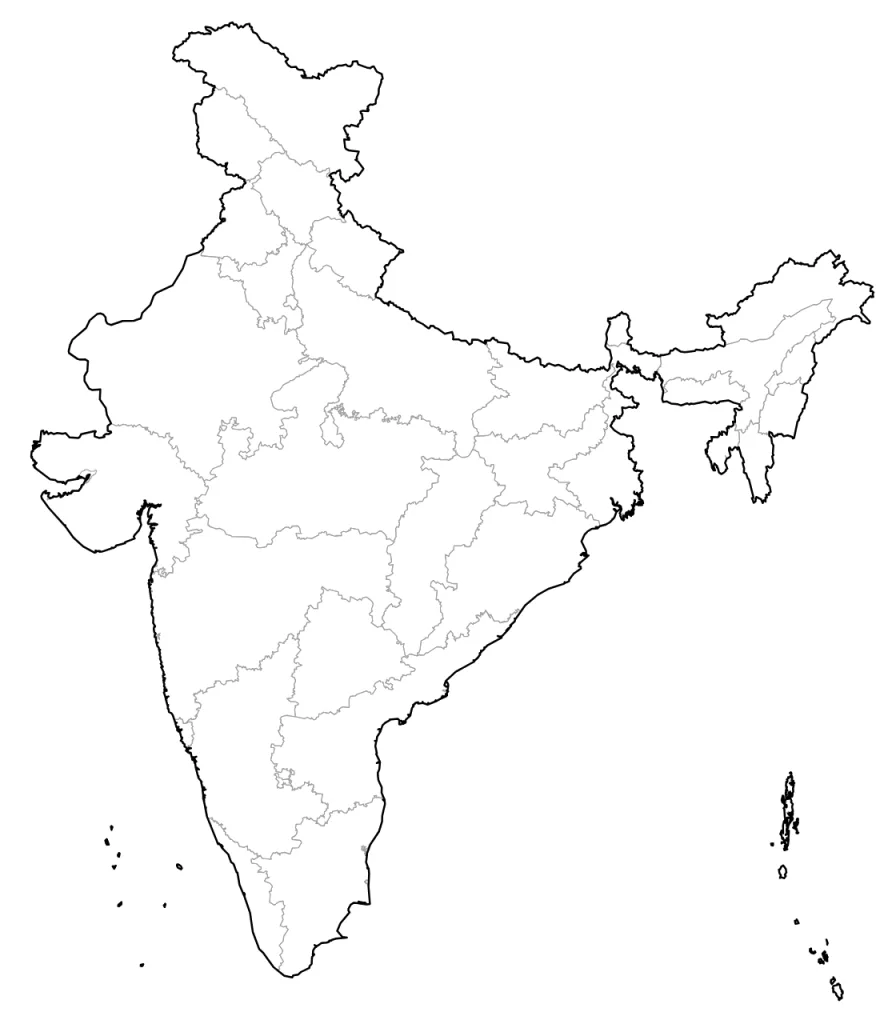
(i) Singrauli Thermal Power Plant (1 mark)
Answer.
- Singrauli: in the Singrauli coal area at the Uttar Pradesh-Madhya Pradesh border (a mark on either side of the border is accepted), located correctly with a symbol and labelled — 1 mark
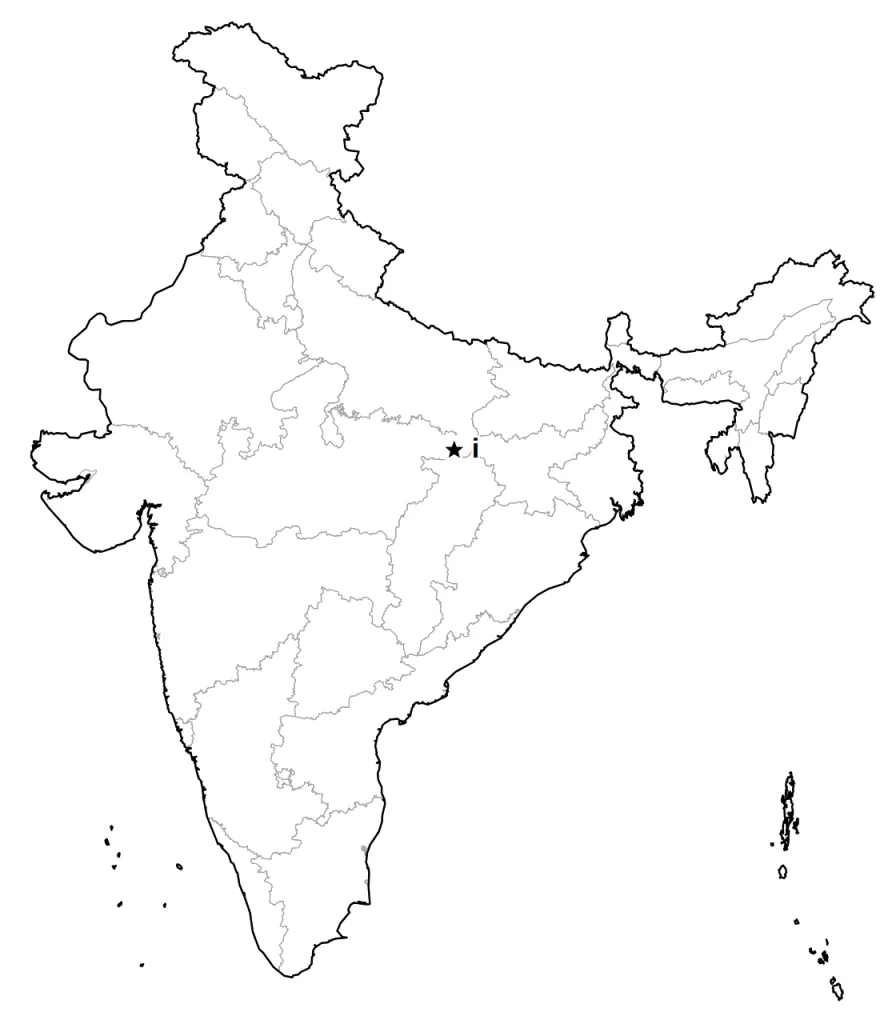
(ii) Kanpur - a cotton textile centre (1 mark)
Answer.
- Kanpur: on the Ganga in Uttar Pradesh, located correctly with a symbol and labelled — 1 mark
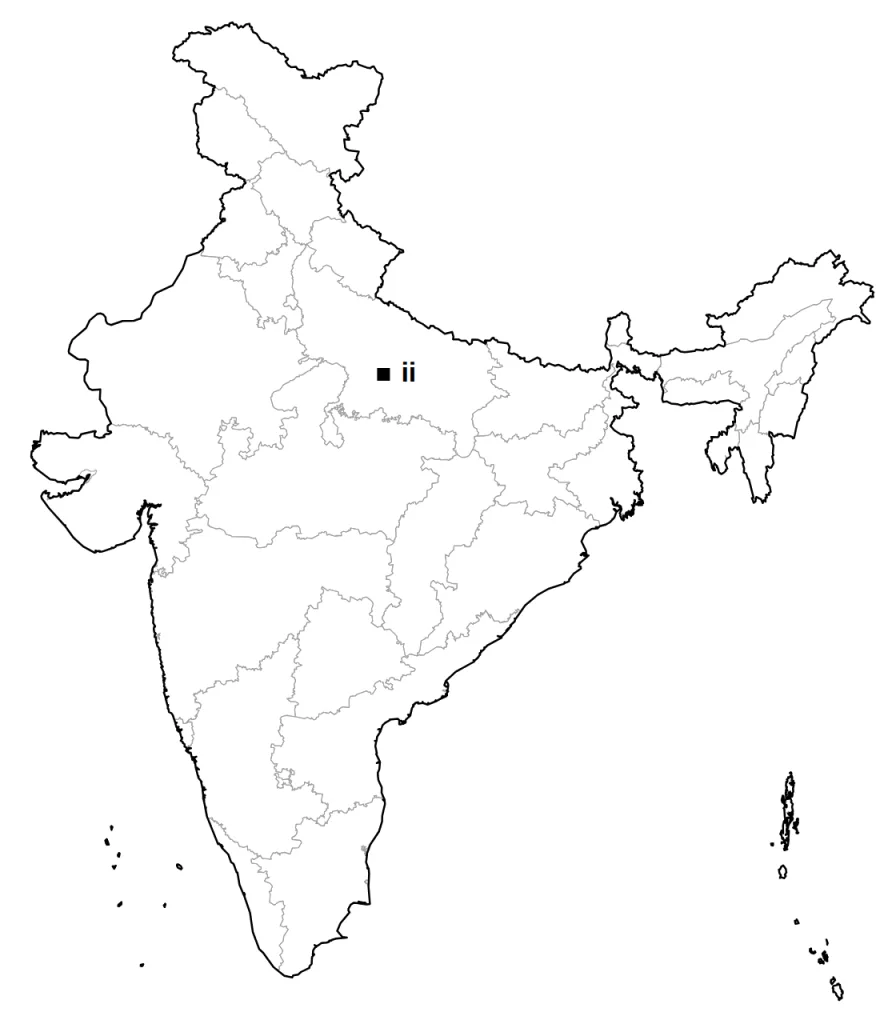
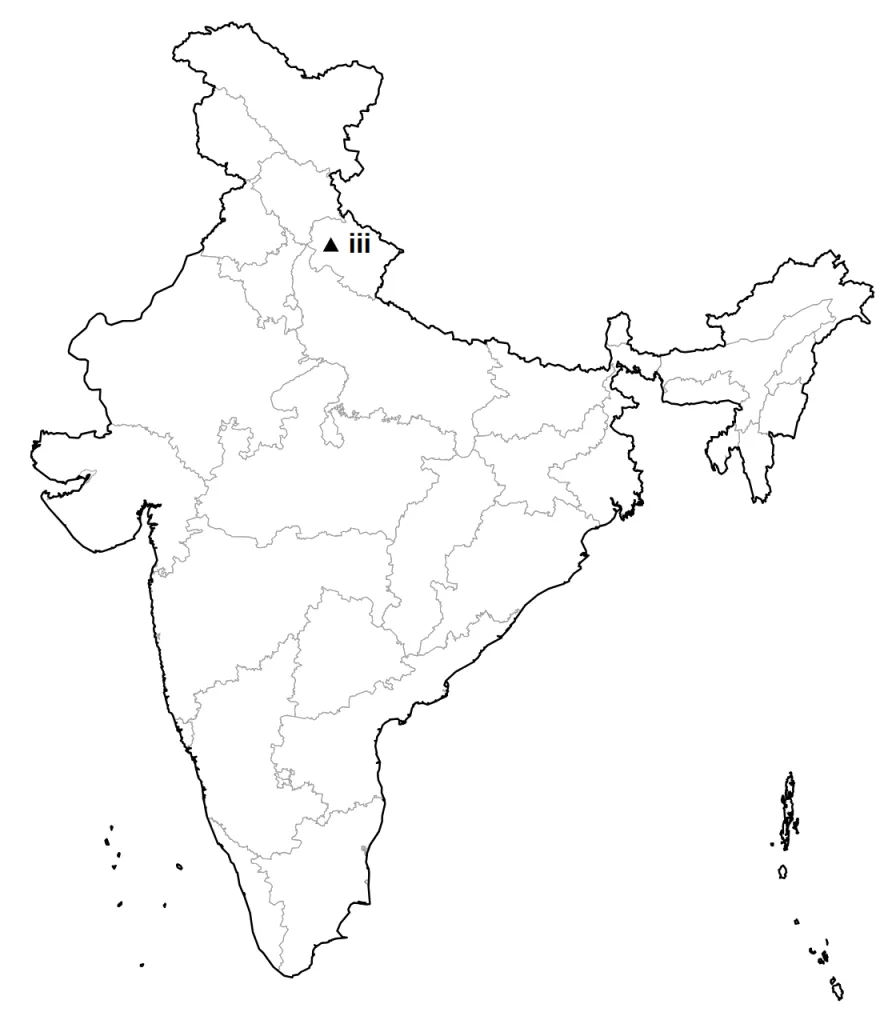
(iii) Tehri Dam (1 mark)
Answer.
- Tehri Dam: on the Bhagirathi, in the Garhwal hills of Uttarakhand, located correctly with a symbol and labelled — 1 mark
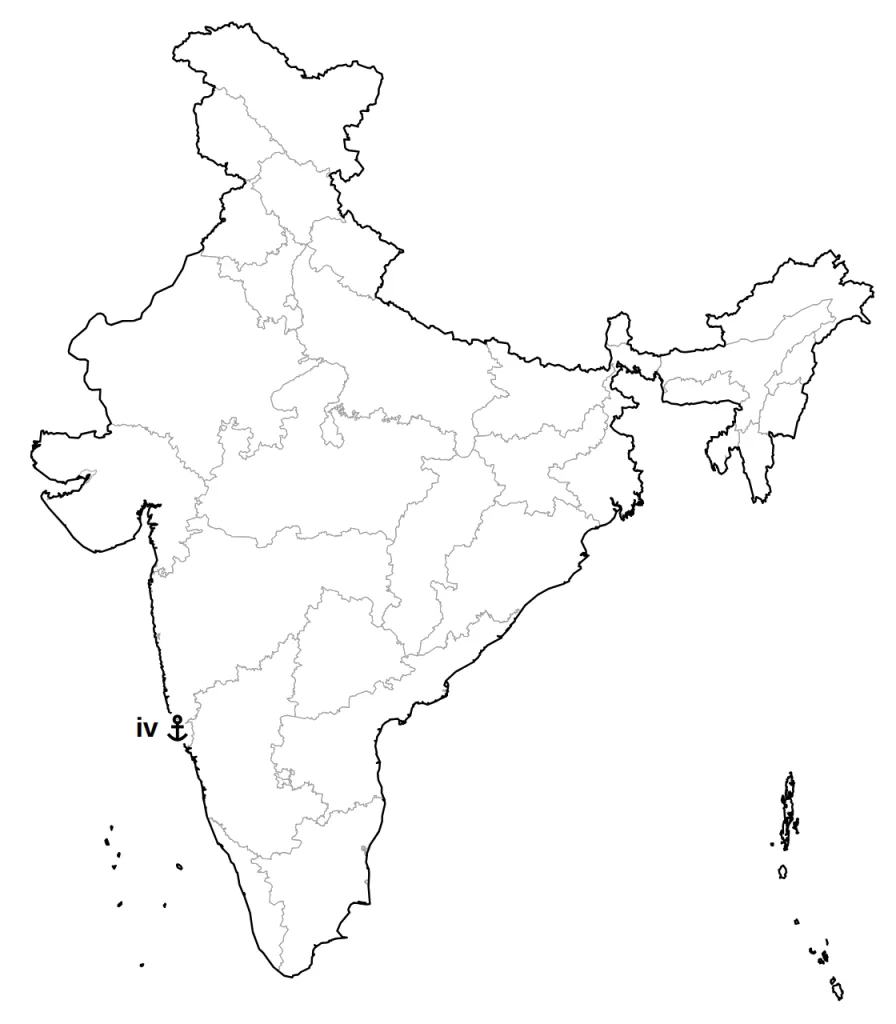
(iv) Marmagao Port (1 mark)
Answer.
- Marmagao: a sea port on the coast of Goa, located correctly with a symbol and labelled — 1 mark
Section C - Political Science (20 marks)
Question 24 (2 marks)
In the imaginary State of Kalinga Nadu, the ruling party won 170 of the 200 seats in the Assembly. Explain two reasons why the opposition parties still matter for democracy in that State.
Answer.
Model answer:
First, the opposition criticises the government's failures and wrong policies in the Assembly, so it must defend its decisions. Second, it rallies people against such policies and offers voters an alternative, so the ruling party stays careful.
Marking scheme:
- They voice different views and criticise the government in the Assembly for its failures or wrong policies, so the government has to explain and defend its decisions — 1 mark
- They mobilise opposition to the government among the people, through meetings, protests and the media, and offer voters an alternative at the next election, so the ruling party cannot take the people for granted (accept: they give a voice to the many voters who chose other parties; any other relevant point) — 1 mark
Question 25 (2 marks)
Surveys in the countries of South Asia have found that most people prefer democracy to any other form of government, even though many of them complain about how their governments work. Give two reasons for this.
Answer.
Model answer:
First, people want rulers they elect, so they see a democratic government as their own even when it disappoints. Second, they feel their vote counts, so they would rather change governments than lose that right.
Marking scheme:
- People want to be ruled by representatives they elect, so they see a democratic government as their own and accept its right to rule even when it performs badly; this is what makes it legitimate — 1 mark
- People believe that their vote makes a difference to how they are governed, so they would rather improve or change governments through elections than give up the power to choose them (accept: they feel democracy suits their own country; any other relevant point) — 1 mark
Question 26 (3 marks)
A study of the imaginary district of Jalpur found the following (hypothetical findings):
(i) Nine out of every ten marriages took place between families of the same caste.
(ii) Marriages between families of different castes were five times as common in the district's town as in its villages.
(iii) Among the district's panchayat heads and municipal councillors, the share of Scheduled Castes, Scheduled Tribes and Other Backward Classes is now close to their share of the population, though very few of them held such posts fifty years ago.
Explain what each finding shows about caste in India today.
Answer.
Model answer:
(i) Most people still marry within their own caste, so caste still shapes family life. (ii) Caste rules loosen faster in towns, where education and new kinds of work bring castes together. (iii) Voting rights and reserved seats have given groups once kept out of power a real share in local government.
Marking scheme:
- (i) Caste still shapes personal and family life: most people still marry within their own caste or tribe, so caste has not disappeared — 1 mark
- (ii) Old caste rules are weakening faster in towns: urbanisation, education and new kinds of work bring people of different castes together and loosen the hold of caste on choices such as marriage — 1 mark
- (iii) Politics has given groups once kept out of power a share in it: with universal adult franchise and reserved seats, their votes and representatives now count, so their place in public life has grown (accept: caste still shapes politics, as parties and voters take it into account) — 1 mark
Question 27 (5 marks)
Belgium and Sri Lanka are both democracies with more than one language group, but they dealt with the demands of their minorities in very different ways. Answer the following.
(a) Compare the steps taken by the governments of the two countries on three points. (3 marks)
Answer.
Model answer:
First, Sri Lanka made Sinhala its only official language in 1956, while Belgium gave both language groups equal numbers of ministers in the central government. Second, Belgium gave its regions powers of their own, while Sri Lanka refused autonomy to the Tamil provinces. Third, Sri Lanka favoured Sinhala applicants for university places and jobs, while Belgium gave each community its own government for education and culture.
Marking scheme:
- Language: Sri Lanka's Act of 1956 made Sinhala the only official language, setting Tamil aside; Belgium treated its Dutch- and French-speaking communities as equals, with equal numbers of ministers from each in the central government, and some laws need the support of a majority of each language group — 1 mark
- Power to regions: Belgium gave its State governments powers of their own that the Central Government cannot take back; Sri Lanka did not accept the Tamil demand for autonomy for the provinces where Tamils lived — 1 mark
- Education and culture: Sri Lanka favoured Sinhala applicants for university places and government jobs, and gave the state a duty to protect and foster Buddhism; Belgium set up a community government for each language group to run its education, culture and language matters — 1 mark
(b) Explain two ways in which the results of the two approaches differed. (2 marks)
Answer.
Model answer:
First, Belgium avoided civic strife and a split, while in Sri Lanka distrust grew into a long civil war. Second, both Belgian communities accepted the government as theirs, while Sri Lanka's Tamils felt left out, and some demanded a separate state.
Marking scheme:
- Peace and unity: Belgium's arrangement eased the tension between its communities, and the country avoided civic strife and a split on language lines; in Sri Lanka distrust between the communities grew and turned into a long civil war — 1 mark
- How the minority saw the government: in Belgium both communities came to accept the government as their own, even though the system is complicated; in Sri Lanka the Tamils felt left out and that the state did not care for their language and culture, and some began to demand a separate state (any other relevant point) — 1 mark
OR
The imaginary country of Tarin has two communities. The Kelo, about 70 per cent of the people, live all over the country; the Masi live mostly in its eastern hills and feel shut out of power. A committee has proposed three measures:
(i) The eastern hills will get an elected provincial government, with its own powers over schools, forests and the police.
(ii) Some seats in the national parliament will be reserved for Masi candidates.
(iii) Tarin's Supreme Court will be able to strike down any law or order of the government that treats a community unfairly.
Answer the following.
(a) Name the form of power sharing that each measure shows, and explain how it shares power. (3 marks)
Answer.
Model answer:
(i) is a vertical division: power is shared between the national and a provincial government, and the hills get powers of their own. (ii) shares power among social groups: reserved seats give the Masi a voice in parliament. (iii) is a horizontal division: the court can check the legislature and executive, so no organ has unlimited power.
Marking scheme:
- (i) Vertical division of power, among governments at different levels: power is divided between the national government and a provincial government, and the hills get powers of their own that the national government cannot simply take over — 1 mark
- (ii) Power shared among social groups: reserved seats make sure that the smaller community has a voice in the national legislature, as reserved constituencies do for weaker sections in India — 1 mark
- (iii) Horizontal division of power, among the organs of government: the judiciary can check the legislature and the executive, so that no organ has unlimited power (a system of checks and balances) — 1 mark
(b) Which one of the three measures would do most to meet the Masi's feeling of being shut out of power? Give two reasons for your choice. (2 marks)
Answer.
Model answer:
Measure (i). Most Masi live in the eastern hills, so their own provincial government would let them decide schools, forests and policing themselves. Its powers would not depend on the goodwill of the Kelo majority at the centre, so their share in power would last.
Marking scheme:
- Choice with first reason: for example, measure (i), since most Masi live in the eastern hills, so a provincial government of their own would let them decide matters of daily life such as schools, forests and the police, as Belgium's regional governments do — 1 mark
- Second reason: for example, the powers of such a government would not depend on the goodwill of the Kelo majority at the centre, so the Masi's share in power would last (accept measure (ii) or (iii) if it is backed by two sound reasons) — 1 mark
Question 28 (4 marks)
Read the source given below and answer the questions that follow.
'The Morning the Order Came'
Mr Rao, a retired government officer of Suvarnapur, a State in the south of India, still remembers one morning from his early years of service. 'We had a new Chief Minister,' he says. 'For the first time our voters had chosen a party that was not in power in Delhi. The new government cut school fees and began a canal that our district had wanted for years.'
'Then, less than two years later, an order came from the Centre dismissing that government. It still had a clear majority in the Assembly; no vote there had gone against it. The canal work stopped. People in our town said that their vote had been thrown away.'
'At the next election the voters remembered. The party that had welcomed the dismissal lost nearly every seat in the State. Such dismissals are rare today, and the courts look at them closely.' (Mr Rao and Suvarnapur are imaginary.)
28.1 According to Mr Rao, why did people in his town feel that their vote had been thrown away? (1 mark)
Answer.
Model answer:
The government they had elected was dismissed by the Centre although it still had a clear majority.
Marking scheme:
- The government they had elected was dismissed by the Centre within two years, although it still had a clear majority in the Assembly — 1 mark
28.2 Explain two reasons why dismissing an elected State government that still had a majority went against the spirit of federalism. (2 marks)
Answer.
Model answer:
First, each level of government gets its powers from the Constitution and answers to its own voters, so the dismissal set aside the choice of the State's people. Second, federalism needs mutual respect; if the Centre can remove States at will, they become its subordinates, as in a unitary system.
Marking scheme:
- In a federation each level of government gets its powers from the Constitution and answers to its own voters; the State government was answerable to the people of the State, so removing it set aside their choice — 1 mark
- Federalism works only when the two levels respect and trust each other; if the Centre can remove a State government at will, the States become its subordinates, as in a unitary system, and the division of power loses its meaning (any other relevant point) — 1 mark
28.3 Why might the voters of the State have punished, at the next election, the party that welcomed the dismissal? (1 mark)
Answer.
Model answer:
They felt the party had sided with the Centre against their own choice, instead of defending the State's right to keep the government it elected.
Marking scheme:
- They saw the party as siding with the Centre against their own choice; voters in a State expect its parties to stand up for the State's right to choose and keep its own government (accept: the dismissal had also stopped work, such as the canal, that the people wanted) — 1 mark
Section D - Economics (20 marks)
Question 35 (3 marks)
The size of India's economy is measured every year as its gross domestic product (GDP), and the figure is also worked out separately for each sector. Answer the following.
(i) Who measures India's GDP? (1 mark)
Answer.
Model answer:
A central government ministry, helped by the departments of all the States and Union Territories.
Marking scheme:
- A central government ministry, which collects figures on the goods and services produced and their prices with the help of the departments of all the States and Union Territories — 1 mark
(ii) Explain two reasons why it is useful to know each sector's share of GDP, and not only the total. (2 marks)
Answer.
Model answer:
First, sector shares show which sectors grow and which lag, so the government can plan help, such as irrigation or credit for farms. Second, comparing a sector's share of output with its share of workers shows where new jobs are needed.
Marking scheme:
- It shows which sectors are growing and which are lagging behind, so the government can plan help where it is needed, for example irrigation, storage or credit if farm output lags — 1 mark
- Comparing a sector's share of output with its share of workers shows whether its workers are productively employed, and so where new jobs need to be created (any other relevant point) — 1 mark
Question 36 (3 marks)
The government of an imaginary State passes a law that no moneylender may charge interest of more than 24 per cent a year. Explain two ways in which this law could help poor borrowers, and one reason why it may not be enough on its own.
Answer.
Model answer:
First, a lower rate takes a smaller share of a borrower's earnings, leaving more for food, schooling and work. Second, a bad crop is less likely to push borrowers into a debt trap. But no one supervises moneylenders, and the poor lack collateral for bank loans, so they may still accept hidden charges.
Marking scheme:
- Lower cost: a lower rate means that a smaller part of the borrower's earnings goes to repay the loan, so more is left for food, schooling or the borrower's own work — 1 mark
- Less risk of a debt trap: with a lower rate, a bad crop or a bad month is less likely to force the borrower to take a fresh loan to repay the old one, or to sell land or other assets — 1 mark
- Why it may not be enough: no organisation supervises the lending of moneylenders, who often lend without any papers, so the limit is hard to enforce; and since poor borrowers usually have no collateral for bank loans, they still depend on moneylenders and may accept hidden charges (accept: the lasting answer is to extend cheap formal credit to the poor through banks, cooperatives and self-help groups; any other relevant point) — 1 mark
Question 37 (3 marks)
A multinational company (MNC) that makes washing machines has its designers in Germany, buys motors from a factory in Thailand and puts the machines together at its own plant in Pune, for buyers in many countries. Using this case, explain three ways in which the MNC links the economies of these countries.
Answer.
Model answer:
First, it joins production: Thai motor makers depend on Pune's orders, and German designs shape what Pune makes. Second, it joins markets: Pune's machines reach buyers in many countries, where producers of different lands compete. Third, the Pune plant is foreign investment, bringing money, machines and designs into India.
Marking scheme:
- Production: work done in three countries becomes parts of one production process; the Thai motor makers depend on orders from the Pune plant, and German designs decide what Pune makes, so producers far apart are tied together — 1 mark
- Markets: machines made in Pune are sold to buyers in many countries, so Indian output reaches markets abroad, buyers there get Indian-made goods, and producers of different countries compete in the same markets — 1 mark
- Investment: the Pune plant is foreign investment by the MNC, which brings money, machines and designs from abroad into India, so Indian workers become part of a worldwide company (accept one technology point: fast transport and communication make these links possible; any other relevant point) — 1 mark
Question 38 (5 marks)
The table gives some figures for two imaginary countries in 2005 and 2025. Study the table and answer the questions that follow. (The data are hypothetical, for practice only.)
| Country | Year | Total income (US dollars, billion) | Population (million) | Life expectancy at birth (years) |
|---|---|---|---|---|
| A | 2005 | 60 | 20 | 66 |
| A | 2025 | 120 | 30 | 71 |
| B | 2005 | 40 | 10 | 70 |
| B | 2025 | 60 | 12 | 69 |
(i) Calculate the per capita income of A in 2005 and in 2025. (1 mark)
Answer.
Model answer:
2005: 60 billion ÷ 20 million = 3,000 dollars. 2025: 120 billion ÷ 30 million = 4,000 dollars.
Marking scheme:
- 2005: 60 billion ÷ 20 million = 3,000 US dollars; 2025: 120 billion ÷ 30 million = 4,000 US dollars (both needed for the mark) — 1 mark
(ii) A's total income doubled between 2005 and 2025, but its per capita income rose by only one-third. Explain why, using the table. (2 marks)
Answer.
Model answer:
Per capita income is total income divided by population. A's population grew by half, from 20 to 30 million, so the doubled income was shared among many more people, and the average rose only from 3,000 to 4,000 dollars.
Marking scheme:
- Per capita income is total income divided by the population, so it depends on how many people share the income — 1 mark
- A's population grew by half, from 20 to 30 million, so the doubled income was shared among many more people, and the average rose only from 3,000 to 4,000 dollars — 1 mark
(iii) 'B is still ahead of A, since its per capita income is higher.' Give two points from the table to question this statement. (2 marks)
Answer.
Model answer:
First, A's life expectancy rose from 66 to 71 years, above B's, while B's fell from 70 to 69. Second, A's per capita income grew faster, by a third against B's quarter, and income alone does not show how well people live.
Marking scheme:
- Health: A's life expectancy rose from 66 to 71 years and is now above B's, while B's fell from 70 to 69, so A's people now live longer — 1 mark
- Growth: A's per capita income grew faster, by one-third (3,000 to 4,000 dollars) against B's one-quarter (4,000 to 5,000 dollars); and income alone does not show how well people live (any other relevant point) — 1 mark
OR
Answer the following questions using the table given above for the two countries.
(i) Calculate B's per capita income in 2025. (1 mark)
Answer.
Model answer:
60 billion ÷ 12 million = 5,000 dollars.
Marking scheme:
- 60 billion ÷ 12 million = 5,000 US dollars — 1 mark
(ii) By what percentage did the per capita income of each country grow between 2005 and 2025? Which grew faster? (2 marks)
Answer.
Model answer:
A: 3,000 to 4,000 dollars, about 33 per cent. B: 4,000 to 5,000 dollars, 25 per cent. A grew faster; both rose by 1,000 dollars, but A started lower.
Marking scheme:
- A: from 3,000 to 4,000 dollars, a rise of 1,000 ÷ 3,000 = about 33 per cent; B: from 4,000 to 5,000 dollars, a rise of 1,000 ÷ 4,000 = 25 per cent — 1 mark
- A's per capita income grew faster, although both rose by the same 1,000 dollars, because A started from a lower base — 1 mark
(iii) If A's population had stayed at 20 million, what would its per capita income have been in 2025? What does this show? (2 marks)
Answer.
Model answer:
120 billion ÷ 20 million = 6,000 dollars instead of 4,000. This shows that population growth held back the rise in average income; per capita income rises only when income grows faster than population.
Marking scheme:
- 120 billion ÷ 20 million = 6,000 US dollars, instead of the actual 4,000 — 1 mark
- Population growth held back the rise in average income: per capita income rises only when total income grows faster than the population (any other relevant point) — 1 mark