
CBSE Class 10 Social Science Sample Paper 2027 – Set 4
Time allowed: 3 hours · Maximum marks: 80
General Instructions
- This question paper has 38 questions. All questions are compulsory.
- The paper has four sections: Section A History (20 marks), Section B Geography (20 marks), Section C Political Science (20 marks) and Section D Economics (20 marks).
- Multiple choice questions (MCQs) carry 1 mark each.
- Very Short Answer (VSA) questions carry 2 marks each. Answer each in not more than 40 words.
- Short Answer (SA) questions carry 3 marks each. Answer each in not more than 60 words.
- Long Answer (LA) questions carry 5 marks each. Answer each in not more than 120 words.
- Case-based questions (CBQ) have three sub-questions and carry 4 marks each. Answer each question in not more than 100 words.
- The map-based questions carry 5 marks in two parts: Question 9 in Section A (2 marks) and Question 19 in Section B (3 marks). Mark your answers on a printed outline map of India.
- There is no overall choice in the question paper. However, an internal choice has been provided in a few questions. Attempt only one of the choices in such questions.
- A separate question has been provided for Visually Impaired candidates in lieu of questions having visual inputs or maps. Such questions are to be attempted by Visually Impaired candidates only.
How to use this paper: set a 3-hour timer and write all your answers on paper, just like the board exam. When you finish, take the quiz at the end of this page to score your objective (MCQ) answers instantly, then open the Detailed Solutions and check the rest step by step, with the marks each step carries.
Section A - History (20 marks)
Questions 1 to 9. Questions 1 to 4 are MCQs of 1 mark each; Question 9 is map-based.
1. Which of the following statements about the printing of religious texts in nineteenth-century India are correct?
I. Tulsidas composed the Ramcharitmanas in the sixteenth century, but its first printed edition came from a Calcutta press only in 1810.
II. From about the 1850s, lithographic presses turned out low-priced editions of such works, and these sold in large numbers across north India.
III. The Naval Kishore Press of Lucknow brought out religious works only in Sanskrit, since it printed for priests and scholars alone.
IV. A believer could now keep a small printed copy at home or take it on a journey, and one person who could read could share it with many listeners.
Choose the correct option:
(a) Only I and III
(b) Only II and III
(c) Only I, II and IV
(d) Only II, III and IV
2. Study the picture given below. It is drawn after a painting made in Europe in 1848. Which one of the following statements about it is correct?
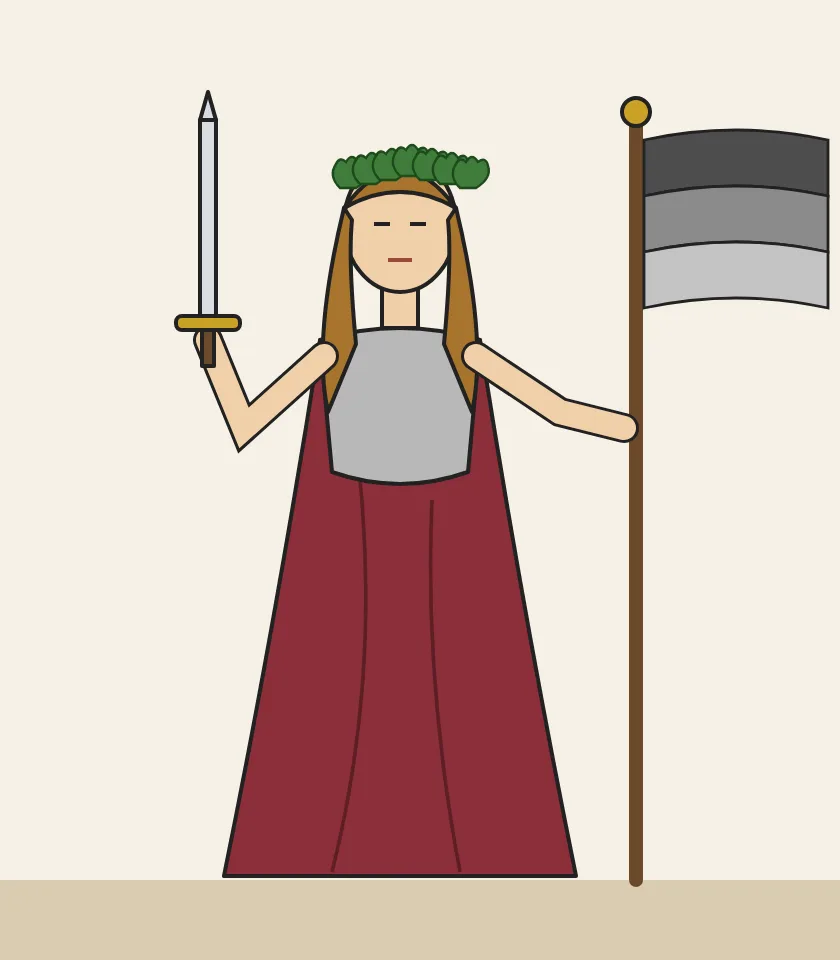
(a) It shows Marianne, and the sword in her hand stands for the rule of law.
(b) It shows Germania, and the sword in her hand stands for readiness to fight.
(c) It shows Germania, and the sword in her hand stands for a wish for peace.
(d) It shows Marianne, and the sword in her hand stands for the end of the monarchy.
3. Read the statements given below and choose the correct option.
Statement I: After the potato reached Europe from the Americas, Europe's poor began to eat better and live longer.
Statement II: The conquest and colonisation of the Americas by Portugal and Spain began only in the eighteenth century.
(a) Statement I is correct and Statement II is incorrect.
(b) Statement I is incorrect and Statement II is correct.
(c) Both Statements I and II are correct.
(d) Both Statements I and II are incorrect.
4. Arrange the following events in chronological order, from the earliest to the latest.
I. The Rowlatt Act, which allowed political prisoners to be held without trial, became law.
II. Gandhiji returned to India after his years in South Africa.
III. Indian business groups came together in FICCI, their all-India federation of chambers of commerce and industry.
IV. Gandhiji left his ashram at Sabarmati on foot, heading for the coastal village of Dandi.
Choose the correct option:
(a) I, II, III, IV
(b) II, III, I, IV
(c) II, I, IV, III
(d) II, I, III, IV
5. Compare the trade links of the silk routes with the links that grew between Europe and the Americas after 1492, on two points. (2 marks)
6. In the late nineteenth and early twentieth centuries, printed books began to reach poor people in India who had never owned a book before. Explain three ways in which this happened. (3 marks)
OR
In the seventeenth century, as city life grew in China, printed books began to reach new kinds of readers. Explain three ways in which the readership of print in China changed.
7. In 1815, after the defeat of Napoleon, representatives of Britain, Russia, Prussia and Austria met at Vienna, hosted by the Austrian Chancellor Duke Metternich, to draw up a settlement for Europe. Answer the following.
(a) Explain three changes that the Treaty of Vienna made to the rulers and the map of Europe. (3 marks)
(b) Explain two ways in which this settlement stood in the way of German and Italian unity. (2 marks)
OR
Italy became a single state only in 1861. Answer the following.
(a) An English caricature of the time shows Garibaldi helping King Victor Emmanuel II to pull on a boot shaped like Italy. The caption reads: 'If it won't go on, sire, try a little more powder.' Explain three things that this caricature suggests about the unification of Italy. (3 marks)
(b) Why did the rulers of Sardinia-Piedmont take up the cause of a united Italy after 1848? Give two reasons. (2 marks)
8. Read the source given below and answer the questions that follow.
Salt from the Creek
Sarala was sixteen in April 1930, when the news reached Lavanpur, a small town near the sea, that Gandhiji had broken the salt law. Within a week her aunt, a widow who had rarely stepped out of the house, was leading a line of women down to the creek. They carried earthen pots, boiled sea water over wood fires and held up the grey crystals for the police to see. In the afternoons they sat outside the liquor shop and the shop that sold foreign cloth, and asked each customer to turn back. Her aunt spent six weeks in jail.
Most of the marchers came from the landowning and lawyers' families of the town. The washerwomen by the river watched from their doorsteps; they could not afford to lose a day's earnings.
When the protests slowed down, Sarala asked a local Congress leader whether a woman could become secretary of the town committee. He smiled and said that the women had already done their part. At home, her father praised her courage, but reminded her that the house still came first. (Lavanpur and Sarala are imaginary.)
8.1 Which law did the women of Lavanpur openly break, and how? (1 mark)
8.2 Why did the washerwomen by the river not join the march? (1 mark)
8.3 The movement brought women like Sarala's aunt into public life, but changed their position in the Congress and at home only a little. Using the source and your own knowledge, explain two reasons for this. (2 marks)
9. Two places, A and B, are marked on the outline map of India given for this question. Use the clues below to identify each place, and write its correct name.
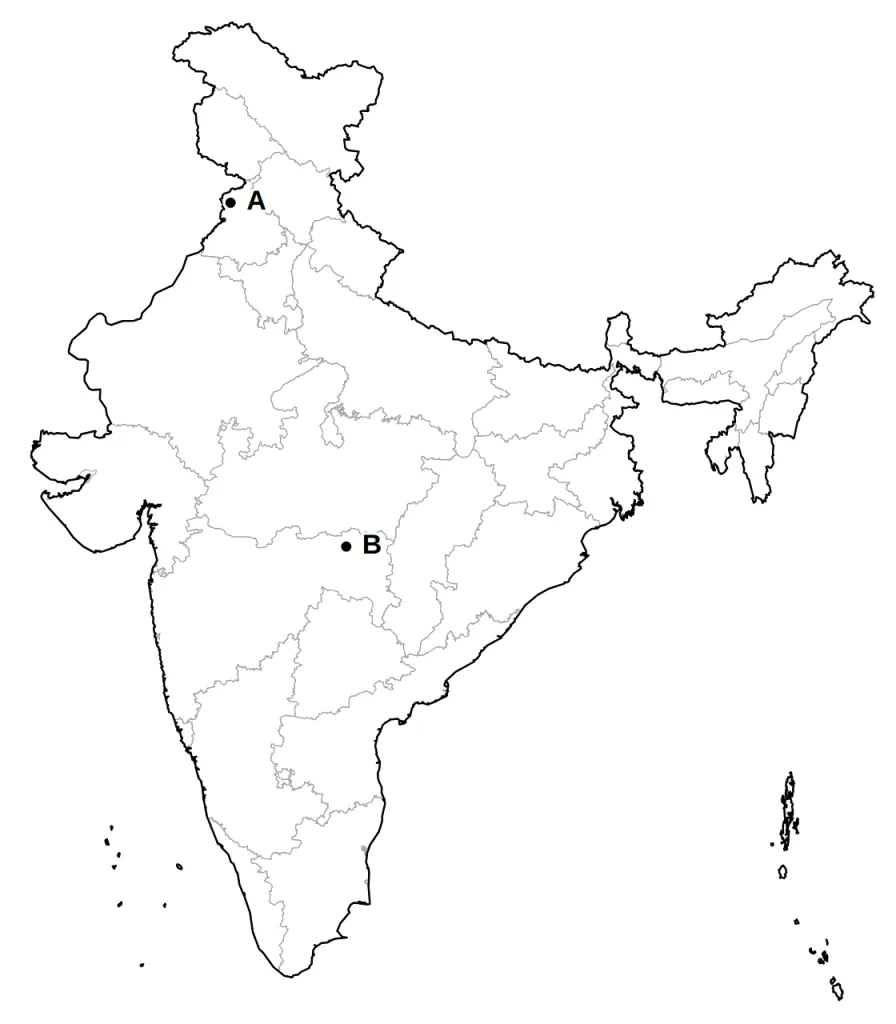
A The city where, on 13 April 1919, General Dyer's troops fired on a crowd gathered in an enclosed ground, many of whom were villagers who had come to town for a fair. (1 mark)
B The city in central India where the Congress met in December 1920 and, after its leaders had worked out a compromise, adopted the programme of non-cooperation. (1 mark)
Section B - Geography (20 marks)
Questions 10 to 19. Questions 10 to 15 are MCQs of 1 mark each; Question 19 is map-based.
10. Read the clues given below and identify the crop.
- It is a bush crop of the hill slopes, planted where rainwater drains away quickly.
- It needs a warm, humid climate free of frost, and frequent showers through the year keep new leaves coming.
- Workers pick its young leaves by hand, and the leaves are usually processed in a factory on the garden itself.
(a) Coffee
(b) Rubber
(c) Tea
(d) Sugarcane
11. Match the mines and oil fields in Column I with what is obtained from them in Column II, and choose the correct option.
| Column I (Mine or oil field) | Column II (What it yields) |
|---|---|
| 1. Koderma | X. Petroleum |
| 2. Ankaleshwar | Y. Iron ore |
| 3. Kudremukh | Z. Mica |
(a) 1-Z, 2-X, 3-Y
(b) 1-Y, 2-X, 3-Z
(c) 1-Z, 2-Y, 3-X
(d) 1-X, 2-Z, 3-Y
12. Which of the following statements about the cotton textile industry of India are correct?
I. In India this one industry handles every step itself, from the raw fibre right up to finished clothing of high value.
II. Khadi, spun and woven by hand, provides work to many people in their own homes.
III. In its early years the industry grew up mainly around the coalfields of the Chotanagpur plateau.
IV. Before power looms came into use, cotton cloth in India was made by spinning and weaving by hand.
Choose the correct option:
(a) Only I and III
(b) Only I, II and IV
(c) Only II and III
(d) Only III and IV
13. A hilly district of Himachal Pradesh has swift, snow-fed rivers, but no coal, oil or natural gas within hundreds of kilometres, and its roads are often blocked in winter. Planners want a steady source of electricity for the district. Which choice suits it best?
(a) A hydroelectric plant, since swift water is on the spot and is renewable
(b) A coal-based thermal plant, since coal is the most plentiful fuel found in India
(c) A nuclear plant, since the fuel it needs is mined in the hills of Himachal Pradesh
(d) A gas-based thermal plant, since natural gas burns cleanly, with very little smoke
14. In many parts of India, local communities hold certain trees and animals sacred and protect them. Match Column I with Column II and choose the correct option.
| Column I (Community) | Column II (What it holds sacred) |
|---|---|
| 1. Mundas and Santhals of the Chota Nagpur region | X. Blackbuck, chinkara, nilgai and peacocks |
| 2. Tribal people of Odisha and Bihar | Y. The mahua and kadamba trees |
| 3. Bishnoi villagers of Rajasthan | Z. Tamarind and mango trees, worshipped during weddings |
(a) 1-X, 2-Y, 3-Z
(b) 1-Z, 2-X, 3-Y
(c) 1-Y, 2-Z, 3-X
(d) 1-Y, 2-X, 3-Z
Directions: In Questions 15, 20 and 34, a statement of Assertion (A) is followed by a statement of Reason (R). Choose the correct option.
15. Assertion (A): Among the states of India, Rajasthan is the largest producer of jowar.
Reason (R): Jowar is a rain-fed crop, grown mostly in moist areas, where it hardly needs irrigation.
(a) Both Assertion (A) and Reason (R) are true, and Reason (R) is the correct explanation of Assertion (A).
(b) Both Assertion (A) and Reason (R) are true, but Reason (R) is not the correct explanation of Assertion (A).
(c) Assertion (A) is true, but Reason (R) is false.
(d) Assertion (A) is false, but Reason (R) is true.
16. In a fruit-growing valley, heavy spraying of pesticides killed most of the bees and many of the birds that used to eat insects. Explain two ways in which this could harm the farms of the valley. (2 marks)
17. Ramesh farms on the plain of the Ganga in Uttar Pradesh. Savita farms on the lava plateau of western Maharashtra. Answer the following.
(a) Compare the soils of their farms on three points. (3 marks)
(b) A soil test shows that Savita's field has plenty of lime and potash but very little of one important nutrient. Ramesh's yields have been falling after many years of growing rice and wheat on the same land. Suggest one step each should take, giving a reason from the soil. (2 marks)
OR
The table shows how the land of an imaginary district was used in 2000 and in 2020 (hypothetical data). Study it and answer the following.
| Land use | 2000 (% of area) | 2020 (% of area) |
|---|---|---|
| Forests | 24 | 17 |
| Net sown area | 50 | 44 |
| Land under non-agricultural uses (houses, roads, factories) | 6 | 15 |
| Barren and waste land | 8 | 9 |
| Current fallow | 5 | 8 |
| Permanent pastures | 7 | 7 |
(a) Explain three changes in land use shown in the table, giving a likely reason for each. (3 marks)
(b) Explain two reasons why the fall in the district's forest cover is a cause for concern. (2 marks)
18. Read the source given below and answer the questions that follow.
A Tank under Every Roof
Neelpur, a growing city on the Deccan plateau, gets a fair amount of rain each monsoon. Yet by April most of its borewells run dry, and water tankers queue outside its housing colonies. Almost all the rain that falls on the city lands on concrete roofs and roads and rushes into the drains. Very little of it soaks into the ground to refill the water that thousands of borewells pump out every day.
Five years ago, the families of Shanti Colony decided to try something different. Each house fitted pipes that carry rain from its roof through a simple sand-and-gravel filter into a tank under the ground. When a tank is full, the extra water flows into a pit dug near the house, from where it seeps down into the earth. Tanker trips to the colony have fallen by half, and the colony's borewells now last well into the summer.
Several neighbouring colonies have copied the idea. The city council is now discussing a rule that every new house must have such a system. (Neelpur and Shanti Colony are imaginary.)
18.1 According to the source, why does Neelpur run short of water although it gets a fair amount of rain? (1 mark)
18.2 Explain two ways in which rooftop rainwater harvesting has helped Shanti Colony. (2 marks)
18.3 Why might the council prefer a rule for every new house to leaving rooftop harvesting to each family's choice? (1 mark)
19. Locate and label any three of the following on the outline map of India given for this question, using suitable symbols.
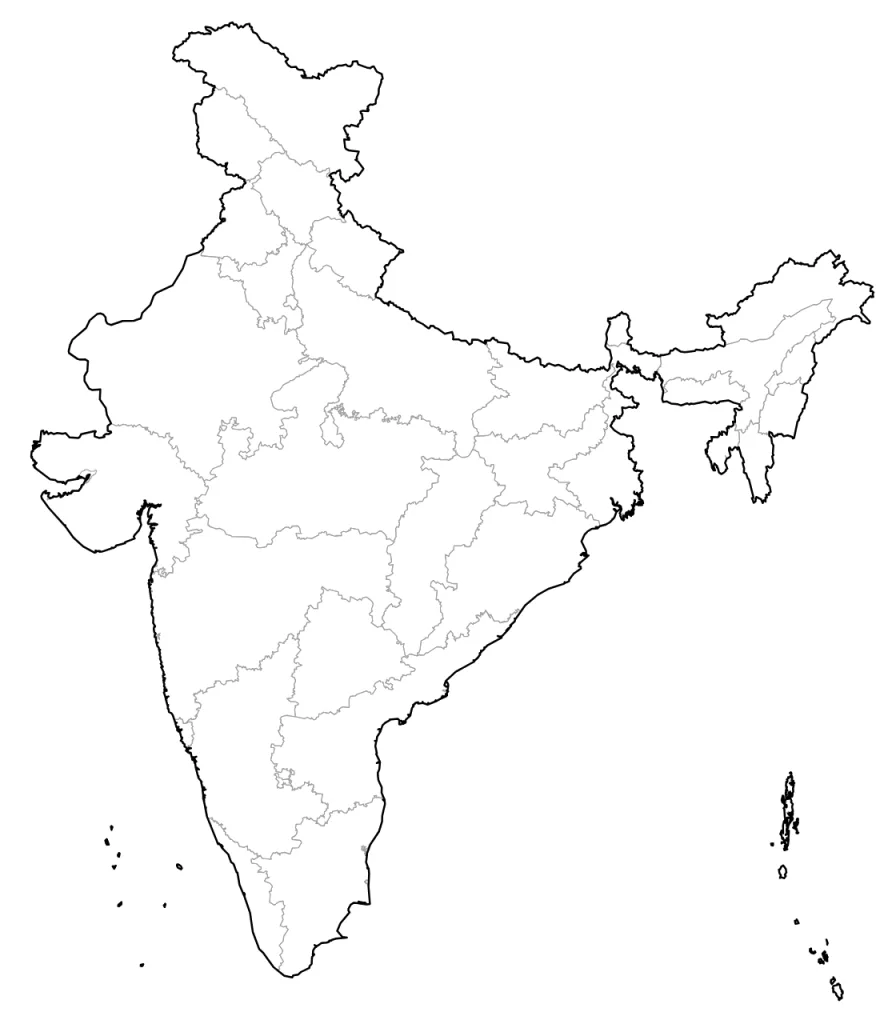
(i) Singrauli Thermal Power Plant (1 mark)
(ii) Kanpur - a cotton textile centre (1 mark)
(iii) Tehri Dam (1 mark)
(iv) Marmagao Port (1 mark)
Section C - Political Science (20 marks)
Questions 20 to 28. Questions 20 to 23 are MCQs of 1 mark each.
20. Assertion (A): Tamil speakers make up nearly half of the population of Sri Lanka.
Reason (R): Sri Lanka's Tamil speakers form two groups: Sri Lankan Tamils, who are natives of the country, and Indian Tamils, whose forefathers came from India as plantation workers in colonial times.
(a) Both Assertion (A) and Reason (R) are true, and Reason (R) is the correct explanation of Assertion (A).
(b) Both Assertion (A) and Reason (R) are true, but Reason (R) is not the correct explanation of Assertion (A).
(c) Assertion (A) is true, but Reason (R) is false.
(d) Assertion (A) is false, but Reason (R) is true.
21. In the imaginary democracy of Pravara, the State's recruitment board announces the names of the candidates it has selected as school teachers. When other candidates ask to see their own marks and the rules by which everyone was ranked, the board refuses. Which quality of a democratic government is missing here?
(a) Legitimacy
(b) Transparency
(c) Majority rule
(d) Political equality
22. Which national political party do the following clues describe?
- It was formed in 1984 under the leadership of Kanshi Ram.
- It seeks to represent and secure power for the bahujan samaj, which includes the Scheduled Castes, the Scheduled Tribes, the Other Backward Classes and religious minorities.
- It draws inspiration from the ideas and teachings of Sahu Maharaj, Mahatma Phule, Periyar Ramaswami Naicker and Babasaheb Ambedkar.
(a) Bahujan Samaj Party
(b) Communist Party of India (Marxist)
(c) National People's Party
(d) Indian National Congress
23. Study the cartoon given below. In it, figure P stands for the Union Government, figure Q for a State government, and the pie for the power to make laws. Going by the cartoon, which list of subjects does slice 3 stand for?
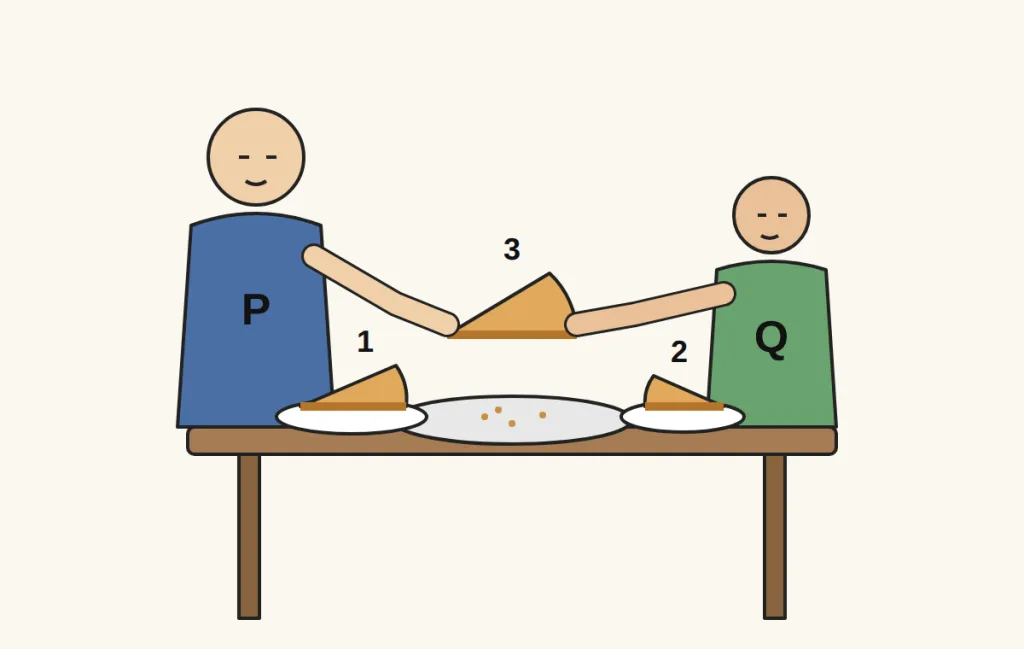
(a) The Union List, with subjects such as banking and currency
(b) The State List, with subjects such as irrigation and trade within the State
(c) The Concurrent List, with subjects such as marriage and trade unions
(d) The residuary subjects, such as computer software
24. In the imaginary State of Kalinga Nadu, the ruling party won 170 of the 200 seats in the Assembly. Explain two reasons why the opposition parties still matter for democracy in that State. (2 marks)
25. Surveys in the countries of South Asia have found that most people prefer democracy to any other form of government, even though many of them complain about how their governments work. Give two reasons for this. (2 marks)
26. A study of the imaginary district of Jalpur found the following (hypothetical findings):
(i) Nine out of every ten marriages took place between families of the same caste.
(ii) Marriages between families of different castes were five times as common in the district's town as in its villages.
(iii) Among the district's panchayat heads and municipal councillors, the share of Scheduled Castes, Scheduled Tribes and Other Backward Classes is now close to their share of the population, though very few of them held such posts fifty years ago.
Explain what each finding shows about caste in India today. (3 marks)
27. Belgium and Sri Lanka are both democracies with more than one language group, but they dealt with the demands of their minorities in very different ways. Answer the following.
(a) Compare the steps taken by the governments of the two countries on three points. (3 marks)
(b) Explain two ways in which the results of the two approaches differed. (2 marks)
OR
The imaginary country of Tarin has two communities. The Kelo, about 70 per cent of the people, live all over the country; the Masi live mostly in its eastern hills and feel shut out of power. A committee has proposed three measures:
(i) The eastern hills will get an elected provincial government, with its own powers over schools, forests and the police.
(ii) Some seats in the national parliament will be reserved for Masi candidates.
(iii) Tarin's Supreme Court will be able to strike down any law or order of the government that treats a community unfairly.
Answer the following.
(a) Name the form of power sharing that each measure shows, and explain how it shares power. (3 marks)
(b) Which one of the three measures would do most to meet the Masi's feeling of being shut out of power? Give two reasons for your choice. (2 marks)
28. Read the source given below and answer the questions that follow.
'The Morning the Order Came'
Mr Rao, a retired government officer of Suvarnapur, a State in the south of India, still remembers one morning from his early years of service. 'We had a new Chief Minister,' he says. 'For the first time our voters had chosen a party that was not in power in Delhi. The new government cut school fees and began a canal that our district had wanted for years.'
'Then, less than two years later, an order came from the Centre dismissing that government. It still had a clear majority in the Assembly; no vote there had gone against it. The canal work stopped. People in our town said that their vote had been thrown away.'
'At the next election the voters remembered. The party that had welcomed the dismissal lost nearly every seat in the State. Such dismissals are rare today, and the courts look at them closely.' (Mr Rao and Suvarnapur are imaginary.)
28.1 According to Mr Rao, why did people in his town feel that their vote had been thrown away? (1 mark)
28.2 Explain two reasons why dismissing an elected State government that still had a majority went against the spirit of federalism. (2 marks)
28.3 Why might the voters of the State have punished, at the next election, the party that welcomed the dismissal? (1 mark)
Section D - Economics (20 marks)
Questions 29 to 38. Questions 29 to 34 are MCQs of 1 mark each.
29. A survey of 200 workers in an imaginary block finds 90 farmers and farm workers, 10 fishermen, 40 workers in brick kilns, 20 handloom weavers, and 40 shopkeepers, teachers and bus drivers. What share of these workers is in the secondary sector?
(a) 30 per cent
(b) 20 per cent
(c) 35 per cent
(d) 50 per cent
30. Kiran runs a small bakery. For her bank loan of ₹2,00,000, she had pledged the papers of her house. The bank now agrees to hold her fixed deposit of ₹2,50,000 as security instead, and returns the house papers. The rate of interest, the instalments and the proofs of identity and income she gave stay the same. Which term of credit has changed?
(a) The rate of interest
(b) The collateral
(c) The mode of repayment
(d) The documents required
31. Which one of the following is NOT an example of credit?
(a) A trader gives a shoemaker leather now, to be paid for after the shoes are sold
(b) A farmer takes seeds from a dealer, promising to pay after the harvest
(c) A bank lends a builder money to buy bricks, to be repaid with interest
(d) A family takes out its own savings from its bank account to buy a new television
32. Which one of the following would NOT help the countries of the world to become more closely connected?
(a) Refrigerated containers now carry grapes from Nashik to Europe quickly and cheaply
(b) A government raises the taxes on imported machines to keep foreign goods out
(c) A jeweller in Jaipur shows new designs to a buyer in Dubai on a video call
(d) A country removes many of its limits on foreign companies setting up factories
33. The families of a housing colony want to make their homes safe from theft. Which arrangement is likely to give them the most security for the least money?
(a) Each family hires its own guard for its own house
(b) Only the richest families hire guards, and the rest do without
(c) Each family fits stronger locks and does nothing more
(d) All the families share the cost of guards and street lights for the whole colony
34. Assertion (A): Workers in the organised sector get benefits such as paid leave, provident fund and medical benefits.
Reason (R): Employers in the organised sector give these benefits only as a favour, since no law requires them to do so.
(a) Both Assertion (A) and Reason (R) are true, and Reason (R) is the correct explanation of Assertion (A).
(b) Both Assertion (A) and Reason (R) are true, but Reason (R) is not the correct explanation of Assertion (A).
(c) Assertion (A) is true, but Reason (R) is false.
(d) Assertion (A) is false, but Reason (R) is true.
35. The size of India's economy is measured every year as its gross domestic product (GDP), and the figure is also worked out separately for each sector. Answer the following.
(i) Who measures India's GDP? (1 mark)
(ii) Explain two reasons why it is useful to know each sector's share of GDP, and not only the total. (2 marks)
36. The government of an imaginary State passes a law that no moneylender may charge interest of more than 24 per cent a year. Explain two ways in which this law could help poor borrowers, and one reason why it may not be enough on its own. (3 marks)
37. A multinational company (MNC) that makes washing machines has its designers in Germany, buys motors from a factory in Thailand and puts the machines together at its own plant in Pune, for buyers in many countries. Using this case, explain three ways in which the MNC links the economies of these countries. (3 marks)
38. The table gives some figures for two imaginary countries in 2005 and 2025. Study the table and answer the questions that follow. (The data are hypothetical, for practice only.)
| Country | Year | Total income (US dollars, billion) | Population (million) | Life expectancy at birth (years) |
|---|---|---|---|---|
| A | 2005 | 60 | 20 | 66 |
| A | 2025 | 120 | 30 | 71 |
| B | 2005 | 40 | 10 | 70 |
| B | 2025 | 60 | 12 | 69 |
(i) Calculate the per capita income of A in 2005 and in 2025. (1 mark)
(ii) A's total income doubled between 2005 and 2025, but its per capita income rose by only one-third. Explain why, using the table. (2 marks)
(iii) 'B is still ahead of A, since its per capita income is higher.' Give two points from the table to question this statement. (2 marks)
OR
Answer the following questions using the table given above for the two countries.
(i) Calculate B's per capita income in 2025. (1 mark)
(ii) By what percentage did the per capita income of each country grow between 2005 and 2025? Which grew faster? (2 marks)
(iii) If A's population had stayed at 20 million, what would its per capita income have been in 2025? What does this show? (2 marks)