
Detailed Solutions: CBSE Class 10 Social Science Sample Paper 2027 – Set 5
Every written question from the paper (2, 3, 4 and 5 marks) is solved here in order, with the marks given for each step, so you can check your answer sheet the way an examiner would. Where a question has an internal choice (OR), both options are solved. The 1-mark questions are answered, with explanations, in the quiz on the Question Paper page.
Section A - History (20 marks)
Question 5 (2 marks)
For centuries, polenta, a thick porridge eaten in northern Italy, was made from barley or millet. By the seventeenth century, most families there were making it from maize. Explain two things that this change tells us about the world after the end of the fifteenth century.
Answer.
Model answer:
First, maize came from the Americas, long cut off from Europe; it reached Italy only after European ships crossed the Atlantic in the 1490s. Second, crops of the Americas began to change everyday food in distant lands.
Marking scheme:
- New links with the Americas: maize is a crop of the Americas, which had been cut off from regular contact with Europe, Asia and Africa for a very long time; it could reach Italy only after European ships crossed the Atlantic in the 1490s — 1 mark
- Crops of the Americas changed everyday life far away: food travelled along the new links and entered ordinary homes, a sign of long-distance exchange (accept: potatoes, tomatoes and chillies also spread to Europe and Asia in this way; any other relevant point) — 1 mark
Question 6 (3 marks)
In 1840, the imaginary German state of Kaldenburg had the following features:
(i) The king made all the laws himself. There was no constitution and no elected assembly.
(ii) Only men from noble families could become army officers or senior officials.
(iii) Every newspaper needed the approval of the king's censor, and political clubs were banned.
How would a liberal of that time have criticised each of these features? Explain.
Answer.
Model answer:
(i) A liberal wanted rule by the people's consent: a constitution and an elected parliament, not a king ruling alone. (ii) He stood for equality before the law, so posts should not be kept for nobles by birth. (iii) He wanted freedom of the press and of association, so no censor and no ban on clubs.
Marking scheme:
- (i) Autocracy: liberals stood for government by the consent of the people, so they would demand an end to autocracy, a written constitution and representative government through an elected parliament — 1 mark
- (ii) Privileges of birth: liberals stood for the freedom of the individual and equality of all before the law, so posts should not be reserved for nobles by birth — 1 mark
- (iii) Censorship: liberals demanded freedom of the press and freedom of association, so they would oppose the censor and the ban on clubs (any other relevant point) — 1 mark
OR
The French revolutionaries of the 1790s and the Romantic artists and poets of the early nineteenth century both tried to build a feeling of nationhood, but in very different ways. Compare the two on three points: who led the effort, the means they used, and what they saw as the basis of the nation.
Answer.
Model answer:
First, the revolutionary government led through the state; the Romantics were artists and poets working through culture. Second, the state used a flag, hymns, oaths and one language; the Romantics used folk songs, poems, music and history to stir feelings. Third, one saw the nation as equal citizens, the other as a shared language, culture and past.
Marking scheme:
- Who led it: in France it was the revolutionary government, using the power of the state; the Romantics were artists, poets, musicians and thinkers working through culture, not through government — 1 mark
- Means: the revolutionaries used laws and symbols, a new flag, hymns and oaths, a centralised administration, uniform laws, weights and measures, and French as the common language; the Romantics used folk songs, poems, tales, music and history, and appealed to feelings and intuition rather than to reason alone — 1 mark
- Basis of the nation: for the revolutionaries, the nation was a body of citizens with equal rights, in whom sovereignty lay (la patrie, le citoyen); for the Romantics, it rested on a shared language, culture and past, whose true spirit lived among the common people (any other relevant point) — 1 mark
Question 7 (5 marks)
Between 1919 and 1932, Indians used many forms of peaceful protest against British rule. Answer the following.
(a) Explain three such forms of protest, other than the boycott of foreign goods, giving an example of each from a different movement. (3 marks)
Answer.
Model answer:
First, hartal: on 6 April 1919, against the Rowlatt Act, shops closed and railway workshops struck work. Second, leaving British institutions: in the Non-Cooperation Movement students left government schools, lawyers gave up practice and council elections were boycotted. Third, openly breaking unjust laws: in the Civil Disobedience Movement people made salt, forest people broke forest laws and peasants refused revenue.
Marking scheme:
- Hartal: shops and offices closed and work stopped for a day, as on 6 April 1919 against the Rowlatt Act, when workers in railway workshops also went on strike — 1 mark
- Withdrawing from British institutions: in the Non-Cooperation Movement students left government schools and colleges, teachers resigned, lawyers gave up their practice and council elections were boycotted in most provinces — 1 mark
- Breaking an unjust law openly: in the Civil Disobedience Movement people made salt against the salt law, forest people broke forest laws, and peasants refused to pay revenue and the chaukidari tax (accept: picketing of liquor shops and cloth shops; giving up titles; any three distinct forms with examples from different movements) — 1 mark
(b) Why did the colonial government often find such peaceful mass protest harder to deal with than a violent revolt? Explain two reasons. (2 marks)
Answer.
Model answer:
First, using force on peaceful people who were breaking laws such as the salt law showed how unjust colonial rule was, and won the movement more support. Second, when huge numbers broke laws together, the government could not jail them all, and its work was disrupted.
Marking scheme:
- Force used against peaceful people, many of them breaking laws that most Indians felt were unjust, such as the salt law, showed the injustice of colonial rule and won the movement more sympathy and support — 1 mark
- When very large numbers broke a law or refused to cooperate at the same time, the government could not jail them all, and its offices, courts and collection of revenue were disrupted (accept: satyagrahis did not seek revenge, so there was no violence the government could point to as an excuse; any other relevant point) — 1 mark
OR
The table gives a hypothetical price index for four goods in an Indian town during the First World War. The figures are invented for this question.
| Item (hypothetical price index, 1913 = 100) | 1913 | 1918 |
|---|---|---|
| Rice | 100 | 170 |
| Cotton cloth | 100 | 290 |
| Kerosene | 100 | 150 |
| Salt | 100 | 125 |
Answer the following.
(a) The war ended in November 1918, but its effects did not. Apart from rising prices, explain three effects of the war and its end that gave Indians fresh reasons for discontent by 1919. (3 marks)
Answer.
Model answer:
First, villages had to supply soldiers, often by force, which angered rural areas. Second, Ottoman Turkey was defeated and Muslims feared a harsh treaty on the Khalifa, so a Khilafat Committee was formed in March 1919. Third, instead of easing wartime controls, the government passed the Rowlatt Act in 1919, allowing detention without trial for two years.
Marking scheme:
- Villages: during the war, villages were made to supply soldiers, often by force, and this caused widespread anger in rural areas — 1 mark
- Muslims: Ottoman Turkey was defeated, and there were fears of a harsh peace treaty on the Ottoman emperor, the spiritual head (Khalifa) of the Muslim world; a Khilafat Committee was formed in Bombay in March 1919 — 1 mark
- Civil liberties: instead of loosening its wartime grip, the government passed the Rowlatt Act in 1919, which allowed political activists to be held without trial for two years (accept any other relevant effect of the war other than prices) — 1 mark
(b) Using only the table, answer: (i) Which good's price rose the most between 1913 and 1918, and by what percentage? (ii) A family spent ₹5 a month on rice in 1913. What would the same amount of rice cost it in 1918? (2 marks)
Answer.
Model answer:
(i) Cotton cloth rose the most: from 100 to 290, a rise of 190 per cent. (ii) Rice cost 170 per cent of its 1913 price, so ₹5 × 170 ÷ 100 = ₹8.50 a month.
Marking scheme:
- (i) Cotton cloth: its index rose from 100 to 290, a rise of 190 per cent — 1 mark
- (ii) ₹5 × 170 ÷ 100 = ₹8.50 a month — 1 mark
Question 8 (4 marks)
Read the source given below and answer the questions that follow.
Ellen's Saturday Book
Ellen Price was nineteen in 1862. Her father kept the accounts of a grocer in a busy mill town in northern England, and she helped in a dressmaker's shop. New books cost more than she earned in a week, but for a small yearly fee a lending library near the market let her borrow two volumes at a time. Every Saturday evening she carried home a novel, and she often read it aloud to her mother and her younger sister by lamplight.
On weekdays the three of them shared a cheap weekly paper written for women. It carried sewing patterns, recipes, advice on running a home and on good manners, and a story that went on from week to week. Her mother liked the recipes; Ellen liked the story best.
Several of Ellen's favourite novels were written by women. Their heroines did not simply wait for others to decide things for them: they thought for themselves and chose their own way. Ellen copied some of their words into a notebook and, quietly, began to write a story of her own. (Ellen and her town are imaginary.)
8.1 How was Ellen able to read so many novels, although she could not afford to buy books? (1 mark)
Answer.
Model answer:
She borrowed them from a lending library near the market for a small yearly fee.
Marking scheme:
- She borrowed them from a lending library near the market, which charged only a small yearly fee — 1 mark
8.2 What does the weekly paper that Ellen's family shared tell us about the readers of print in nineteenth-century Europe? (1 mark)
Answer.
Model answer:
Women had become an important group of readers, so publishers brought out cheap papers meant especially for them.
Marking scheme:
- Women had become an important group of readers, so publishers brought out cheap papers and manuals written especially for them (accept: publishers mixed advice with serial stories to suit readers of different tastes) — 1 mark
8.3 'For Ellen, print was much more than a way to pass the time.' Support this statement with two points from the source. (2 marks)
Answer.
Model answer:
First, the novels gave her new ideas: their heroines thought for themselves and chose their own way, and she copied their words. Second, since women wrote many of these novels, she too began to write a story of her own, moving from reader to writer.
Marking scheme:
- New ideas about women: the novels showed her heroines who thought for themselves and chose their own way, and she copied their words into her notebook (accept: the weekly paper gave the family practical advice as well as stories) — 1 mark
- From reader to writer: seeing that women wrote many of her favourite novels, she began to write a story of her own, as women in that century became writers as well as readers (accept: by reading aloud, she brought print to her mother and sister too; any other relevant point) — 1 mark
Question 9 (2 marks)
Read the clues given below. Each clue points to a place marked on the outline map of India for this question, as A or B. Identify the two places and write their correct names.
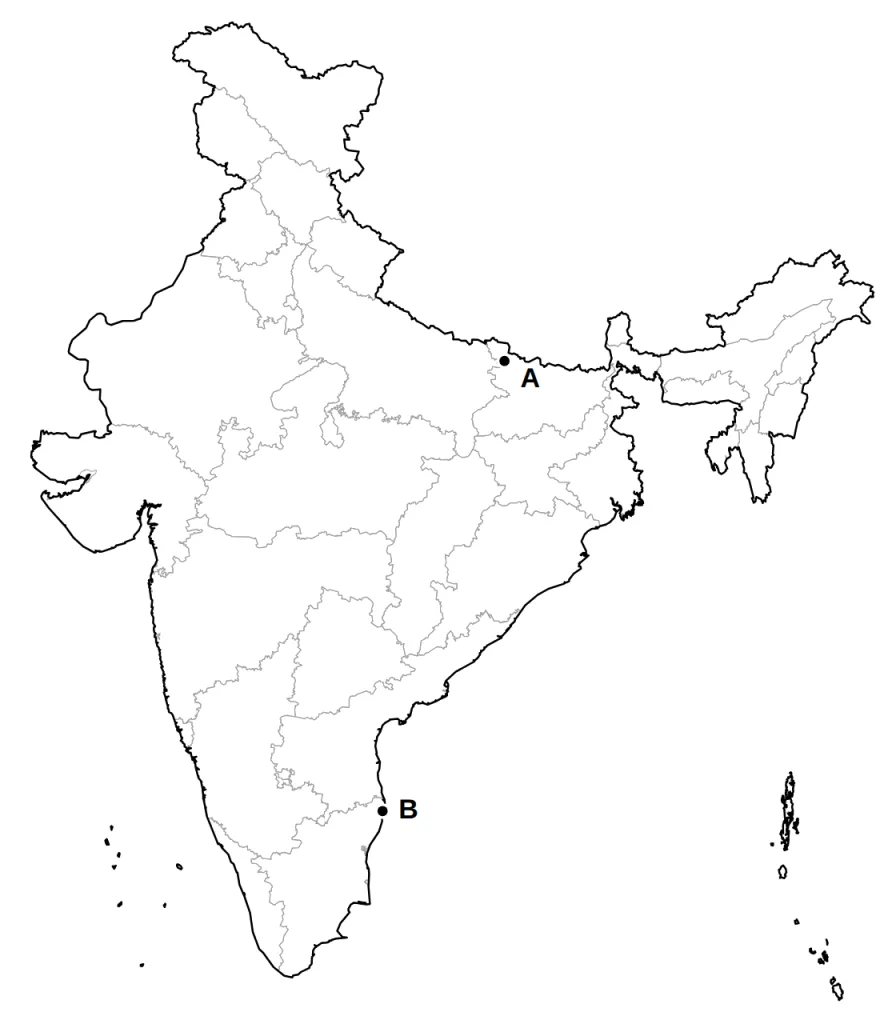
A The district of Bihar where, in 1917, Gandhiji took up the first of his satyagrahas on Indian soil, two years after his return from South Africa. (1 mark)
Answer.
- A: Champaran (Bihar) — 1 mark
B The largest city of the Coromandel coast, where the Indian National Congress held its annual session in December 1927. (1 mark)
Answer.
- B: Madras, now Chennai (Tamil Nadu) — 1 mark
Section B - Geography (20 marks)
Question 16 (2 marks)
An imaginary district has four units: a silk-weaving unit, an edible oil mill that crushes groundnuts, a cement plant and an aluminium smelter.
(a) Group these units into agro-based and mineral-based industries.
(b) One year the monsoon fails badly. Which group is likely to feel the effect first? Give a reason.
Answer.
Model answer:
(a) Agro-based: silk-weaving unit and edible oil mill. Mineral-based: cement plant and aluminium smelter. (b) The agro-based units, because groundnuts and the mulberry leaves that feed silkworms come from rain-fed farms, while limestone and bauxite are mined.
Marking scheme:
- (a) Agro-based: the silk-weaving unit and the edible oil mill; mineral-based: the cement plant and the aluminium smelter (all four correct for the mark) — 1 mark
- (b) The agro-based units: their raw materials come from farms whose harvest depends on the rains (groundnuts, and the mulberry leaves on which silkworms feed), while limestone and bauxite are mined and do not depend on one season's rain (accept a reasoned note that a shortage of hydroelectric power could also hit the smelter) — 1 mark
Question 17 (5 marks)
A multipurpose project supplies water to many users, and this often leads to disputes over who should get it. Answer the following.
(a) Explain three kinds of conflict that have arisen over the water or the land of multipurpose projects, with an example wherever you can. (3 marks)
Answer.
Model answer:
First, towns and farmers clash: in the Sabarmati basin, farmers protested when cities got priority for water in a drought. Second, States quarrel over sharing costs and benefits, as in the Krishna-Godavari dispute over Koyna. Third, valley people lose land and livelihood while landowners, industries and towns gain, which led to movements like the Narmada Bachao Andolan.
Marking scheme:
- Between towns and farmers: users want different things from the same water; in the Sabarmati basin in Gujarat, farmers protested when water for the cities was given priority during a drought — 1 mark
- Between States: sharing the costs and benefits of a project leads to inter-state water disputes, such as the Krishna-Godavari dispute over Maharashtra's plan to divert more water at Koyna — 1 mark
- Between those who lose and those who gain: people of the valley lose their land and livelihood to the reservoir, often without a fair share of the benefits, which go largely to landowners, industries and towns; this has led to movements such as the Narmada Bachao Andolan (accept: in command areas, a widening gap between rich landowners and the landless poor; any three kinds) — 1 mark
(b) Suggest two ways in which such conflicts could be reduced. (2 marks)
Answer.
Model answer:
First, States and users should agree before the project is built how water, costs and benefits will be shared, especially in droughts. Second, displaced people should be properly resettled and given a share of the benefits and a say in decisions.
Marking scheme:
- Fair sharing agreed in advance: the States and the different users should agree, before the project is built, how water, costs and benefits will be shared, especially in drought years (accept: settling disputes through talks or a tribunal) — 1 mark
- A fair deal for those who lose: displaced people should get proper resettlement and a share of the benefits, and local people should have a say in decisions (accept: easing the pressure on one river through local rainwater harvesting; smaller projects; any other reasonable way) — 1 mark
OR
The table gives hypothetical figures for an imaginary village in a semi-arid part of India. Study it and answer the questions that follow.
| Months | Rainfall (mm) | Water used by the village (thousand cubic metres) |
|---|---|---|
| June-September | 560 | 30 |
| October-January | 30 | 45 |
| February-May | 10 | 55 |
(a) Using the table, explain three facts about this village's water problem. (3 marks)
Answer.
Model answer:
First, about 93 per cent of the rain, 560 of 600 mm, falls in June-September. Second, the village uses the most water, 55 thousand cubic metres, in February-May, when only 10 mm of rain falls. Third, it uses over three times as much water in October-May as in the rainy months, so it must store monsoon water or run short.
Marking scheme:
- Rain comes almost all at once: 560 of the year's 600 mm, about 93 per cent, falls in June-September — 1 mark
- Need is greatest when rain is least: the village uses the most water, 55 thousand cubic metres, in February-May, when only 10 mm of rain falls — 1 mark
- So the shortage is one of season, not only of total rain: the water used in October-May (100 thousand cubic metres) is more than three times that used in the rainy months, so unless monsoon water is stored, the village must draw down its groundwater or go short (any other relevant point from the table) — 1 mark
(b) How much water must the village store from the rains to cover its use in February-May? Give one reason why a covered or underground store would suit this village better than an open pond. (2 marks)
Answer.
Model answer:
55 thousand cubic metres, the village's use in February-May. In the hot dry months an open pond loses much water to evaporation and gets dirty, while a covered or underground store keeps it clean.
Marking scheme:
- 55 thousand cubic metres, the water the village uses in February-May, when only 10 mm of rain falls — 1 mark
- In a semi-arid area the dry months are hot, so an open pond loses much of its water to evaporation and can get dirty, while a covered or underground store keeps the water and keeps it clean (any other relevant point) — 1 mark
Question 18 (4 marks)
Read the source given below and answer the questions that follow.
The Grass Came Back First
Raghu joined the forest department of the Sitapani hills as a young guard in 1974, a year after the country began a national scheme to save its dwindling tigers. In his first winter he found only two sets of pugmarks. Much of the forest had been cut over, cattle from a dozen villages grazed right up to the streams, and hunters' snares lay along the deer paths.
That year the central part of the forest was closed. No trees could be felled there, cattle were kept out and all hunting was stopped. Some villagers were angry, because the grass inside had fed their cattle for as long as anyone could remember.
Raghu says the grass came back first, then the spotted deer and the wild pigs, and only after that the tigers. Today about thirty tigers live in the reserve. The streams that rise in its core flow right through the dry season, and the villages at its edge draw water from them. (Sitapani and Raghu are imaginary.)
18.1 Name the national scheme, begun in 1973, that the source refers to. (1 mark)
Answer.
Model answer:
Project Tiger.
Marking scheme:
- Project Tiger — 1 mark
18.2 Raghu says that the grass came back first, then the deer and the wild pigs, and only after that the tigers. Explain two things this order of recovery tells us. (2 marks)
Answer.
Model answer:
First, a forest's life forms a food chain: grass feeds the deer and pigs, which are the tiger's prey, so each returned only after the level below it. Second, saving a predator needs its prey and habitat to recover, so grazing, felling and snares had to stop too.
Marking scheme:
- The living things of a forest depend on one another in a food chain: grass feeds the deer and wild pigs, and these are the tiger's prey, so each could return only after the one below it had recovered — 1 mark
- A predator cannot be saved by stopping only the hunting of predators: its prey base and habitat must recover too, which is why grazing, felling and the snares on the deer paths had to stop (any other relevant point) — 1 mark
18.3 Why were some villagers angry when the central part of the forest was closed? (1 mark)
Answer.
Model answer:
They lost the grass inside, on which their cattle had fed for generations.
Marking scheme:
- They lost the grass inside the forest on which their cattle had fed for generations, so their livelihood suffered — 1 mark
Question 19 (3 marks)
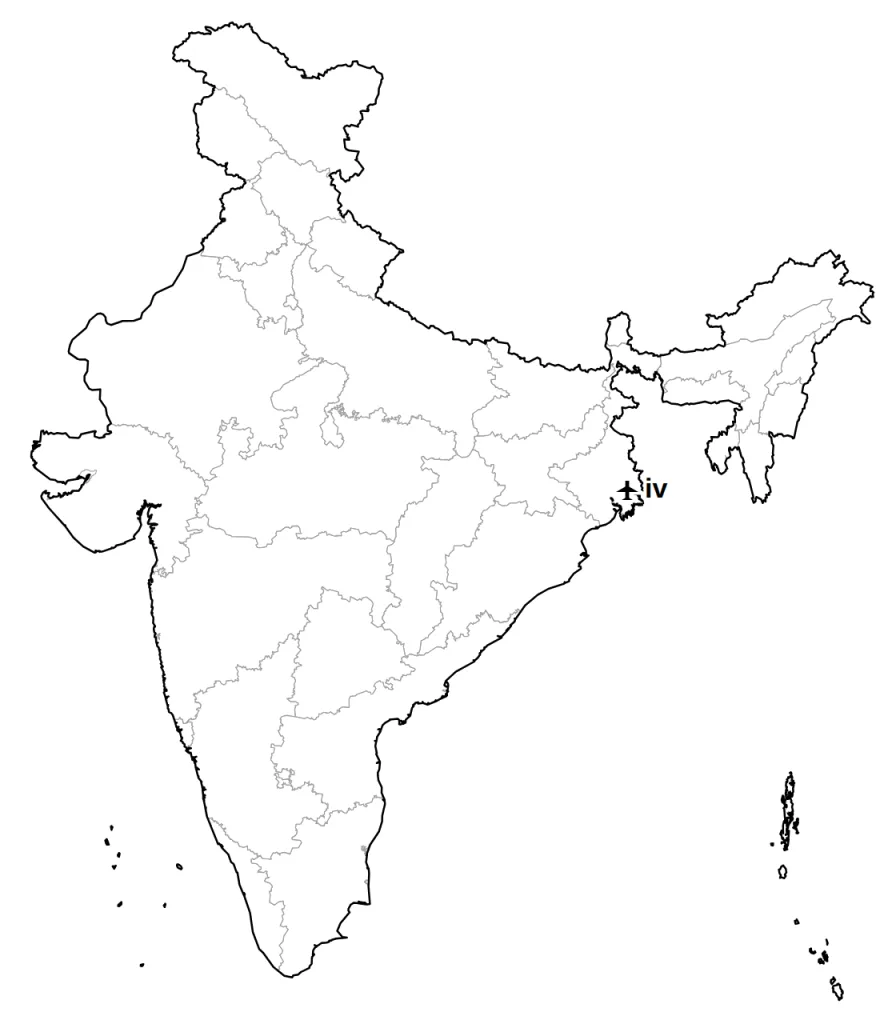
Show any three of the following places on the outline map of India provided for this question. Mark each with a suitable symbol and write its name.
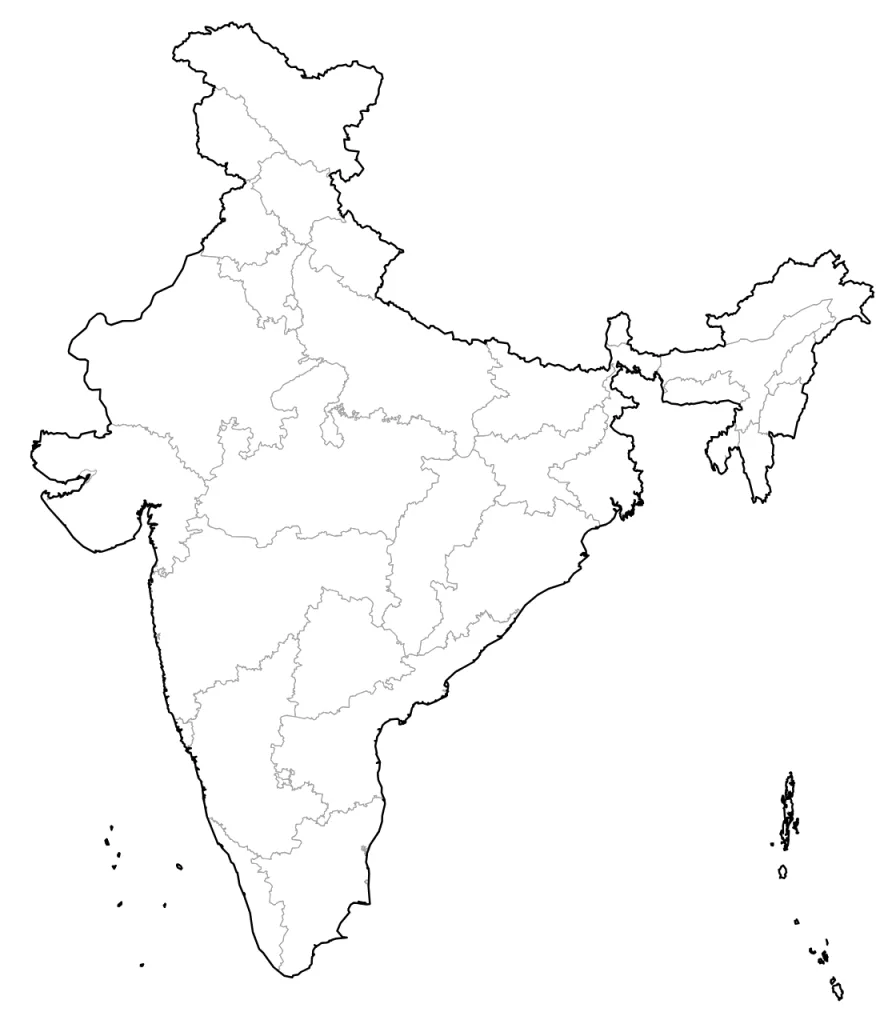
(i) Ramagundam Thermal Power Plant (1 mark)
Answer.
- Ramagundam: on the Godavari in northern Telangana, located correctly with a symbol and labelled — 1 mark
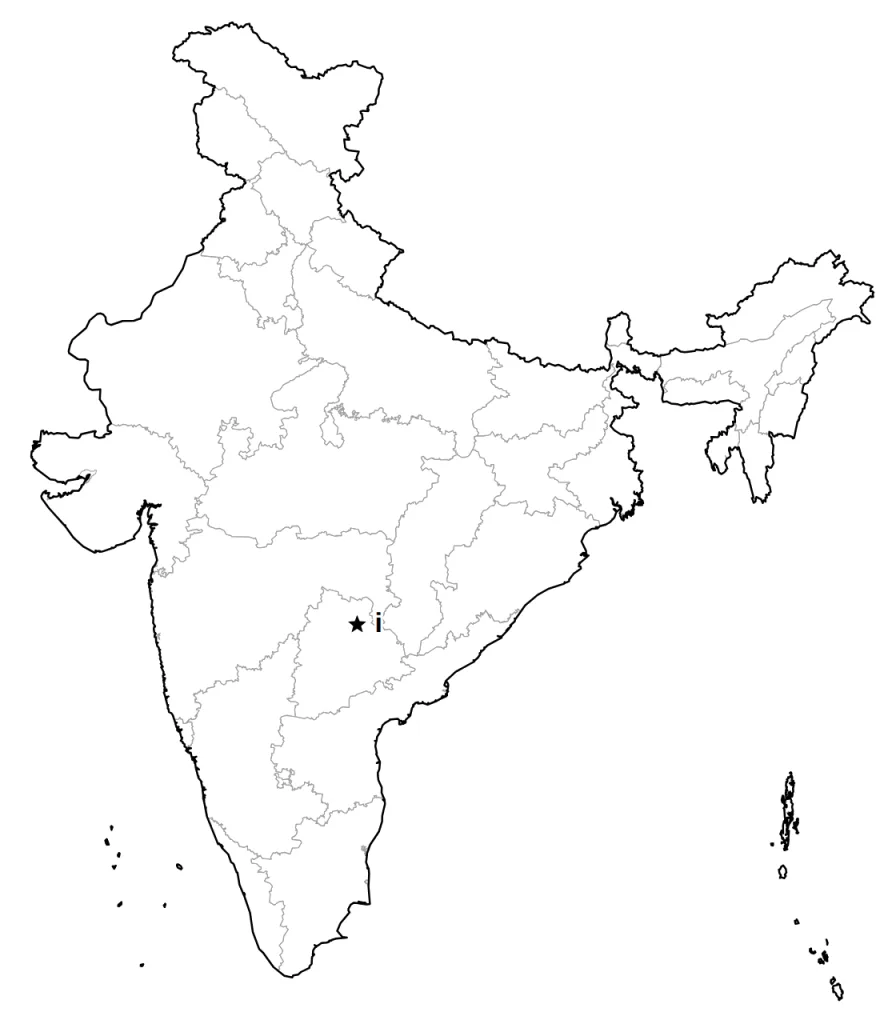
(ii) Coimbatore - a cotton textile centre (1 mark)
Answer.
- Coimbatore: in western Tamil Nadu, near the Palghat gap, located correctly with a symbol and labelled — 1 mark
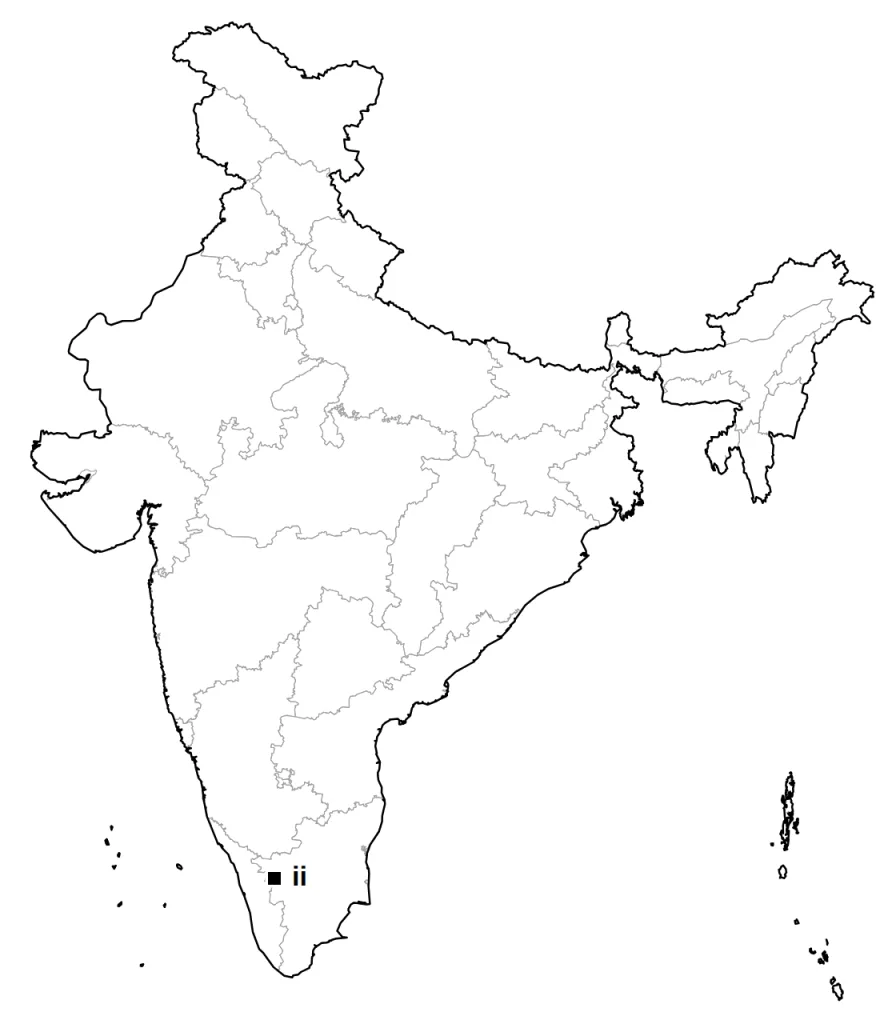
(iii) Tungabhadra Dam (1 mark)
Answer.
- Tungabhadra Dam: on the Tungabhadra, near Hosapete in Karnataka, located correctly with a symbol and labelled — 1 mark
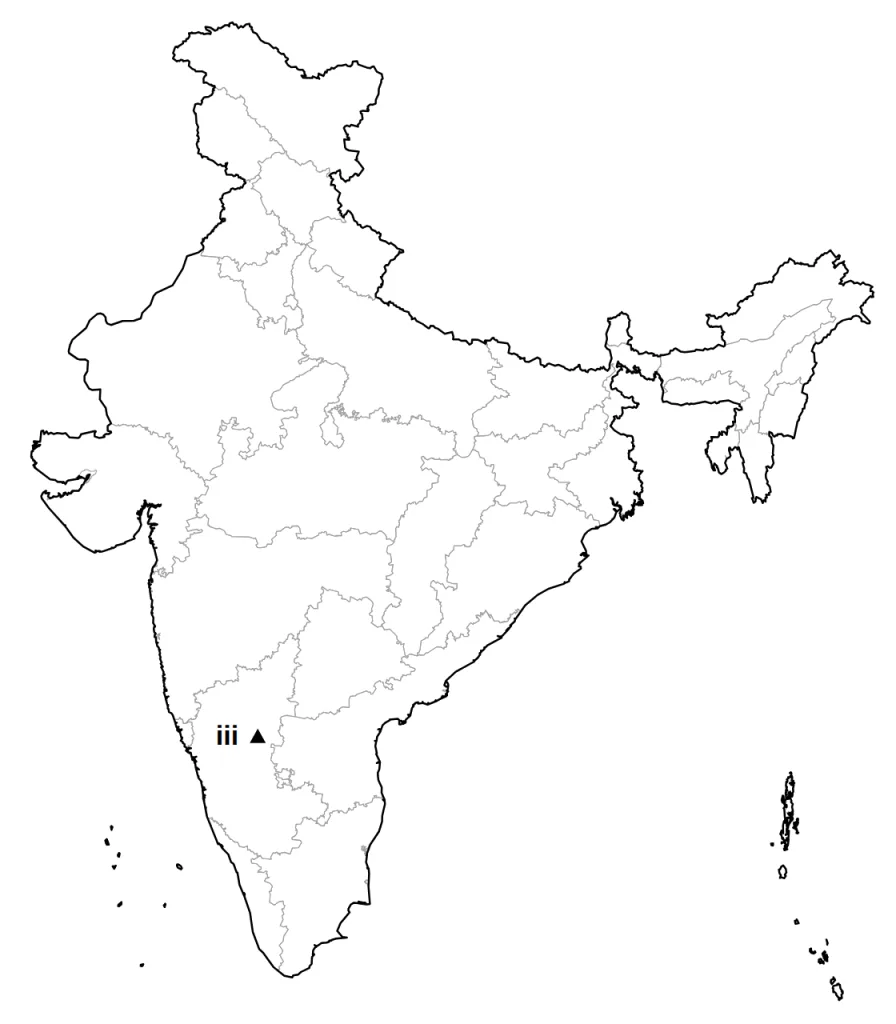
(iv) Netaji Subhash Chandra Bose International Airport (1 mark)
Answer.
- Netaji Subhash Chandra Bose Airport: at Kolkata, West Bengal, located correctly with a symbol and labelled — 1 mark
Section C - Political Science (20 marks)
Question 24 (2 marks)
In the imaginary democracy of Nelora, the city government ordered all street vendors off the main market road. Within a month the vendors protested peacefully, newspapers reported their losses and councillors raised the matter in the city council. The order was then changed to allow selling at fixed hours. Explain two features of democracy that made it possible to correct this decision.
Answer.
Model answer:
First, people may protest peacefully and the press may report freely, so a wrong decision is debated openly and cannot stay hidden. Second, rulers answer to elected councillors and must face voters again, so they have to respond.
Marking scheme:
- Freedom of expression and public debate: people can protest peacefully and the press can report freely, so a wrong decision is discussed in public and cannot stay hidden (accept: transparency) — 1 mark
- Rulers answer to elected representatives and must face the voters again, so they have to listen to complaints and can be made to change a bad decision (accept: people can also go to the courts; any other relevant point) — 1 mark
Question 25 (2 marks)
In the imaginary federation of Sumera, the provinces run the public hospitals. The national parliament, where one party has a simple majority, passes a law that takes the hospitals away from the provinces, without asking them. Explain two reasons why a change like this could not be made in this way in a federation such as India.
Answer.
Model answer:
First, the Constitution fixes each level's subjects, so one level cannot take over another's on its own. Second, such a change needs both levels to agree: in India, two-thirds of each House and at least half the State legislatures.
Marking scheme:
- Each level's powers are laid down in the Constitution: the subjects of the States, such as health, belong to them, and one level cannot take over another level's subjects on its own — 1 mark
- Changing the basic sharing of powers needs the consent of both levels: in India it needs a two-thirds majority in each House of Parliament and the approval of at least half of the State legislatures, and the courts can strike down a law that breaks this (any other relevant point) — 1 mark
Question 26 (3 marks)
Read about three arrangements in imaginary countries. For each, say whether it is an example of power sharing, and give a reason. Where it is, name the form of power sharing.
(i) In Teral, each province elects its own government, which runs schools and roads; the national government cannot dismiss it at will.
(ii) In the city of Ambar, the mayor is chosen by the elected councillors, and they can remove her if she loses their support.
(iii) In Varos, the government has decided that all senior public posts will go to members of the largest language group, since it is the majority.
Answer.
Model answer:
(i) Yes, vertical division: the provinces have powers of their own that the national government cannot take away at will. (ii) Yes, horizontal division: the council checks the mayor, who heads the executive, so power is not in one hand. (iii) No: it is majoritarianism; the majority takes all posts and shuts others out, as in Sri Lanka.
Marking scheme:
- (i) Yes: vertical division of power, between governments at different levels; the provinces have powers of their own that the national government cannot take away at will — 1 mark
- (ii) Yes: horizontal division of power within the city's government; the elected council keeps a check on the mayor, who heads its executive, so power does not stay in one hand (checks and balances) — 1 mark
- (iii) No: this is majoritarianism; the majority group takes all the senior posts and shuts the others out, the opposite of sharing power, and it can breed distrust and conflict, as it did in Sri Lanka — 1 mark
Question 27 (5 marks)
The table shows the share of seats held by women in four elected bodies of an imaginary State of India. (The figures are hypothetical.) Study the table and answer the questions that follow.
| Elected body | Women's share of seats in 1990 (%) | Women's share of seats in 2020 (%) |
|---|---|---|
| Gram panchayats | 4 | 38 |
| Municipal councils | 3 | 36 |
| State Legislative Assembly | 4 | 9 |
| The State's seats in the Lok Sabha | 5 | 12 |
(a) Explain three conclusions about the political representation of women that you can draw from the table. (3 marks)
Answer.
Model answer:
First, women's share in panchayats and municipalities rose to over a third, since at least one-third of their seats are reserved for women. Second, in the Assembly and Lok Sabha, with no reserved seats, women still hold only about a tenth, far below their share of the population. Third, in 1990 patriarchy kept women's share tiny everywhere; the big rise came only where the law reserved seats.
Marking scheme:
- Local bodies: women's share rose from almost nothing to more than a third, because since the 1992 amendments at least one-third of the seats in panchayats and municipalities are reserved for women (accept: some women also win seats that are not reserved) — 1 mark
- Legislatures: in the Assembly and the Lok Sabha, where no seats were reserved, women still hold only about a tenth of the seats, far below their half share of the population (accept: a law of 2023 will reserve one-third of these seats for women after the next census and delimitation) — 1 mark
- Change came through the law, not on its own: in 1990 women held a tiny share everywhere, as patriarchal ideas kept them out of public life, and the big rise came only where seats were reserved (accept: parties give few tickets to women; any other relevant point) — 1 mark
(b) Suggest two steps, other than reserving seats, that could raise the share of women in the State Assembly. (2 marks)
Answer.
Model answer:
First, parties could give many more tickets to women, for example a third of their tickets. Second, if housework is shared and more girls study and women take up paid work, more women will have the time and confidence for public life.
Marking scheme:
- Political parties could give many more tickets to women candidates, for example about one-third of their tickets, as has been suggested for reforming parties — 1 mark
- Household work could be shared more equally, and girls' education and women's paid work widened, so that more women have the time, confidence and experience for public life (accept: women who have served in panchayats could be helped to contest higher posts; any other relevant point) — 1 mark
OR
Read about three incidents in an imaginary country.
(i) In a school debate, a student says that the followers of a certain faith are 'naturally lazy', and many in the hall nod in agreement.
(ii) Before an election, a leader holds his rallies at places of worship and tells the voters of his faith that only their 'own' candidates can protect them from 'the others'.
(iii) After a rumour spreads, a crowd attacks and burns the shops of people of another faith.
Answer the following.
(a) Name the form of communalism that each incident shows, and explain it. (3 marks)
Answer.
Model answer:
(i) Everyday beliefs: prejudice and stereotypes about another faith and a belief that one's own is superior. (ii) Political mobilisation on religious lines: sacred places, emotional appeals and fear used to unite one religion's followers in politics. (iii) Communal violence: hatred turns into attacks on people of another faith.
Marking scheme:
- (i) Communalism in everyday beliefs: religious prejudice and stereotypes about another community, and the belief that one's own religion is better than others — 1 mark
- (ii) Political mobilisation on religious lines: using sacred places and symbols, emotional appeals and plain fear to bring the followers of one religion together in politics — 1 mark
- (iii) Communal violence: hatred between communities turns into attacks, riots and destruction aimed at people of another faith — 1 mark
(b) Explain two ways in which such politics harms a democracy. (2 marks)
Answer.
Model answer:
First, it treats people as members of a religious bloc, not as equal citizens, so one group may dominate while another feels unsafe. Second, it spreads hatred that can end in violence, and pushes issues such as jobs and schools out of politics.
Marking scheme:
- It treats people as members of a religious bloc rather than as equal citizens, so one community may try to dominate while another feels shut out and unsafe, which goes against equal rights for all — 1 mark
- It spreads hatred and fear that can end in violence, divides the country, and pushes real issues such as jobs, schools and health out of politics (any other relevant point) — 1 mark
Question 28 (4 marks)
Read the source given below and answer the questions that follow.
'Our Own Voice'
Leela Rawat has reported from the hill State of Meghpur for forty years. 'When I started,' she says, 'two national parties shared almost every seat here. Their leaders came from the plains and seldom visited our villages. People felt that nobody spoke for their dialects, their forests or the price of their ginger and oranges.'
'Then a group of teachers and farmers started the Meghpur Jan Party. It asked for primary schools that teach in the local languages and for a fair price for hill crops. Within ten years it was running the State government, and its members now raise the hill districts' problems in Parliament too. The national parties changed as well. They began to choose candidates from the hills and to print their promises in our languages.'
'One thing worries me. The founder led the party for thirty years. When he retired last year, his son became its president, and nobody asked the party's members.' (Leela Rawat, Meghpur and its party are imaginary.)
28.1 Why did the people of the hills turn to the Meghpur Jan Party? Give one reason from the source. (1 mark)
Answer.
Model answer:
The national parties ignored their languages and crop prices, while the new party asked for local-language schools and fair prices for hill crops.
Marking scheme:
- They felt that the national parties did not speak for their languages, forests or crop prices, while the new party took up these demands, such as schools in the local languages and a fair price for hill crops — 1 mark
28.2 Explain two ways in which the rise of State parties like this one has been good for democracy in India. (2 marks)
Answer.
Model answer:
First, they give a voice to regional needs and identities that national parties neglected, so these reach the State government and Parliament. Second, they push national parties to respond, for example by choosing local candidates, so voters get a real choice.
Marking scheme:
- More people are represented: State parties give a voice to regional needs and identities that the national parties had neglected, so these reach the State government and Parliament, which becomes more diverse — 1 mark
- More competition and choice: national parties are pushed to respond to regional demands, for example by choosing local candidates, so voters get a real choice (accept: State parties have shared power in coalition governments at the Centre, which has strengthened federalism; any other relevant point) — 1 mark
28.3 Which challenge faced by political parties does the last paragraph of the source show? (1 mark)
Answer.
Model answer:
Dynastic succession: the top post went to the founder's son without asking the members, so ordinary members get no fair chance to rise.
Marking scheme:
- Dynastic succession: the top post passed to the founder's son without the members being asked, so ordinary members get no fair chance to rise to the top (accept: lack of internal democracy) — 1 mark
Section D - Economics (20 marks)
Question 35 (3 marks)
The health department of an imaginary district starts a drive to vaccinate every newborn baby and to see that mothers give birth in a health centre. After five years, it wants to know whether the drive has worked. Answer the following.
(i) Which development indicator should the department mainly look at? Give a reason. (1 mark)
Answer.
Model answer:
The infant mortality rate, since it counts deaths of babies under one year per 1,000 live births.
Marking scheme:
- The infant mortality rate: it counts how many children die before the age of one year for every 1,000 live births, and the drive aims to keep babies alive through their first year — 1 mark
(ii) Explain why the district's per capita income or its literacy rate would not show whether the drive has worked. (2 marks)
Answer.
Model answer:
Per capita income is average money income; it moves with crop prices or jobs, not with babies' survival. The literacy rate counts people aged 7 and above who can read, so it reflects schooling, not infant health.
Marking scheme:
- Per capita income is the average money income of the district's people; it can rise or fall because of crop prices or jobs, and it says nothing about how many babies survive — 1 mark
- The literacy rate is the share of people aged 7 and above who can read and write; it changes with schooling, not with the health of infants, and a baby saved today will be counted in it only years later (any other relevant point) — 1 mark
Question 36 (3 marks)
Ramu mends shoes on a footpath in a town and earns a little every day. He needs ₹15,000 to set up a small stall of his own. Explain three terms of credit that could make it hard for him to get this loan from a bank.
Answer.
Model answer:
First, the bank wants collateral, such as land or a house, and Ramu owns none. Second, it needs papers proving identity and a regular income, but his earnings vary daily and are not recorded. Third, it expects fixed instalments with interest on fixed dates, which his uneven earnings make hard.
Marking scheme:
- Collateral: the bank asks for an asset, such as land or a house, as security until the loan is repaid; Ramu owns none, and the lack of collateral is a main reason why the poor cannot get bank loans — 1 mark
- Documentation: the bank needs papers such as proof of identity, address and a regular income; Ramu's small earnings vary from day to day and are not written down anywhere — 1 mark
- Mode of repayment and interest: the bank expects fixed instalments with interest on fixed dates, and Ramu's daily earnings rise and fall, so he may fear falling behind (accept: he may then turn to a moneylender who knows him and asks for no papers, though at a higher rate; any other relevant point) — 1 mark
Question 37 (3 marks)
The table gives some facts about an imaginary carpet-weaving cluster in India. (The data are hypothetical.)
| 1990 | 2020 | |
|---|---|---|
| How buyers abroad place orders | An agent visits once a year | By e-mail and video call, at any time |
| Cost of sending 1 kg of carpet to Europe (₹, at 2020 prices) | 300 | 90 |
| Tax on imported wool yarn (%) | 60 | 10 |
| Share of the cluster's carpets sold abroad (%) | 10 | 45 |
Name the factor of globalisation shown by each of the first three changes, and explain how each could have helped the cluster to sell more of its carpets abroad.
Answer.
Model answer:
First, e-mail and video calls show information and communication technology: buyers abroad can order and agree prices at any time. Second, the fall in freight from ₹300 to ₹90 a kg shows transport technology: carpets reach Europe cheaply. Third, the cut in yarn tax from 60 to 10 per cent shows trade liberalisation: good yarn is cheaper.
Marking scheme:
- Orders: information and communication technology; e-mail and video calls let buyers abroad see designs, place orders and agree prices at any time, instead of waiting for an agent's yearly visit — 1 mark
- Freight: transport technology; the cost of sending a kilogram to Europe fell from ₹300 to ₹90, so the carpets reach distant buyers cheaply and can be sold at competitive prices — 1 mark
- Yarn: liberalisation of foreign trade; the tax on imported wool yarn fell from 60 to 10 per cent, so the weavers can buy good yarn from abroad cheaply and make the kind of carpets foreign buyers want at a lower cost (any other relevant point) — 1 mark
Question 38 (5 marks)
The table describes the units in which all the workers of an imaginary district work. (The data are hypothetical, for practice only.) Study the table and answer the questions that follow.
| Unit | Owned by | Registered with the government | Workers | Workers get paid leave and provident fund | What it does |
|---|---|---|---|---|---|
| P | The State government | Yes | 300 | Yes | Runs the district's government schools |
| Q | A private company | Yes | 200 | Yes | Makes bicycle parts in a factory |
| R | A family | No | 20 | No | Runs a roadside eating place |
| S | The Central government | Yes | 500 | Yes | Makes railway coaches |
| T | A trader | No | 80 | No | Gets saris woven on looms in the weavers' homes |
| U | Farming families | No | 1,400 | No | Grow vegetables on their own small farms |
(i) What percentage of the district's workers work in the organised sector? (1 mark)
Answer.
Model answer:
P, Q and S are organised: 300 + 200 + 500 = 1,000 of 2,500 workers, that is, 40 per cent.
Marking scheme:
- P, Q and S are registered and give their workers benefits: 300 + 200 + 500 = 1,000 of the 2,500 workers, that is, 40 per cent — 1 mark
(ii) If unit T registered with the government and began to follow its rules on employment, what share of the district's workers would then be in the organised sector? What would change for T's weavers? (2 marks)
Answer.
Model answer:
1,080 of 2,500 workers, about 43 per cent, would be organised. T's weavers would get regular terms, fixed hours, a minimum wage, paid leave and provident fund, and could not simply be dropped.
Marking scheme:
- 1,000 + 80 = 1,080 of the 2,500 workers, that is, about 43 per cent (43.2 per cent) — 1 mark
- The weavers would come under laws such as the Minimum Wages Act, with regular terms of work, fixed hours, paid leave and provident fund, and they could not simply be dropped when orders fell (any other relevant point) — 1 mark
(iii) A planner says that it matters more to create 200 more jobs like those in Q than 200 more jobs like those in R. Give two reasons in support of this view. (2 marks)
Answer.
Model answer:
First, a regular income lets families plan, save, keep children in school and borrow from banks. Second, such jobs bring legal protection, paid leave and provident fund, while jobs like R's are low-paid and irregular.
Marking scheme:
- A regular, secure income lets families plan, save, keep children in school and even get loans from banks, instead of living from day to day — 1 mark
- Such jobs come with protection under the law, such as paid leave, provident fund and safe working conditions, while jobs like those in R are low-paid, irregular and unprotected (any other relevant point) — 1 mark
OR
Answer the following questions using the table given above for the imaginary district.
(i) Which units are in the public sector, and how many workers do they employ together? (1 mark)
Answer.
Model answer:
P and S, owned by the government; together they employ 300 + 500 = 800 workers.
Marking scheme:
- P and S, which are owned by the government; together they employ 300 + 500 = 800 workers (both needed for the mark) — 1 mark
(ii) What percentage of the workers in privately owned units work in the organised sector? What does this show? (2 marks)
Answer.
Model answer:
Private units employ 1,700 workers, and only Q's 200 are organised: about 12 per cent. So most private-sector workers here are unorganised, and 800 of the 1,000 organised jobs are in the public units.
Marking scheme:
- The private units Q, R, T and U employ 200 + 20 + 80 + 1,400 = 1,700 workers, of whom only the 200 in Q are organised: 200 ÷ 1,700 × 100 = about 12 per cent — 1 mark
- Most workers in the private units are in the unorganised sector, and 800 of the district's 1,000 organised jobs are in the public units, so secure jobs here depend largely on the government's units (any other relevant point) — 1 mark
(iii) Which sector of economic activity employs most of the district's unorganised workers? Work out its share of the unorganised workers, and give one reason why work in this sector is mostly unorganised. (2 marks)
Answer.
Model answer:
The primary sector: U's 1,400 farm workers are about 93 per cent of the 1,500 unorganised workers. Small family farms are not registered, so no rules on hours, wages or leave apply.
Marking scheme:
- The primary sector: the 1,400 farm workers of U are 1,400 of the 1,500 unorganised workers, about 93 per cent — 1 mark
- Farming here is done on small family farms that are not registered with the government, so no rules on hours, wages or leave apply, and work and income rise and fall with the season (any other relevant point) — 1 mark