
CBSE Class 10 Social Science Sample Paper 2027 – Set 5
Time allowed: 3 hours · Maximum marks: 80
General Instructions
- This question paper has 38 questions. All questions are compulsory.
- The paper has four sections: Section A History (20 marks), Section B Geography (20 marks), Section C Political Science (20 marks) and Section D Economics (20 marks).
- Multiple choice questions (MCQs) carry 1 mark each.
- Very Short Answer (VSA) questions carry 2 marks each. Answer each in not more than 40 words.
- Short Answer (SA) questions carry 3 marks each. Answer each in not more than 60 words.
- Long Answer (LA) questions carry 5 marks each. Answer each in not more than 120 words.
- Case-based questions (CBQ) have three sub-questions and carry 4 marks each. Answer each question in not more than 100 words.
- The map-based questions carry 5 marks in two parts: Question 9 in Section A (2 marks) and Question 19 in Section B (3 marks). Mark your answers on a printed outline map of India.
- There is no overall choice in the question paper. However, an internal choice has been provided in a few questions. Attempt only one of the choices in such questions.
- A separate question has been provided for Visually Impaired candidates in lieu of questions having visual inputs or maps. Such questions are to be attempted by Visually Impaired candidates only.
How to use this paper: set a 3-hour timer and write all your answers on paper, just like the board exam. When you finish, take the quiz at the end of this page to score your objective (MCQ) answers instantly, then open the Detailed Solutions and check the rest step by step, with the marks each step carries.
Section A - History (20 marks)
Questions 1 to 9. Questions 1 to 4 are MCQs of 1 mark each; Question 9 is map-based.
1. Before 1859, the Italian peninsula was divided among several states and rulers. Match the parts of Italy in Column I with their rulers in Column II, and choose the correct option.
| Column I (Part of Italy) | Column II (Ruler) |
|---|---|
| 1. Sardinia-Piedmont | W. The Pope |
| 2. The northern regions | X. The Bourbon kings of Spain |
| 3. The central states | Y. An Italian princely house |
| 4. The south, the Kingdom of the Two Sicilies | Z. The Austrian Habsburgs |
(a) 1-Z, 2-Y, 3-W, 4-X
(b) 1-Y, 2-X, 3-Z, 4-W
(c) 1-Y, 2-Z, 3-W, 4-X
(d) 1-W, 2-Z, 3-Y, 4-X
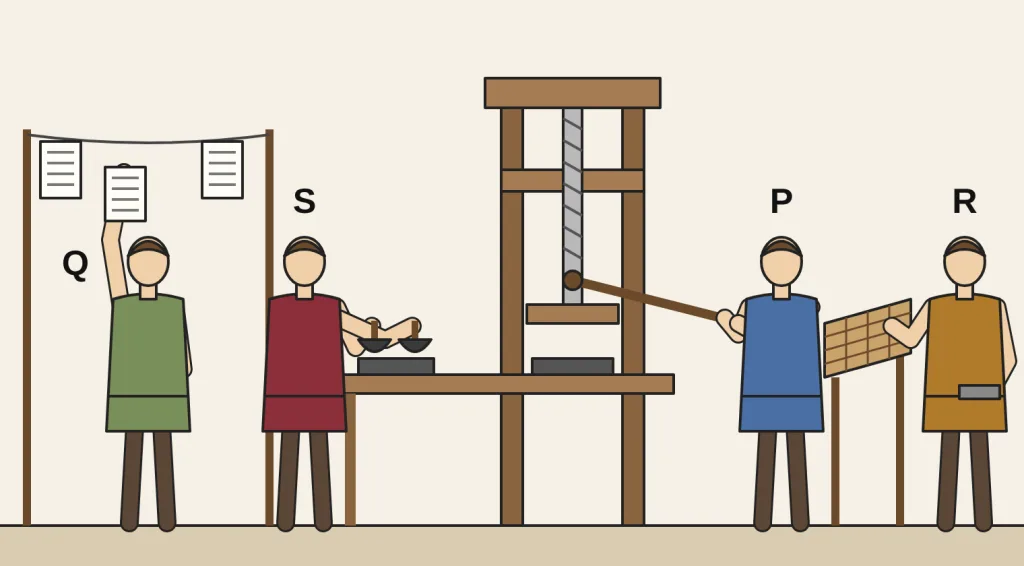
2. The picture given below shows four workers, P, Q, R and S, in a printing workshop in sixteenth-century Europe. In which order did their tasks follow one another when a sheet was printed?
(a) S, R, P, Q
(b) R, S, P, Q
(c) R, P, S, Q
(d) P, R, S, Q
3. Read the statements given below about Alluri Sitarama Raju, who led a rebellion in the Gudem Hills of Andhra Pradesh in the early 1920s, and choose the correct option.
Statement I: He spoke of Gandhiji's greatness and urged the people to give up drinking.
Statement II: He held that India could win its freedom only by peaceful non-cooperation, as Gandhiji taught.
(a) Statement I is correct and Statement II is incorrect.
(b) Statement I is incorrect and Statement II is correct.
(c) Both Statements I and II are correct.
(d) Both Statements I and II are incorrect.
4. Arrange the following in chronological order, from the earliest to the latest.
I. Christopher Columbus, sailing west in search of a sea route to Asia, reached the Americas.
II. Arab traders, it is thought, took pasta to the island of Sicily.
III. The Portuguese and the Spanish had brought large parts of the Americas under their rule.
IV. Chinese silk began to travel west along the network of land routes known as the silk routes.
Choose the correct option:
(a) II, IV, I, III
(b) IV, I, II, III
(c) IV, II, I, III
(d) II, IV, III, I
5. For centuries, polenta, a thick porridge eaten in northern Italy, was made from barley or millet. By the seventeenth century, most families there were making it from maize. Explain two things that this change tells us about the world after the end of the fifteenth century. (2 marks)
6. In 1840, the imaginary German state of Kaldenburg had the following features:
(i) The king made all the laws himself. There was no constitution and no elected assembly.
(ii) Only men from noble families could become army officers or senior officials.
(iii) Every newspaper needed the approval of the king's censor, and political clubs were banned.
How would a liberal of that time have criticised each of these features? Explain. (3 marks)
OR
The French revolutionaries of the 1790s and the Romantic artists and poets of the early nineteenth century both tried to build a feeling of nationhood, but in very different ways. Compare the two on three points: who led the effort, the means they used, and what they saw as the basis of the nation.
7. Between 1919 and 1932, Indians used many forms of peaceful protest against British rule. Answer the following.
(a) Explain three such forms of protest, other than the boycott of foreign goods, giving an example of each from a different movement. (3 marks)
(b) Why did the colonial government often find such peaceful mass protest harder to deal with than a violent revolt? Explain two reasons. (2 marks)
OR
The table gives a hypothetical price index for four goods in an Indian town during the First World War. The figures are invented for this question.
| Item (hypothetical price index, 1913 = 100) | 1913 | 1918 |
|---|---|---|
| Rice | 100 | 170 |
| Cotton cloth | 100 | 290 |
| Kerosene | 100 | 150 |
| Salt | 100 | 125 |
Answer the following.
(a) The war ended in November 1918, but its effects did not. Apart from rising prices, explain three effects of the war and its end that gave Indians fresh reasons for discontent by 1919. (3 marks)
(b) Using only the table, answer: (i) Which good's price rose the most between 1913 and 1918, and by what percentage? (ii) A family spent ₹5 a month on rice in 1913. What would the same amount of rice cost it in 1918? (2 marks)
8. Read the source given below and answer the questions that follow.
Ellen's Saturday Book
Ellen Price was nineteen in 1862. Her father kept the accounts of a grocer in a busy mill town in northern England, and she helped in a dressmaker's shop. New books cost more than she earned in a week, but for a small yearly fee a lending library near the market let her borrow two volumes at a time. Every Saturday evening she carried home a novel, and she often read it aloud to her mother and her younger sister by lamplight.
On weekdays the three of them shared a cheap weekly paper written for women. It carried sewing patterns, recipes, advice on running a home and on good manners, and a story that went on from week to week. Her mother liked the recipes; Ellen liked the story best.
Several of Ellen's favourite novels were written by women. Their heroines did not simply wait for others to decide things for them: they thought for themselves and chose their own way. Ellen copied some of their words into a notebook and, quietly, began to write a story of her own. (Ellen and her town are imaginary.)
8.1 How was Ellen able to read so many novels, although she could not afford to buy books? (1 mark)
8.2 What does the weekly paper that Ellen's family shared tell us about the readers of print in nineteenth-century Europe? (1 mark)
8.3 'For Ellen, print was much more than a way to pass the time.' Support this statement with two points from the source. (2 marks)
9. Read the clues given below. Each clue points to a place marked on the outline map of India for this question, as A or B. Identify the two places and write their correct names.
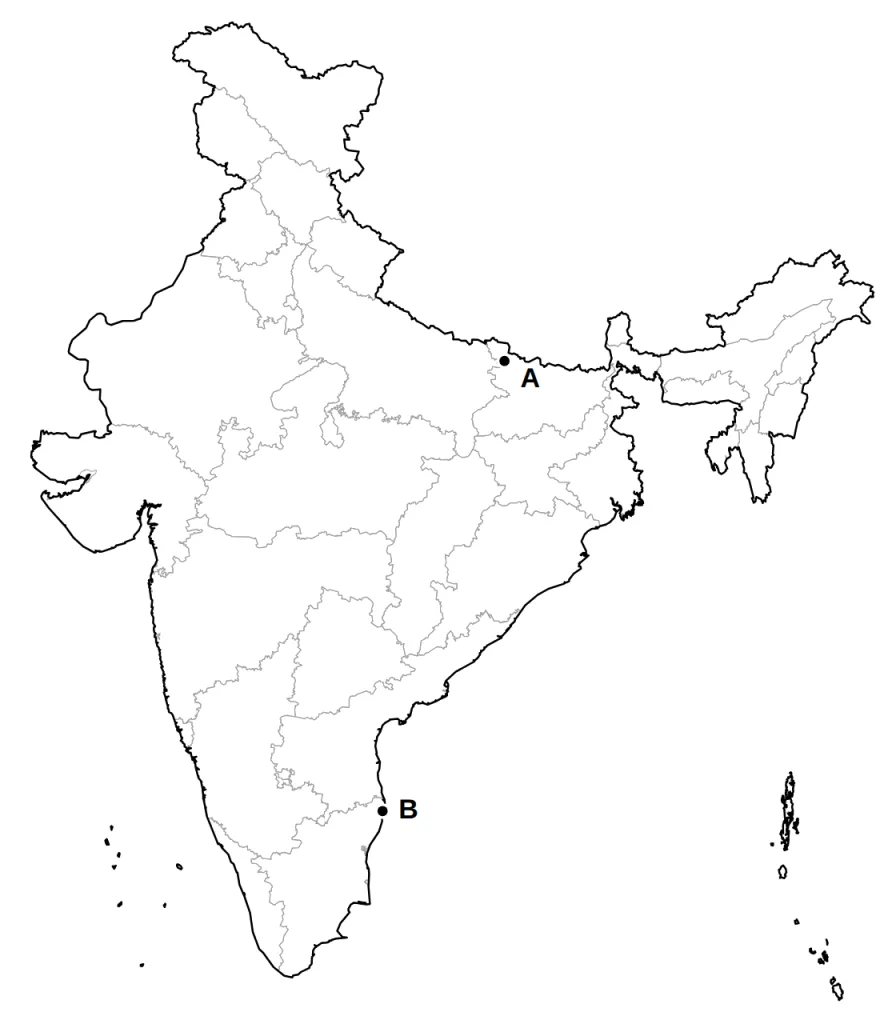
A The district of Bihar where, in 1917, Gandhiji took up the first of his satyagrahas on Indian soil, two years after his return from South Africa. (1 mark)
B The largest city of the Coromandel coast, where the Indian National Congress held its annual session in December 1927. (1 mark)
Section B - Geography (20 marks)
Questions 10 to 19. Questions 10 to 15 are MCQs of 1 mark each; Question 19 is map-based.
10. Kavita lists four resources of her village in Odisha: (i) the fish in the village pond, (ii) a herd of goats, (iii) building stone cut from a quarry on the hill and (iv) the iron ore that lies under the hill. Which option classifies them correctly on the basis of their origin?
(a) Renewable: (i), (ii) and (iii); non-renewable: (iv)
(b) Biotic: (i), (ii) and (iii); abiotic: (iv)
(c) Community-owned: (i) and (iii); individual: (ii) and (iv)
(d) Biotic: (i) and (ii); abiotic: (iii) and (iv)
11. India grows both tropical and temperate fruits, and some regions are known for particular fruits. Match Column I with Column II and choose the correct option.
| Column I (Fruit) | Column II (Region known for it) |
|---|---|
| 1. Lichis and guavas | W. Nagpur and Cherrapunjee |
| 2. Oranges | X. Jammu and Kashmir and Himachal Pradesh |
| 3. Grapes | Y. Uttar Pradesh and Bihar |
| 4. Apples, pears, apricots and walnuts | Z. Andhra Pradesh, Telangana and Maharashtra |
(a) 1-Y, 2-Z, 3-W, 4-X
(b) 1-X, 2-W, 3-Z, 4-Y
(c) 1-Y, 2-W, 3-Z, 4-X
(d) 1-W, 2-Y, 3-X, 4-Z
12. A student has sorted four sources of energy in the table given below. Study the table and choose the option that lists the rows she has filled in correctly.
| Row | Source | Conventional or non-conventional | Renewable or non-renewable |
|---|---|---|---|
| P | Firewood | Conventional | Renewable |
| Q | Hydroelectricity | Non-conventional | Renewable |
| R | Atomic (nuclear) energy | Non-conventional | Non-renewable |
| S | Biogas | Non-conventional | Renewable |
(a) Only P, R and S
(b) Only P and Q
(c) Only Q, R and S
(d) Only R and S
13. For many years, a chemical factory near a village dumped its solid waste and sludge in an open pit beside its wall. Now the water from the village handpumps smells bad and makes people ill, although no waste was ever poured into the wells. What is the most likely explanation?
(a) Hot water from the factory's cooling system has raised the temperature of the groundwater.
(b) Rainwater soaking through the dumped waste has carried harmful substances down into the groundwater.
(c) The pit has lowered the water table, so the pumps now draw up salty water from far below.
(d) Smoke from the factory's chimney has settled over the village and polluted the air.
14. On a plateau of crystalline rock in the Deccan, the soil of the dry upland fields is red, while the soil of the low, damp fields beside a stream looks yellow. Both soils have formed from the same rock. Which statement best explains the difference in colour?
(a) The yellow soil was carried there by the stream from the Himalayas.
(b) The yellow soil is laterite, formed where heavy rain has washed the nutrients out of it.
(c) Iron gives the soil its red colour, which looks yellow where the soil is hydrated.
(d) The red soil has lost all its iron, which the stream has washed away.
Directions: In Questions 15, 20 and 34, a statement of Assertion (A) is followed by a statement of Reason (R). Choose the correct option.
15. Assertion (A): The Gulf of Khambhat and the Gulf of Kachchh in Gujarat offer good conditions for using tidal energy.
Reason (R): Tidal energy, like solar and wind energy, is counted among the non-conventional sources of energy.
(a) Both Assertion (A) and Reason (R) are true, and Reason (R) is the correct explanation of Assertion (A).
(b) Both Assertion (A) and Reason (R) are true, but Reason (R) is not the correct explanation of Assertion (A).
(c) Assertion (A) is true, but Reason (R) is false.
(d) Assertion (A) is false, but Reason (R) is true.
16. An imaginary district has four units: a silk-weaving unit, an edible oil mill that crushes groundnuts, a cement plant and an aluminium smelter.
(a) Group these units into agro-based and mineral-based industries.
(b) One year the monsoon fails badly. Which group is likely to feel the effect first? Give a reason. (2 marks)
17. A multipurpose project supplies water to many users, and this often leads to disputes over who should get it. Answer the following.
(a) Explain three kinds of conflict that have arisen over the water or the land of multipurpose projects, with an example wherever you can. (3 marks)
(b) Suggest two ways in which such conflicts could be reduced. (2 marks)
OR
The table gives hypothetical figures for an imaginary village in a semi-arid part of India. Study it and answer the questions that follow.
| Months | Rainfall (mm) | Water used by the village (thousand cubic metres) |
|---|---|---|
| June-September | 560 | 30 |
| October-January | 30 | 45 |
| February-May | 10 | 55 |
(a) Using the table, explain three facts about this village's water problem. (3 marks)
(b) How much water must the village store from the rains to cover its use in February-May? Give one reason why a covered or underground store would suit this village better than an open pond. (2 marks)
18. Read the source given below and answer the questions that follow.
The Grass Came Back First
Raghu joined the forest department of the Sitapani hills as a young guard in 1974, a year after the country began a national scheme to save its dwindling tigers. In his first winter he found only two sets of pugmarks. Much of the forest had been cut over, cattle from a dozen villages grazed right up to the streams, and hunters' snares lay along the deer paths.
That year the central part of the forest was closed. No trees could be felled there, cattle were kept out and all hunting was stopped. Some villagers were angry, because the grass inside had fed their cattle for as long as anyone could remember.
Raghu says the grass came back first, then the spotted deer and the wild pigs, and only after that the tigers. Today about thirty tigers live in the reserve. The streams that rise in its core flow right through the dry season, and the villages at its edge draw water from them. (Sitapani and Raghu are imaginary.)
18.1 Name the national scheme, begun in 1973, that the source refers to. (1 mark)
18.2 Raghu says that the grass came back first, then the deer and the wild pigs, and only after that the tigers. Explain two things this order of recovery tells us. (2 marks)
18.3 Why were some villagers angry when the central part of the forest was closed? (1 mark)
19. Show any three of the following places on the outline map of India provided for this question. Mark each with a suitable symbol and write its name.
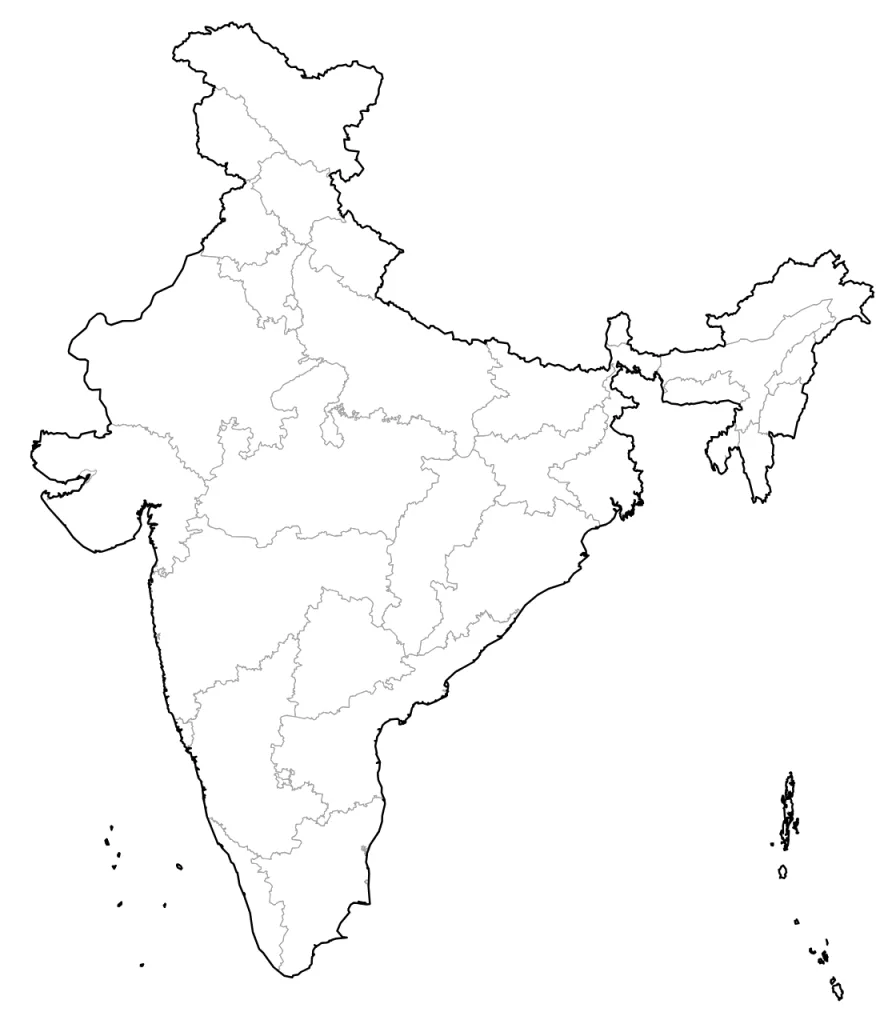
(i) Ramagundam Thermal Power Plant (1 mark)
(ii) Coimbatore - a cotton textile centre (1 mark)
(iii) Tungabhadra Dam (1 mark)
(iv) Netaji Subhash Chandra Bose International Airport (1 mark)
Section C - Political Science (20 marks)
Questions 20 to 28. Questions 20 to 23 are MCQs of 1 mark each.
20. Assertion (A): Besides Hindi, the Indian Constitution protects the use of many other languages, and each State may carry on its official work in its own language.
Reason (R): Fewer than half of the people of India speak Hindi as their mother tongue.
(a) Both Assertion (A) and Reason (R) are true, and Reason (R) is the correct explanation of Assertion (A).
(b) Both Assertion (A) and Reason (R) are true, but Reason (R) is not the correct explanation of Assertion (A).
(c) Assertion (A) is true, but Reason (R) is false.
(d) Assertion (A) is false, but Reason (R) is true.
21. In a television debate on a new bridge, the spokespersons of two parties are asked the same questions. Each of them praises every step taken by his own party's government and finds fault with everything the other party did, even on points where the facts plainly favoured the other side. Which feature of political parties does this show?
(a) Partisanship
(b) Defection
(c) Lack of internal democracy
(d) Lack of a meaningful choice
22. Read the two statements given below and choose the correct option.
Statement I: Sharing power is needed only in countries that are divided by language or religion.
Statement II: People accept a government more readily as rightfully their own when they have a real say in how they are governed.
(a) Statement I is correct and Statement II is incorrect.
(b) Statement I is incorrect and Statement II is correct.
(c) Both Statements I and II are correct.
(d) Both Statements I and II are incorrect.
23. Study the cartoon given below. Which feature of democratic government does it show?

(a) Accommodation of social diversity
(b) Reduction of economic inequality
(c) Quick decisions taken by a strong leader
(d) A government that is accountable to its citizens
24. In the imaginary democracy of Nelora, the city government ordered all street vendors off the main market road. Within a month the vendors protested peacefully, newspapers reported their losses and councillors raised the matter in the city council. The order was then changed to allow selling at fixed hours. Explain two features of democracy that made it possible to correct this decision. (2 marks)
25. In the imaginary federation of Sumera, the provinces run the public hospitals. The national parliament, where one party has a simple majority, passes a law that takes the hospitals away from the provinces, without asking them. Explain two reasons why a change like this could not be made in this way in a federation such as India. (2 marks)
26. Read about three arrangements in imaginary countries. For each, say whether it is an example of power sharing, and give a reason. Where it is, name the form of power sharing.
(i) In Teral, each province elects its own government, which runs schools and roads; the national government cannot dismiss it at will.
(ii) In the city of Ambar, the mayor is chosen by the elected councillors, and they can remove her if she loses their support.
(iii) In Varos, the government has decided that all senior public posts will go to members of the largest language group, since it is the majority. (3 marks)
27. The table shows the share of seats held by women in four elected bodies of an imaginary State of India. (The figures are hypothetical.) Study the table and answer the questions that follow.
| Elected body | Women's share of seats in 1990 (%) | Women's share of seats in 2020 (%) |
|---|---|---|
| Gram panchayats | 4 | 38 |
| Municipal councils | 3 | 36 |
| State Legislative Assembly | 4 | 9 |
| The State's seats in the Lok Sabha | 5 | 12 |
(a) Explain three conclusions about the political representation of women that you can draw from the table. (3 marks)
(b) Suggest two steps, other than reserving seats, that could raise the share of women in the State Assembly. (2 marks)
OR
Read about three incidents in an imaginary country.
(i) In a school debate, a student says that the followers of a certain faith are 'naturally lazy', and many in the hall nod in agreement.
(ii) Before an election, a leader holds his rallies at places of worship and tells the voters of his faith that only their 'own' candidates can protect them from 'the others'.
(iii) After a rumour spreads, a crowd attacks and burns the shops of people of another faith.
Answer the following.
(a) Name the form of communalism that each incident shows, and explain it. (3 marks)
(b) Explain two ways in which such politics harms a democracy. (2 marks)
28. Read the source given below and answer the questions that follow.
'Our Own Voice'
Leela Rawat has reported from the hill State of Meghpur for forty years. 'When I started,' she says, 'two national parties shared almost every seat here. Their leaders came from the plains and seldom visited our villages. People felt that nobody spoke for their dialects, their forests or the price of their ginger and oranges.'
'Then a group of teachers and farmers started the Meghpur Jan Party. It asked for primary schools that teach in the local languages and for a fair price for hill crops. Within ten years it was running the State government, and its members now raise the hill districts' problems in Parliament too. The national parties changed as well. They began to choose candidates from the hills and to print their promises in our languages.'
'One thing worries me. The founder led the party for thirty years. When he retired last year, his son became its president, and nobody asked the party's members.' (Leela Rawat, Meghpur and its party are imaginary.)
28.1 Why did the people of the hills turn to the Meghpur Jan Party? Give one reason from the source. (1 mark)
28.2 Explain two ways in which the rise of State parties like this one has been good for democracy in India. (2 marks)
28.3 Which challenge faced by political parties does the last paragraph of the source show? (1 mark)
Section D - Economics (20 marks)
Questions 29 to 38. Questions 29 to 34 are MCQs of 1 mark each.
29. Which one of the following changes in a village would NOT show up as a rise in its per capita income?
(a) A new flour mill starts paying wages to fifty villagers
(b) Farmers get better prices for their vegetables in the town market
(c) More families begin to earn money by selling milk
(d) Girls now feel safe walking to the high school in the next village
30. Which one of the following would be counted in India's gross domestic product (GDP) for the year 2025?
(a) The wheat that a flour mill buys in 2025 to grind into flour for sale
(b) The price of a car made in 2019 and sold second-hand in 2025
(c) The fees that a barber in Pune earns for haircuts during 2025
(d) The output in 2025 of a factory in Kenya owned by an Indian company
31. In an imaginary village, most of the loans that farm families take each year are taken in June and repaid in November. Which statement best explains this pattern?
(a) Banks in the village open their loan counters only during the monsoon months
(b) Interest rates are lowest in June, so farmers borrow then even when they have no need for money
(c) Farmers borrow in June mainly to repay the loans they took in the previous year
(d) Farmers pay for seeds and fertilisers at sowing but earn only after the harvest is sold
32. Which one of the following is an example of using a renewable resource in a sustainable way?
(a) A village cuts only as much bamboo each year as grows back in its grove
(b) A town pumps more water from its wells each year than the rain puts back
(c) A family burns more firewood every winter but never plants a tree
(d) A town builds a power plant with enough coal to run it for fifty years
33. Read the following statements about the factors that have enabled globalisation.
I. Cheaper and faster transport lets a factory in one country use parts made in factories far away.
II. Telecommunication and the internet let a producer learn about prices and orders abroad within seconds.
III. Liberalisation means that a government puts new barriers on goods coming in from abroad.
IV. When a government removes limits on foreign investment, companies from abroad find it easier to set up production there.
Which of the statements given above are correct?
(a) I and III only
(b) II and III only
(c) I, II, III and IV
(d) I, II and IV only
34. Assertion (A): In the Human Development Report, Sri Lanka, a small neighbour of India, is placed well above India.
Reason (R): India's population is many times larger than that of Sri Lanka.
(a) Both Assertion (A) and Reason (R) are true, and Reason (R) is the correct explanation of Assertion (A).
(b) Both Assertion (A) and Reason (R) are true, but Reason (R) is not the correct explanation of Assertion (A).
(c) Assertion (A) is true, but Reason (R) is false.
(d) Assertion (A) is false, but Reason (R) is true.
35. The health department of an imaginary district starts a drive to vaccinate every newborn baby and to see that mothers give birth in a health centre. After five years, it wants to know whether the drive has worked. Answer the following.
(i) Which development indicator should the department mainly look at? Give a reason. (1 mark)
(ii) Explain why the district's per capita income or its literacy rate would not show whether the drive has worked. (2 marks)
36. Ramu mends shoes on a footpath in a town and earns a little every day. He needs ₹15,000 to set up a small stall of his own. Explain three terms of credit that could make it hard for him to get this loan from a bank. (3 marks)
37. The table gives some facts about an imaginary carpet-weaving cluster in India. (The data are hypothetical.)
| 1990 | 2020 | |
|---|---|---|
| How buyers abroad place orders | An agent visits once a year | By e-mail and video call, at any time |
| Cost of sending 1 kg of carpet to Europe (₹, at 2020 prices) | 300 | 90 |
| Tax on imported wool yarn (%) | 60 | 10 |
| Share of the cluster's carpets sold abroad (%) | 10 | 45 |
Name the factor of globalisation shown by each of the first three changes, and explain how each could have helped the cluster to sell more of its carpets abroad. (3 marks)
38. The table describes the units in which all the workers of an imaginary district work. (The data are hypothetical, for practice only.) Study the table and answer the questions that follow.
| Unit | Owned by | Registered with the government | Workers | Workers get paid leave and provident fund | What it does |
|---|---|---|---|---|---|
| P | The State government | Yes | 300 | Yes | Runs the district's government schools |
| Q | A private company | Yes | 200 | Yes | Makes bicycle parts in a factory |
| R | A family | No | 20 | No | Runs a roadside eating place |
| S | The Central government | Yes | 500 | Yes | Makes railway coaches |
| T | A trader | No | 80 | No | Gets saris woven on looms in the weavers' homes |
| U | Farming families | No | 1,400 | No | Grow vegetables on their own small farms |
(i) What percentage of the district's workers work in the organised sector? (1 mark)
(ii) If unit T registered with the government and began to follow its rules on employment, what share of the district's workers would then be in the organised sector? What would change for T's weavers? (2 marks)
(iii) A planner says that it matters more to create 200 more jobs like those in Q than 200 more jobs like those in R. Give two reasons in support of this view. (2 marks)
OR
Answer the following questions using the table given above for the imaginary district.
(i) Which units are in the public sector, and how many workers do they employ together? (1 mark)
(ii) What percentage of the workers in privately owned units work in the organised sector? What does this show? (2 marks)
(iii) Which sector of economic activity employs most of the district's unorganised workers? Work out its share of the unorganised workers, and give one reason why work in this sector is mostly unorganised. (2 marks)