
Hand Printing in China
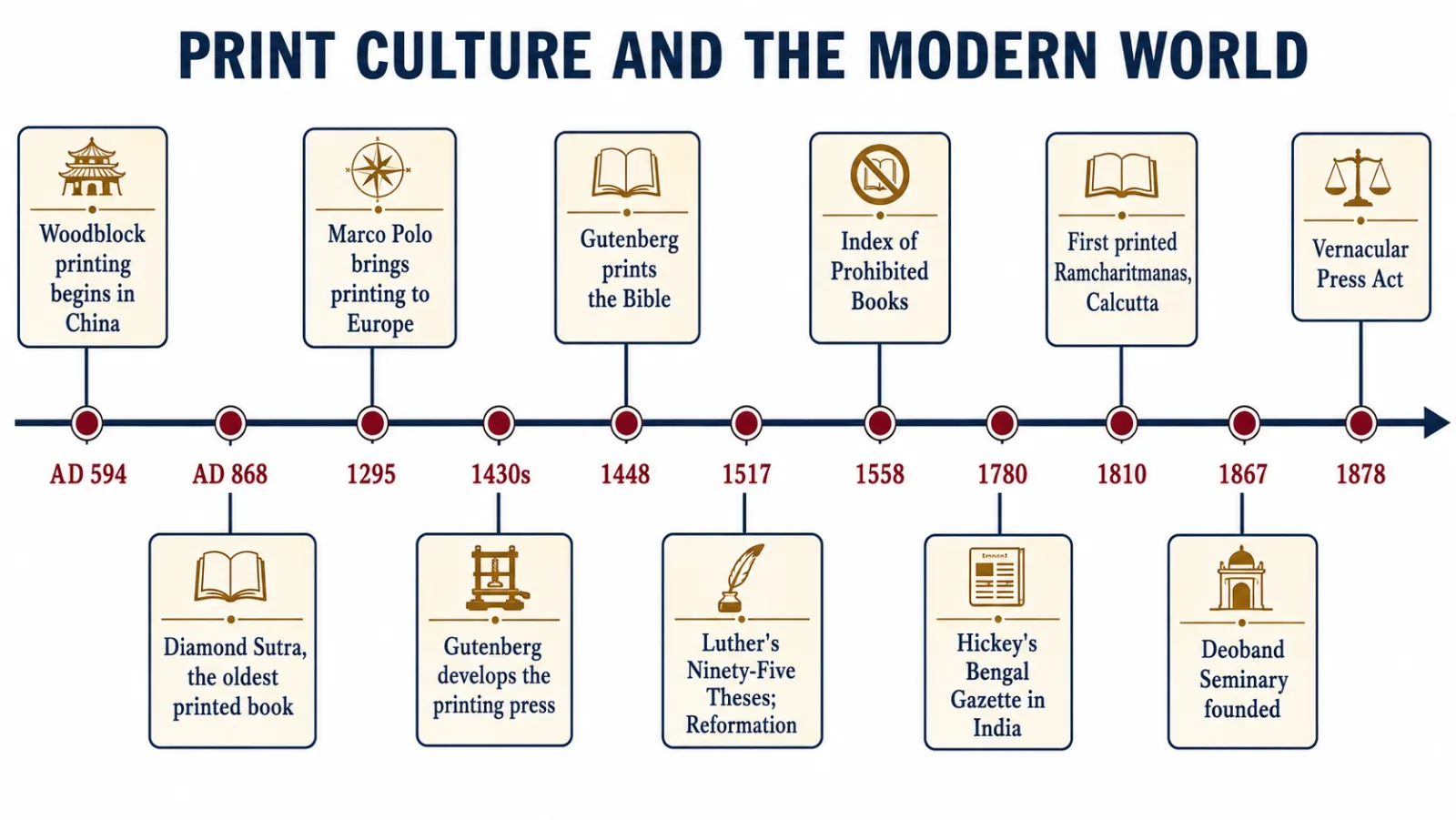
The earliest print technology was developed in China, Japan and Korea — a system of hand printing. From AD 594 onwards, books in China were printed by rubbing paper (also invented there) against the inked surface of woodblocks. Since both sides of the thin paper could not be printed, the traditional Chinese 'accordion book' was folded and stitched at the side.
For a long time the imperial state was the major producer of printed material. China's huge bureaucracy recruited officials through civil service examinations, and textbooks for these examinations were printed in vast numbers under the state's sponsorship. From the sixteenth century, the number of examination candidates rose, increasing the volume of print.
The Diversification of Print in China
By the seventeenth century, as urban culture bloomed, the uses of print diversified. Print was no longer used only by scholar-officials — merchants used it for trade information, and reading became a leisure activity. The new readers preferred fiction, poetry, autobiographies and romantic plays, and rich women began to read and even to publish their poetry and plays.
Later, Western printing techniques and mechanical presses were imported in the late nineteenth century, and Shanghai became the hub of the new print culture, marking a gradual shift from hand printing to mechanical printing.
Print in Japan and Korea
Buddhist missionaries from China introduced hand-printing into Japan around AD 768–770. The oldest printed book, the Buddhist Diamond Sutra (AD 868), contained six sheets of text and woodcut illustrations. In Japan, books were cheap and abundant; in the flourishing urban culture of Edo (later Tokyo), illustrated books flourished. Kitagawa Utamaro (born 1753) was famous for ukiyo ('pictures of the floating world'), prints that later influenced European artists like Manet, Monet and Van Gogh.
In Korea, the Tripitaka Koreana (a collection of Buddhist scriptures engraved on about 80,000 woodblocks) and the Jikji (among the world's oldest books printed with movable metal type, late 14th century) are landmarks of early print.
Questions and Answers
Q1. Where and how was the earliest print technology developed? Ans. The earliest print technology was developed in China, Japan and Korea as a system of hand printing. From AD 594, books in China were printed by rubbing paper against inked woodblocks, producing the folded 'accordion book'.
Q2. Why was the imperial state the major producer of print in China? Ans. China had a huge bureaucracy recruited through civil service examinations, and the textbooks for these examinations were printed in vast numbers under the sponsorship of the imperial state — so the state was the major producer of print.
Questions and Answers (continued)
Q3. How did the uses of print diversify in seventeenth-century China? Ans. As urban culture bloomed, print was used not only by scholar-officials but by merchants for trade information, and reading became a leisure activity. Readers preferred fiction, poetry and plays, and rich women began to read and publish their own works.
Q4. What was ukiyo, and who was Kitagawa Utamaro? Ans. Ukiyo ('pictures of the floating world') was a Japanese art form depicting ordinary urban life. Kitagawa Utamaro (born 1753) was famous for ukiyo prints, which later influenced European artists like Manet, Monet and Van Gogh.