
A Long History of Interconnection
When we talk of 'globalisation', we often mean an economic system that has emerged over the last fifty years or so. But the making of the global world has a long history — of trade, migration, people in search of work, and the movement of capital.
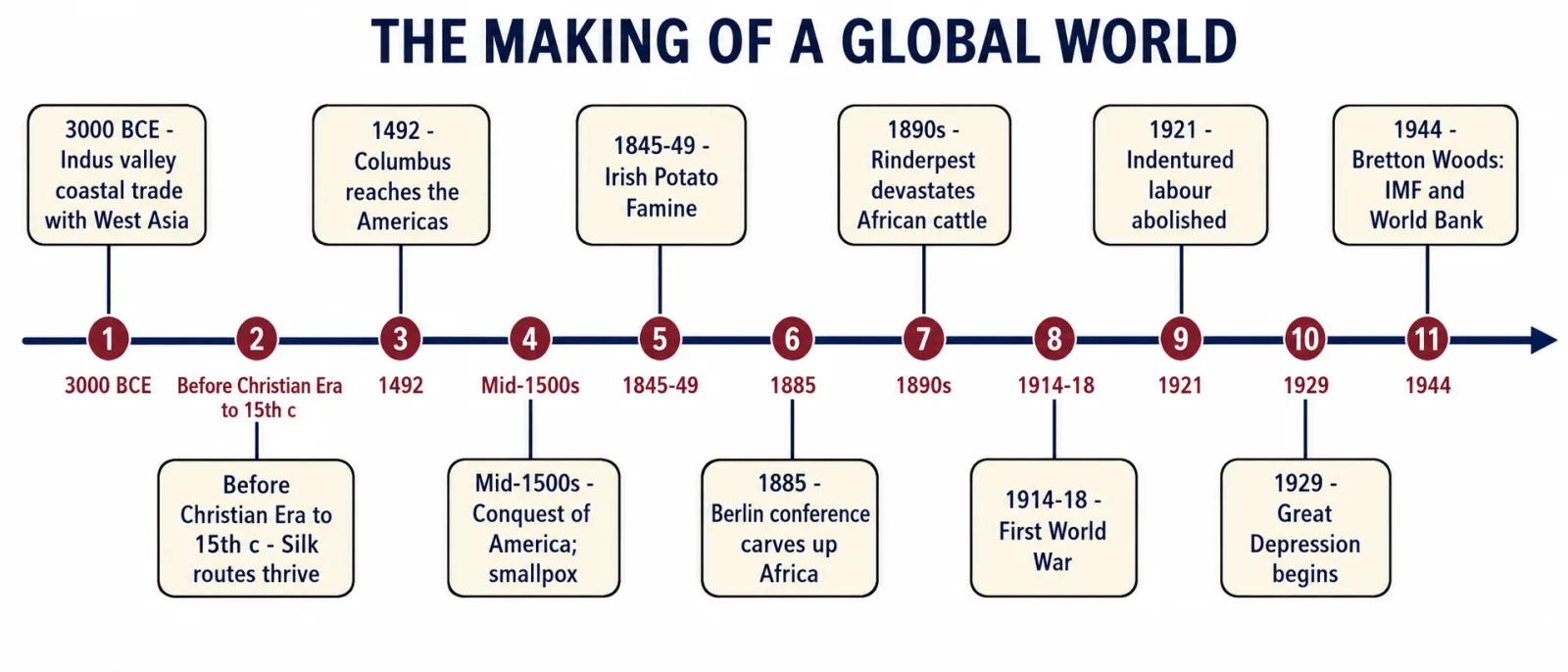
All through history, human societies have become steadily more interlinked. From ancient times, travellers, traders, priests and pilgrims journeyed vast distances for knowledge, opportunity and spiritual fulfilment, carrying goods, money, values, skills, ideas, inventions — and even germs and diseases. As early as 3000 BCE, an active coastal trade linked the Indus valley civilisations with West Asia, and for over a thousand years cowries (shells used as currency) from the Maldives reached China and East Africa.
The Silk Routes
The silk routes are a good example of vibrant pre-modern trade and cultural links. The name points to the importance of West-bound Chinese silk cargoes. Historians have identified several silk routes, over land and by sea, knitting together vast regions of Asia and linking Asia with Europe and northern Africa. They existed before the Christian Era and thrived till the fifteenth century.
Along these routes travelled not only silk but also Chinese pottery, and textiles and spices from India and Southeast Asia; in return, precious metals — gold and silver — flowed from Europe to Asia. Trade and culture went hand in hand: Christian missionaries and, later, Muslim preachers travelled these routes, and much earlier Buddhism spread from eastern India through the silk routes.
Food Travels: Spaghetti and the Potato
Food offers many examples of long-distance cultural exchange. It is believed that noodles travelled west from China to become spaghetti; or perhaps Arab traders took pasta to fifth-century Sicily. Such guesswork suggests the possibilities of long-distance cultural contact even in the pre-modern world.
Many common foods — potatoes, soya, groundnuts, maize, tomatoes, chillies and sweet potatoes — were unknown to our ancestors until about five centuries ago. They were introduced to Europe and Asia only after Christopher Columbus discovered the Americas. Sometimes a new crop made the difference between life and death: Europe's poor began to eat better and live longer with the humble potato. But Ireland's poorest peasants became so dependent on it that when disease destroyed the potato crop in the mid-1840s, hundreds of thousands died of starvation in the Irish Potato Famine.
Questions and Answers
Q1. What were the silk routes? Ans. The silk routes were a network of land and sea routes that linked vast regions of Asia with Europe and northern Africa, existing from before the Christian Era to about the fifteenth century. Along them travelled Chinese silk and pottery, Indian textiles and spices, and gold and silver from Europe, as well as religions like Buddhism, Christianity and Islam.
Q2. Give one example of long-distance cultural exchange through food. Ans. It is believed that noodles travelled west from China to become spaghetti, and that foods such as potatoes, maize, tomatoes and chillies reached Europe and Asia from the Americas after Columbus — showing long-distance cultural contact.
Questions and Answers (continued)
Q3. How did the introduction of the potato affect Europe, especially Ireland? Ans. The potato helped Europe's poor to eat better and live longer. But Ireland's poorest peasants became so dependent on it that when disease destroyed the crop in the mid-1840s, hundreds of thousands died in the Irish Potato Famine.
Q4. Give an early example of trade linking the Indian subcontinent with the wider world. Ans. As early as 3000 BCE, an active coastal trade linked the Indus valley civilisations with West Asia, and cowrie shells from the Maldives reached China and East Africa as a form of currency.