
The Chapter in One Read
Anatomy is the study of the internal structure of plants, and the chapter is built on a single move repeated six times: take a transverse section, start at the outside, and name each ring as you reach it.
Before the sections come the tissues. Meristems divide - apical at the tips giving growth in length, intercalary at the base of leaves in grasses, and lateral in mature regions giving growth in girth. What they produce are the permanent tissues: the simple ones, made of a single cell type - parenchyma thin-walled and general-purpose, collenchyma thickened at the corners and supporting growing parts, sclerenchyma thick, lignified and usually dead - and the complex ones made of several cell types, xylem carrying water upward and phloem carrying food.
Those tissues are then sorted a second time, by where they sit, into three tissue systems. The epidermal system is the outer covering - epidermal cells, the cuticle that stops water loss and is absent in roots, the stomata with their bean-shaped guard cells and subsidiary cells, the unicellular root hairs that absorb and the multicellular trichomes that prevent water loss. The ground system is everything except epidermis and vascular bundles - cortex, pericycle, pith, medullary rays, and the mesophyll of a leaf. The vascular system is the xylem and phloem together as bundles, classified on two independent axes: radial or conjoint by how the two tissues sit, and open or closed by whether a cambium is there.
Then the six sections. A dicot root runs epiblema, cortex, endodermis with casparian strips, pericycle, two to four xylem patches, small pith; a monocot root is the same but polyarch, with a large pith and no secondary growth. A dicot stem runs epidermis, collenchymatous hypodermis, cortex, starch-sheath endodermis, semi-lunar sclerenchyma pericycle, medullary rays, a ring of conjoint open endarch bundles, pith; a monocot stem replaces all of that with a sclerenchymatous hypodermis and scattered closed bundles in one parenchymatous ground tissue. A dorsiventral leaf has more stomata below, a mesophyll split into palisade and spongy, and bundles in the veins with a thick-walled sheath; an isobilateral leaf has stomata on both faces, an undifferentiated mesophyll, and bulliform cells that curl it up under water stress.
Learn the layers in order and the differences in pairs, and the chapter is finished.
Master Quick Recap
Meristems
- Apical - tips of roots and shoots; primary growth, length.
- Intercalary - base of leaves or above nodes; grasses.
- Lateral - mature regions; secondary growth, girth; vascular cambium, cork cambium.
Simple permanent tissues
- Parenchyma - isodiametric, thin cellulose walls; photosynthesis, storage, secretion.
- Collenchyma - below the epidermis in dicot stems and petioles; thickened at the corners; no intercellular spaces; support for growing parts.
- Sclerenchyma - long, narrow, thick lignified walls with pits, usually dead; fibres and sclereids; support.
Complex permanent tissues
- Xylem - tracheids, vessels, xylem fibres, xylem parenchyma; only the parenchyma is living; vessels absent in gymnosperms.
- Phloem - sieve tube elements, companion cells, phloem parenchyma, phloem fibres; gymnosperms have albuminous cells and sieve cells.
Epidermal system
- Usually single-layered, parenchymatous; cuticle prevents water loss, absent in roots.
- Stomata - two bean-shaped guard cells, dumb-bell in grasses; outer wall thin, inner wall highly thickened; chloroplasts present; subsidiary cells; stomatal apparatus = aperture + guard cells + subsidiary cells.
- Root hairs unicellular, absorb; trichomes multicellular, prevent water loss.
Ground system - all tissues except epidermis and vascular bundles; mesophyll in leaves.
Vascular system
- Radial - roots. Conjoint - stems and leaves, phloem outside the xylem.
- Open - cambium present, dicot stems. Closed - no cambium, monocots.
- Protoxylem narrower, metaxylem wider; endarch in stems, exarch in roots.
Every Section, Side by Side
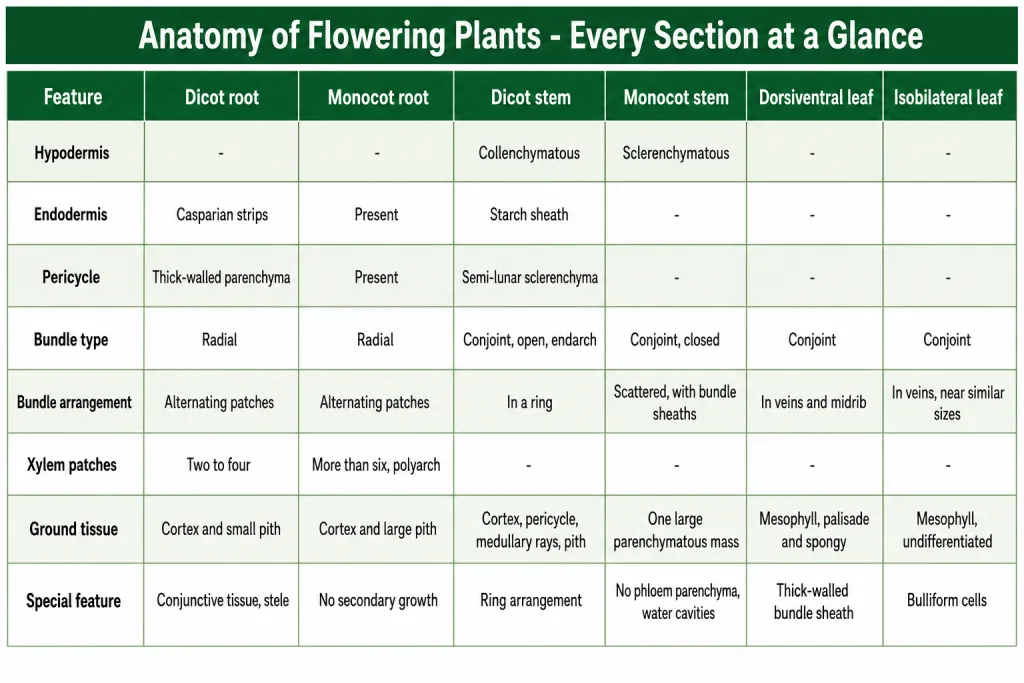
| Feature | Dicot root | Monocot root | Dicot stem | Monocot stem | Dorsiventral leaf | Isobilateral leaf |
|---|---|---|---|---|---|---|
| Outermost layer | Epiblema, with unicellular root hairs | Epidermis | Epidermis with cuticle, trichomes, a few stomata | Epidermis | Adaxial and abaxial epidermis with conspicuous cuticle | Same |
| Hypodermis | - | - | Collenchymatous | Sclerenchymatous | - | - |
| Endodermis | Casparian strips of suberin | Present | Starch sheath | - | - | - |
| Pericycle | Thick-walled parenchyma; lateral roots, vascular cambium | Present | Semi-lunar sclerenchyma above the phloem | - | - | - |
| Bundle type | Radial | Radial | Conjoint, open, endarch | Conjoint, closed | Conjoint | Conjoint |
| Bundle arrangement | Alternating patches | Alternating patches | In a ring | Scattered, with sclerenchymatous bundle sheaths | In veins and midrib | In veins, near similar sizes |
| Xylem patches | Two to four | More than six - polyarch | - | - | - | - |
| Ground tissue | Cortex + small pith | Cortex + large pith | Cortex, endodermis, pericycle, medullary rays, pith | One large parenchymatous mass | Mesophyll - palisade + spongy | Mesophyll, undifferentiated |
| Stomata | - | - | A few | - | More abaxial; adaxial may lack them | Both surfaces |
| Special feature | Conjunctive tissue, stele | No secondary growth | Ring arrangement | No phloem parenchyma, water-containing cavities | Thick-walled bundle sheath | Bulliform cells |
How this table is examined. One cell at a time. Read it down a column to learn one section, then across a row to learn one difference - and the rows that generate the most questions are hypodermis, bundle arrangement and ground tissue.
The Six Comparisons Worth Memorising
- Root hair against trichome - unicellular and absorbs against multicellular and prevents water loss.
- Collenchyma against sclerenchyma - thickened at the corners, living, supports growing parts against thick lignified walls, usually dead, rigid support.
- Open against closed - cambium present, can form secondary tissue against no cambium.
- Radial against conjoint - alternate radii, roots against same radius, stems and leaves.
- Endarch against exarch - protoxylem towards the centre, stems against protoxylem towards the periphery, roots.
- Dorsiventral against isobilateral - stomata mostly below, mesophyll differentiated against stomata both sides, mesophyll undifferentiated.
Two axes that must not be collapsed. Radial or conjoint is about where the xylem and phloem sit relative to each other. Open or closed is about whether a cambium is present. A bundle carries one label from each pair, which is why a dicot stem bundle is described with three words at once - conjoint, open, endarch.
Writing the Chapter-End Exercises Well
Class 11 has no board paper, but the chapter-end exercises and your school tests are still written answers, and here the marks sit almost entirely on labels. Everything below is about writing, not about choosing.
What gets asked. Two labelled diagrams, three or four comparisons, one definition with a diagram, and two longer answers - the dorsiventral leaf and the usefulness of anatomy. That is the whole chapter.
Five rules that convert knowledge into marks.
- Write the label list even if the drawing is rough. For the root, stem and leaf questions the marks are on epiblema, endodermis, casparian strip, pericycle, protoxylem, metaxylem, pith, palisade, spongy, bundle sheath - not on the quality of the circle.
- Comparisons go in tables, the same characters in the same order on both sides.
- Identification answers carry their reason. "Monocot stem" is half an answer; add scattered conjoint bundles, sclerenchymatous bundle sheaths, no phloem parenchyma and it is whole.
- Use the exact term. Epiblema not "outer layer"; conjunctive tissue not "cells between"; semi-lunar patches of sclerenchyma not "hard bits".
- For "how is anatomy useful", give more than one use. Identification of plants and timber, detection of adulteration in plant drugs, support for classification, the explanation of conduction and transpiration, and the adaptations plants show to their environments.
The exercises to be able to write from memory: the two labelled comparisons, the stomatal apparatus with its diagram, the three tissue systems with their tissues, and the dorsiventral leaf in full.
NEET Strategy
What the paper asks. One layer, one feature, one section - with a distractor pulled from the neighbouring structure.
How to prepare for exactly that.
- Learn each section as an ordered list of rings, outside inward, and recite it. Most questions are just asking which ring comes where.
- Drill the six comparisons above. Between them they cover the great majority of the chapter's NEET questions.
- Keep the two bundle axes separate. Radial or conjoint and open or closed are independent, and a question that mixes them is testing exactly that.
- Attach each special structure to exactly one place. Casparian strips - root endodermis. Starch sheath - dicot stem endodermis. Semi-lunar sclerenchyma - dicot stem pericycle. Bundle sheath - monocot stem bundle and leaf bundle. Bulliform cells - grass leaf adaxial epidermis. Conjunctive tissue - between root xylem and phloem.
- Watch the hedge words. The epidermis is usually single-layered; the adaxial epidermis may lack stomata; trichomes are usually multicellular.
- Learn the negatives. No cuticle in roots. No phloem parenchyma in a monocot stem. No secondary growth in monocot roots. No palisade-spongy split in an isobilateral leaf. Negative facts are the cheapest questions an examiner can set.
Time discipline. These are one-line recall items. If a question takes more than 40 seconds you do not know the fact, and rereading the options will not create it.
The Mistakes That Cost the Most Marks
- The two hypodermes swapped. Collenchymatous in a dicot stem, sclerenchymatous in a monocot stem.
- Endarch and exarch reversed. Endarch in stems, exarch in roots.
- Open confused with exposed. Open means a cambium is present, nothing else.
- Radial and open treated as alternatives. They are on different axes - a bundle takes one label from each pair.
- Casparian strips given to the pericycle. They are on the endodermis, on its tangential and radial walls, and they are made of suberin.
- The pericycle described the same way in root and stem. In a root it is thick-walled parenchyma that starts lateral roots; in a dicot stem it is semi-lunar patches of sclerenchyma.
- Cuticle drawn on a root. It is absent in roots.
- Root hairs called multicellular. They are unicellular; trichomes are the multicellular ones.
- Palisade placed below the spongy layer. Palisade is adaxial - the side facing the light.
- Bulliform cells given to dicots. They occur in grasses, on the adaxial epidermis along the veins.
- Monocot stem given a pith. It has one large parenchymatous ground tissue, not a cortex and pith.
- Phloem parenchyma left in a monocot stem. It is absent, and so are cambium and secondary growth.
- Companion cells listed under xylem. They are phloem; the four xylem elements are tracheids, vessels, xylem fibres and xylem parenchyma.
- The stomatal apparatus given as the guard cells alone. It is the aperture, the guard cells and the subsidiary cells together.
A Short Revision Plan
First pass - one hour. Read sections 1 to 6 straight through. In the margin of each of the six section descriptions, write the rings in order from the outside inward and nothing else.
Second pass - forty minutes. Cover the side-by-side table and rebuild it column by column - dicot root, monocot root, dicot stem, monocot stem, dorsiventral leaf, isobilateral leaf. Check, and rewrite only the cells you missed.
Third pass - thirty minutes. The six comparisons, recited as pairs until they come without hesitation. This is the highest-return half hour in the chapter.
Fourth pass - fifty minutes. Draw and fully label, from memory, the dicot root, the monocot root, the dicot stem, the monocot stem and the dorsiventral leaf. Then write out the usefulness-of-anatomy answer, which is the one item here that cannot be drawn.
Fifth pass - forty minutes. The 40 NEET-pattern questions under time. Return only to the ones where you were choosing between two options, and reread the paragraph each of those two options came from.
The day before - ten minutes. The list of mistakes above, and nothing else. In a chapter this short, the swapped pairs are the only things that slip.