
Read This First
This section sits outside the current syllabus.
Secondary growth was taken out of the rationalised chapter, and the chapter you are examined on no longer teaches it. It is here for two reasons: the chapter summary still ends by saying that secondary growth occurs in most dicotyledonous roots and stems, and the chapter body itself refers to the vascular cambium forming in the pericycle during secondary growth and to bundles being open precisely because they can form secondary tissues - neither of which means much unless you know what secondary growth is.
Treat it as background, not core revision. Do the six sections before this one first. Nothing in the NEET blocks of this chapter depends on it, and its quiz items are tagged as bonus.
The Vascular Cambium Ring
Secondary growth is the increase in girth of a stem or root, and it is the work of the lateral meristems.
How the ring forms in a dicot stem. In a young dicot stem the cambium already sits inside each vascular bundle, between the xylem and the phloem - that is the intrafascicular cambium, and it is what makes the bundle open. During secondary growth the cells of the medullary rays that lie in line with it become meristematic and form the interfascicular cambium. The two join up into a complete cambial ring.
What the ring does. It cuts off new cells on both sides:
- Inward - secondary xylem.
- Outward - secondary phloem.
Far more secondary xylem is produced than secondary phloem, so the xylem soon makes up the bulk of the stem. The primary and secondary phloem get crushed as the stem expands, while the primary xylem stays more or less intact in the centre. Where the ring lies opposite a medullary ray it produces secondary medullary rays, which keep radial channels open through the new wood.
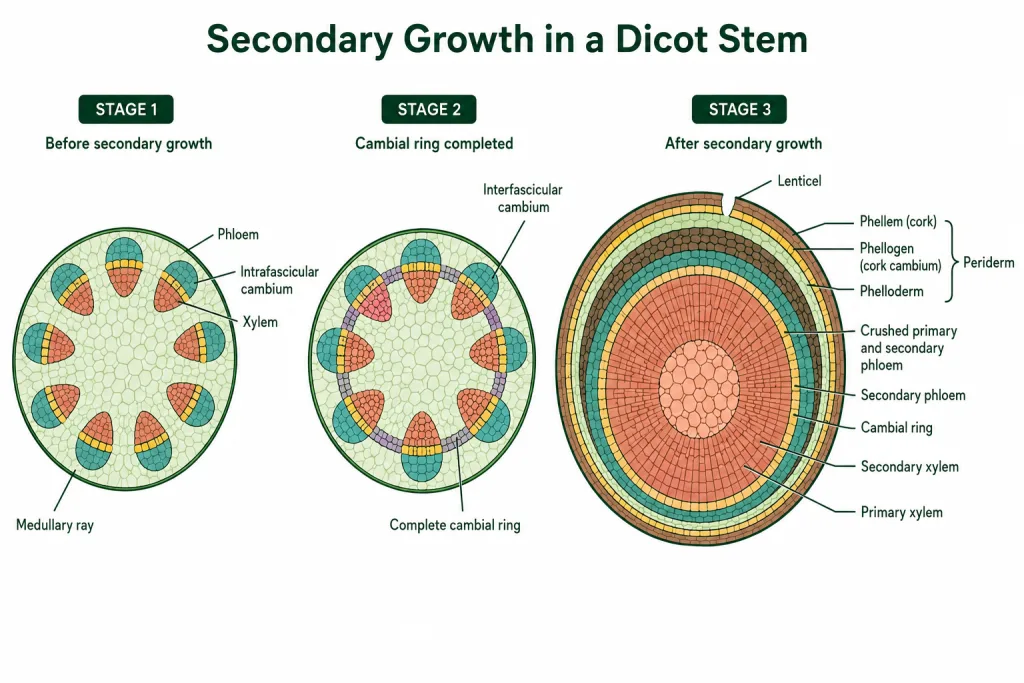
[Bonus] The single fact that explains the shape of a tree trunk is that secondary xylem is produced far faster than secondary phloem. That is why almost all of a trunk is wood, and why the phloem is squeezed into a thin band near the outside.
Spring Wood, Autumn Wood and Annual Rings
The cambium does not work at the same rate all year.
- Spring wood, or early wood. In spring the cambium is very active and produces xylem with vessels of wider cavities. The result is lighter in colour and lower in density.
- Autumn wood, or late wood. In autumn the cambium is less active and produces fewer xylary elements with narrower vessels. The result is darker in colour and higher in density.
Spring wood and autumn wood together make one annual ring, and counting the rings in a cut trunk gives an estimate of the age of the tree.
Heartwood and Sapwood
In an old tree the wood is not uniform either.
- Heartwood. The greater part of the secondary xylem, lying in the centre, is dark brown because of the deposition of organic compounds - tannins, resins, oils, gums, aromatic substances and essential oils. It is dead, highly durable and resistant to insects and micro-organisms, and it provides mechanical support to the stem.
- Sapwood. The peripheral region of the secondary xylem is lighter in colour and is the part involved in the conduction of water and minerals from root to leaf.
| Heartwood | Sapwood | |
|---|---|---|
| Position | Central | Peripheral |
| Colour | Dark brown | Lighter |
| Contents | Tannins, resins, oils, gums, aromatic substances, essential oils | - |
| Living or dead | Dead | Living |
| Job | Mechanical support; durable, resistant to insects and micro-organisms | Conduction of water and minerals |
[Bonus] Two answers get set from this block: the list of what darkens heartwood, and the pairing spring wood light and wide-vesselled, autumn wood dark and narrow-vesselled, the two together making one annual ring.
The Cork Cambium, Periderm and Lenticels
As a stem increases in girth, the outer cortical and epidermal layers break. The plant needs a new protective covering, and it makes one.
Cork cambium, or phellogen. It develops in the cortex. It is usually a couple of layers thick, made of narrow, thin-walled and nearly rectangular cells. Like the vascular cambium it cuts off cells on both sides:
- Outward - cork, also called phellem. Its cells are suberised and therefore impervious to water.
- Inward - secondary cortex, also called phelloderm, which is parenchymatous.
Periderm is the name for the three together - phellogen, phellem and phelloderm.
Lenticels. At certain places the phellogen cuts off closely arranged parenchymatous cells on the outside instead of cork cells. These push out and rupture the epidermis, leaving lens-shaped openings called lenticels. They permit the exchange of gases between the outer atmosphere and the internal tissue of the stem, and they occur in most woody trees.
Bark. A non-technical term for all the tissues exterior to the vascular cambium, which therefore includes the secondary phloem. Bark formed early in the season is soft bark or bast; that formed later is hard bark.
Secondary Growth in Roots
In a dicot root the vascular cambium is completely secondary in origin. It arises from the tissue just below the phloem bundles together with a portion of the pericycle lying above the protoxylem, forming a complete and continuous wavy ring, which later becomes circular as secondary xylem is added.
[Bonus] The three-layer name is the one students lose marks on: periderm = phellogen + phellem + phelloderm. And note that bark is not a technical term - it means everything outside the vascular cambium, secondary phloem included.
Quick Recap
Vascular cambium
- Intrafascicular cambium inside the bundle + interfascicular cambium from the medullary ray cells = a complete cambial ring.
- Cuts secondary xylem inward, secondary phloem outward; far more xylem than phloem.
- Primary and secondary phloem get crushed; primary xylem stays more or less intact in the centre.
- Produces secondary medullary rays.
Wood
- Spring / early wood - cambium very active, wider vessels, lighter, lower density.
- Autumn / late wood - cambium less active, fewer elements, narrower vessels, darker, higher density.
- Spring wood + autumn wood = one annual ring; ring counts estimate the age of the tree.
- Heartwood - central, dark brown from tannins, resins, oils, gums, aromatic substances and essential oils; dead, durable, resistant to insects and micro-organisms, gives mechanical support.
- Sapwood - peripheral, lighter, conducts water and minerals.
Cork cambium
- Phellogen develops in the cortex; narrow, thin-walled, nearly rectangular cells, a couple of layers thick.
- Cuts cork or phellem outward - suberised, impervious to water; secondary cortex or phelloderm inward - parenchymatous.
- Periderm = phellogen + phellem + phelloderm.
- Lenticels - lens-shaped openings where phellogen cuts parenchymatous cells outward and ruptures the epidermis; exchange of gases; in most woody trees.
- Bark - non-technical, all tissues exterior to the vascular cambium, including secondary phloem; soft bark or bast early, hard bark later.
In roots - the vascular cambium is completely secondary in origin, from below the phloem bundles and the pericycle above the protoxylem, forming a wavy ring that later becomes circular.
Solved Examples
Question 1
Q. What is secondary growth?
Answer. The increase in girth of a stem or root, produced by the lateral meristems.
Question 2
Q. How does the complete cambial ring form in a dicot stem?
Answer. The intrafascicular cambium already lies inside each vascular bundle. The medullary ray cells in line with it become meristematic and form the interfascicular cambium, and the two join into a complete ring.
Question 3
Q. What does the vascular cambium cut off, and on which side?
Answer. Secondary xylem on the inside and secondary phloem on the outside.
Question 4
Q. Why is a tree trunk almost entirely wood?
Answer. Because the cambium produces far more secondary xylem than secondary phloem. The xylem accumulates year after year while the phloem gets crushed against the outside as the stem expands.
Question 5
Q. Distinguish between spring wood and autumn wood.
Answer.
| Spring / early wood | Autumn / late wood | |
|---|---|---|
| Cambial activity | Very active | Less active |
| Vessels | Wider cavities | Narrower, and fewer xylary elements |
| Colour and density | Lighter, lower density | Darker, higher density |
Question 6
Q. What is an annual ring, and what is it used for?
Answer. Spring wood and autumn wood together make one annual ring. Counting the rings in a cut trunk gives an estimate of the age of the tree.
Question 7
Q. What gives heartwood its dark colour?
Answer. The deposition of organic compounds - tannins, resins, oils, gums, aromatic substances and essential oils.
Question 8
Q. Compare heartwood and sapwood.
Answer. Heartwood is the central, dark brown, dead part of the secondary xylem. It is highly durable and resistant to insects and micro-organisms and gives mechanical support. Sapwood is the peripheral, lighter coloured part, and it is the one involved in the conduction of water and minerals.
Question 9
Q. Why does a plant need a cork cambium at all?
Answer. Because as the stem increases in girth the outer cortical and epidermal layers break. The plant has lost its protective covering, so the cork cambium develops in the cortex and makes a new one.
Question 10
Q. What does the cork cambium produce on each side, and what are the two products called?
Answer. Outward it produces cork, also called phellem, whose cells are suberised and impervious to water. Inward it produces the secondary cortex, also called phelloderm, which is parenchymatous.
Question 11
Q. What is the periderm?
Answer. The phellogen, the phellem and the phelloderm taken together.
Question 12
Q. What are lenticels, how do they form, and what are they for?
Answer. At certain places the phellogen cuts off closely arranged parenchymatous cells on the outside instead of cork. These rupture the epidermis and leave lens-shaped openings, the lenticels. They permit the exchange of gases between the outer atmosphere and the internal tissue, and they occur in most woody trees.
Question 13
Q. What does the word bark mean?
Answer. It is a non-technical term for all the tissues exterior to the vascular cambium, so it includes the secondary phloem. Bark formed early in the season is soft bark or bast; that formed later is hard bark.
Question 14
Q. How does the vascular cambium of a root differ in origin from that of a stem?
Answer. In a root the cambium is completely secondary in origin - there is no intrafascicular cambium to start from. It arises from the tissue just below the phloem bundles together with a portion of the pericycle above the protoxylem, and it first forms a wavy ring that later becomes circular.
Question 15
Q. A cut log shows a dark central region and a paler outer region. Name both, and say which one is still doing a job for the tree.
Answer. The dark centre is heartwood and the pale outer region is sapwood. Only the sapwood is still working - it conducts water and minerals. The heartwood is dead, and its job is mechanical support.