
Read This First
Anatomy is the study of the internal structure of plants. Plants have cells as the basic unit, cells are organised into tissues, and tissues are organised into organs. Different organs show different internal structure, and within the angiosperms the monocots and dicots are anatomically different as well. Internal structure also shows adaptations to diverse environments.
This first section covers the tissues themselves - the meristems that make new cells, and the permanent tissues they turn into. The chapter that follows uses these names constantly - parenchyma, collenchyma, sclerenchyma, xylem, phloem, cambium - without stopping to define them, and one of the chapter-end exercises asks you to name the tissues under each tissue system. So this section is not optional background. Read it first, and the rest of the chapter reads easily.
Meristematic Tissues
A meristem is a tissue whose cells keep dividing. Everything else in the plant is made from what a meristem produces.
Apical meristem. Present at the tips of roots and shoots. It produces the primary tissues and is responsible for growth in length - what is called primary growth.
Intercalary meristem. Present at the base of leaves or above the nodes, as in grasses. It is what lets a mown lawn or a grazed grass blade grow back from the bottom.
Apical and intercalary meristems together are the primary meristems, because they appear early in the life of a plant and contribute to the formation of the primary plant body.
Lateral meristem. Appears later, in the mature regions of roots and stems, and is a secondary meristem. It is cylindrical, and it produces growth in girth - secondary growth. The two lateral meristems are the vascular cambium and the cork cambium.
| Meristem | Where | What it gives |
|---|---|---|
| Apical | Tips of roots and shoots | Primary growth - increase in length |
| Intercalary | Base of leaves or above the nodes; grasses | Regrowth from the base |
| Lateral | Mature regions, cylindrical | Secondary growth - increase in girth |
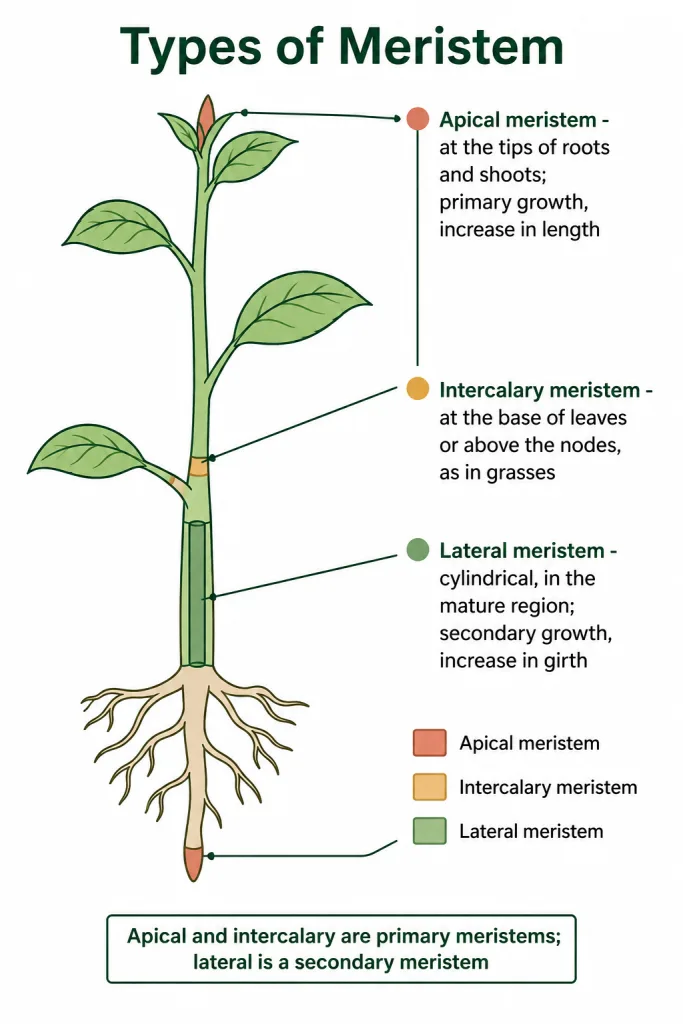
[NEET Important] Two words settle most questions here: primary growth is length, secondary growth is girth. Apical and intercalary are primary meristems; the lateral meristem is a secondary meristem, and the vascular cambium and cork cambium are the two of them.
Permanent Tissues - the Simple Tissues
A permanent tissue is one whose cells have lost the ability to divide and have taken on a definite role. Simple tissues are made of one type of cell; complex tissues are made of more than one.
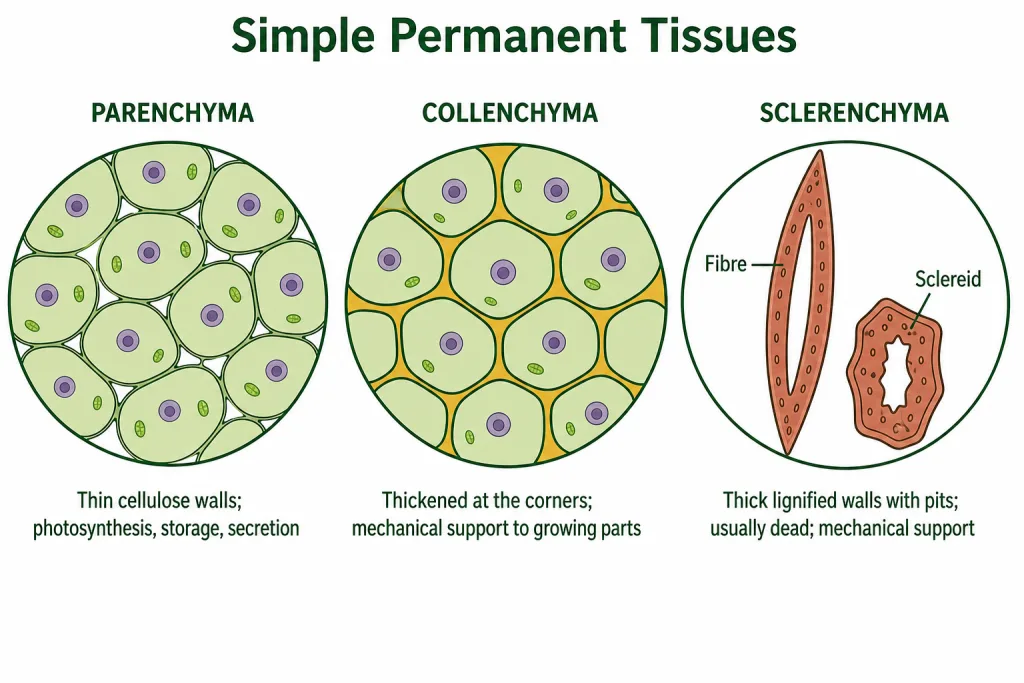
Parenchyma. Cells are usually isodiametric - about as wide as they are long - with thin cell walls made of cellulose. They may be closely packed or have small intercellular spaces. Parenchyma is the general-purpose tissue: it carries out photosynthesis, storage and secretion.
Collenchyma. Occurs in layers below the epidermis in dicotyledonous plants, in the stem and in the petiole. The cells may be oval, spherical or polygonal, and they are thickened at the corners by a deposit of cellulose, hemicellulose and pectin. There are no intercellular spaces. Collenchyma cells may contain chloroplasts and then assimilate food, and their main job is to provide mechanical support to the growing parts of the plant, such as a young stem or a petiole.
Sclerenchyma. Cells are long and narrow with thick, lignified secondary walls, often carrying a few or numerous pits. They are usually dead and without protoplasts. Sclerenchyma comes in two forms - fibres, which are long and pointed and occur in bundles, and sclereids, which are short with very thick walls and narrow cavities, found in nut shells, seed coats and the gritty flesh of a pear. Its job is mechanical support.
| Parenchyma | Collenchyma | Sclerenchyma | |
|---|---|---|---|
| Cell shape | Isodiametric | Oval, spherical or polygonal | Long and narrow |
| Wall | Thin, cellulose | Thickened at the corners with cellulose, hemicellulose and pectin | Thick and lignified, with pits |
| Intercellular spaces | Small ones may be present | Absent | Absent |
| Living or dead | Living | Living | Usually dead |
| Where | Everywhere - cortex, pith, mesophyll | Below the epidermis in dicot stems and petioles | Wherever hard support is needed |
| Job | Photosynthesis, storage, secretion | Mechanical support to growing parts | Mechanical support |
[NEET Important] The wall is what separates the three, and the exact wording is asked: parenchyma is thin-walled, collenchyma is thickened at the corners, sclerenchyma is thick and lignified. Two more one-liners get set often - collenchyma has no intercellular spaces, and sclerenchyma is usually dead.
Permanent Tissues - the Complex Tissues
A complex tissue is made of more than one type of cell, all working together as a unit. There are two, and together they form the vascular bundles.
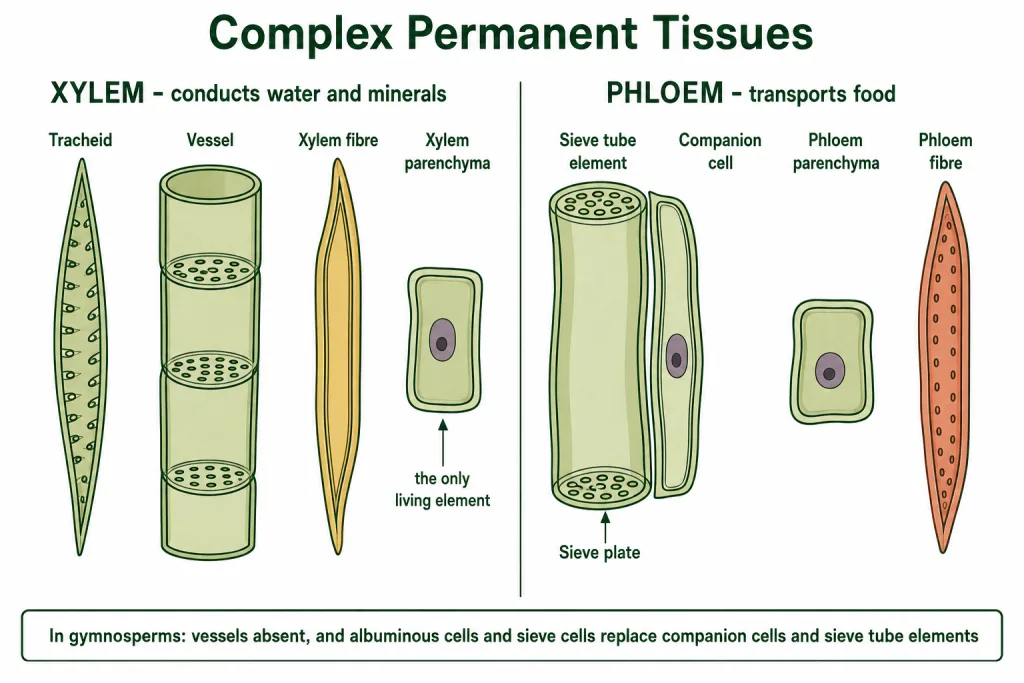
Xylem conducts water and minerals from the root upward, and also gives mechanical strength. It has four kinds of element:
- Tracheids - elongated, dead, with thick lignified walls and tapering ends.
- Vessels - long cylindrical tube-like structures made of many cells joined end to end, with the partition walls perforated. Vessels are absent in gymnosperms.
- Xylem fibres - thick-walled, for support.
- Xylem parenchyma - the only living element, storing food.
Phloem transports food, chiefly sucrose, from the leaves to the rest of the plant. It also has four kinds of element:
- Sieve tube elements - long tube-like cells arranged end to end, their end walls perforated as sieve plates.
- Companion cells - specialised parenchyma cells closely associated with the sieve tube elements.
- Phloem parenchyma - storage.
- Phloem fibres - support.
In gymnosperms the phloem has albuminous cells and sieve cells instead of companion cells and sieve tube elements.
| Xylem | Phloem | |
|---|---|---|
| Carries | Water and minerals, upward | Food, to wherever it is needed |
| Elements | Tracheids, vessels, xylem fibres, xylem parenchyma | Sieve tube elements, companion cells, phloem parenchyma, phloem fibres |
| Living element | Only the xylem parenchyma | All except the phloem fibres |
| In gymnosperms | Vessels absent | Albuminous cells and sieve cells in place of companion cells and sieve tube elements |
[NEET Important] Learn each list as a set of four, because questions are usually "which of the following is not a component of xylem?" The two gymnosperm exceptions - no vessels, and albuminous cells and sieve cells - are asked far more often than their length in the book suggests.
Quick Recap
Anatomy - the study of the internal structure of plants. Cells to tissues to organs.
Meristematic
- Apical - tips of roots and shoots; primary growth, increase in length.
- Intercalary - base of leaves or above the nodes; grasses.
- Apical + intercalary = primary meristems, forming the primary plant body.
- Lateral - cylindrical, in mature regions; secondary meristem; secondary growth, increase in girth; vascular cambium and cork cambium.
Simple permanent tissues
- Parenchyma - isodiametric, thin cellulose walls, living; photosynthesis, storage, secretion.
- Collenchyma - below the epidermis in dicot stems and petioles; thickened at the corners with cellulose, hemicellulose and pectin; no intercellular spaces; may hold chloroplasts; mechanical support to growing parts.
- Sclerenchyma - long, narrow, thick lignified walls with pits, usually dead; fibres and sclereids; mechanical support.
Complex permanent tissues
- Xylem - tracheids, vessels, xylem fibres, xylem parenchyma; carries water and minerals; vessels absent in gymnosperms.
- Phloem - sieve tube elements, companion cells, phloem parenchyma, phloem fibres; carries food; gymnosperms have albuminous cells and sieve cells.
Solved Examples
Question 1
Q. What is anatomy?
Answer. The study of the internal structure of plants.
Question 2
Q. Name the three types of meristem and say where each one sits.
Answer. Apical - at the tips of roots and shoots. Intercalary - at the base of leaves or above the nodes. Lateral - in the mature regions of roots and stems.
Question 3
Q. Which meristems are called primary, and why?
Answer. The apical and intercalary meristems. They appear early in the life of a plant and build the primary plant body.
Question 4
Q. What kind of growth does the lateral meristem give, and what are its two forms?
Answer. Secondary growth, which is an increase in girth. Its two forms are the vascular cambium and the cork cambium.
Question 5
Q. Describe parenchyma.
Answer. The cells are isodiametric with thin cellulose walls, either closely packed or with small intercellular spaces. Parenchyma does the general work of the plant - photosynthesis, storage and secretion.
Question 6
Q. Where is collenchyma found, and how are its walls thickened?
Answer. In layers below the epidermis of dicotyledonous stems and petioles. The walls are thickened at the corners by a deposit of cellulose, hemicellulose and pectin.
Question 7
Q. Why is collenchyma the right tissue for a young stem?
Answer. Because it gives mechanical support while still being living and flexible. A young stem is still growing, so it needs support that can stretch with it - which is exactly why the support in growing parts is collenchyma rather than the rigid, dead sclerenchyma.
Question 8
Q. Describe sclerenchyma and name its two kinds of cell.
Answer. The cells are long and narrow with thick, lignified secondary walls carrying pits, and they are usually dead and without protoplasts. The two kinds are fibres and sclereids. Its job is mechanical support.
Question 9
Q. What makes a tissue simple, and what makes it complex?
Answer. A simple tissue is made of one type of cell - parenchyma, collenchyma, sclerenchyma. A complex tissue is made of more than one type of cell working as a unit - xylem and phloem.
Question 10
Q. Name the four elements of xylem and say which one is living.
Answer. Tracheids, vessels, xylem fibres and xylem parenchyma. Only the xylem parenchyma is living.
Question 11
Q. Name the four elements of phloem.
Answer. Sieve tube elements, companion cells, phloem parenchyma and phloem fibres.
Question 12
Q. Give the two ways in which the vascular tissue of a gymnosperm differs from that of an angiosperm.
Answer. Vessels are absent from gymnosperm xylem, and gymnosperm phloem has albuminous cells and sieve cells in place of the companion cells and sieve tube elements of an angiosperm.
Question 13
Q. A tissue is found just under the epidermis of a petiole, its cells are living, thickened only at the corners, and there are no gaps between them. Name it and say what it is doing there.
Answer. Collenchyma. It is providing mechanical support to a growing part - which is exactly the position and the job the tissue is described for.
Question 14
Q. A tissue is made of long narrow dead cells with thick lignified walls and pits. Name it, name its two cell types, and say what it is for.
Answer. Sclerenchyma, made of fibres and sclereids, and it is there for mechanical support.