
How to Read a Transverse Section
For a better understanding of tissue organisation in roots, stems and leaves, it is convenient to study the transverse sections of the mature zones of these organs. Everything from here on is read the same way: work inward from the outermost layer and name each ring as you reach it.
The Dicotyledonous Root
The section usually drawn is the sunflower root. Working inward:
Epiblema. The outermost layer. Many of its cells protrude in the form of unicellular root hairs.
Cortex. Several layers of thin-walled parenchyma cells with intercellular spaces.
Endodermis. The innermost layer of the cortex. It is a single layer of barrel-shaped cells without any intercellular spaces. The tangential as well as radial walls of the endodermal cells have a deposition of the water-impermeable, waxy material suberin in the form of casparian strips.
Pericycle. Next to the endodermis lie a few layers of thick-walled parenchymatous cells. Initiation of lateral roots and of vascular cambium during secondary growth takes place in these cells.
Vascular tissue. There are usually two to four xylem and phloem patches. The parenchymatous cells lying between the xylem and the phloem are called conjunctive tissue. Later a cambium ring develops between the xylem and the phloem.
Pith. Small or inconspicuous.
Stele. All the tissues on the inner side of the endodermis - pericycle, vascular bundles and pith - constitute the stele.
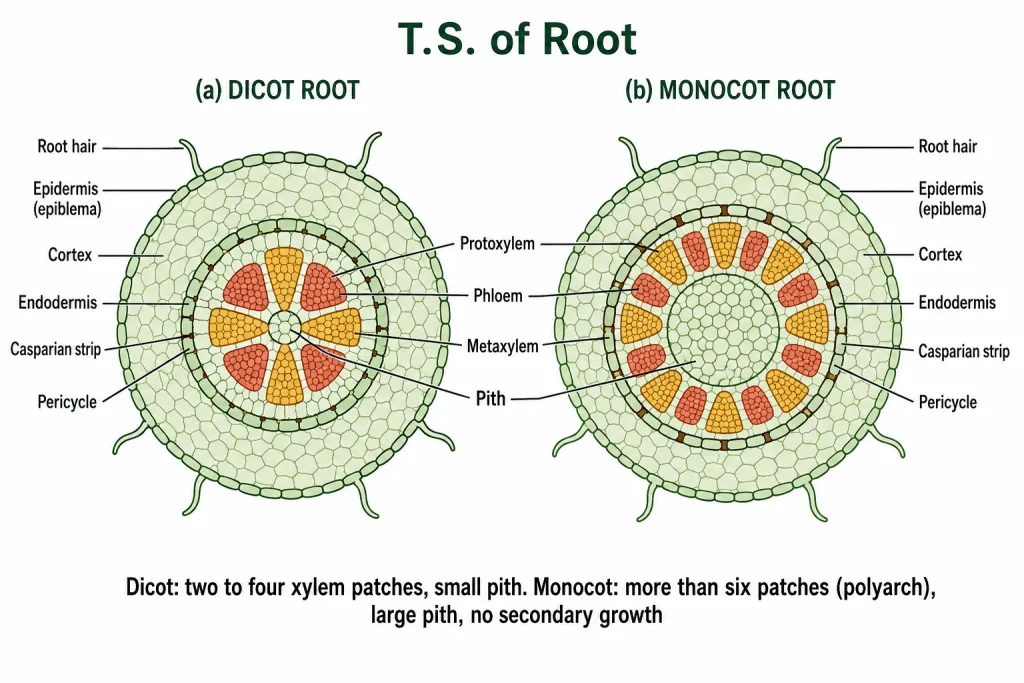
[NEET Important] Two structures here generate most of the questions. The casparian strips are suberin deposited on the tangential and radial walls of the endodermis - all three details are asked. And the pericycle is where lateral roots start, which is why root branches appear to burst out from deep inside rather than from the surface.
The Monocotyledonous Root
The anatomy of the monocot root is similar to the dicot root in many respects. It has the same rings - epidermis, cortex, endodermis, pericycle, vascular bundles and pith.
Three differences, and they are the whole of what is asked:
- Xylem bundles. A dicot root has fewer - usually two to four. A monocot root usually has more than six, which is described as polyarch.
- Pith. Small or inconspicuous in the dicot root; large and well developed in the monocot root.
- Secondary growth. Monocotyledonous roots do not undergo any secondary growth.
| Feature | Dicot root | Monocot root |
|---|---|---|
| Outermost layer | Epiblema, with unicellular root hairs | Epidermis |
| Cortex | Thin-walled parenchyma with intercellular spaces | Same |
| Endodermis | Barrel-shaped cells, casparian strips of suberin | Same |
| Pericycle | Thick-walled parenchyma; starts lateral roots and the vascular cambium | Present |
| Xylem bundles | Two to four | More than six - polyarch |
| Pith | Small or inconspicuous | Large and well developed |
| Between xylem and phloem | Conjunctive tissue | Present |
| Secondary growth | Occurs | Does not occur |
| Vascular bundle type | Radial | Radial |
[NEET Important] Three facts separate the two roots and they are almost always asked together: number of xylem bundles, size of the pith, and whether secondary growth happens. Note what is the same in both, because that gets asked as a negative question - both are radial, both have an endodermis with casparian strips, both have a pericycle.
Quick Recap
Dicot root, working inward
- Epiblema - outermost; cells protrude as unicellular root hairs.
- Cortex - several layers of thin-walled parenchyma with intercellular spaces.
- Endodermis - innermost layer of the cortex; single layer of barrel-shaped cells, no intercellular spaces; casparian strips of suberin on the tangential and radial walls.
- Pericycle - a few layers of thick-walled parenchyma; lateral roots and the vascular cambium start here.
- Two to four xylem and phloem patches; conjunctive tissue between them; a cambium ring develops later.
- Pith small or inconspicuous.
- Stele = everything inside the endodermis - pericycle, vascular bundles and pith.
Monocot root
- Same rings as the dicot root.
- More than six xylem bundles - polyarch.
- Pith large and well developed.
- No secondary growth.
Solved Examples
Question 1
Q. What is the outermost layer of a dicot root called, and what grows out of it?
Answer. The epiblema. Many of its cells protrude as unicellular root hairs.
Question 2
Q. Describe the cortex of a dicot root.
Answer. Several layers of thin-walled parenchyma cells with intercellular spaces.
Question 3
Q. Describe the endodermis of a root.
Answer. It is the innermost layer of the cortex, a single layer of barrel-shaped cells with no intercellular spaces. Its tangential and radial walls carry casparian strips - deposits of the water-impermeable waxy material suberin.
Question 4
Q. What are casparian strips made of, and on which walls do they lie?
Answer. They are made of suberin, a water-impermeable waxy material, and they lie on the tangential as well as the radial walls of the endodermal cells.
Question 5
Q. What two things begin in the pericycle?
Answer. The initiation of lateral roots, and the initiation of vascular cambium during secondary growth.
Question 6
Q. What is conjunctive tissue?
Answer. The parenchymatous cells lying between the xylem and the phloem in a root.
Question 7
Q. Define the stele.
Answer. All the tissues on the inner side of the endodermis - the pericycle, the vascular bundles and the pith.
Question 8
Q. How many xylem patches does a dicot root have, and how many a monocot root?
Answer. A dicot root has two to four. A monocot root usually has more than six, which is called polyarch.
Question 9
Q. Give three differences between a dicot root and a monocot root.
Answer.
| Dicot root | Monocot root | |
|---|---|---|
| Xylem bundles | Two to four | More than six, polyarch |
| Pith | Small or inconspicuous | Large and well developed |
| Secondary growth | Occurs | Does not occur |
This is part of one of the chapter-end exercises.
Question 10
Q. Name three features a dicot root and a monocot root share.
Answer. Both have the same set of rings - epidermis, cortex, endodermis, pericycle, vascular bundles and pith. Both have an endodermis with casparian strips. And in both the vascular bundles are radial.
Question 11
Q. A root section shows eight xylem patches and a large pith. Identify it and give your reason.
Answer. A monocot root. More than six xylem bundles makes it polyarch, and the large well developed pith confirms it - a dicot root would have two to four patches and a small or inconspicuous pith.
Question 12
Q. Why can a monocot root never grow thicker the way a dicot root does?
Answer. Because monocot roots do not undergo any secondary growth. In a dicot root a cambium ring develops between the xylem and the phloem, and the pericycle supplies the vascular cambium; without that activity there is nothing to add new tissue and increase the girth.