
The Ground Tissue System
The definition is written as a subtraction, and it is worth learning in exactly that form.
All tissues except epidermis and vascular bundles constitute the ground tissue.
- It consists of the simple tissues - parenchyma, collenchyma and sclerenchyma.
- Parenchymatous cells are usually present in the cortex, pericycle, pith and medullary rays, in the primary stems and roots.
- In leaves, the ground tissue consists of thin-walled chloroplast-containing cells and is called mesophyll.
| Where you are | What the ground tissue is called |
|---|---|
| Primary stem or root | Cortex, pericycle, pith, medullary rays - largely parenchyma |
| Leaf | Mesophyll - thin-walled cells containing chloroplasts |
[NEET Important] Learn the definition as a subtraction - everything except epidermis and vascular bundles - because that is how the question is set, and it saves you from having to list the parts. The one-word answer worth having ready is mesophyll: the ground tissue of a leaf.
The Vascular Tissue System
The vascular system consists of the complex tissues, the phloem and the xylem. The xylem and phloem together constitute vascular bundles.
Vascular bundles are then classified by two independent questions.
Question one: is a cambium present?
- In dicotyledonous stems, cambium is present between phloem and xylem. Such bundles possess the ability to form secondary xylem and phloem tissues, and are therefore called open.
- In the monocotyledons, the vascular bundles have no cambium. Since they do not form secondary tissues they are called closed.
Question two: how are xylem and phloem placed?
- Radial - the xylem and phloem within a vascular bundle are arranged in an alternate manner along the different radii. Found in roots.
- Conjoint - the xylem and phloem are jointly situated along the same radius. These are common in stems and leaves, and they usually have the phloem located only on the outer side of the xylem.
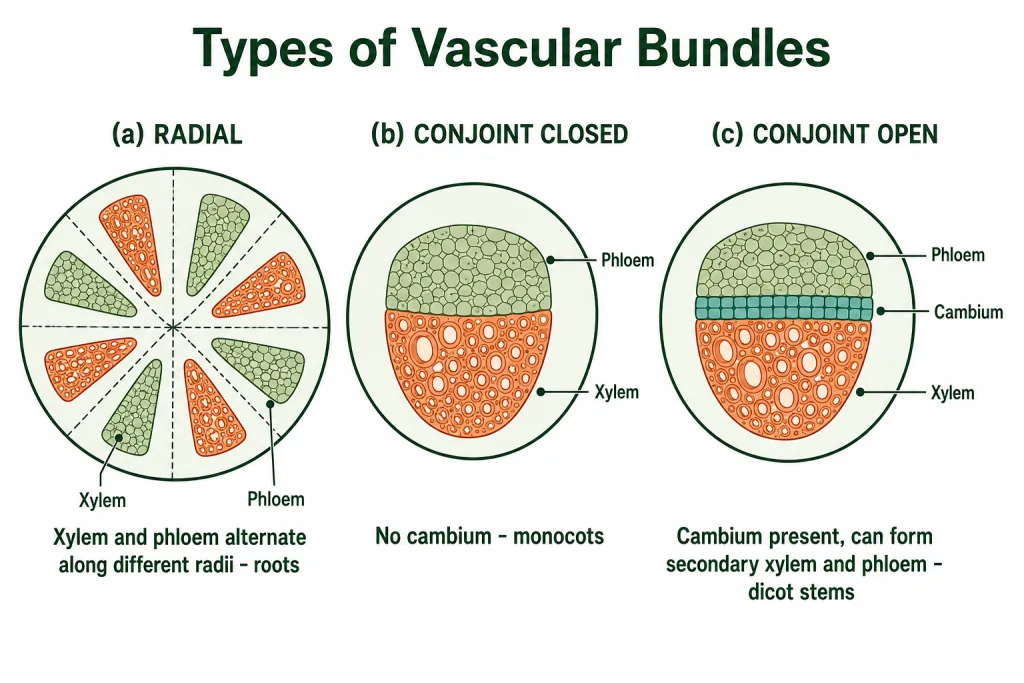
| Type | What it means | Where |
|---|---|---|
| Radial | Xylem and phloem alternate along different radii | Roots |
| Conjoint | Xylem and phloem on the same radius, phloem usually outside the xylem | Stems and leaves |
| Open | Cambium present; can form secondary tissues | Dicot stems |
| Closed | Cambium absent; no secondary tissues | Monocots |
[NEET Important] These are two separate labels, not one scale, and a question will check whether you know that. A dicot stem bundle is conjoint and open; a monocot stem bundle is conjoint and closed; a root bundle is radial. Also fix the reason behind the words - open means it can still grow, because the cambium is there to make secondary xylem and phloem.
Protoxylem, Metaxylem and the Direction of Development
The retained chapter uses the phrase endarch protoxylem when describing the dicot stem, so these two terms have to be in place.
- Protoxylem is the first-formed xylem; its elements are narrower.
- Metaxylem is the later-formed xylem; its elements are wider.
Where the protoxylem sits relative to the metaxylem gives the arrangement a name.
- Endarch - the protoxylem lies towards the centre and the metaxylem towards the periphery. This is the arrangement in stems.
- Exarch - the protoxylem lies towards the periphery and the metaxylem towards the centre. This is the arrangement in roots.
| Endarch | Exarch | |
|---|---|---|
| Protoxylem lies | Towards the centre | Towards the periphery |
| Found in | Stems | Roots |
These two terms are foundation material rather than part of the current chapter text, which uses "endarch" without defining it. They are here because you cannot read the dicot stem section without them.
[NEET Important] The mnemonic that works: endarch - inner; both start with the same sound, and inner means towards the centre, which is the stem. Everything else follows by elimination.
Quick Recap
Ground tissue system
- All tissues except epidermis and vascular bundles.
- Made of the simple tissues - parenchyma, collenchyma, sclerenchyma.
- Parenchyma occupies the cortex, pericycle, pith and medullary rays of primary stems and roots.
- In leaves the ground tissue is the mesophyll - thin-walled, chloroplast-containing cells.
Vascular tissue system
- The complex tissues, xylem and phloem, together forming vascular bundles.
- Open - cambium present between phloem and xylem, so secondary xylem and phloem can form; dicot stems.
- Closed - no cambium, no secondary tissues; monocots.
- Radial - xylem and phloem alternate along different radii; roots.
- Conjoint - xylem and phloem on the same radius, phloem outside the xylem; stems and leaves.
Xylem development
- Protoxylem - first formed, narrower. Metaxylem - later formed, wider.
- Endarch - protoxylem towards the centre; stems.
- Exarch - protoxylem towards the periphery; roots.
Solved Examples
Question 1
Q. Define the ground tissue system.
Answer. All tissues except the epidermis and the vascular bundles. It is made of the simple tissues - parenchyma, collenchyma and sclerenchyma.
Question 2
Q. Where is parenchyma found in a primary stem or root?
Answer. In the cortex, pericycle, pith and medullary rays.
Question 3
Q. What is the ground tissue of a leaf called, and what is it made of?
Answer. The mesophyll. It is made of thin-walled cells containing chloroplasts.
Question 4
Q. What makes up the vascular tissue system?
Answer. The complex tissues, the phloem and the xylem, which together make up the vascular bundles.
Question 5
Q. What is an open vascular bundle, and where is it found?
Answer. One with cambium present between the phloem and the xylem, which gives it the ability to form secondary xylem and phloem. It is found in dicotyledonous stems.
Question 6
Q. Why are monocot vascular bundles called closed?
Answer. Because they have no cambium, so they cannot form secondary tissues. There is nothing left in them that can grow.
Question 7
Q. What is a radial vascular bundle and where does it occur?
Answer. One in which the xylem and phloem are arranged in an alternate manner along the different radii. This is the arrangement found in roots.
Question 8
Q. What is a conjoint vascular bundle, and where is the phloem in it?
Answer. One in which the xylem and phloem are jointly situated along the same radius. The phloem is usually located only on the outer side of the xylem. Conjoint bundles are common in stems and leaves.
Question 9
Q. Distinguish between protoxylem and metaxylem.
Answer. Protoxylem is the first-formed xylem and its elements are narrower. Metaxylem is the later-formed xylem and its elements are wider.
Question 10
Q. What do endarch and exarch mean, and where is each found?
Answer. Endarch means the protoxylem lies towards the centre, and that is the arrangement in stems. Exarch means the protoxylem lies towards the periphery, and that is the arrangement in roots.
Question 11
Q. A vascular bundle is described as conjoint and open. What can you say about the organ and the plant?
Answer. Conjoint means it is from a stem or a leaf, and open means a cambium is present, which makes the plant a dicot. So it is a dicot stem.
Question 12
Q. A section shows xylem and phloem lying on separate radii, alternating with each other. Name the bundle type and the organ.
Answer. The bundle is radial, and the organ is a root. That alternate arrangement occurs nowhere else.