
The Three Tissue Systems
Tissues can be sorted by the type of cells they contain, which is what the previous section did. They can also be sorted by where they sit in the plant body, and since structure and function both depend on location, that turns out to be the more useful sort.
On the basis of their structure and location there are three tissue systems:
- The epidermal tissue system
- The ground or fundamental tissue system
- The vascular or conducting tissue system
[NEET Important] Naming these three, and naming the tissues that fall under each, is one of the chapter-end exercises - so learn them as a set of three from the start, and attach the tissue names to each one as you go.
The Epidermal Tissue System
The epidermal tissue system forms the outer-most covering of the whole plant body. It comprises epidermal cells, stomata and the epidermal appendages - the trichomes and hairs.
The epidermis.
- It is the outermost layer of the primary plant body.
- Made of elongated, compactly arranged cells which form a continuous layer.
- Usually single-layered.
- Epidermal cells are parenchymatous, with a small amount of cytoplasm lining the cell wall and a large vacuole.
- The outside is often covered with a waxy thick layer called the cuticle, which prevents the loss of water. Cuticle is absent in roots.
[NEET Important] Three exact phrases get quoted in questions: the epidermis is usually single-layered, its cells are parenchymatous, and the cuticle prevents the loss of water and is absent in roots. That last one is a favourite, and the reason is obvious once you see it - a root has to let water in, so a waterproof layer would defeat the purpose.
Stomata and the Stomatal Apparatus
Stomata are structures present in the epidermis of leaves. They regulate the process of transpiration and gaseous exchange.
- Each stoma is composed of two bean-shaped cells known as guard cells, which enclose the stomatal pore.
- In grasses, the guard cells are dumb-bell shaped.
- The outer walls of the guard cells, away from the stomatal pore, are thin, and the inner walls, towards the pore, are highly thickened.
- The guard cells possess chloroplasts and regulate the opening and closing of stomata.
- Sometimes a few epidermal cells in the vicinity of the guard cells become specialised in their shape and size and are known as subsidiary cells.
- The stomatal aperture, guard cells and the surrounding subsidiary cells are together called the stomatal apparatus.
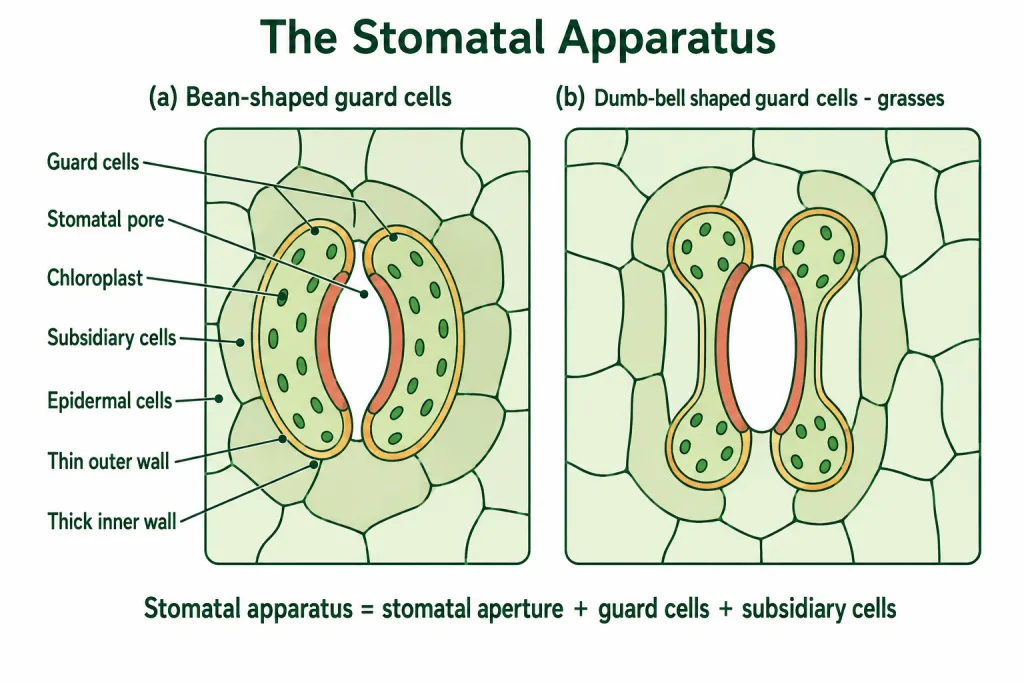
| Feature | The fact to hold |
|---|---|
| Where | Epidermis of leaves |
| Function | Transpiration and gaseous exchange |
| Guard cells | Two, bean-shaped; dumb-bell shaped in grasses |
| Guard cell walls | Outer thin, inner highly thickened |
| Chloroplasts | Present in the guard cells |
| Subsidiary cells | Specialised epidermal cells near the guard cells |
| Stomatal apparatus | Stomatal aperture + guard cells + subsidiary cells |
[NEET Important] The definition of the stomatal apparatus is a chapter-end exercise and it must be given in full - the aperture, the guard cells and the surrounding subsidiary cells together. The wall detail is the other favourite: outer wall thin, inner wall highly thickened, and it is that unequal thickening that lets the guard cells bend and open the pore.
Trichomes and Root Hairs
The cells of the epidermis bear a number of hairs, and the chapter is careful to give them two different names depending on where they are.
Root hairs
- Unicellular elongations of the epidermal cells.
- They help absorb water and minerals from the soil.
Trichomes
- The epidermal hairs on the stem are called trichomes.
- The trichomes in the shoot system are usually multicellular.
- They may be branched or unbranched, soft or stiff, and may even be secretory.
- They help in preventing water loss due to transpiration.
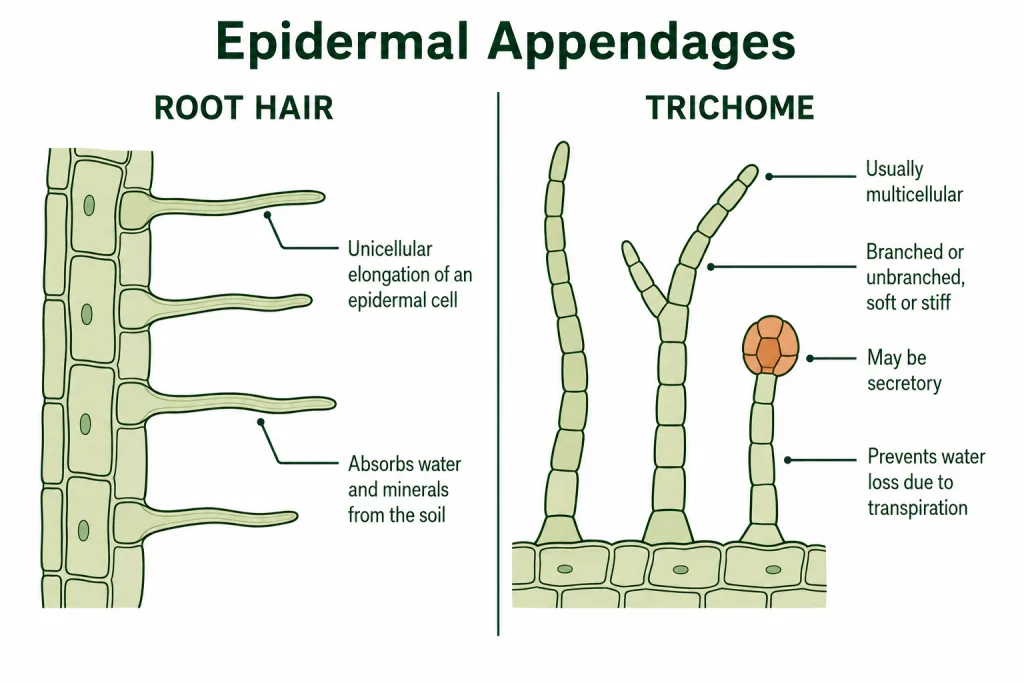
| Root hair | Trichome | |
|---|---|---|
| Where | Root epidermis | Stem and the rest of the shoot system |
| Cells | Unicellular | Usually multicellular |
| Form | Simple elongation | Branched or unbranched, soft or stiff, sometimes secretory |
| Job | Absorb water and minerals from the soil | Prevent water loss due to transpiration |
[NEET Important] This is the cleanest one-line contrast in the chapter, and it is asked constantly: root hairs are unicellular and absorb; trichomes are multicellular and prevent water loss. Get the cell count the wrong way round and both halves of the answer go.
Quick Recap
Three tissue systems, sorted by structure and location: epidermal, ground or fundamental, vascular or conducting.
Epidermal tissue system - the outer-most covering of the whole plant body; epidermal cells + stomata + epidermal appendages (trichomes and hairs).
Epidermis
- Outermost layer of the primary plant body; elongated, compactly arranged cells in a continuous layer; usually single-layered.
- Cells parenchymatous, with a small amount of cytoplasm lining the wall and a large vacuole.
- Cuticle - waxy and thick, prevents loss of water; absent in roots.
Stomata
- In the epidermis of leaves; regulate transpiration and gaseous exchange.
- Two bean-shaped guard cells enclosing the stomatal pore; dumb-bell shaped in grasses.
- Outer wall thin, inner wall highly thickened; guard cells have chloroplasts.
- Subsidiary cells - specialised epidermal cells near the guard cells.
- Stomatal apparatus = aperture + guard cells + subsidiary cells.
Hairs
- Root hairs - unicellular elongations of epidermal cells; absorb water and minerals.
- Trichomes - on the stem, usually multicellular, branched or unbranched, soft or stiff, may be secretory; prevent water loss due to transpiration.
Solved Examples
Question 1
Q. Name the three tissue systems and say what they are classified on.
Answer. The epidermal, the ground or fundamental, and the vascular or conducting tissue systems. They are classified on the basis of their structure and location in the plant body.
Question 2
Q. What makes up the epidermal tissue system?
Answer. Epidermal cells, stomata, and the epidermal appendages - the trichomes and hairs.
Question 3
Q. Describe the epidermis.
Answer. It is the outermost layer of the primary plant body, made of elongated, compactly arranged cells forming a continuous layer, and it is usually single-layered. The cells are parenchymatous, with a small amount of cytoplasm lining the cell wall and a large vacuole.
Question 4
Q. What is the cuticle, what does it do, and where is it missing?
Answer. A waxy thick layer on the outside of the epidermis. It prevents the loss of water. It is absent in roots.
Question 5
Q. What do stomata do?
Answer. They regulate transpiration and gaseous exchange.
Question 6
Q. Describe the guard cells of a stoma.
Answer. There are two, and they are bean-shaped, enclosing the stomatal pore. In grasses they are dumb-bell shaped instead. Their outer walls, away from the pore, are thin and their inner walls, towards the pore, are highly thickened, and they possess chloroplasts and regulate the opening and closing of the stoma.
Question 7
Q. What are subsidiary cells?
Answer. A few epidermal cells in the vicinity of the guard cells that have become specialised in their shape and size.
Question 8
Q. What is the stomatal apparatus?
Answer. The stomatal aperture, the guard cells and the surrounding subsidiary cells taken together. This is one of the chapter-end exercises, and the answer needs all three parts.
Question 9
Q. How does a root hair differ from a trichome?
Answer.
| Root hair | Trichome | |
|---|---|---|
| Where | On the root | On the stem and shoot system |
| Cells | Unicellular | Usually multicellular |
| Job | Absorbs water and minerals from the soil | Prevents water loss due to transpiration |
Question 10
Q. In what forms can a trichome occur?
Answer. Branched or unbranched, soft or stiff, and it may even be secretory.
Question 11
Q. Why does a root have no cuticle when a leaf has a thick one?
Answer. Because the two surfaces have opposite jobs. The cuticle prevents the loss of water, which is what a leaf needs. A root has to absorb water and minerals from the soil, and a waxy waterproof layer would block exactly that. So the cuticle is absent in roots.
Question 12
Q. A leaf epidermis is examined and the guard cells are found to be dumb-bell shaped. What does that tell you about the plant?
Answer. It is a grass. Guard cells are bean-shaped in most plants and dumb-bell shaped in grasses, so the shape alone identifies the group.