
The Dicotyledonous Stem
Working inward from the outside of a typical young dicot stem:
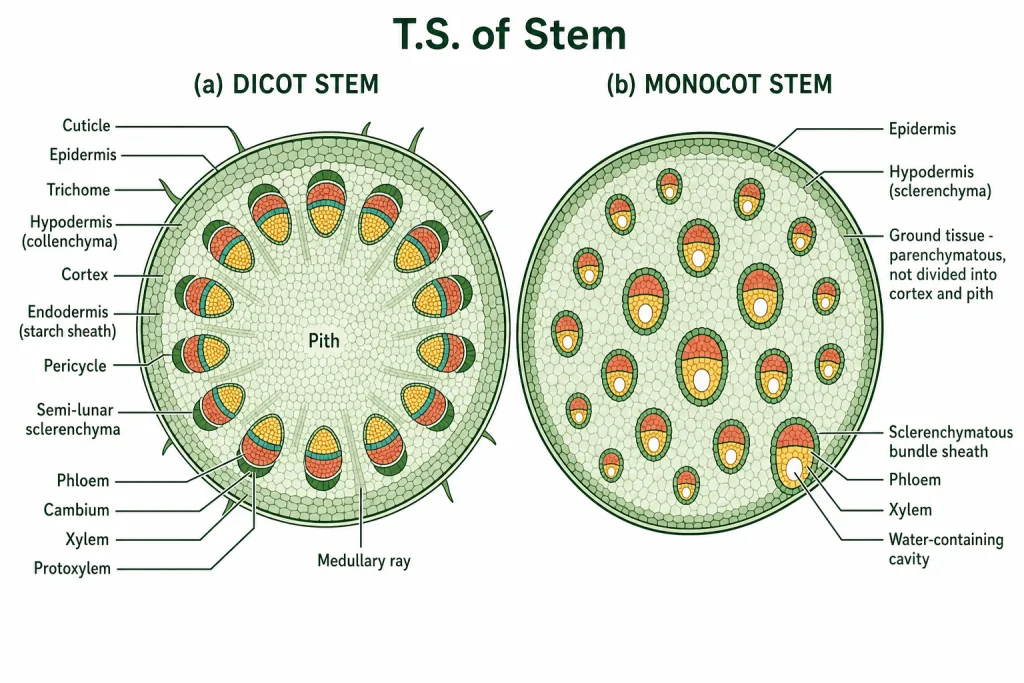
Epidermis. The outermost protective layer, covered with a thin layer of cuticle. It may bear trichomes and a few stomata.
Cortex. The cells arranged in multiple layers between the epidermis and the pericycle. It has three sub-zones:
- Hypodermis - the outer zone, a few layers of collenchymatous cells just below the epidermis, which provide mechanical strength to the young stem.
- Cortical layers below the hypodermis - rounded, thin-walled parenchymatous cells with conspicuous intercellular spaces.
- Endodermis - the innermost layer of the cortex. Its cells are rich in starch grains, and the layer is therefore also called the starch sheath.
Pericycle. Present on the inner side of the endodermis and above the phloem, in the form of semi-lunar patches of sclerenchyma.
Medullary rays. In between the vascular bundles there are a few layers of radially placed parenchymatous cells.
Vascular bundles. A large number arranged in a ring - and the ring arrangement of vascular bundles is a characteristic of the dicot stem. Each vascular bundle is conjoint, open, and with endarch protoxylem.
Pith. A large number of rounded parenchymatous cells with large intercellular spaces occupying the central portion of the stem.
[NEET Important] Three phrases from this block appear again and again: the endodermis is the starch sheath, the pericycle is semi-lunar patches of sclerenchyma above the phloem, and each bundle is conjoint, open and endarch. That last one is a three-word answer and all three words carry a mark.
The Monocotyledonous Stem
The monocot stem is described entirely by how it differs, and there are six points.
- A sclerenchymatous hypodermis - not the collenchymatous one of the dicot stem.
- A large number of scattered vascular bundles, not a ring.
- Each bundle is surrounded by a sclerenchymatous bundle sheath.
- A large, conspicuous parenchymatous ground tissue - not separated into cortex and pith.
- Vascular bundles are conjoint and closed.
- Peripheral vascular bundles are generally smaller than the centrally located ones.
- The phloem parenchyma is absent, and water-containing cavities are present within the vascular bundles.
| Feature | Dicot stem | Monocot stem |
|---|---|---|
| Hypodermis | Collenchymatous | Sclerenchymatous |
| Vascular bundles | Arranged in a ring | Scattered |
| Bundle type | Conjoint, open, endarch | Conjoint and closed |
| Bundle sheath | Absent | Sclerenchymatous bundle sheath round each bundle |
| Ground tissue | Divided into cortex, endodermis (starch sheath), pericycle, medullary rays and pith | A single large conspicuous parenchymatous ground tissue |
| Bundle size | Similar | Peripheral bundles smaller than central ones |
| Phloem parenchyma | Present | Absent |
| Water-containing cavities | Absent | Present within the vascular bundles |
| Secondary growth | Occurs | Does not occur |
[NEET Important] One of the chapter-end exercises hands you a section and asks you to identify it from scattered conjoint bundles with sclerenchymatous bundle sheaths and no phloem parenchyma - that is a monocot stem, and those three features together are conclusive. The single quickest test in practice is the hypodermis: collenchymatous means dicot, sclerenchymatous means monocot.
Quick Recap
Dicot stem, working inward
- Epidermis - outermost protective layer, thin cuticle, may bear trichomes and a few stomata.
- Cortex in three sub-zones: collenchymatous hypodermis giving mechanical strength to the young stem; rounded thin-walled parenchyma with conspicuous intercellular spaces; and the endodermis, rich in starch grains, also called the starch sheath.
- Pericycle - semi-lunar patches of sclerenchyma, inside the endodermis and above the phloem.
- Medullary rays - radially placed parenchymatous cells between the vascular bundles.
- Vascular bundles - a large number arranged in a ring; each conjoint, open, endarch.
- Pith - rounded parenchymatous cells with large intercellular spaces in the centre.
Monocot stem
- Sclerenchymatous hypodermis.
- Scattered vascular bundles, each with a sclerenchymatous bundle sheath.
- Large conspicuous parenchymatous ground tissue.
- Bundles conjoint and closed; peripheral bundles smaller than central ones.
- Phloem parenchyma absent; water-containing cavities present within the bundles.
Solved Examples
Question 1
Q. What covers the epidermis of a dicot stem, and what may it bear?
Answer. A thin layer of cuticle. It may bear trichomes and a few stomata.
Question 2
Q. Name the three sub-zones of the cortex of a dicot stem.
Answer. The hypodermis, the cortical layers below it, and the endodermis.
Question 3
Q. What is the hypodermis of a dicot stem made of, and what does it do?
Answer. A few layers of collenchymatous cells just below the epidermis, and they provide mechanical strength to the young stem.
Question 4
Q. Why is the endodermis of a dicot stem called the starch sheath?
Answer. Because its cells are rich in starch grains.
Question 5
Q. Describe the pericycle of a dicot stem.
Answer. It lies on the inner side of the endodermis and above the phloem, in the form of semi-lunar patches of sclerenchyma.
Question 6
Q. What are medullary rays in a dicot stem?
Answer. A few layers of radially placed parenchymatous cells lying between the vascular bundles.
Question 7
Q. Describe a dicot stem vascular bundle in three words, and say what the arrangement of the bundles is.
Answer. Conjoint, open and endarch. The bundles are arranged in a ring, and that ring arrangement is a characteristic of the dicot stem.
Question 8
Q. Give the features of a monocot stem.
Answer. A sclerenchymatous hypodermis; a large number of scattered vascular bundles, each surrounded by a sclerenchymatous bundle sheath; a large, conspicuous parenchymatous ground tissue; bundles that are conjoint and closed; peripheral bundles generally smaller than the central ones; no phloem parenchyma; and water-containing cavities within the vascular bundles.
Question 9
Q. You cut a transverse section of a young stem and look at it under the microscope. How would you decide whether it is a monocot stem or a dicot stem?
Answer. Check three things, in this order.
- The arrangement of the vascular bundles. In a ring means dicot; scattered through the section means monocot.
- The hypodermis. Collenchymatous means dicot; sclerenchymatous means monocot.
- The bundle itself. A cambium between xylem and phloem, making the bundle open, means dicot; no cambium, so closed, and a sclerenchymatous bundle sheath round it, means monocot.
A dicot stem will also show a distinct cortex, endodermis, pericycle and pith, where a monocot stem has one undivided parenchymatous ground tissue. This is one of the chapter-end exercises.
Question 10
Q. A transverse section shows vascular bundles that are conjoint, scattered and surrounded by sclerenchymatous bundle sheaths, and the phloem parenchyma is absent. What will you identify it as?
Answer. A monocotyledonous stem. Each of those three features points to it, and together they are conclusive - a dicot stem has its bundles in a ring, no bundle sheath, and phloem parenchyma present. This is one of the chapter-end exercises.
Question 11
Q. Why does a dicot stem have a collenchymatous hypodermis while a monocot stem has a sclerenchymatous one?
Answer. A young dicot stem is still growing and will thicken later, so it needs support that is living and flexible - which is collenchyma. A monocot stem does not undergo secondary growth, so it reaches its final thickness early and can afford rigid, dead sclerenchyma for support from the start.
Question 12
Q. Where is the pith in a monocot stem?
Answer. There is no separate pith. A monocot stem has a single large, conspicuous parenchymatous ground tissue that is not divided into cortex and pith, because the scattered bundles run through the whole of it.