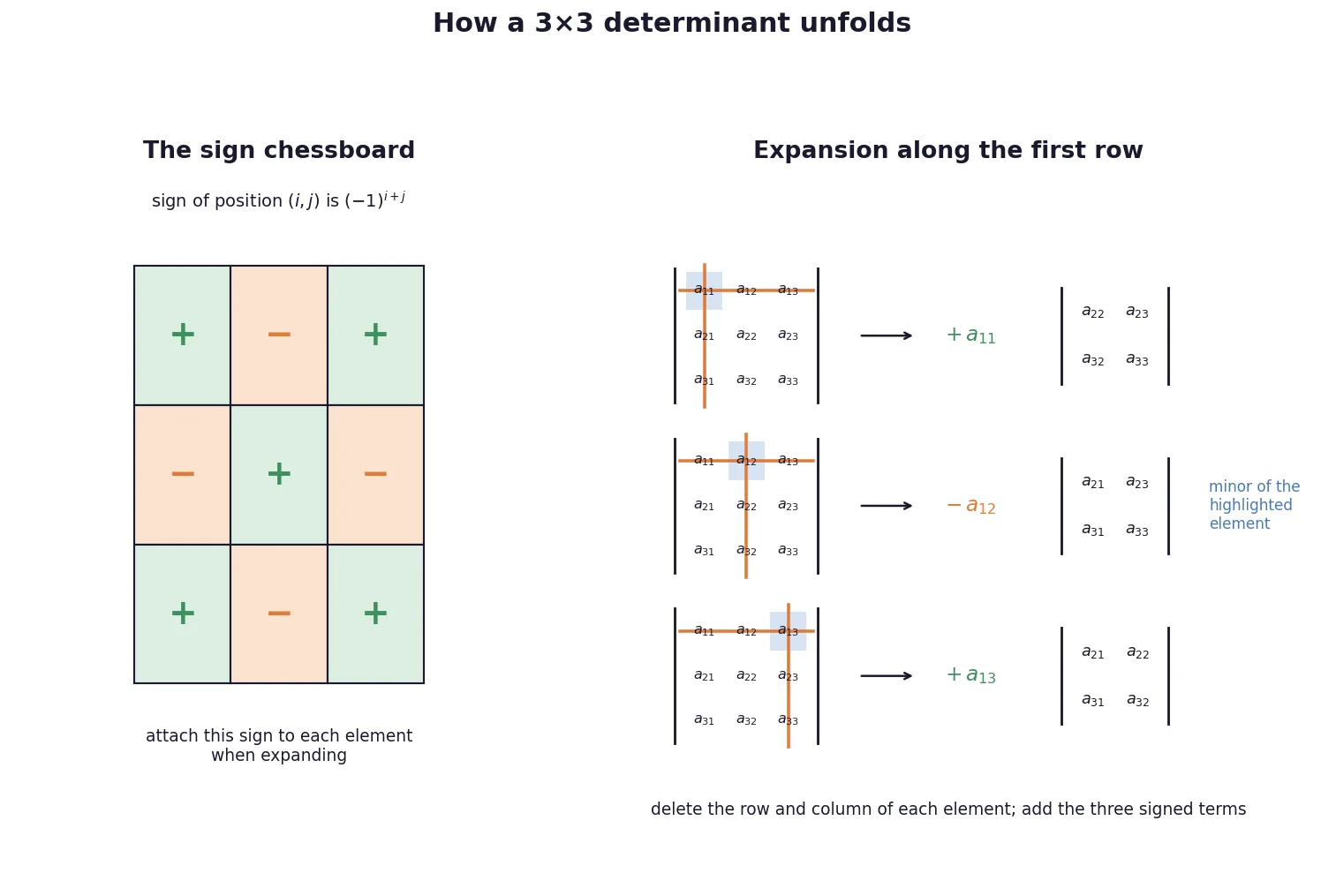
To every square matrix A=[aij] of order n we attach a single number (real or complex) called its determinant, written detA, ∣A∣ or Δ. Think of it as a function f:M→K from the set of square matrices to the set of numbers — each square matrix in, exactly one number out. Chapter 3 ended with invertibility; this number is precisely what decides it.
Two warnings before any computation (both are favourite one-mark traps):
∣A∣ is read determinant ofA — it is not a modulus, and a determinant can be negative.
Only square matrices have determinants. A 2×3 matrix has none.
Order one
For A=[a], simply detA=a. (So the determinant of [−5] is −5, not 5 — warning 1 already at work.)
Order two
For A=(a11a21a12a22):
∣A∣=a11a21a12a22=a11a22−a21a12
— the product of the main diagonal minus the product of the other diagonal. For example,
2−142=2(2)−4(−1)=8
Entries can be algebraic too, and the algebra often collapses:
xx−1x+1x=x2−(x+1)(x−1)=x2−(x2−1)=1
— a determinant that is the same number for every x.
Solved Examples — Order Two
Example 1 — A plain evaluation
Evaluate 2−54−1.
Step 1 — diagonal rule: main diagonal product minus anti-diagonal product: 2(−1)−4(−5).
There are six possible expansions — three rows and three columns — and all six give the same value. That freedom is worth marks:
The zeros shortcut. Expand along the row or column with the most zeros: every zero kills its whole term. In
Δ=1−14231400
the third column has two zeros, so expanding along C3 leaves a single term: Δ=4−1431−0+0=4(−1−12)=−52.
The sign chessboard. Instead of computing (−1)i+j each time, remember the pattern +−+−+−+−+ — corners and centre positive, edges negative.
The scaling law
Multiplying the whole matrix by k multiplies every row by k, and each of the n rows contributes one factor:
∣kA∣=kn∣A∣(A of order n)
So for a 2×2 matrix ∣2A∣=4∣A∣, and for a 3×3 matrix ∣3A∣=27∣A∣. Writing ∣kA∣=k∣A∣ is the classic error of this section — determinants are not linear in the matrix.
One more freebie: a triangular matrix (all zeros below, or above, the diagonal) has determinant equal to the product of its diagonal entries — expand repeatedly along the zero-heavy column and watch every other term vanish.
Solved Examples — Order Three
Example 4 — Using the zeros shortcut
Evaluate Δ=303−10−5−2−10.
Step 1 — choose the row with most zeros:R2 has two zeros, so expand along it. Chessboard signs for row 2 are −,+,−.
Step 2 — only one term survives:Δ=−0−1−5−20+033−20−(−1)33−1−5
Step 3 — finish:Δ=1⋅(3(−5)−(−1)(3))=−15+3=−12.
Answer:−12.
Example 5 — A determinant that vanishes identically
Evaluate Δ=0−sinαcosαsinα0−sinβ−cosαsinβ0.
Step 1 — expand along R1:Δ=0−sinα−sinαcosαsinβ0+(−cosα)−sinαcosα0−sinβ
Step 2 — evaluate the two minors: first bracket: 0−sinβcosα=−sinβcosα; second bracket: sinαsinβ−0=sinαsinβ.
Step 3 — combine:Δ=sinαsinβcosα−cosαsinαsinβ=0.
Answer:0. (Look at the matrix again: it is skew-symmetric of odd order — Section 8 turns this observation into a one-line rule.)
Example 6 — Verifying the scaling law
For A=(1422), show that ∣2A∣=4∣A∣.
Step 1 — left side:2A=(2844), so ∣2A∣=8−32=−24.
Step 2 — right side:∣A∣=2−8=−6, so 4∣A∣=−24.
Answer: both sides equal −24; in general ∣kA∣=k2∣A∣ for order 2.
Example 7 — A triangular determinant
Evaluate ∣A∣ for A=100010124, and hence find ∣3A∣.
Step 1 — expand along C1 (two zeros):∣A∣=11024=4 — exactly the product of the diagonal entries 1⋅1⋅4.
Step 2 — scaling law with n=3:∣3A∣=33∣A∣=27×4=108.
Answer:∣A∣=4 and ∣3A∣=108.
Ready to test your knowledge?
Take a quick interactive quiz on this topic —
free, works without login.