Key Concepts and Formulas

1. Determinant Expansion

  • For a 2×22 \times 2 matrix A=[abcd]A = \begin{bmatrix} a & b \\ c & d \end{bmatrix}, the determinant is A=adbc|A| = ad - bc.
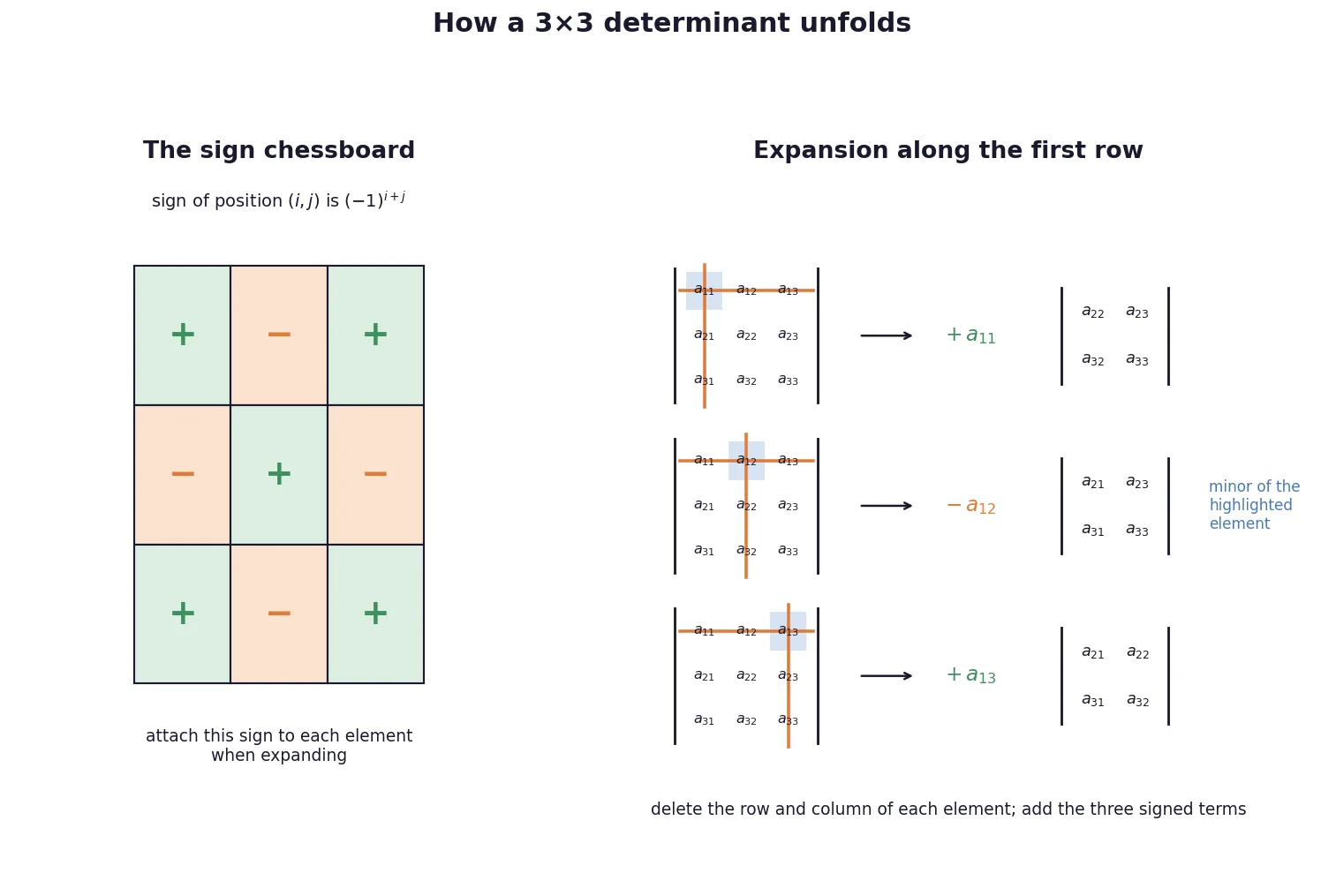
  • For a 3×33 \times 3 matrix, the determinant is expanded using the elements of any row or column and their corresponding cofactors. E.g., expanding along R1R_1: Δ=a11A11+a12A12+a13A13\Delta = a_{11}A_{11} + a_{12}A_{12} + a_{13}A_{13}.

2. Area of a Triangle

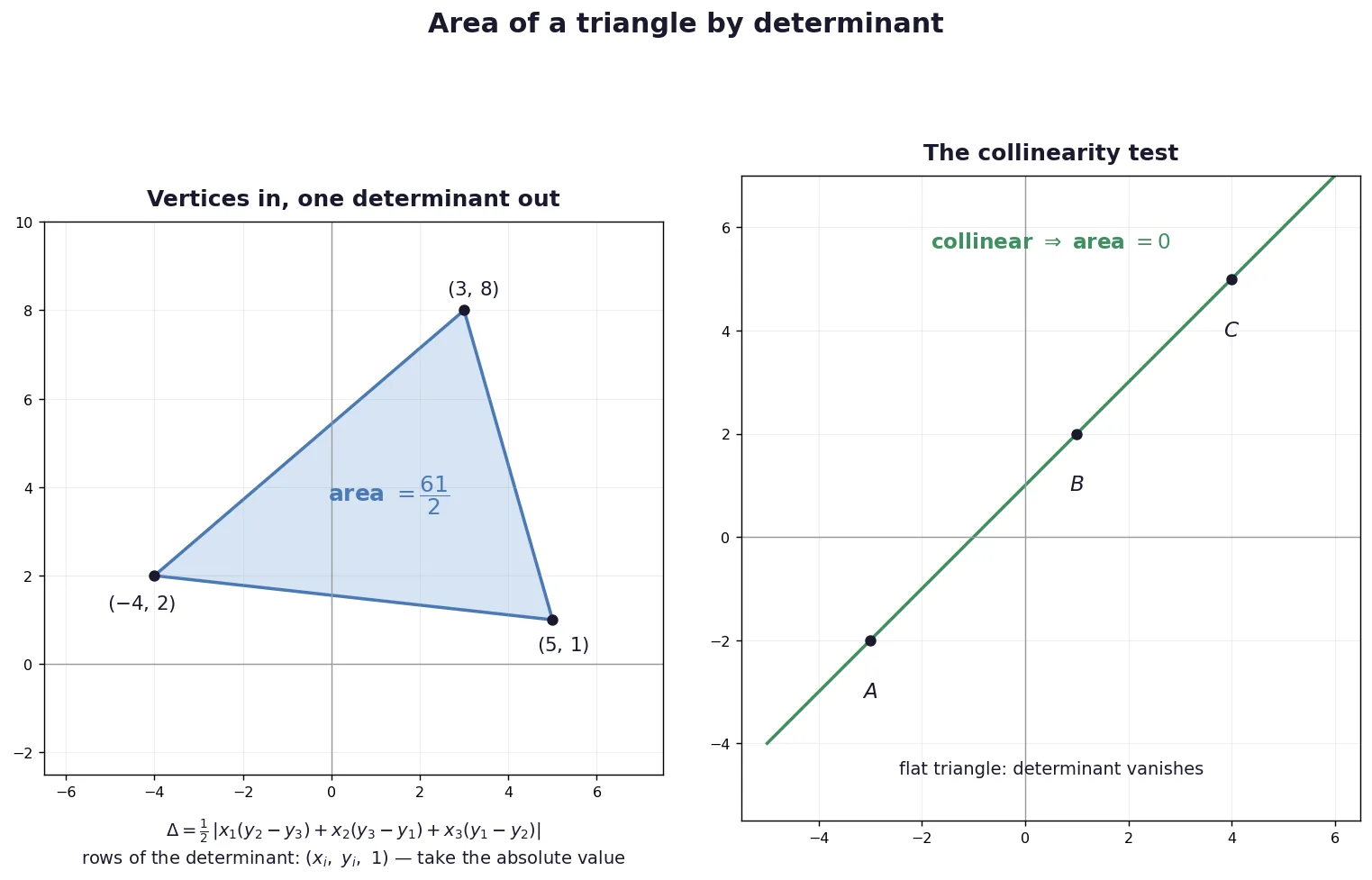
  • Area Δ=12x1y11x2y21x3y31\Delta = \frac{1}{2} \left| \begin{vmatrix} x_1 & y_1 & 1 \\ x_2 & y_2 & 1 \\ x_3 & y_3 & 1 \end{vmatrix} \right|.
  • Collinearity: Three points are collinear if the area of the triangle formed by them is zero, i.e., x1y11x2y21x3y31=0\begin{vmatrix} x_1 & y_1 & 1 \\ x_2 & y_2 & 1 \\ x_3 & y_3 & 1 \end{vmatrix} = 0.
  • Equation of a line: The equation of a line passing through (x1,y1)(x_1, y_1) and (x2,y2)(x_2, y_2) is given by xy1x1y11x2y21=0\begin{vmatrix} x & y & 1 \\ x_1 & y_1 & 1 \\ x_2 & y_2 & 1 \end{vmatrix} = 0.

3. Minors and Cofactors

  • Minor (MijM_{ij}): Determinant obtained by deleting the ithi^{th} row and jthj^{th} column.
  • Cofactor (AijA_{ij}): Aij=(1)i+jMijA_{ij} = (-1)^{i+j} M_{ij}.
  • Zero Property: The sum of products of elements of any row (or column) with the cofactors of any other row (or column) is zero.

4. Adjoint and Inverse of a Matrix

  • Adjoint (adj A\text{adj } A): The transpose of the cofactor matrix.
  • Inverse (A1A^{-1}): A1=1Aadj AA^{-1} = \frac{1}{|A|} \text{adj } A, provided A0|A| \neq 0 (i.e., AA is non-singular).
Important Adjoint Properties (Order nn)
  1. A(adj A)=(adj A)A=AIA(\text{adj } A) = (\text{adj } A)A = |A|I
  2. adj A=An1|\text{adj } A| = |A|^{n-1}
  3. adj(adj A)=A(n1)2|\text{adj}(\text{adj } A)| = |A|^{(n-1)^2}
  4. adj(AB)=(adj B)(adj A)\text{adj}(AB) = (\text{adj } B)(\text{adj } A)
Important Inverse Properties
  1. (A1)1=A(A^{-1})^{-1} = A
  2. (AB)1=B1A1(AB)^{-1} = B^{-1}A^{-1} (Reversal Law)
  3. (AT)1=(A1)T(A^T)^{-1} = (A^{-1})^T
  4. A1=1A|A^{-1}| = \frac{1}{|A|}

5. System of Linear Equations (AX=BAX = B)

  • Unique Solution (Consistent): If A0|A| \neq 0, then X=A1BX = A^{-1}B.
  • No Solution (Inconsistent): If A=0|A| = 0 and (adj A)BO(\text{adj } A)B \neq O.
  • Infinitely Many Solutions (Consistent): If A=0|A| = 0 and (adj A)B=O(\text{adj } A)B = O.

Exam Tips for Board Exams

Show Your Work

Board exams award step marks. When finding the inverse of a 3×33 \times 3 matrix, explicitly show the calculation of at least a few cofactors. Do not just write the final adjoint matrix directly.

Formula First

Always write the general formula before plugging in numbers (e.g., write A1=1Aadj AA^{-1} = \frac{1}{|A|} \text{adj } A before calculating it).

Checking Consistency

Before calculating the adjoint for solving AX=BAX = B, always calculate A|A| first. If A=0|A| = 0, explicitly state the condition you are checking next ((adj A)B(\text{adj } A)B) and write the conclusion clearly.

Matrix Polynomials

For questions asking to prove A25A+7I=OA^2 - 5A + 7I = O and "hence find A1A^{-1}", do not use the standard adjoint method to find A1A^{-1}. You must multiply the polynomial equation by A1A^{-1} and solve it algebraically. Using the adjoint method here will result in a loss of marks.

Word Problems

Clearly define your variables (x,y,zx, y, z) and formulate the equations step-by-step. Representing them in the AX=BAX=B format carries partial credit even if subsequent calculations have an error.

Smart Expansion

When evaluating a 3×33 \times 3 determinant, scan for the row or column with the maximum number of zeros and expand along it to save time and reduce calculation errors.


Exam Tips for JEE Main & Advanced

Master Adjoint Properties

The properties adj A=An1|\text{adj } A| = |A|^{n-1} and adj(adj A)=A(n1)2|\text{adj}(\text{adj } A)| = |A|^{(n-1)^2} are extremely high-yield. Memorize them perfectly. They often turn complex 3-minute calculations into 10-second mental math problems.

Homogeneous Systems (AX=OAX = O)

Questions frequently ask for conditions where a homogeneous system has non-trivial solutions. This directly implies you need to set A=0|A| = 0 and solve for the unknown parameter (like λ\lambda or kk).

Trigonometric & Polynomial Determinants

JEE questions often embed trigonometry or polynomials inside determinants. Use row/column operations (RiRi+kRjR_i \to R_i + kR_j) vigorously to create zeros or pull out common factors before expanding. Expanding directly usually leads to messy algebra.

Cayley-Hamilton Theorem

While not explicitly in the NCERT syllabus, knowing that every square matrix satisfies its own characteristic equation (AλI=0|A - \lambda I| = 0) is a massive shortcut for finding higher powers of a matrix (like A50A^{50}) or relating A1A^{-1} to AA and A2A^2.

Symmetric and Skew-Symmetric Integration

Be prepared to use determinant properties like AT=A|A^T| = |A|. Recall that the determinant of an odd-order skew-symmetric matrix is always 00.

Check for Constant Determinants

Sometimes, after applying a single row/column operation (like adding all columns to C1C_1), you might find that the determinant is entirely independent of the variable xx or θ\theta. Look out for this pattern.