
The Chapter in One Sweep
A Linear Programming Problem: find the optimal (maximum or minimum) value of a linear objective function subject to linear constraints and the non-negative restrictions . The are decision variables; formulation is the four-move recipe — name variables, write , translate each resource () or requirement () into an inequality, add non-negativity.
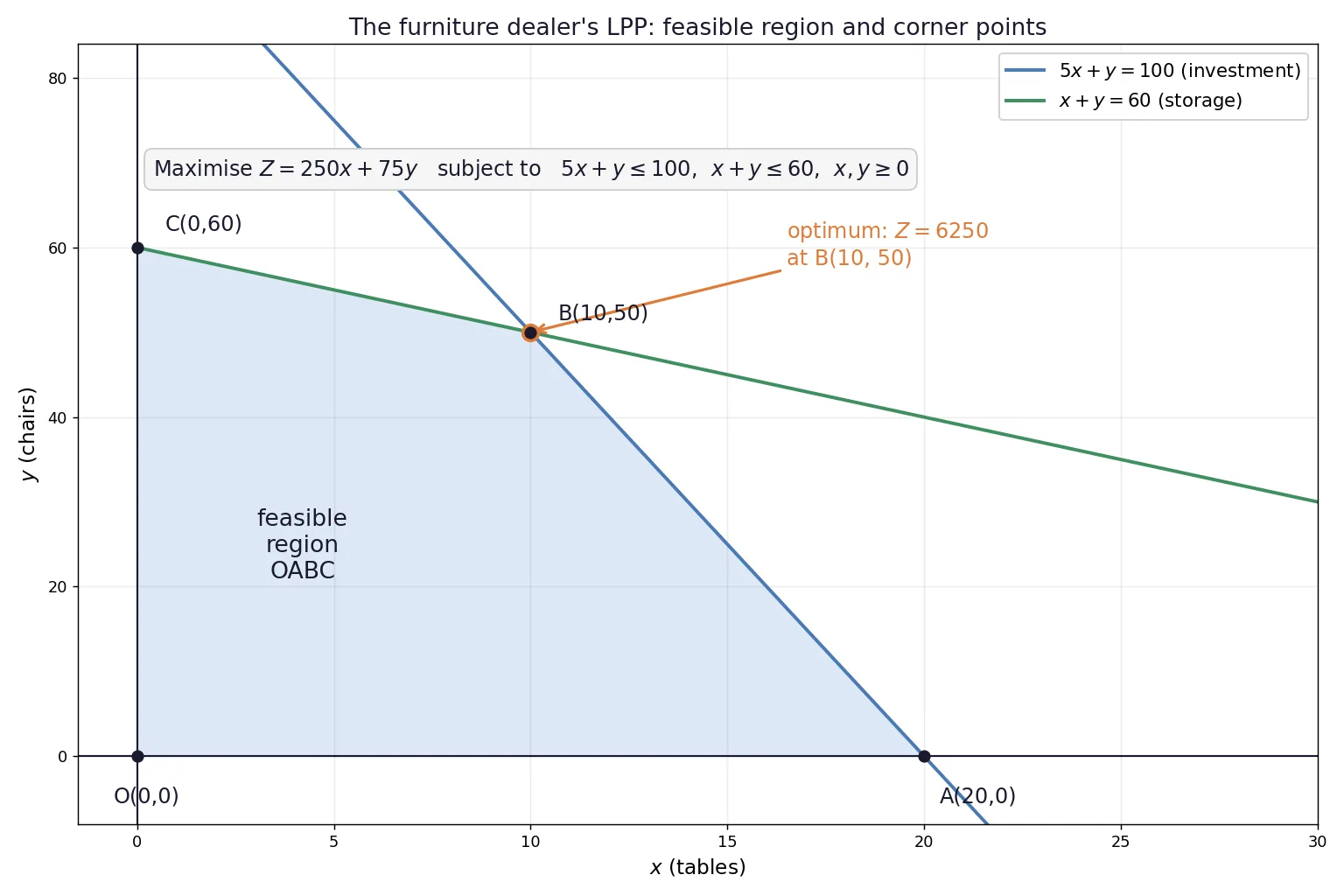
The engine
The constraints carve out the feasible region — the convex common region of all half-planes. Theorem 1: an optimal value, when it exists, occurs at a corner point. Theorem 2: a bounded region guarantees both a maximum and a minimum, at corners.
The Corner Point Method: draw the region → find the corners (solve intersecting line pairs) → tabulate at each corner → largest is , smallest is → bounded: done; unbounded: run the half-plane test.
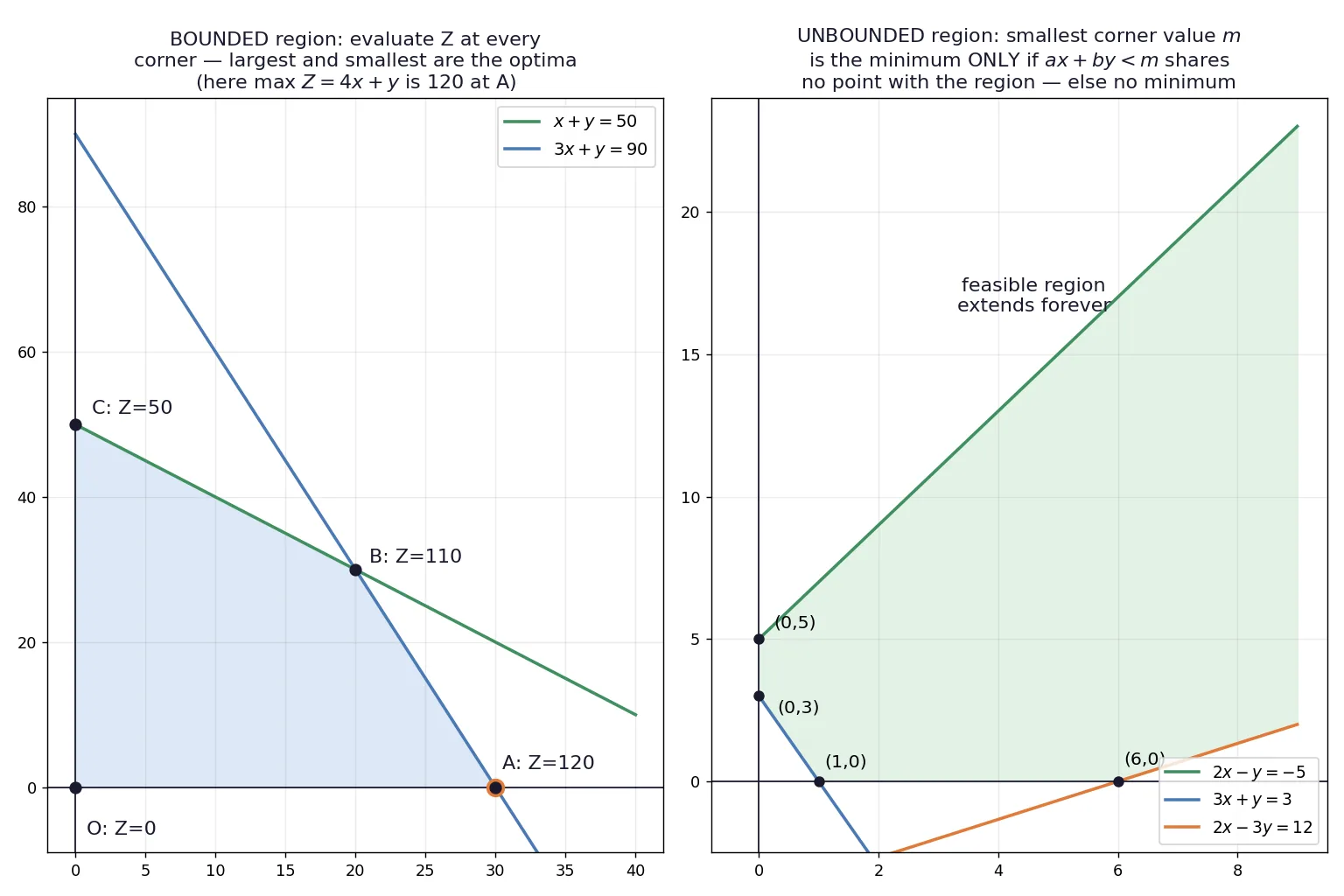
The decision table
| Region | Maximum | Minimum |
|---|---|---|
| Bounded | , at a corner | , at a corner |
| Unbounded | only if misses the region; else none | only if misses the region; else none |
| Empty | no feasible solution | no feasible solution |
Ties: equal optimal values at two corners extend to every point of the joining segment — infinitely many optimal solutions, occurring when the objective line is parallel to that edge.
Applied Problems, and the Mistake Checklist
The three applied archetypes
- Diet (minimise cost; nutrient floors, ; region unbounded — test mandatory).
- Manufacturing (maximise profit; resource ceilings, ; region bounded).
- Allocation (capital + space/count ceilings; maximise profit or item count).
Conclude applied answers in the story's language: items, rupees, kilograms — not bare coordinates.
The mistake checklist — run it before submitting
- Shaded the right side? Test each half-plane with the origin (or any convenient point off the line).
- All corners found? Every pair of adjacent boundary lines meets at one — including the axis intercepts.
- Evaluated only at feasible corners? A tempting point that violates one constraint is worthless.
- Region unbounded? Then the corner table alone proves nothing — write the half-plane test.
- Tie in the table? Report the whole segment, not one endpoint.
- Units consistent? Convert kg to g, rupees to the same scale, before writing constraints.
- Non-negativity written? appears in every formulation, every time.
- Conclusion sentence naming the optimal value AND where it occurs (in context for word problems).
Where each skill was built
Formulation and vocabulary — Section 1. The graphical method and theorems — Section 2. Graded worked problems — Section 3. Board practice — Section 4. Diet, manufacturing and allocation word problems — Section 5. Full drill — Section 6.