
Information Changes Probability
Toss three fair coins: , each outcome with probability . Let = "at least two heads" and = "first coin shows tail". Then .
Now suppose you are told the first coin showed tail. The outcomes with a first-coin head are ruled out: the world shrinks to . Within this reduced world, only has at least two heads, so the updated probability is — the information halved it.
This updated probability is the conditional probability of given , written .
The definition
The favourable outcomes inside the reduced world are exactly the outcomes of , so with equally likely outcomes , and dividing numerator and denominator by :
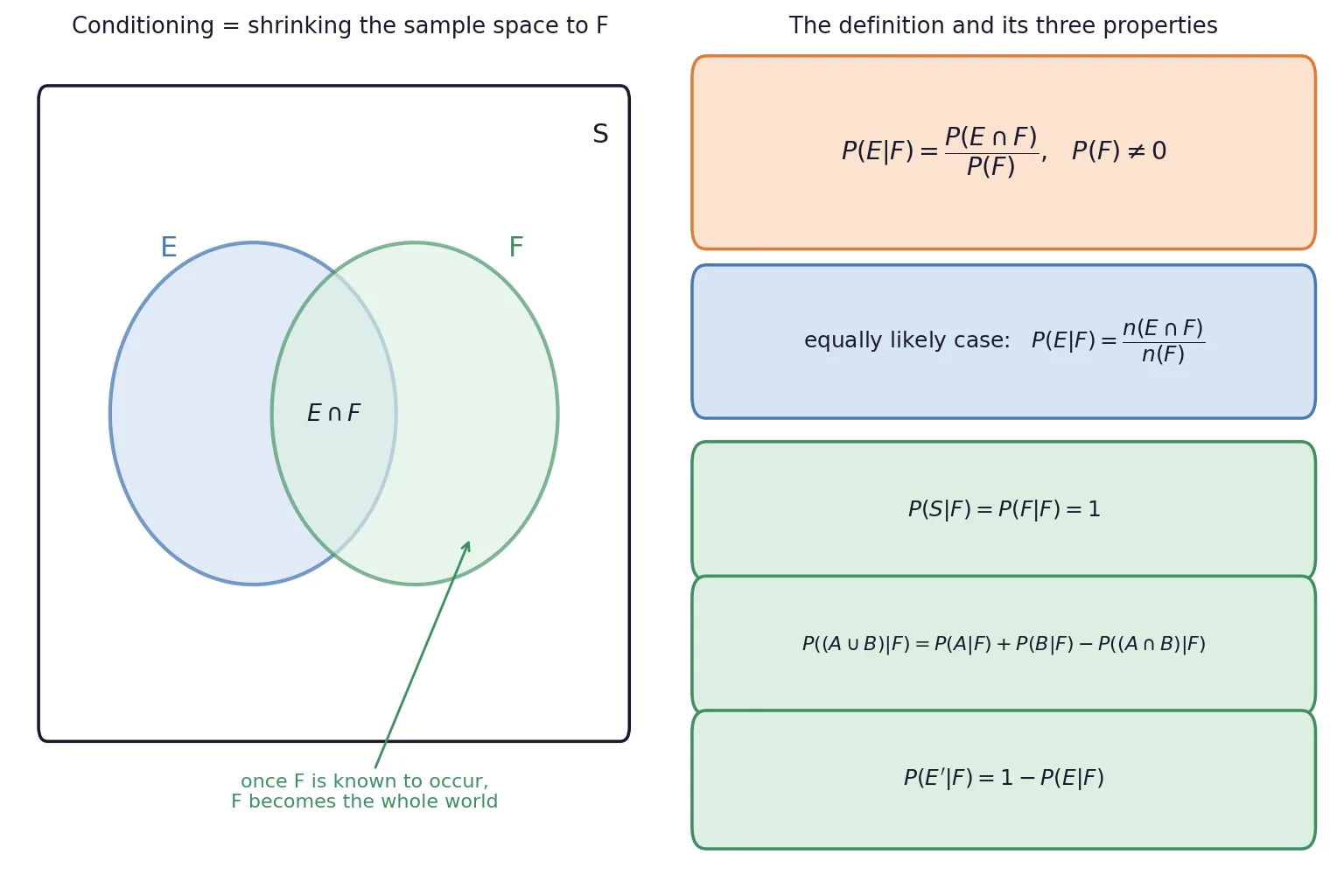
Key Point: conditioning does not change the experiment — it changes the sample space. Every conditional question can be answered two ways: recount inside the reduced world (fast when outcomes are listable), or apply the formula (necessary when only probabilities are given). Both must agree.
The formula also works when outcomes are not equally likely — compute and by adding the individual outcome probabilities (tree diagrams organise this bookkeeping).
Properties of Conditional Probability
For events of a sample space with :
Certainty given anything: — the whole space, and itself, are certain once has occurred.
Addition rule survives conditioning:
and for disjoint the last term vanishes.
- Complement rule survives too: .
Key Point: conditional probability behaves like an ordinary probability in its first slot — all the familiar rules hold with "" carried along. What it does NOT do is behave symmetrically: and are different numbers in general (they share the numerator but divide by different things).
The classic traps
- "Both boys given at least one boy" — the reduced world has three outcomes , not two: the answer is , not . Listing the reduced sample space prevents the error.
- vs : "probability the card is even given it exceeds 3" is not "probability it exceeds 3 given it is even". Read which event is given — it goes in the denominator.
- Zero denominators: is not defined when — there is no world to shrink to.
Solved Examples
Example 1: Straight from the formula
If , and , evaluate .
Solution:
- Formula: .
Answer: — note itself was never needed.
Example 2: The two-children classic
A family has two children. What is the probability that both are boys, given that at least one is a boy?
Solution:
- Sample space: .
- Events: ; ("at least one boy") ; .
- Formula: .
Answer: — the reduced world has three equally likely families, only one of them all-boy.
Example 3: A numbered-cards conditional
A card is drawn from ten cards numbered to . Given that the number drawn is more than , what is the probability that it is even?
Solution:
- Events: = even ; = greater than ; .
- Count in the reduced world: .
Answer: .
Example 4: Percentages as probabilities
A school has students, of them girls; of the girls study in Class XII. What is the probability that a randomly chosen student studies in Class XII, given the student is a girl?
Solution:
- Translate: (girl); (girl AND in Class XII, i.e. of ).
- Formula: .
Answer: — as it must be: " of the girls" is the conditional probability, and the formula simply recovers it.
Example 5: Dice with a known sum
A die is thrown twice and the sum is observed to be . What is the conditional probability that has appeared at least once?
Solution:
- Reduced world: — five outcomes.
- Favourable inside it: .
- Count: .
Answer: .
Example 6: Unequal outcome probabilities (a tree)
Toss a coin; if it shows head, toss again, and if tail, throw a die. Find the probability that the die shows a number greater than , given there is at least one tail.
Solution:
- Outcome probabilities (via the tree): and carry each; each carries .
- The events: = at least one tail with ; with probability .
- Formula: .
Answer: — with unequal outcomes, counting fails and only the probability form of the formula works.
Example 7: A question-bank conditional
A question bank has easy true/false, difficult true/false, easy multiple choice and difficult multiple choice questions. A question is selected at random. What is the probability that it is easy, given that it is multiple choice?
Solution:
- Reduced world: multiple choice questions: .
- Favourable inside it: easy MCQs: .
- Count: .
Answer: — a two-way table question; conditioning just picks the MCQ column.