1. Conditional Probability & Multiplication Theorem

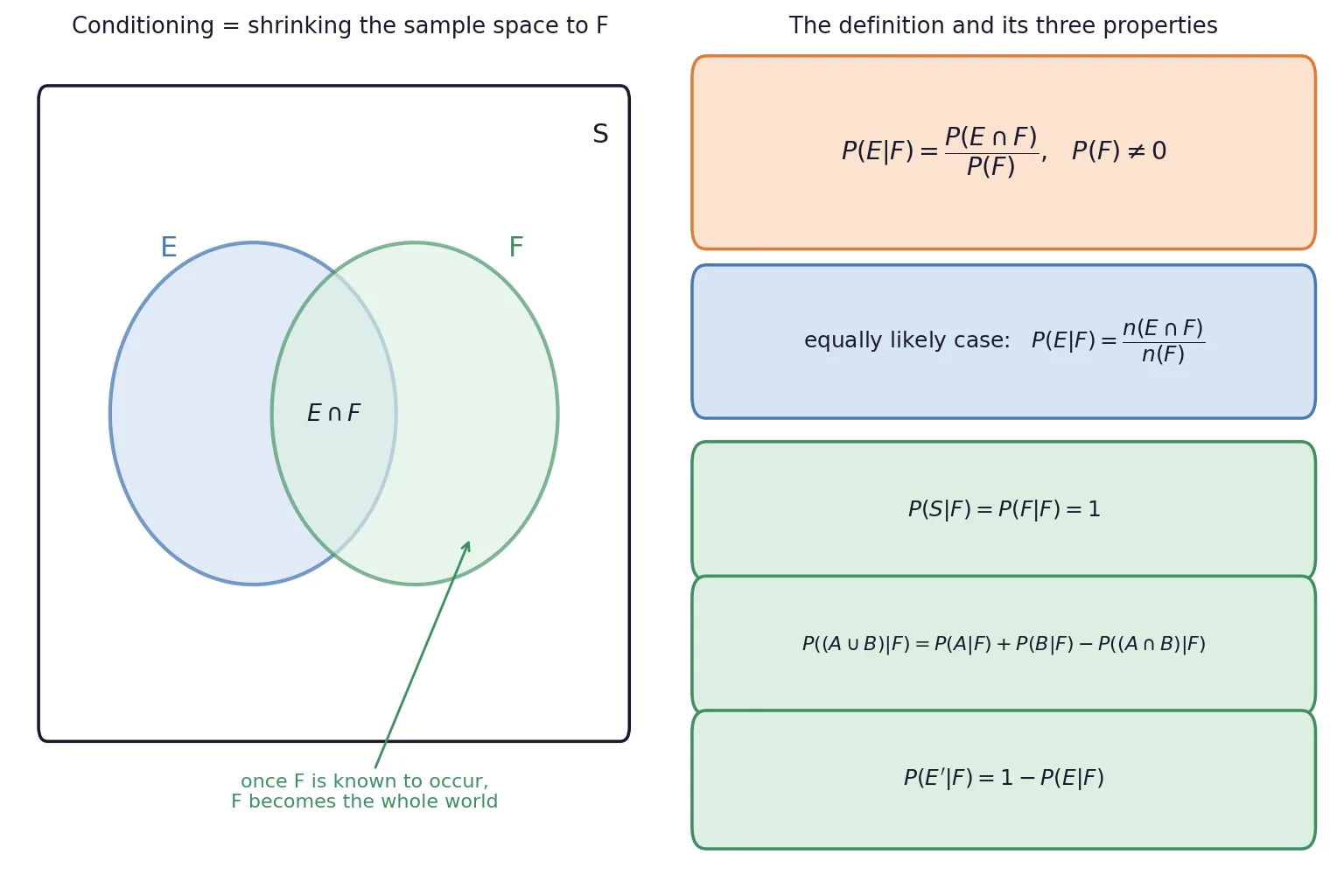
  • Conditional Probability: The probability of occurrence of event AA when it is known that event BB has already occurred is given by P(AB)=P(AB)P(B),P(B)0P(A\mid B)=\frac{P(A\cap B)}{P(B)}, \qquad P(B)\ne 0 This formula reduces the sample space to event BB and then measures how much of that reduced space also belongs to AA.

  • Multiplication Rule: Rearranging the conditional probability formula gives P(AB)=P(A)P(BA)=P(B)P(AB)P(A\cap B)=P(A)\,P(B\mid A)=P(B)\,P(A\mid B) This result is extremely useful when events occur in stages.

  • Independent Events: Two events AA and BB are said to be independent if the occurrence of one does not affect the probability of occurrence of the other. Mathematically, P(AB)=P(A)P(B)P(A\cap B)=P(A)P(B) Equivalently, if P(B)0P(B)\ne 0, then P(AB)=P(A)P(A\mid B)=P(A) and if P(A)0P(A)\ne 0, then P(BA)=P(B)P(B\mid A)=P(B) Also, if AA and BB are independent, then the pairs (A,B)(A,B'), (A,B)(A',B) and (A,B)(A',B') are also independent.

2. Bayes' Theorem & Total Probability

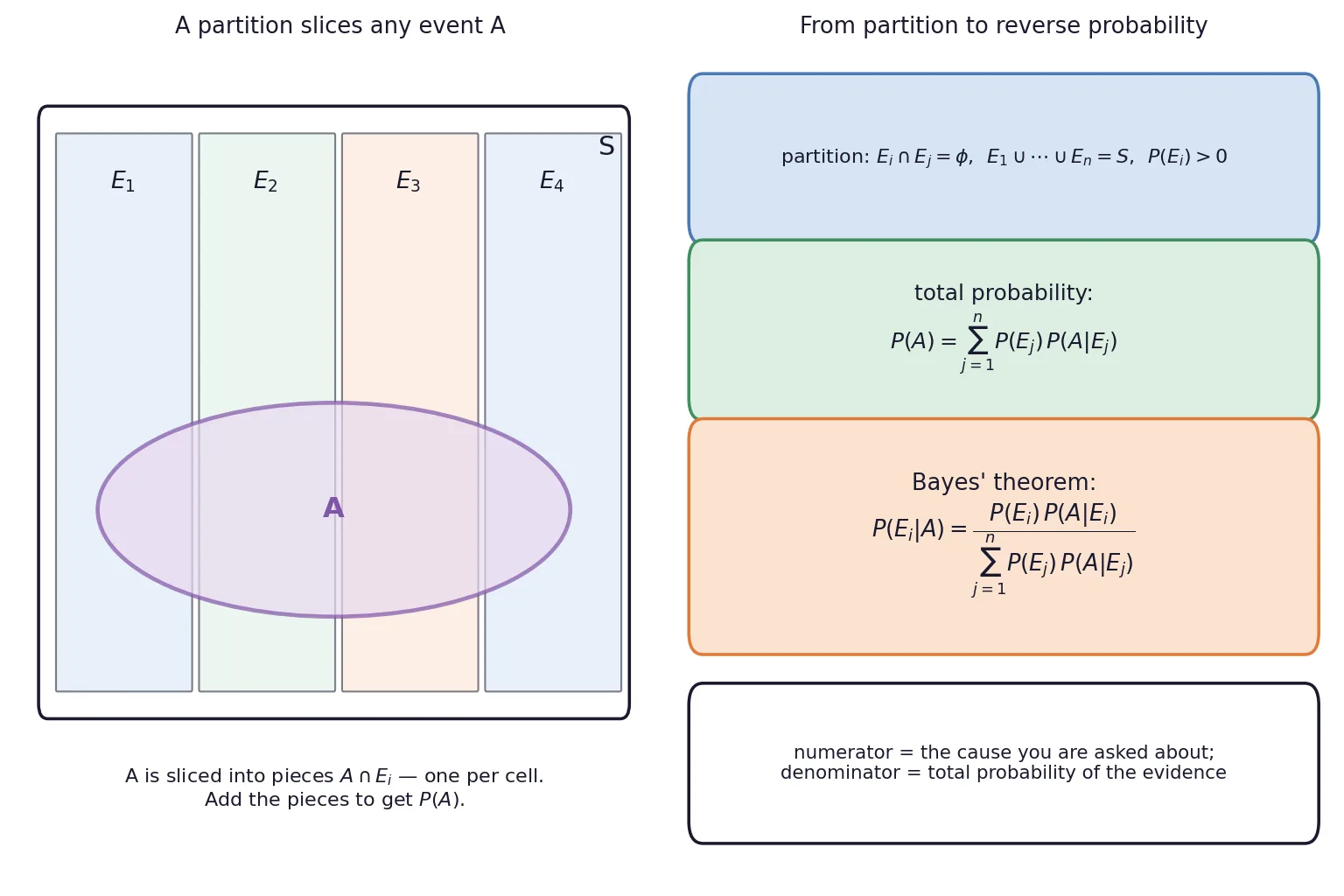
  • Partition of Sample Space: A collection of events E1,E2,,EnE_1,E_2,\dots,E_n is said to form a partition of the sample space if EiEj=(ij)E_i\cap E_j=\varnothing \quad (i\ne j) and E1E2En=SE_1\cup E_2\cup \cdots \cup E_n=S with each P(Ei)>0P(E_i)>0. Thus the events are pairwise disjoint and exhaustive.

  • Theorem of Total Probability: If E1,E2,,EnE_1,E_2,\dots,E_n form a partition of the sample space and AA is any event, then P(A)=j=1nP(Ej)P(AEj)P(A)=\sum_{j=1}^{n} P(E_j)P(A\mid E_j) This theorem is used when an event AA can happen through several mutually exclusive causes.

  • Bayes' Theorem: If E1,E2,,EnE_1,E_2,\dots,E_n form a partition of the sample space and AA is an event with P(A)>0P(A)>0, then for any fixed ii, P(EiA)=P(Ei)P(AEi)j=1nP(Ej)P(AEj)P(E_i\mid A)=\frac{P(E_i)P(A\mid E_i)}{\sum_{j=1}^{n} P(E_j)P(A\mid E_j)} Bayes' theorem helps us find the probability of a cause after observing the result. That is why it is often called the theorem of inverse probability.

3. Random Variables & Distributions

  • Random Variable: A random variable is a real-valued function defined on the sample space. In school-level probability, we usually deal with discrete random variables.

  • Mean (Expectation): If a random variable XX takes values x1,x2,,xnx_1,x_2,\dots,x_n with probabilities p1,p2,,pnp_1,p_2,\dots,p_n, then its mean or expectation is E(X)=μ=xipiE(X)=\mu=\sum x_i p_i This gives the long-run average value of the random variable.

  • Second Moment About Origin: E(X2)=xi2piE(X^2)=\sum x_i^2 p_i This is used in the calculation of variance.

  • Variance: Variance measures the spread or dispersion of the values of the random variable about its mean. It is given by Var(X)=σ2=E(X2)[E(X)]2Var(X)=\sigma^2=E(X^2)-[E(X)]^2 Since variance is a measure of spread, it is always non-negative.

  • Standard Deviation: σ=Var(X)\sigma=\sqrt{Var(X)} It is the positive square root of the variance and has the same unit as the random variable.

  • Linear Properties: For constants aa and bb, E(aX+b)=aE(X)+bE(aX+b)=aE(X)+b and Var(aX+b)=a2Var(X)Var(aX+b)=a^2Var(X) Notice that adding a constant changes the mean but does not affect the variance, while multiplying by aa multiplies the variance by a2a^2.

4. Bernoulli Trials & Binomial Distribution

  • Bernoulli Trials: A sequence of trials is called a sequence of Bernoulli trials if the following conditions are satisfied:
  1. The number of trials is finite.
  2. Each trial has exactly two possible outcomes, usually called success and failure.
  3. The trials are independent.
  4. The probability of success remains constant from trial to trial.

If the probability of success is pp, then the probability of failure is q=1pq=1-p

  • Binomial Distribution: If XX denotes the number of successes in nn Bernoulli trials, then XX follows a binomial distribution with parameters nn and pp, written as XB(n,p)X\sim B(n,p) Its probability mass function is P(X=r)=(nr)prqnr,r=0,1,2,,nP(X=r)=\binom{n}{r}p^r q^{\,n-r}, \qquad r=0,1,2,\dots,n where q=1pq=1-p

  • Mean and Variance of Binomial Distribution: If XB(n,p)X\sim B(n,p), then E(X)=npE(X)=np and Var(X)=npqVar(X)=npq Therefore, the standard deviation is σ=npq\sigma=\sqrt{npq}

Important Exam Tips for Board Exams

  • Define Events Clearly: In questions based on Bayes' theorem or total probability, begin by writing statements such as: E1=first cause,E2=second cause,A=observed eventE_1=\text{first cause}, \qquad E_2=\text{second cause}, \qquad A=\text{observed event} This makes the logic of your solution very clear.

  • Use a Probability Distribution Table: For random variable questions, present the values in a neat tabular form with rows like XX and P(X)P(X). This improves presentation and reduces mistakes.

  • Show Combination Logic: In binomial and combinatorial probability problems, write at least one clear step showing how (nr)\binom{n}{r} is obtained. This helps secure full method marks.

  • Always Check Total Probability: For a valid probability distribution, P(X=xi)=1\sum P(X=x_i)=1 If the sum is not 1, then some outcome has been omitted or a computational error has been made.

Important Exam Tips for JEE Main & Advanced

  • Use the 'At Least One' Shortcut: Whenever you see the phrase at least one success, immediately think in terms of the complement: P(at least one success)=1P(no success)P(\text{at least one success})=1-P(\text{no success}) This is much faster than adding many separate cases.

  • Remember Linearity of Expectation: For random variables XX and YY, E(X+Y)=E(X)+E(Y)E(X+Y)=E(X)+E(Y) This is true even when XX and YY are not independent. This fact is heavily used in advanced problems.

  • Infinite-Turn Games: In turn-based games involving dice or coins, the total probability often forms an infinite geometric progression. Write the first winning term carefully and identify the common ratio correctly.

  • Do Not Assume Independence Without Reason: If a question involves selection without replacement, then the outcomes are usually dependent. In such cases, use combinations or the multiplication rule instead of the independence formula.

  • Check Binomial Conditions Before Applying Binomial Formula: The formula P(X=r)=(nr)prqnrP(X=r)=\binom{n}{r}p^r q^{\,n-r} can be used only when all Bernoulli trial conditions are satisfied.