
The Chapter in One Sweep
Directions
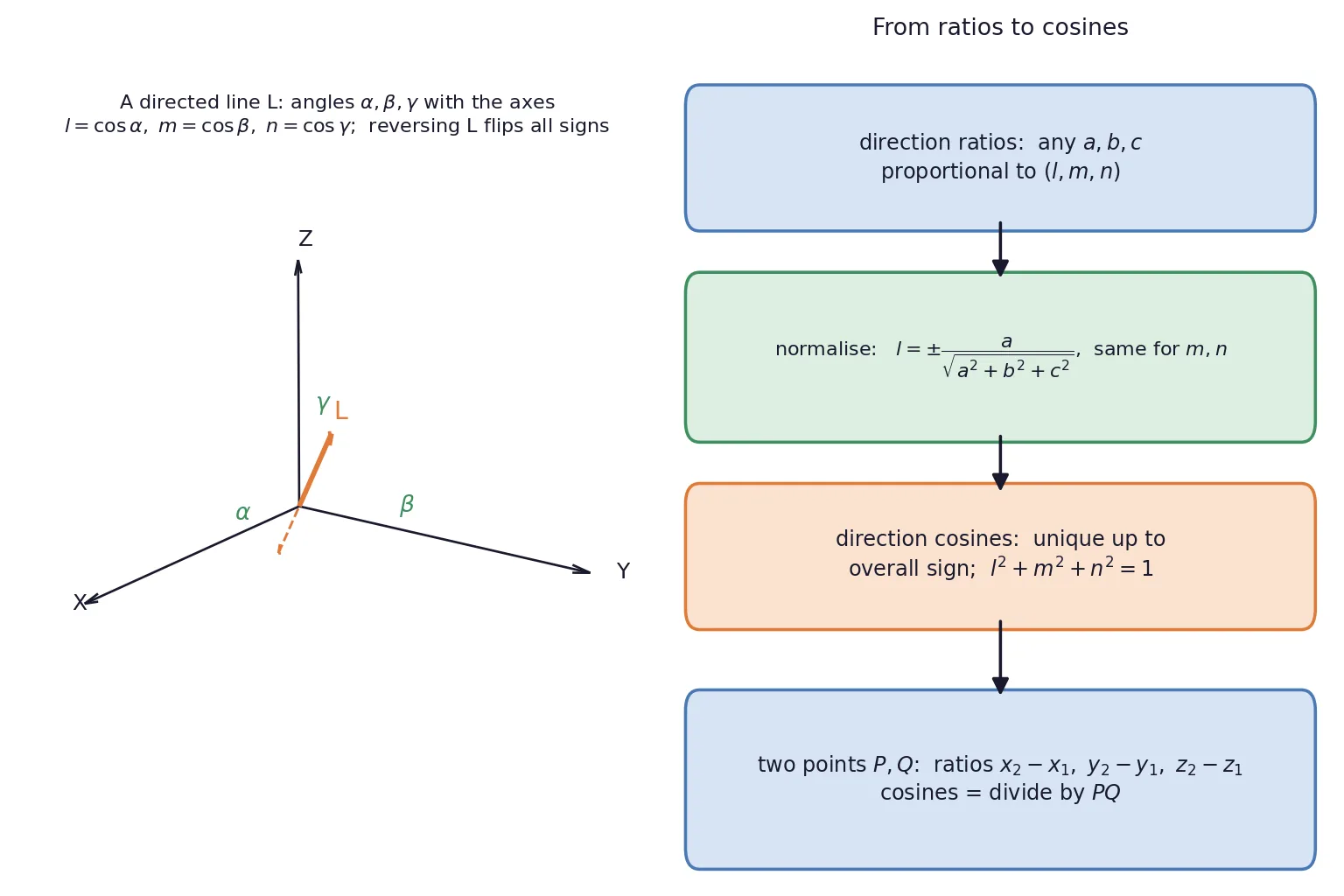
A line's direction is a triple: direction cosines with (two sets per undirected line, differing by an overall sign), or any proportional direction ratios — normalise by to recover cosines. Through two points, the coordinate differences are ratios, and dividing by the distance gives cosines. Collinearity of points = proportional ratios of consecutive segments.
The line, both ways
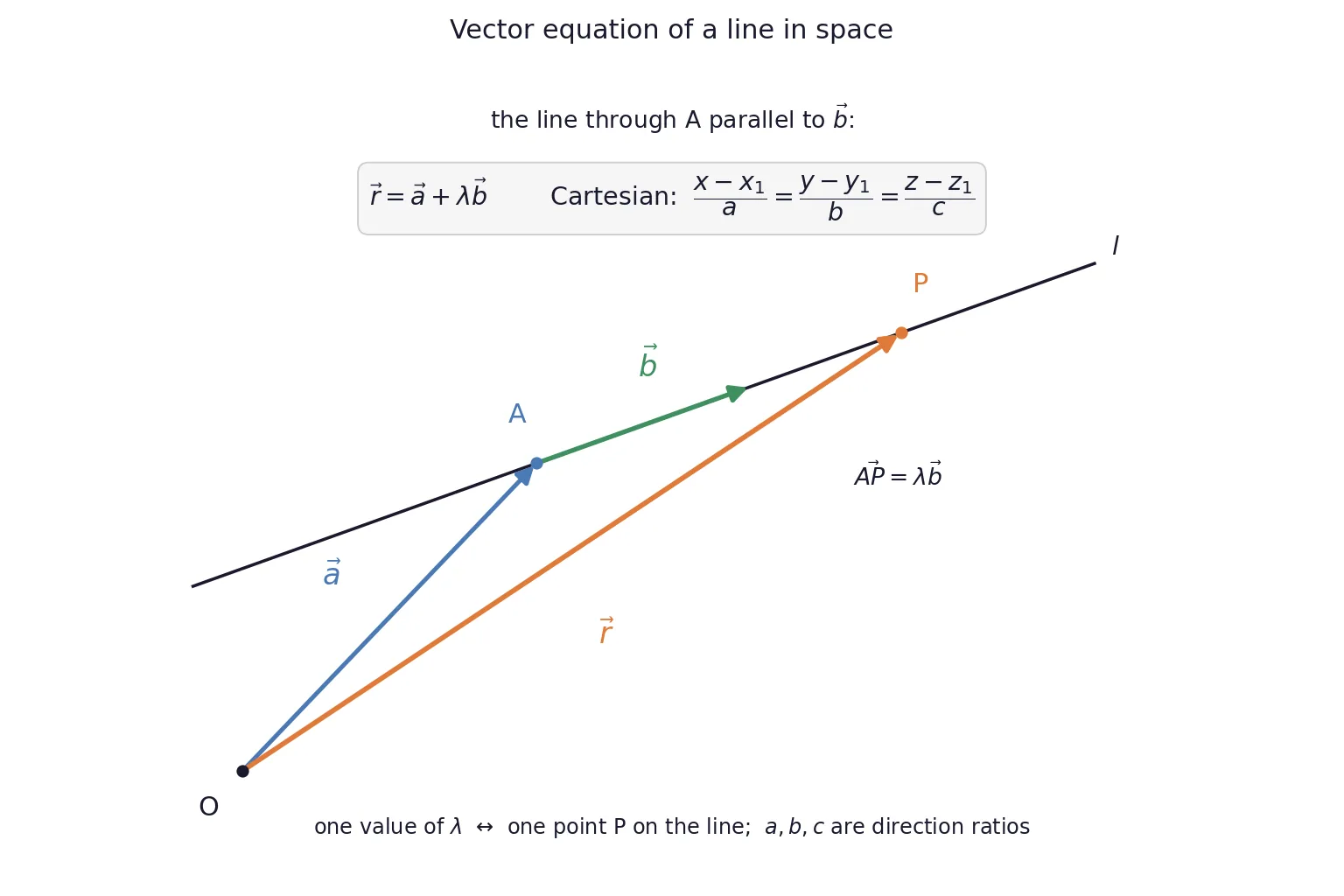
Point from (numerators), direction from (denominators). Two-point form: direction . Standardise before reading: numerators , unit coefficients.
Angle between lines
Perpendicular: . Parallel: proportional ratios. With direction cosines, the denominators vanish.
Shortest distance
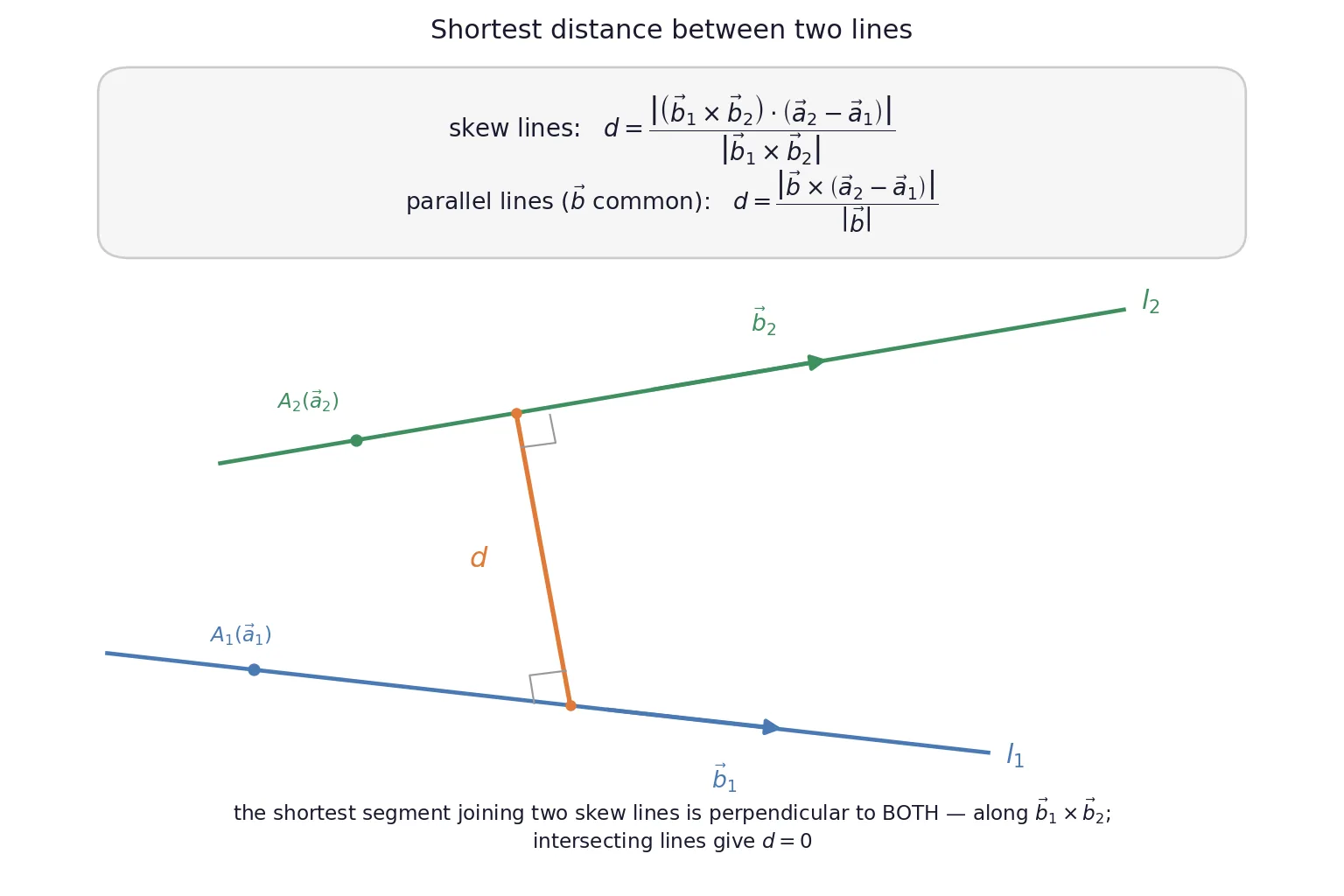
for non-parallel lines means they intersect (the numerator is the coplanarity triple product).
The JEE Plane Sheet, and the Mistake Checklist
Planes (JEE retains what NCERT dropped)
| Item | Formula |
|---|---|
| General form | , normal ratios |
| Point-normal | |
| Intercept form | |
| Point-plane distance | |
| Parallel planes | (normals matched first) |
| Plane-plane angle | of the normals |
| Line-plane angle | |
| Foot/image in plane | walk , solve for ; image at |
| Family of planes | through the intersection line |
The mistake checklist — run it before submitting
- Standardised the equation? Numerators ; no , no , coefficients .
- Ratios vs cosines: divided by exactly when cosines were asked?
- All three 's agree when testing a point on a line — two agreeing is not enough.
- Modulus in every distance and acute-angle formula.
- Sine for line-plane; cosine for line-line and plane-plane.
- Parallel-plane distance only after matching normals (scale one equation first).
- Foot before image: the image is , never .
- Zero denominators in symmetric form are statements ("that coordinate is constant"), not divisions.
Where each skill was built
Direction cosines and ratios — Section 1. Line equations — Section 2. Angles — Section 3. Shortest distance — Section 4. Graded worked examples — Section 5. Board practice — Section 6. Planes and JEE tools — Section 7. Full JEE drill — Section 8.