
Taxonomic Categories and the Taxonomic Hierarchy
Classification is not a single step but a series of taxonomic categories (ranks). All the categories together constitute the taxonomic hierarchy. Each category, being a rank, is part of the overall taxonomic arrangement; the actual group of organisms placed at a rank is a taxon.
There are seven obligate (main) categories. In ascending order they are:
Species -> Genus -> Family -> Order -> Class -> Phylum (Division) -> Kingdom
- For animals the category above Class is Phylum.
- For plants the corresponding category is Division.
Golden rule: As we move up the hierarchy (species -> kingdom), the number of common characteristics decreases and it becomes harder to establish relationships. As we move down (kingdom -> species), organisms share more common features.
The categories, defined
- Species - the lowest category. A group of individuals with fundamental similarities, capable of interbreeding (Mayr's biological concept). The specific epithet denotes the species: sapiens, indica, tuberosum, leo.
- Genus - a group of related species that have more characters in common with one another than with species of other genera. Example: genus Panthera (lion P. leo, tiger P. tigris, leopard P. pardus); genus Solanum (potato, brinjal, makoi).
- Family - a group of related genera with still fewer similarities than species and genera. Plant families use both vegetative and reproductive features. Example: Solanaceae (Solanum, Petunia, Datura); Felidae (Panthera, Felis); Hominidae (Homo).
Higher Categories and Worked Examples
- Order - an assemblage of related families sharing a few similar characters. Example: order Primata (comprising families such as Hominidae); order Carnivora (Felidae + Canidae); order Polymoniales (Solanaceae + Convolvulaceae).
- Class - a group of related orders. Example: class Mammalia (orders Primata + Carnivora and others).
- Phylum / Division - a group of related classes. For animals it is Phylum (e.g., Chordata - fishes, amphibians, reptiles, birds, mammals); for plants it is Division (e.g., Angiospermae).
- Kingdom - the highest category. All animals belong to kingdom Animalia; all plants to kingdom Plantae.
NCERT taxonomic-hierarchy table (memorise this)
| Category | Man | Housefly | Mango | Wheat |
|---|---|---|---|---|
| Species | sapiens | domestica | indica | aestivum |
| Genus | Homo | Musca | Mangifera | Triticum |
| Family | Hominidae | Muscidae | Anacardiaceae | Poaceae |
| Order | Primata | Diptera | Sapindales | Poales |
| Class | Mammalia | Insecta | Dicotyledonae | Monocotyledonae |
| Phylum/Division | Chordata | Arthropoda | Angiospermae | Angiospermae |
| Kingdom | Animalia | Animalia | Plantae | Plantae |
Common exam traps
- Plant family, class and division names have typical endings: family often ends in -aceae (Poaceae, Solanaceae); animal family in -idae (Hominidae, Muscidae, Felidae); plant order in -ales (Sapindales, Poales); plant class in -ae (Dicotyledonae).
- The category between Class and Kingdom is Phylum in animals but Division in plants.
- The higher the category, the fewer the shared characters (kingdom = fewest; species = most).
Visual - The Taxonomic Hierarchy
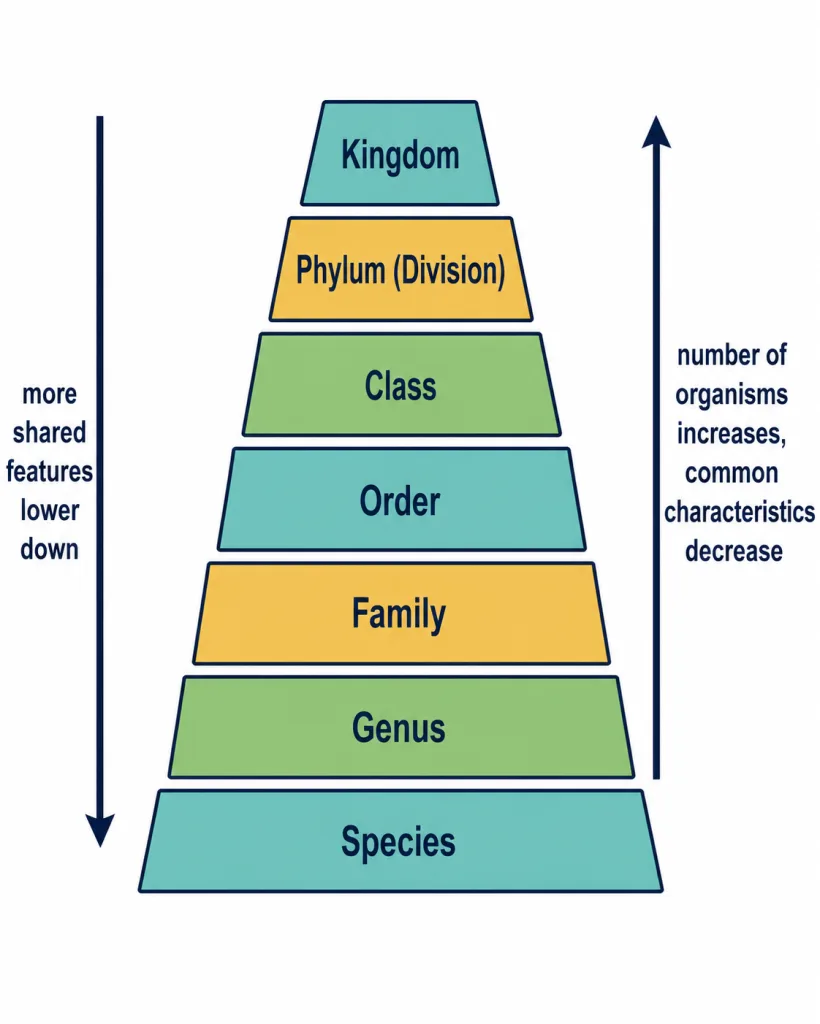
Reading up (Species -> Kingdom) the number of shared characters decreases and relationships get harder to establish; reading down, organisms share more characters.