
The Earth Before There Was Life
The earth is thought to have begun as a molten mass, and at that stage it had no covering of gases at all. As the surface cooled, gases escaped from within the crust and gathered above it: water vapour, methane, carbon dioxide and ammonia. Notice what is missing from that list. There was no free oxygen. The early atmosphere was a reducing one, and that matters, because free oxygen would have broken down the delicate organic molecules that had to accumulate before life could begin. A student who pictures the early sky as the sky we breathe under today has already lost the thread of the chapter.
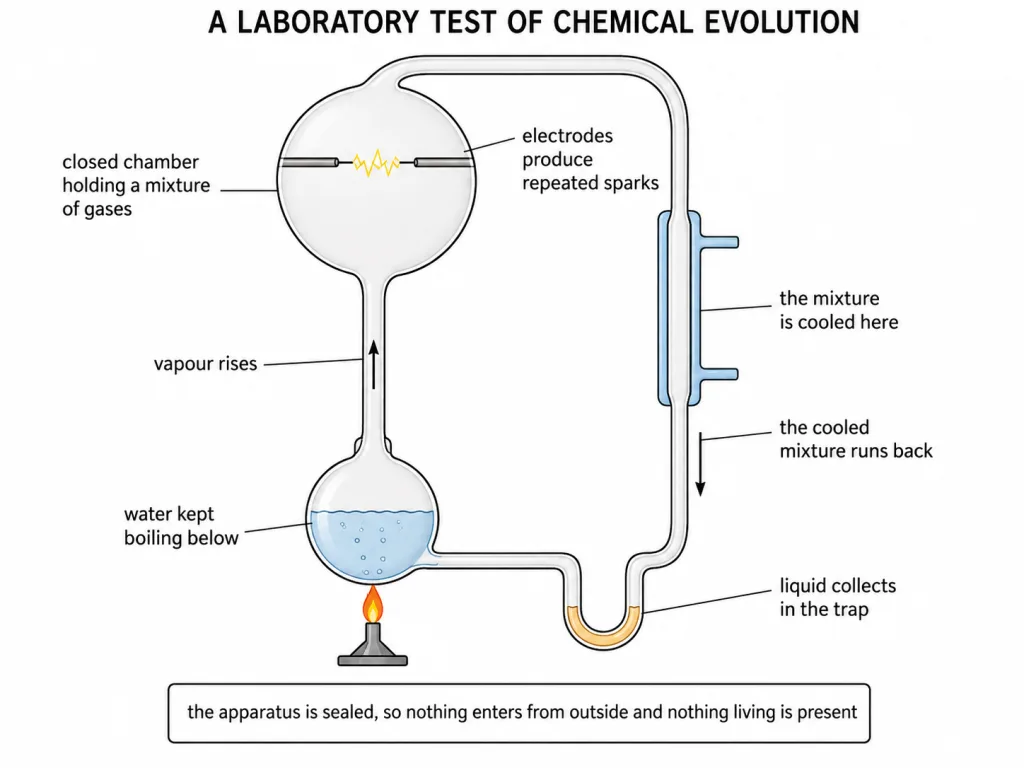
[NEET Important] The four gases of the primitive atmosphere and the four gases Miller sealed into his flask are similar lists but not identical ones. The atmosphere carried carbon dioxide; the flask carried hydrogen. Learn the two lists side by side.
Water made the next move. Ultraviolet rays from the sun struck water vapour and split it into hydrogen and oxygen. Hydrogen, the lightest thing there is, was not held by the earth's gravity and escaped. The oxygen left behind combined with ammonia and methane to give water, carbon dioxide and other compounds, and some of it built up overhead as the ozone layer. Later, as the earth cooled further, the remaining water vapour condensed, fell as rain, and filled every depression in the surface. Those filled depressions are the oceans.
The Accounts People Held Before
Two older accounts have to be set aside before the modern one makes sense.
The theory of special creation carried three claims together: that every organism we see was created just as it now is, that the variety of living things has always been what it is and will not alter, and that the earth itself is only about four thousand years old. All three stand or fall together, and all three are now rejected.
The theory of spontaneous generation -- abiogenesis, in the old sense the word then carried -- was different and, in its day, far more reasonable. It said that life simply came out of decaying and rotting matter, and its support was ordinary experience: worms, maggots and insects turned up in straw, in mud and in refuse, and nobody had watched them arrive. Louis Pasteur settled the question with a pair of flasks. In flasks sterilised beforehand and sealed, killed yeast produced nothing. In another flask, left open to the air, new living organisms appeared. The pair is the argument; either flask on its own proves nothing at all. Pasteur's conclusion was that life comes only from pre-existing life, which is biogenesis.
A third suggestion, panspermia, held that units of life were carried to the earth from outer space. It has an obvious weakness: it never says how those units came to exist in the first place, so it moves the problem rather than solving it.
Chemical Evolution and the Experiment That Tested It
Oparin, working in Russia, and Haldane, working in England, proposed that the first form of life arose from pre-existing non-living organic molecules such as RNA and protein, and that the appearance of life was preceded by chemical evolution, meaning the formation of diverse organic molecules from inorganic constituents. The direction of that claim is the whole point. Chemistry first, biology afterwards.
S. L. Miller put it to the test. He built conditions like those of the primitive earth inside a closed flask: methane, hydrogen, ammonia and water vapour, held at 800 degrees C, with an electric discharge passed through the mixture in place of lightning. From the apparatus he recovered amino acids. In similar experiments other workers obtained sugars, nitrogen bases, pigments and fats. None of this needed a living thing anywhere in the glassware.
[NEET Important] The result did not stand alone. Analysis of meteorite content revealed similar compounds, which indicates that the same chemistry runs elsewhere in space and that the amino acids were not a quirk of one apparatus. Independent corroboration of this kind is examined often and forgotten often.
One word needs care. Abiogenesis names two quite different things. The classical version, life springing ready-made from decaying matter, was rejected. The modern chemical version, the first life assembled from non-living organic molecules under early-earth conditions, is the accepted account. The same word, opposite verdicts. Its counterpart, biogenesis, is the principle Pasteur demonstrated.
What Came First
The first forms of life were not cells. They were giant molecules, RNA, proteins and polysaccharides, able to make copies of themselves. Cellular life came afterwards, and it arose in water. Single cells came before many-celled organisms, and everything that followed is built on that order. Note finally that the experiment cannot be repeated on the earth as it now is: the reducing atmosphere the synthesis needs no longer exists, so the same reaction will not run today.
Reading the Rock Record
Fossils are the remains or the impressions of the hard parts of life forms, preserved in rock. Sedimentary rock is laid down layer upon layer, so the pile itself records order in time: a lower layer was buried earlier, and the remains it holds are older than those above. Rock sediments of different ages carry different sets of life forms, and a form that occurs in the lower layers and then stops occurring is a form that died out. Palaeontology alone shows us bodies that exist nowhere on Earth today.
A fossil carrying features of two groups that are now quite separate is called a connecting link. Archaeopteryx is the standard case. It had feathers, which belong to birds, together with teeth set in the jaws and a long tail supported by many separate bones, which belong to reptiles.
[NEET Important] A connecting link does not say that one living group came out of another living group. It says that both modern groups branch from a shared earlier stock, and that intermediate forms really lived and later disappeared. Reading such a fossil as simply an early member of one group discards the half that carries the argument.
Comparing Bodies: Homology and Analogy
Comparative anatomy sorts resemblances into two kinds, and the sorting turns on origin, not on appearance.
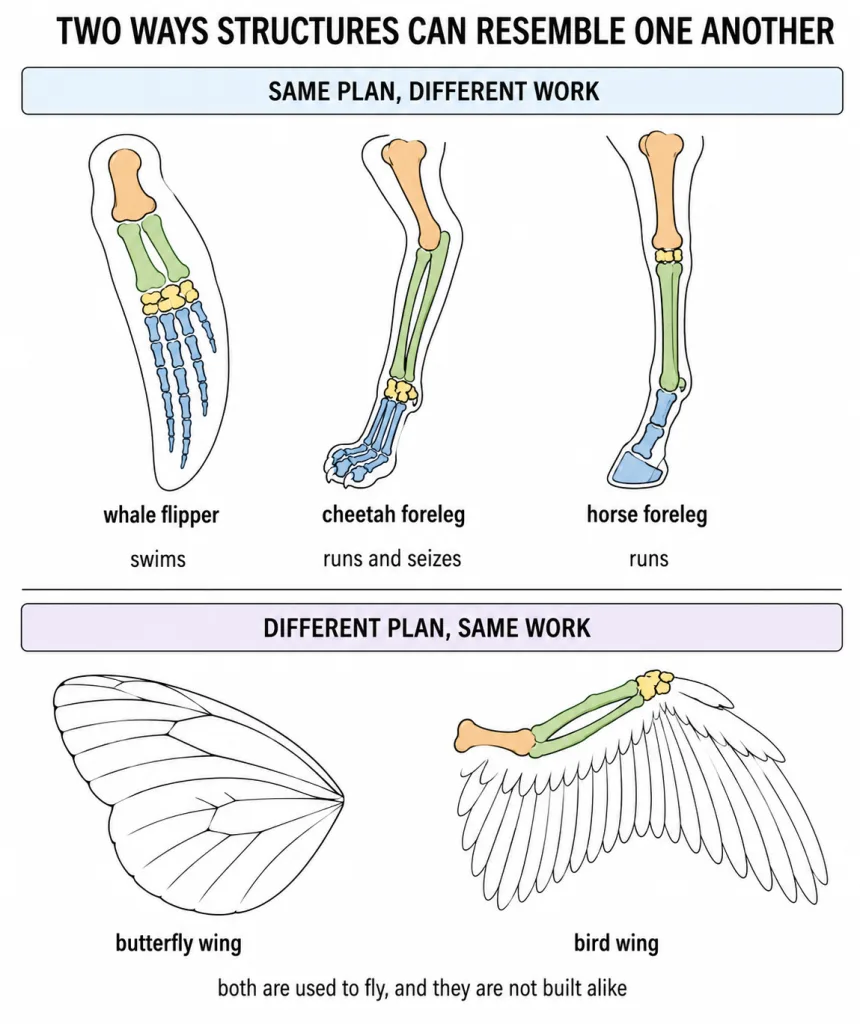
Homologous organs are built to the same anatomical plan and are inherited from a common ancestor, but they may be put to quite unlike work. The forelimb of a whale, of a bat, of a cheetah and of a human each carries humerus, radius and ulna, carpals, metacarpals and phalanges in the same order, although one paddles, one flies, one chases prey and one grasps. Vertebrate hearts and vertebrate brains follow the same rule: one plan, altered in degree from group to group. In plants, the thorn of Bougainvillea and the tendril of Cucurbita are both shoots arising in the axil of a leaf, one serving for defence and one for climbing.
Analogous organs are the mirror image: built to different plans, not inherited from a common ancestor, and merely carrying out the same job. The wing of a butterfly is a flat outgrowth of the body wall stiffened by veins; the wing of a bird is a bony limb clothed in feathers. The octopus eye beside the mammal eye, penguin flippers beside dolphin flippers, and the sweet potato, a swollen root, beside the potato, a swollen stem, are all pairs of this second kind.
[NEET Important] Each category has a process behind it. Divergent evolution takes one ancestral structure and reworks it along different lines in descendants meeting different needs, and it is what produces homology. Convergent evolution takes unrelated lineages that face one common demand and builds like structures independently in each, and it is what produces analogy.
Vestiges, Embryos and Molecules
Vestigial organs are reduced and functionless remnants of organs that were fully working in ancestral forms. In humans the familiar ones are the vermiform appendix, the wisdom teeth, the nictitating membrane of the eye, the muscles of the ear, body hair and the tail vertebrae. Their value as evidence lies entirely in the ancestor they point back to: an organ useless now had a use once, in a body we descended from.
Embryology contributes a plain observation. Embryos of very unlike vertebrates, examined at a comparable early stage, all show gill slits behind the head, structures the adults of the land-living forms do not keep.
What was made of that observation is a separate matter. Ernst Haeckel read it as evidence that a developing embryo repeats the adult stages of its ancestors, so that development replays ancestry. Karl Ernst von Baer disproved it, pointing out that an embryo never passes through the adult stages of any other animal. The observation stands; the interpretation does not, so Haeckel's version is not itself a line of evidence for evolution.
Molecular evidence works at the level of chemistry. The genetic code is universal, so the same three-base word specifies the same amino acid in a bacterium and in every animal. DNA and protein sequences are similar across species, the similarity greater between groups that parted more recently. Basic biochemical pathways are shared as well. Sequences across distant groups are similar rather than identical.
One Stock, Many Forms
Adaptive radiation is the process in which a single ancestral stock, arriving in a geographical area with room to spare, gives rise to many forms adapted to different habitats. On the Galapagos, one ancestral finch stock gave rise to a great many varieties, including insectivorous and vegetarian forms. The birds stayed within one island group; what altered from variety to variety was the beak, remade for whatever each form had come to eat. The stock they all came from was a seed-eating one, which is why the insect-eaters and the vegetarians are both departures from it.
Australia carries a second and larger case. Many pouched mammals, each with a different way of life, arose from one ancestral stock on that continent. The Australian marsupials include the numbat, the spotted cuscus, the flying phalanger, the marsupial mole, the Tasmanian wolf and the Tasmanian tiger cat. On other continents, mammals of quite separate ancestry took up the same ways of life, and the results correspond so closely that in several cases the Australian and the non-Australian form even carry the same common name, distinguished only by a qualifier. Two radiations running in isolation, meeting the same demands, end in convergent evolution; this pair of radiations is the standard illustration of it.
Radiation and extinction are read together. When a great many ways of life are emptied at once, the survivors spread into the space that is left, and a burst of new forms follows.