
Lamarck: the first serious theory of changing species
Jean Baptiste Lamarck deserves his place in the chapter because he was the first naturalist to argue, in a worked-out way, that living forms are not fixed. His account has two parts, and students who lose marks here almost always lose them by running the two parts together.
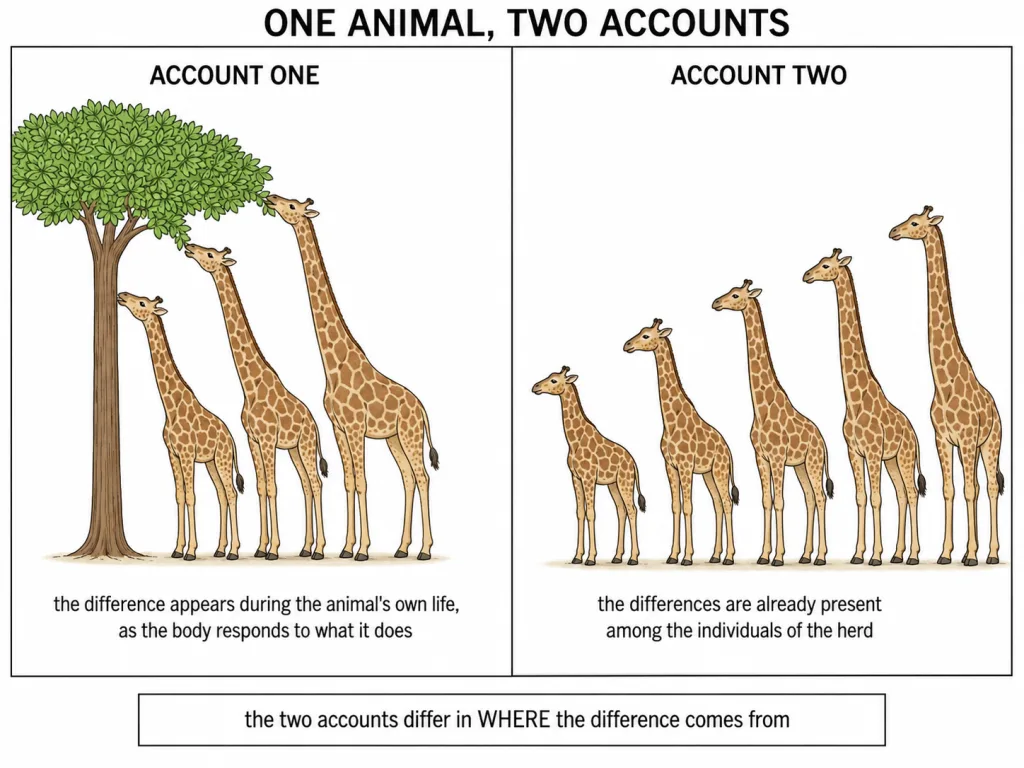
The first part is use and disuse. An organ that an animal employs constantly through its life becomes better developed; an organ it stops employing degenerates. This is a claim about a single body over a single lifetime, and nothing about heredity is being said yet. A great deal of it is simply true: muscle responds to work, and disused structures do waste.
The second part is the inheritance of acquired characters, and this is where the theory stands or falls. Lamarck held that whatever the body gains or loses in its own lifetime is handed on to the offspring. His illustration is the giraffe: ancestral giraffes, feeding on foliage that grew high in the trees, had to stretch their necks upward to reach it; the lengthened neck was then passed to the young, who began from that condition and stretched further still, so the neck grew over generations.
Modern biology accepts that organisms are modified by their surroundings and rejects the transmission step. A character acquired during an individual's life alters the body but does not alter what that individual passes on, so the next generation starts where its parents started.
[NEET Important] Keep the two Lamarckian claims separate in your head. Use and disuse acts within one lifetime; the inheritance of acquired characters is a second and separate assumption, and it is the one that is rejected. Questions are built on exactly this seam.
Darwin: what he saw, what he read, what he concluded
Darwin's material came from a sea voyage of observation in HMS Beagle, which carried him round the world before he had any theory to defend. What the voyage supplied was breadth of comparative material - fossil forms set beside living ones, and related kinds of animal reappearing in altered form on continent after continent and island after island.
On the Galapagos Islands he found many varieties differing slightly from one another within what looked like a single kind. Small differences of that sort, already present in ordinary populations, became the raw material of his theory.
The missing piece came from reading. Thomas Malthus, writing about human beings, argued that populations tend to grow beyond the resources that support them, so that only a fraction of each generation can be fed. Transferred to the natural world this becomes the struggle for existence: more offspring are produced than can possibly survive.
The argument then closes in four steps. Heritable variations exist in every population; far more young are produced than the environment can support; those better fitted to that environment leave more surviving progeny; and over generations the make-up of the population shifts. Darwin also argued from artificial selection - the breeds of dog, pigeon and cattle that humans had produced from wild stock in a short span - that selection really can reshape a population, and that nature does the same thing with no intention behind it.
Two concepts sit at the centre of the theory: branching descent and natural selection. Branching descent is the pattern claim - present-day species are the outer twigs of a repeatedly dividing tree, so similar forms share a recent common ancestor. Natural selection is the mechanism claim.
[NEET Important] Fitness in Darwin's sense means reproductive fitness - leaving more surviving offspring - and not strength, size or dominance.
Wallace, de Vries and the Modern Synthetic theory
Alfred Russel Wallace was a naturalist working in the Malay Archipelago who arrived at natural selection independently of Darwin and at about the same time.
Hugo de Vries worked on the evening primrose, Oenothera lamarckiana. He held that evolution proceeds by mutation - a large, sudden, inheritable change - rather than by the accumulation of small differences, and that a new species can therefore arise in a single step. He called this saltation. Two contrasts have to be held. De Vries' mutations are large and sudden whereas Darwin's variations are small and gradual; and de Vries' mutations are random and directionless whereas Darwin's are directional.
Darwin's own theory had one great gap: no mechanism of inheritance. The Modern Synthetic theory supplied it by joining genetics to natural selection. Variation is traced to mutation and recombination; selection, gene flow and genetic drift act on that variation; and evolution is described as a change in allele frequency in a population.
[NEET Important] Each of these workers is told apart by what he supplied that nobody before him had, so read any attribution question by asking what was added rather than by trying to date the person.
How New Variation Arises
Every evolutionary change begins with differences between individuals, and those differences must be heritable before they can matter. Two processes supply them. Mutation produces new alleles outright. Recombination reshuffles the alleles already present into fresh combinations at each round of sexual reproduction. Neither process is guided by what the organism needs; both throw up differences blindly, and only afterwards does the environment sort among them. A change that appears during one individual's lifetime and is never passed on, such as muscle built by exercise or skin darkened by sun, supplies no raw material for evolution at all.
[NEET Important] What matters here is what each of the two supplies, not how either one works at the molecular level.
Chance, Movement and Small Numbers
Four ideas share a family resemblance and are constantly mixed up.
Gene flow, also called gene migration, occurs when individuals travel from one population to another and breed there. Their alleles travel with them, so the receiving population's composition is pulled towards the composition of the group that arrived. The change has a direction, and that direction is set by whatever the newcomers were carrying.
Genetic drift is change in allele frequency by accident of sampling, with no reference at all to whether an allele is useful. Every generation draws a finite sample of gametes from the pool, and the smaller that draw is, the more the sample can miss the parent frequencies. Drift is therefore a question of numbers, never of fitness.
Two named situations make drift severe. In the founder effect a handful of individuals establish a population somewhere new; the alleles they happen to carry become the whole of the new gene pool, which for that reason alone differs from the source. If the difference is large enough, such founders may in time become a separate species. In a bottleneck the original population itself is cut down to a few survivors by some catastrophe. Numbers may recover afterwards, but only the survivors' alleles are available to rebuild from, so alleles that were rare beforehand are lost for good.
[NEET Important] Separate these two by asking what became of the parent population. In one case a few individuals depart and the source is left intact; in the other the source itself is the thing that was reduced.
The Gene Pool and the Hardy-Weinberg Principle
A gene pool is the total of all the alleles carried by a population. Evolution is measured as a change of allele frequency within that pool rather than as a change in any single organism.
For a gene with two alleles, the two frequencies are proportions of the pool and must sum to one, so p + q = 1. Notice that p is a proportion and not a head count of organisms. Squaring both sides gives the expansion (p + q)^2 = p^2 + 2pq + q^2 = 1. Each term of the expansion counts one genotype class: p^2 counts the homozygous dominants, 2pq counts the heterozygotes and q^2 counts the homozygous recessives. The heterozygote term is doubled because the two different alleles can be contributed in either parental order.
Hardy-Weinberg equilibrium is the statement that these frequencies remain steady from one generation to the next. The agencies that disturb it are gene migration or gene flow, genetic drift, mutation, genetic recombination, and natural selection. Equilibrium is what you observe when none of the five is operating on the pool.
Keep allele frequencies and genotype frequencies clearly apart. p and q are proportions of alleles; p^2, 2pq and q^2 are proportions of individuals, and the three of them add to one.
How Selection Shapes a Population
Natural selection acts on phenotypes, but what it changes is allele frequencies. Exactly three types are recognised, and they are distinguished by what happens to the shape of the population's distribution:
- Stabilising selection favours the middle of the range and narrows the spread.
- Directional selection favours one end of the range over successive generations.
- Disruptive selection favours both ends of the range at the expense of the middle.
Evolution You Can Watch
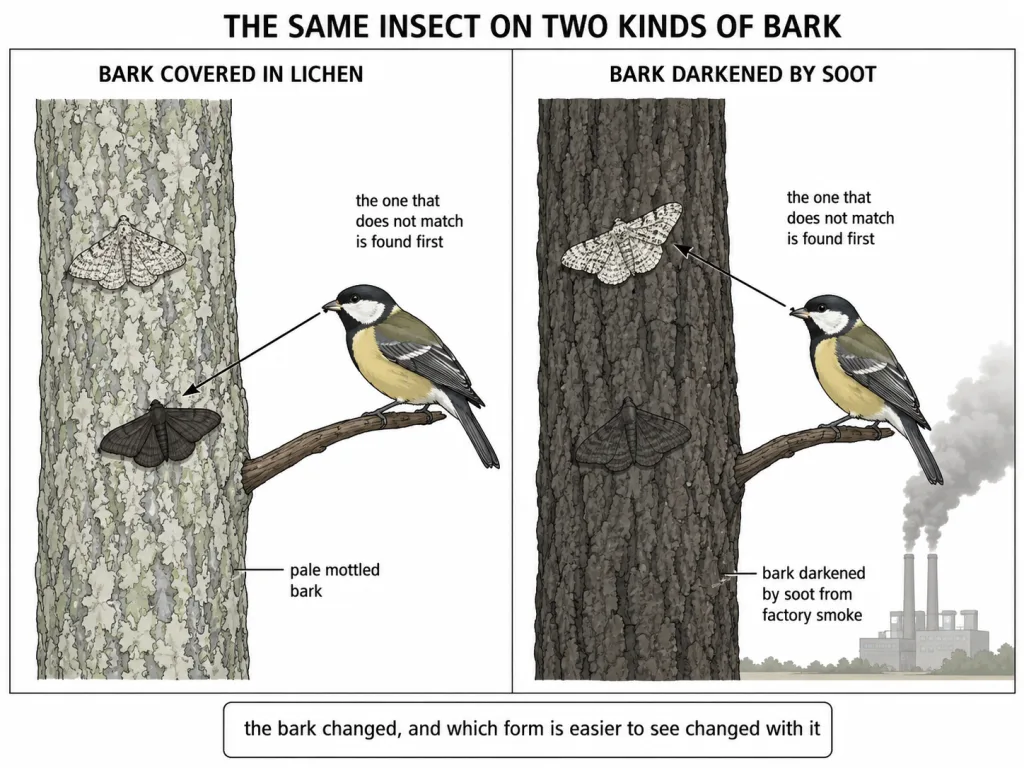
Some cases are observed inside a human lifetime rather than inferred from fossils. Industrial melanism is the classic. On lichen-covered bark the white-winged peppered moth was well camouflaged and abundant; once soot from factories darkened the trunks, the dark-winged form was the better hidden of the two and rose in numbers, because predators found the poorly matched form first. Neither form disappeared, because neither was perfectly conspicuous everywhere: what shifted was the ratio between the two. The same reasoning explains mosquitoes surviving DDT, bacteria surviving antibiotics and weeds surviving herbicides. Resistant individuals were already present in the population, and the chemical merely handed them the field.
Where the human line begins
Human evolution is the story of one branching line of primates, and of the traits that appear along it one at a time. It is worth saying at the outset what the line does not claim: living apes are not our ancestors. Man and the modern apes sit on separate branches running back to a shared ancestor, and that ancestor was neither a man nor a chimpanzee.
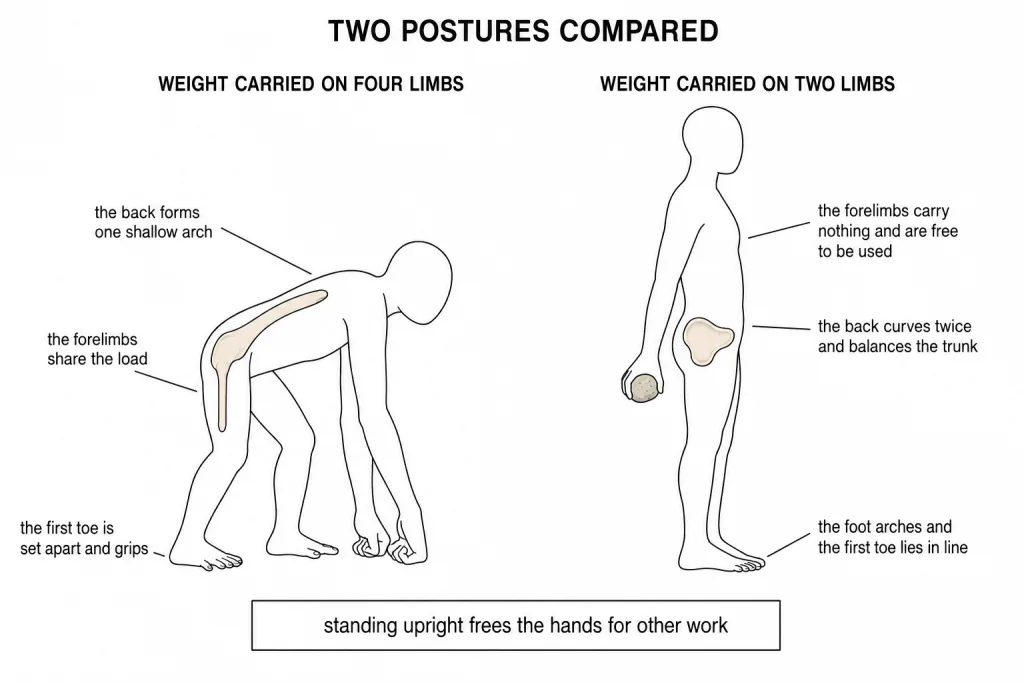
The two names placed earliest on the line are Dryopithecus and Ramapithecus. Both were hairy, and both moved about much as gorillas and chimpanzees do. What separates them is build: Dryopithecus was the more ape-like of the pair, and Ramapithecus the more man-like. The two names look alike on the page and the two descriptions are opposites, which is why they get swapped so often.
A few fossil bones recovered in Ethiopia and Tanzania carry the line forward. They are not many, but they are enough to settle one thing: primates of a man-like kind were already walking about in eastern Africa. Upright posture, in other words, appears early, well ahead of the other features we think of as human. What those bones cannot tell us is what their owners ate or whether they made anything, and no claim of that kind should be read into them.
From the grasslands to the first human-like forms
Australopithecus is the form of the East African grasslands. Two habits are attached to it: these were hunters who used stone weapons, and yet what they mainly ate was fruit. Stone-working runs on through the rest of the line, so the weapons do not belong to this form alone.
Homo habilis is the first form set apart as human-like, and it is where the genus Homo opens. The evidence gathered with its remains points to a diet that did not take in meat. Homo erectus follows, and the change recorded there is exactly the one habilis lacks: meat probably entered the diet. The two are learnt as a pair, because each is defined against the other.
[NEET Important] The two forms in the middle of the line are separated by diet: the first human-like form probably ate no flesh, and the one that followed probably did.
The fossils that revealed erectus were recovered in Java, and the popular name Java man belongs to that find.
The later forms and what they left behind
Homo neanderthalensis is known from remains in near east and central Asia. Two practices are recorded for it: hides were used to protect the body, and the dead were buried. Burial is the more striking of the two, being the first sign anywhere on the line that the dead were treated with care rather than simply left behind.
Modern Homo sapiens closes the line, arising in Africa and moving out from there. The pattern worth holding is one of dispersal and differentiation: a single stock spread widely across the continents, and in the separated regions it reached it diverged into the distinct races living today. That is one species differentiating, not several separate lines coming together, which is the reading students most often put in its place.
Two things follow at the end. Pre-historic cave art develops, and the painted rock shelters at Bhimbetka, in the Raisen district of Madhya Pradesh, are the standard Indian example. Agriculture and settled human life begin only after that.
Holding the line as an order
The most useful thing to carry out of this topic is the order itself, from earliest to latest: Dryopithecus and Ramapithecus, then Australopithecus, then Homo habilis, then Homo erectus, then Homo neanderthalensis, then Homo sapiens, with agriculture and settlement last of all. A student who can recite the seven names but cannot place habilis ahead of erectus has learnt a list rather than a line.
Learn the order of the forms first; every trait in this topic attaches to one of them, and a list of traits with no line to hang them on is the hardest way to carry the topic.