
Detailed Solutions: CBSE Class 10 Social Science Sample Paper 2027 – Set 1
Every written question from the paper (2, 3, 4 and 5 marks) is solved here in order, with the marks given for each step, so you can check your answer sheet the way an examiner would. Where a question has an internal choice (OR), both options are solved. The 1-mark questions are answered, with explanations, in the quiz on the Question Paper page.
Section A - History (20 marks)
Question 5 (2 marks)
'The silk routes carried much more than silk.' Justify the statement with two points.
Answer.
Model answer:
Besides Chinese silk, the routes carried Chinese pottery and textiles and spices from India and South-east Asia, while gold and silver flowed back from Europe. Culture travelled too: Buddhism, early Christian missionaries and Muslim preachers spread along them.
Marking scheme:
- Other goods: Chinese pottery, textiles and spices from India and South-east Asia went west, and gold and silver flowed from Europe to Asia — 1 mark
- Culture and religion: Buddhism spread along the routes, and early Christian missionaries and Muslim preachers also travelled them — 1 mark
Question 6 (3 marks)
Analyse how Romanticism, folk culture and music helped to build the idea of the nation in nineteenth-century Europe.
Answer.
Model answer:
Romantic artists and poets valued feelings and a shared past over cold reason, so people felt they belonged to one community. Herder held that the nation's true spirit lived in the songs, poems and dances of common people. In Poland, Karol Kurpinski's operas celebrated the national struggle and made the polonaise and mazurka national symbols.
Marking scheme:
- Romanticism: artists and poets turned away from the worship of reason and science, and stirred feelings, intuition and pride in a shared past and a common heritage — 1 mark
- Folk culture: Herder said the true spirit of the nation lived among the common people (das volk), in their songs, poetry and dances (or: the Grimm brothers collected folk tales as the pure voice of German culture against French domination) — 1 mark
- Music: in Poland, Karol Kurpinski's operas and music celebrated the national struggle, and folk dances such as the polonaise and mazurka became national symbols — 1 mark
OR
After 1871, why did the Balkans become the region most likely to drag Europe into war over rival nationalisms? Examine.
Answer.
Model answer:
The Balkans had many ethnic groups, broadly called Slavs, mostly under the weakening Ottoman Empire. Inspired by romantic nationalism, each group claimed independence, and the new states fought each other for territory. Meanwhile Russia, Germany, England and Austria-Hungary competed there for trade, colonies and military might, causing wars and finally the First World War.
Marking scheme:
- The Balkans had many ethnic groups (broadly called Slavs), and a large part was under the Ottoman Empire, which was weakening — 1 mark
- Romantic nationalism made each group claim independence on the basis of its past; the Balkan states were jealous of each other and fought for more territory — 1 mark
- Big powers (Russia, Germany, England, Austria-Hungary) competed there for trade, colonies and military might, leading to wars and finally the First World War — 1 mark
Question 7 (5 marks)
'Different social groups joined the Non-Cooperation Movement, but each gave its own meaning to swaraj.' Examine the statement with reference to the peasants of Awadh, the tribal peasants of the Gudem Hills and the plantation workers of Assam.
Answer.
Model answer:
Awadh: Peasants led by Baba Ramchandra rose against talukdars who demanded high rents, cesses and begar. For them swaraj meant lower revenue, no begar and a boycott of oppressive landlords; in 1921 some attacked talukdars' houses.
Gudem Hills: Closed forests stopped tribals from grazing cattle and collecting fuelwood and fruits, so swaraj meant getting their forests back. Led by Alluri Sitaram Raju, they fought a guerrilla war, a use of force Gandhiji could not approve.
Assam: The Inland Emigration Act of 1859 kept plantation workers inside the gardens. For them swaraj meant freedom to move in and out and keep links with their villages, so they left for home, believing Gandhi Raj was coming.
Marking scheme:
- Awadh: peasants led by Baba Ramchandra, a sanyasi, rose against talukdars and landlords who demanded very high rents, cesses and begar — 1 mark
- For them swaraj meant lower revenue, an end to begar and a social boycott of oppressive landlords; in 1921 some went further and attacked talukdars' houses and looted bazaars, which the Congress's non-violence did not allow (either point) — 1 mark
- Gudem Hills (Andhra Pradesh): the colonial government closed large forests, so tribals could not graze cattle or collect fuelwood and fruits; for them swaraj meant getting back the use of their forests — 1 mark
- Led by Alluri Sitaram Raju, they began a guerrilla war in the early 1920s, attacking police stations; this use of force was something Gandhiji could not approve, yet they saw it as part of the struggle for swaraj — 1 mark
- Assam: under the Inland Emigration Act of 1859, plantation workers could not leave the gardens without permission; for them swaraj meant the right to move freely in and out of the confined gardens and to keep a link with their home villages, so they left for home believing Gandhi Raj was coming — 1 mark
OR
Evaluate why the Civil Disobedience Movement failed to win the full support of the Dalits and of large sections of Muslims.
Answer.
Model answer:
Dalits: The Congress had long ignored them, fearing to offend conservative high-caste Hindus. Dalit leaders sought reserved seats and a separate electorate. Dr B.R. Ambedkar formed the Depressed Classes Association in 1930 and clashed with Gandhiji over separate electorates at the Second Round Table Conference. The Poona Pact (1932) gave reserved seats, but Dalit support stayed limited.
Muslims: After the Non-Cooperation-Khilafat movement declined, many Muslims felt alienated as the Congress grew closer to groups like the Hindu Mahasabha, and communal clashes increased. Hope of agreement on representation ended at the All Parties Conference of 1928, when M.R. Jayakar opposed compromise, so many Muslims stayed away.
Marking scheme:
- For long the Congress had ignored the Dalits for fear of offending conservative high-caste Hindus — 1 mark
- Dalit leaders wanted reserved seats and a separate electorate; Dr B.R. Ambedkar formed the Depressed Classes Association in 1930 and clashed with Gandhiji on this at the Second Round Table Conference — 1 mark
- The Poona Pact of 1932 gave reserved seats, but Dalit participation in the movement stayed limited — 1 mark
- After the Non-Cooperation-Khilafat movement declined, many Muslims felt alienated as the Congress came closer to Hindu religious nationalist groups like the Hindu Mahasabha; communal clashes grew (or: many Muslim leaders feared that the culture and identity of the minority would be submerged under a Hindu majority) — 1 mark
- Hope of agreement on representation ended at the All Parties Conference of 1928: Jinnah was willing to give up separate electorates if Muslims got reserved seats in the Central Assembly and representation in proportion to population in the Muslim-majority provinces, but M.R. Jayakar of the Hindu Mahasabha opposed the compromise (any other relevant point) — 1 mark
Question 8 (4 marks)
Read the source given below and answer the questions that follow.
The Hidden Reader
A label in a gallery of an imaginary museum of printing
This glass case holds three objects from Bengal and north India: a worn alphabet primer, a few loose pages of a household almanac and a women's monthly magazine from about 1915.
The primer belonged to a young wife. Her family later said that she hid it among the kitchen tins and practised her letters while the rice boiled. She had reason to be careful. In many conservative homes of the late nineteenth century, a girl who read was thought to be inviting trouble. Some Hindu families feared she would soon be widowed, and some Muslim families worried that romantic stories in Urdu would lead her astray.
The monthly, on the other hand, was sold openly. A woman edited it, and its letters page was full of readers from small towns arguing with one another.
Visitors often ask us which object matters more. Our answer: without the primer, there could have been no monthly.
8.1 According to the label, why did some Muslim families not want girls to learn to read? (1 mark)
Answer.
Model answer:
They feared that reading romantic stories in Urdu would lead girls astray.
Marking scheme:
- They feared that romantic stories in Urdu would lead the girls astray (corrupt them) — 1 mark
8.2 The museum says, 'Without the primer, there could have been no monthly.' Explain this statement with two points. (2 marks)
Answer.
Model answer:
First, a magazine for women could be sold only when enough women could read. Those who learnt at home, in secret or at school, often against their families, became its buyers and letter-writers. Second, such women also began to write, and their printed life stories and articles questioned how women were treated, giving the monthly its debates.
Marking scheme:
- Readers: a women's magazine could sell only when enough women could read; women who learnt at home, in secret or later in girls' schools, often against family opposition, became its buyers and letter-writers — 1 mark
- What women wrote: women who could read also began to write, and their printed life stories, books and articles showed readers how women lived and questioned how they were treated; this created the readers and the debates that a women's monthly depended on — 1 mark
8.3 Name one woman of nineteenth-century India who used print to write about the lives of women. (1 mark)
Answer.
Model answer:
Tarabai Shinde, who wrote against the harsh treatment of upper-caste Hindu women.
Marking scheme:
- Any one: Rashsundari Debi, Kailashbashini Debi, Tarabai Shinde or Pandita Ramabai — 1 mark
Question 9 (2 marks)
Two places A and B have been marked on the given outline map of India. Identify them and write their correct names.
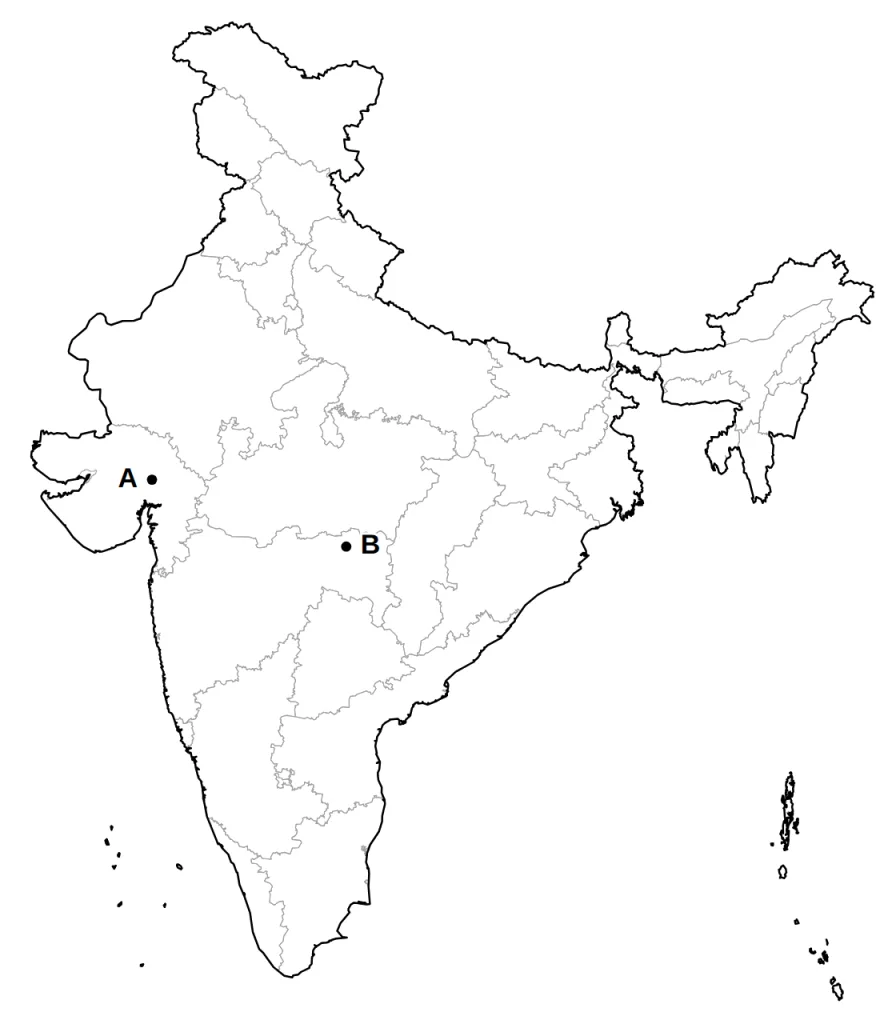
A The textile city where, in 1918, mill workers who were asking for higher wages were backed by a satyagraha led by Gandhiji. (1 mark)
Answer.
- A: Ahmedabad (Gujarat) — 1 mark
B The place where the Indian National Congress held its session in December 1920, at which the Non-Cooperation programme was adopted. (1 mark)
Answer.
- B: Nagpur (Maharashtra) — 1 mark
Section B - Geography (20 marks)
Question 16 (2 marks)
A village in the dry western part of Rajasthan has no coal or oil nearby and is not connected to the power grid. Suggest two non-conventional sources of energy suitable for it, with a reason for each.
Answer.
Model answer:
Solar energy: the dry region gets bright sunshine almost all year, so photovoltaic panels can supply power. Wind energy: strong, steady winds blow in western Rajasthan, and Jaisalmer already uses wind energy effectively.
Marking scheme:
- Solar energy: the dry region gets bright sunshine almost all year, so photovoltaic panels can supply power — 1 mark
- Wind energy: strong, steady winds blow here (Jaisalmer is known for effective use of wind energy); biogas from cattle dung is also acceptable — 1 mark
Question 17 (5 marks)
Lalremruata grows crops on a small forest patch that he has cleared on a hill slope in Mizoram. Gurpreet grows rice on his farm in Punjab using high-yielding variety seeds, chemical fertilisers and assured irrigation. Compare the two types of farming on any five points.
Answer.
Model answer:
- Type: Lalremruata practises primitive subsistence, slash-and-burn farming, called jhumming in the north-east; Gurpreet practises commercial farming.
- Tools and inputs: Lalremruata uses a hoe, dao and digging sticks; Gurpreet uses HYV seeds, chemical fertilisers and pesticides.
- Soil fertility: Jhum depends on natural fertility and the monsoon, and the patch is left when fertility falls; Gurpreet keeps the same land fertile with fertilisers and irrigation.
- Purpose and output: Jhum gives a low yield for the family's own use; Gurpreet gets a high yield, mainly for sale.
- Labour: Lalremruata's family does the work itself; Gurpreet hires workers and uses machines such as tractors.
Marking scheme:
- Type: Lalremruata practises primitive subsistence (slash-and-burn) farming, called jhumming in the north-east; Gurpreet practises commercial farming — 1 mark
- Tools and inputs: hoe, dao and digging sticks, versus HYV seeds, chemical fertilisers, insecticides and pesticides — 1 mark
- Soil fertility: jhum depends on natural fertility and the monsoon, and the patch is abandoned when fertility falls; in Punjab the same land is kept fertile with fertilisers and irrigation — 1 mark
- Output and purpose: low yield grown for the family's own needs, versus high yield grown mainly for sale in the market — 1 mark
- Labour: jhum is worked by the family itself; commercial farms often use hired workers and machines such as tractors (or any other relevant point, e.g. rice is a commercial crop in Punjab but a subsistence crop in Odisha) — 1 mark
OR
An entrepreneur has to choose between setting up a cotton textile mill and a jute mill, and first wants to understand the raw materials. Compare cotton and jute on the basis of the climate and soil they need and their major producing states. If the mill is to be set up in the delta region of West Bengal, which fibre could be sourced locally, and why?
Answer.
Model answer:
Cotton needs high temperatures, light rain or irrigation, about 210 days without frost and plenty of sunshine. It does best on the black soil of the drier Deccan plateau, and Maharashtra, Gujarat and Madhya Pradesh are among the main growers.
Jute also needs heat while it grows, but it wants the well-drained, fertile soil of flood plains, which floods renew every year. West Bengal, Bihar, Assam, Odisha and Meghalaya grow most of it.
For a mill in the West Bengal delta, jute can be sourced locally: the delta's hot flood plains get fresh silt every year and the state is a leading grower, while cotton needs drier land and bright sunshine.
Marking scheme:
- Cotton, climate: high temperature, light rainfall or irrigation, about 210 frost-free days and bright sunshine — 1 mark
- Cotton, soil and states: black soil of the drier parts of the Deccan plateau; grown mainly in Maharashtra, Gujarat, Madhya Pradesh, Karnataka, Andhra Pradesh, Telangana and Tamil Nadu (any three states) — 1 mark
- Jute, climate and soil: high temperature while growing; well-drained fertile soils of flood plains, renewed every year — 1 mark
- Jute, states: West Bengal, Bihar, Assam, Odisha and Meghalaya (any three) — 1 mark
- Delta of West Bengal: jute, because its flood plains get fresh fertile soil every year and stay hot, and West Bengal is a major jute producer; cotton needs drier land and bright sunshine — 1 mark
Question 18 (4 marks)
Read the source given below and answer the questions that follow.
Forty Years on the Saranpur Hills
From a newspaper feature about an imaginary district
When Leela Oraon was a girl in the 1980s, the hills behind her village were thick with sal trees, and anyone collecting mahua flowers at dawn kept an eye out for sloth bears. Today she walks two hours to gather one headload of fuelwood.
The villagers can list what went wrong. The lower valley now lies under the reservoir of a dam built to supply the district's towns with water and power. An iron-ore company was given the eastern ridge, and its trucks now roar through the forest where bears once crossed from hill to hill. As families grew, more slopes were cleared for fields, and large herds of goats nibble every sapling that comes up. The tiger that the old people talk about has not been seen for thirty years.
The bears have not gone away. They now raid the village at night for grain and mahua, and last winter two farmers were badly hurt. 'We are not their enemies,' Leela says, 'but we have taken away their home.'
18.1 Identify any one development project mentioned in the report that has led to the loss of forest. (1 mark)
Answer.
Model answer:
The dam, whose reservoir drowned the forest of the lower valley.
Marking scheme:
- Any one: the dam and its reservoir, or iron-ore mining on the eastern ridge — 1 mark
18.2 Using the report and your own knowledge, explain how the loss of forest in Saranpur harms (a) its wildlife and (b) its people. Give one point for each. (2 marks)
Answer.
Model answer:
(a) The bears and other animals have lost their habitat and food, and the mine has cut the forest paths between hills, so the tiger has vanished and bears now raid villages. (b) Families like Leela's lose fuelwood, fodder, mahua and medicines, and the raiding bears destroy grain and injure people.
Marking scheme:
- (a) Wildlife: animals lose their habitat, food and the paths between forest patches, so some species (like the tiger here) disappear locally and others come into conflict with people — 1 mark
- (b) People: forest-dwelling and tribal families lose fuelwood, fodder, fruits, flowers such as mahua and medicines, and wild animals entering villages destroy crops and endanger lives — 1 mark
18.3 Why does the report count the goats among the causes of forest loss, even though goats do not cut down trees? (1 mark)
Answer.
Model answer:
They eat every young sapling, so no new trees grow and the forest cannot renew itself.
Marking scheme:
- They eat the young saplings, so new trees cannot grow to replace old ones and the forest cannot regenerate (overgrazing) — 1 mark
Question 19 (3 marks)
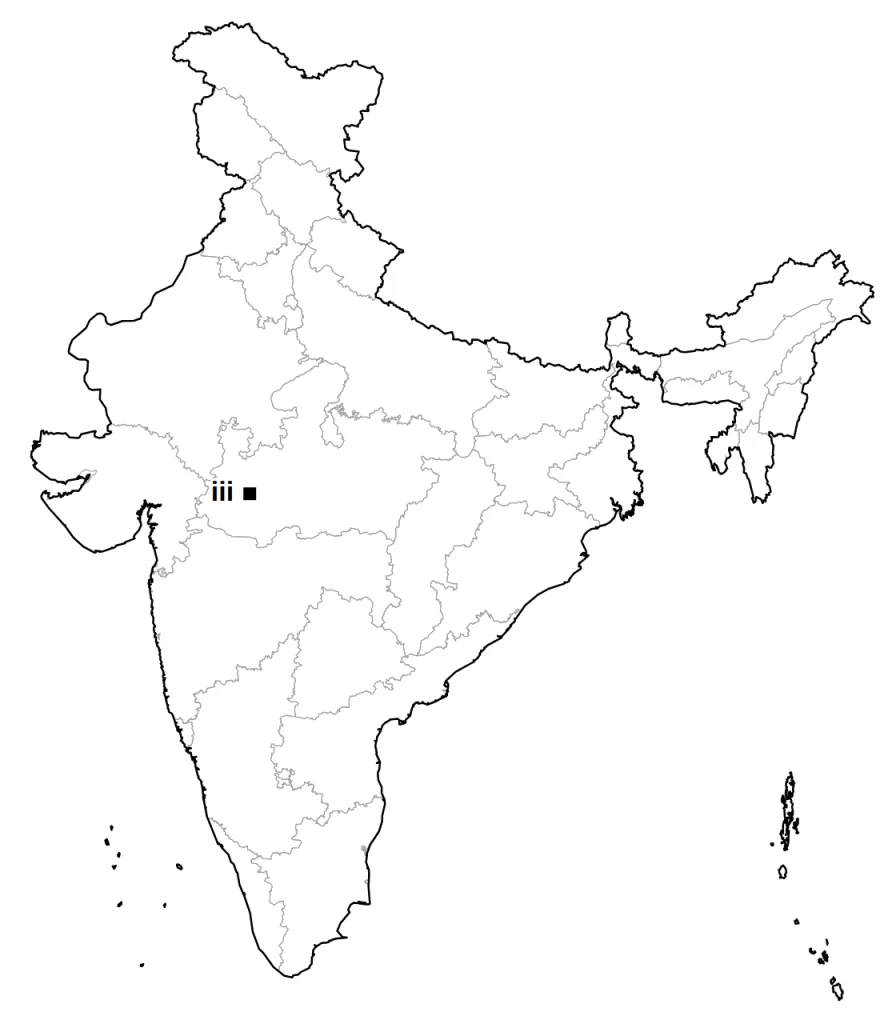
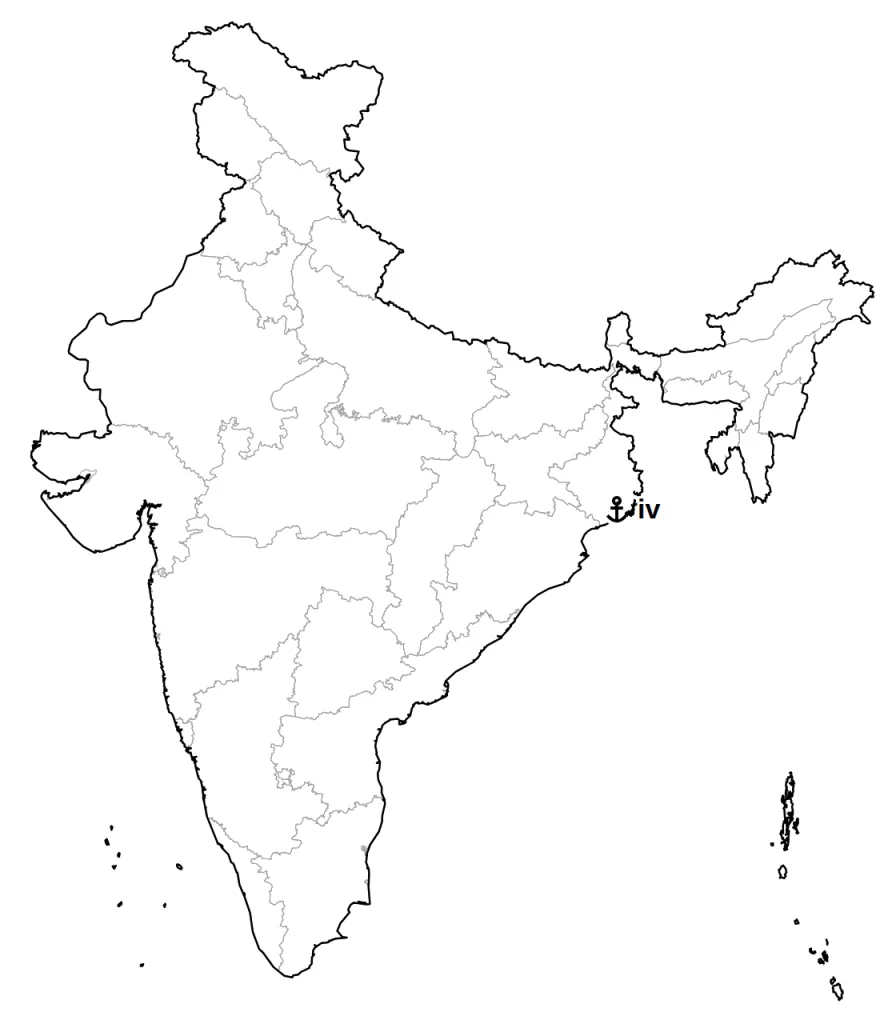
On the outline map of India given for this question, locate and label any three of the following with suitable symbols.
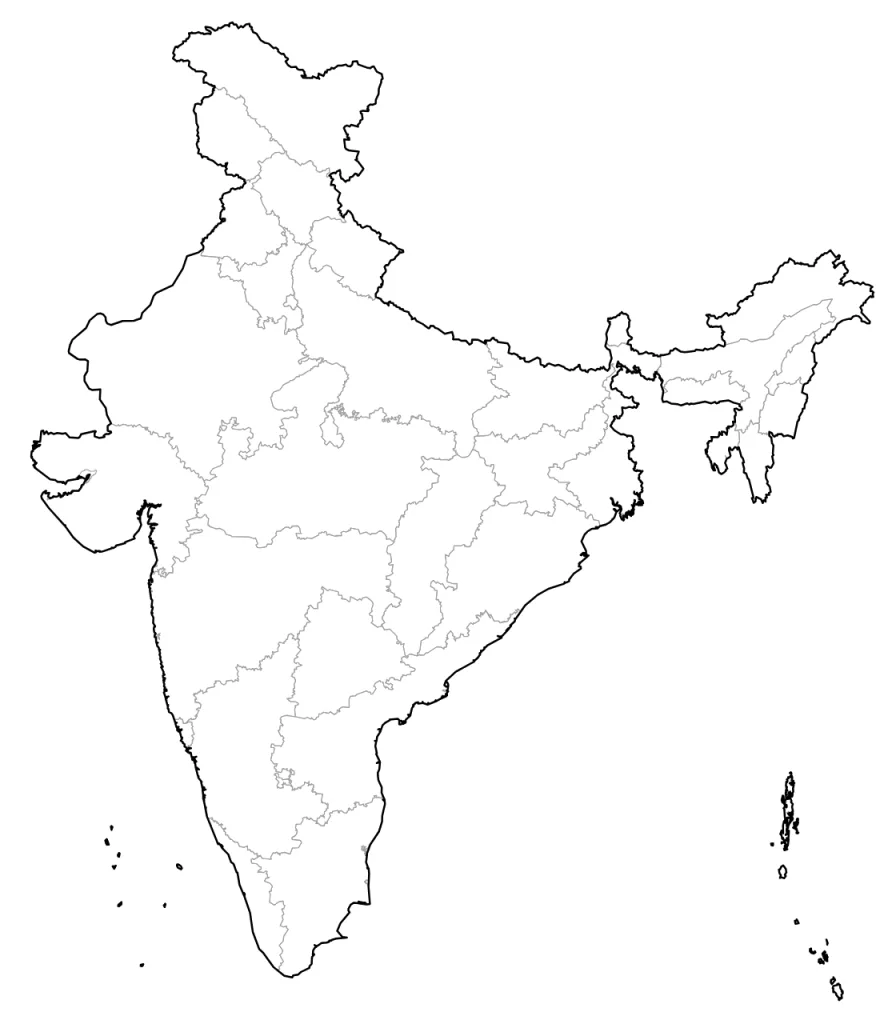
(i) Hirakud Dam (1 mark)
Answer.
- Hirakud Dam: on the Mahanadi near Sambalpur, Odisha, located correctly with a symbol and labelled — 1 mark
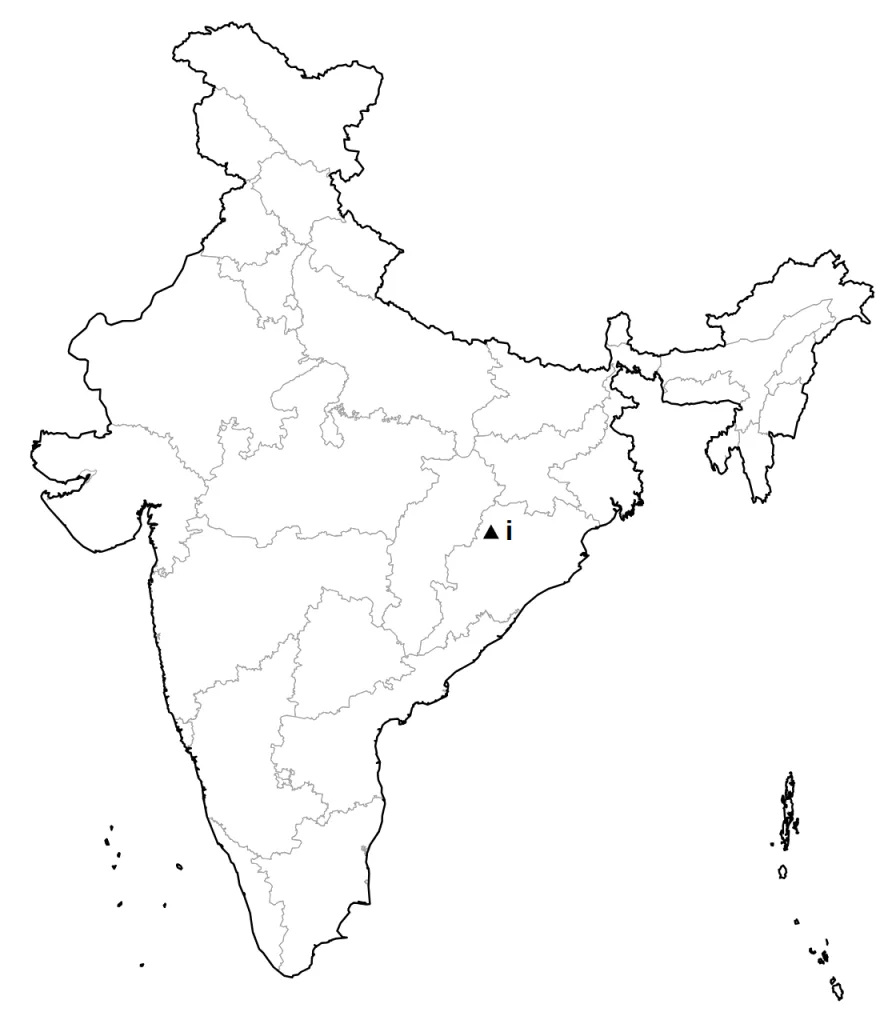
(ii) Kalpakkam Nuclear Power Plant (1 mark)
Answer.
- Kalpakkam: on the coast of Tamil Nadu, south of Chennai, located correctly with a symbol and labelled — 1 mark
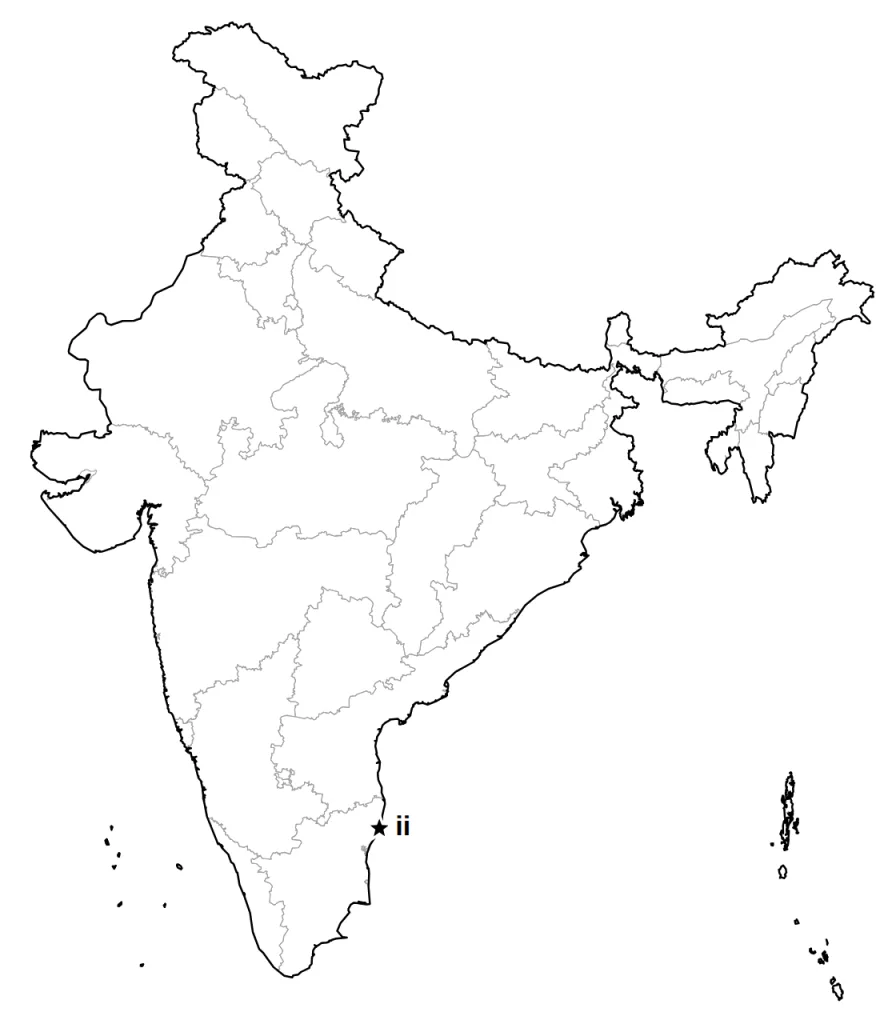
(iii) Indore - a cotton textile centre (1 mark)
Answer.
- Indore: in western Madhya Pradesh, located correctly with a symbol and labelled — 1 mark
(iv) Haldia - a major sea port (1 mark)
Answer.
- Haldia: in West Bengal, near the mouth of the Hugli, located correctly with a symbol and labelled — 1 mark
Section C - Political Science (20 marks)
Question 24 (2 marks)
Analyse two majoritarian measures adopted by the government of Sri Lanka after independence that increased the feeling of alienation among Sri Lankan Tamils.
Answer.
Model answer:
In 1956 an Act made Sinhala the only official language, ignoring Tamil. Governments also followed preferential policies that favoured Sinhala applicants for university positions and government jobs, so Tamils felt their language and interests were neglected.
Marking scheme:
- An Act of 1956 recognised Sinhala as the only official language, disregarding Tamil — 1 mark
- Preferential policies favoured Sinhala applicants for university positions and government jobs (or: the constitution said the state shall protect and foster Buddhism) — 1 mark
Question 25 (2 marks)
A citizen complains that her democratically elected government took three years to decide where to build a new bridge. Explain two ways in which such a delay can still lead to a better decision.
Answer.
Model answer:
First, the delay allows deliberation: people affected by the bridge are heard, so the choice is more acceptable and works better. Second, the process is transparent: citizens can check that proper procedure was followed, keeping the government accountable.
Marking scheme:
- Deliberation and negotiation: those affected are heard and objections are discussed, so the final decision is more acceptable to people and more effective — 1 mark
- Transparency: citizens can check whether the decision followed the correct procedure, which keeps the government accountable (or: decisions follow norms and procedures, which gives the government legitimacy; any other relevant point) — 1 mark
Question 26 (3 marks)
'Religion in politics is not always a problem, but communalism is.' Analyse the statement with three arguments.
Answer.
Model answer:
First, ethical values from religion can guide politics, as Gandhiji believed, and religious groups may raise their needs peacefully. Second, communalism begins when one religion is shown as superior and one group's demands are set against another's. Third, it seeks dominance of one group, even through state power, which our secular Constitution forbids.
Marking scheme:
- Ethical values drawn from religion can guide politics (Gandhiji's view), and religious groups may voice their needs and interests peacefully in a democracy — 1 mark
- Communalism begins when religion is made the basis of the nation, one religion is presented as superior and one group's demands are framed against another's — 1 mark
- It seeks political dominance of one religious group, even using state power, which the secular Constitution forbids (no official religion, freedom of religion, no discrimination) — 1 mark
Question 27 (5 marks)
A visitor from abroad fears that a country with so many languages, and with States drawn on the basis of language, must be in danger of breaking apart. Using India's experience of linguistic States and its language policy, examine why this fear has proved wrong and how federalism has become stronger.
Answer.
Model answer:
Linguistic States: After independence, State boundaries were redrawn so that people speaking the same language lived in one State; some, like Nagaland and Jharkhand, reflected culture, ethnicity or geography. Fears of break-up proved wrong: the country became more united and administration easier.
Language policy: No language was made the national language. Hindi became the official language, but other languages were protected: besides Hindi, 21 languages are Scheduled Languages, Central Government examinations can be taken in any of them, and States have their own official languages. When non-Hindi States resisted ending English in 1965, the Centre kept English along with Hindi. This flexibility avoided a Sri Lanka-type conflict and strengthened federalism.
Marking scheme:
- After independence, State boundaries were redrawn so that people speaking the same language lived in the same State (some States, like Nagaland, Uttarakhand and Jharkhand, were formed on culture, ethnicity or geography) — 1 mark
- Fears that this would break up the country proved wrong: it made the country more united and administration easier — 1 mark
- No language was given the status of national language; Hindi was made the official language with safeguards for others, and besides Hindi 21 languages are Scheduled Languages — 1 mark
- Candidates may take Central Government examinations in any Scheduled Language, and States have their own official languages — 1 mark
- When non-Hindi States opposed ending English in 1965, the Centre agreed to continue English with Hindi; this flexibility avoided the kind of conflict seen in Sri Lanka — 1 mark
OR
Distinguish between 'coming together' and 'holding together' federations. Explain, with three features, why India is described as a 'holding together' federation.
Answer.
Model answer:
In a coming together federation, independent States join on their own to form a bigger unit and keep their identity; units usually have equal power (USA, Switzerland, Australia). In a holding together federation, a large country divides power between its States and the national government; the Centre tends to be stronger and units may be unequal (India, Spain, Belgium).
India is holding together: (1) the Union List covers subjects of national importance, and the Union also legislates on residuary subjects; (2) in a clash on a Concurrent List subject, the Union law prevails; (3) Union Territories like Chandigarh and Lakshadweep lack a State's powers and are run largely by the Centre.
Marking scheme:
- Coming together: independent States come together on their own to form a bigger unit, keeping their identity; units usually have equal power (USA, Switzerland, Australia) — 1 mark
- Holding together: a large country divides power between the constituent States and the national government; the Centre tends to be more powerful and units may have unequal powers (India, Spain, Belgium) — 1 mark
- India: the Union List has subjects of national importance, and the Union can also make laws on residuary subjects — 1 mark
- On Concurrent List subjects, if Union and State laws conflict, the Union law prevails — 1 mark
- Units are not equal: Union Territories such as Chandigarh and Lakshadweep do not have the powers of a State, and the Centre has special powers in running them — 1 mark
Question 28 (4 marks)
Read the source given below and answer the questions that follow.
A Worker's Letter
A letter to the editor of a newspaper in an imaginary town
Sir, I have worked for the Jan Pragati Party in our district for twelve years. I have put up its posters, sat through its rallies and knocked on doors in the summer heat. Last month the party chose its candidates for the Assembly election, and I learnt their names from the television like everyone else.
Our sitting MLA is not contesting this time, and his ticket has gone to his son, who came back from Delhi only last year and has never attended a ward meeting. The other ticket has gone to a man whose gang, everyone knows, 'looks after' the polling booths on election day, and who faces two criminal cases; the leaders say he is sure to win. Nobody asked the workers. For as long as I can remember, our party has not held an election for its own posts.
My neighbours say it hardly matters, since the other big party makes the same promises anyway.
I am told that the law now stops an MLA from crossing over to another party after winning, and that every candidate must file an affidavit about his property and any criminal cases. Good. But none of this touches what happens inside our own party.
A party worker
28.1 Which challenge to political parties is shown by the choice of the sitting MLA's son as the candidate? (1 mark)
Answer.
Model answer:
Dynastic succession: the ticket passes within one family instead of going to a worker.
Marking scheme:
- Dynastic succession: top positions pass to family members, so ordinary workers seldom rise — 1 mark
28.2 The second ticket went to a man whose gang 'looks after' polling booths and who faces criminal cases. Explain two ways in which giving tickets to such candidates can weaken democracy. (2 marks)
Answer.
Model answer:
First, if a gang controls the booths, voters are frightened, so the election is not free and fair and the result may not show what people want. Second, honest workers like the letter-writer are pushed aside, and people facing criminal cases may reach the Assembly and use power for themselves.
Marking scheme:
- Muscle power at the booths frightens voters, so the election is no longer free and fair and the result may not show what people really want — 1 mark
- Honest workers and citizens are discouraged from contesting, and people facing criminal charges may enter the legislature and use power for their own ends; people lose trust in politics (any other relevant point) — 1 mark
28.3 The law against changing parties after winning has reduced defections. State one drawback of this law for elected members. (1 mark)
Answer.
Model answer:
Members find it hard to dissent, since they must accept whatever the party leaders decide.
Marking scheme:
- Dissent has become harder: MPs and MLAs must accept whatever the party leaders decide, even when they disagree — 1 mark
Section D - Economics (20 marks)
Question 35 (3 marks)
Ramesh, a landless labourer from a village in Bihar, spends six months of every year at a brick kiln near a town. He is paid according to the number of bricks he moulds, and nothing on days when rain stops the work. There is no written contract. When he hurt his hand last season, the owner paid nothing for his treatment and simply hired someone else.
(i) In which sector, on the basis of conditions of employment, does Ramesh work? Give one reason from the case. (1 mark)
Answer.
Model answer:
The unorganised sector, since he has no written contract and is paid nothing when work stops.
Marking scheme:
- Unorganised sector; any one reason: no written contract, no pay when work stops, no medical help, or he can be replaced at will — 1 mark
(ii) Suggest two ways in which the government can protect workers like Ramesh, and say how each would help him. (2 marks)
Answer.
Model answer:
First, the government can enforce minimum wages and safety rules at kilns, so Ramesh earns fairly and works more safely. Second, it can give such workers health care and accident insurance, so an injury does not leave him without treatment.
Marking scheme:
- Fix and enforce minimum wages and working hours, with safety rules at kilns, so that he earns a fair, steady amount and works in safer conditions — 1 mark
- Provide social security such as health care, accident insurance or pension (or: cheap credit and support for small units; basic health and education services; registering kilns so that labour laws apply; any other relevant point), so that an injury or a bad season does not leave him without help — 1 mark
Question 36 (3 marks)
Dinesh drives a hired e-rickshaw in Patna. To buy one of his own, he borrows ₹ 60,000 from a local financier at 4 per cent interest per month, and the financier keeps the vehicle's papers. During the monsoon, waterlogged roads cut his earnings sharply for weeks. Analyse how this loan can push Dinesh into a debt trap, and explain why a loan from a bank or a cooperative would have been better for him.
Answer.
Model answer:
Interest at 4 per cent a month means 48 per cent a year, which is very high. When the monsoon cuts his earnings, Dinesh cannot repay; interest piles up, and he may lose the rickshaw or borrow again. This is a debt trap. A bank or cooperative lends far more cheaply, under RBI rules, so repayment would be manageable.
Marking scheme:
- 4 per cent a month is 48 per cent a year, a very high cost of borrowing — 1 mark
- When earnings fall he cannot repay; interest piles up, he may lose the e-rickshaw (the lender holds its papers) or borrow again to repay: a debt trap — 1 mark
- A bank or cooperative charges much lower interest, is supervised by the RBI and has fixed rules on repayment, so the loan is cheaper and safer — 1 mark
Question 37 (3 marks)
Imagine a country that, since 1991, has closed its borders completely to economic links with the rest of the world. Using the meaning of globalisation, explain three kinds of links with other countries that this country has cut itself off from.
Answer.
Model answer:
Globalisation means countries getting linked through the movement of goods, services, investment and technology. This country has cut all three. Its producers cannot sell abroad and its buyers cannot get foreign goods. Foreign companies cannot invest in its factories or offices. And new machines and methods of production cannot come in from other countries.
Marking scheme:
- Goods and services: its producers cannot sell abroad and its buyers cannot get goods or services made in other countries, so its markets stay separate from theirs — 1 mark
- Investment: companies from other countries cannot put money into land, buildings, machines or offices there, and its own companies cannot invest abroad — 1 mark
- Technology: new machines, methods of production and know-how from abroad cannot come in, so it misses the rapid interconnection with other countries that globalisation means (accept: movement of people such as students and workers, if explained as a link) — 1 mark
Question 38 (5 marks)
A member of a district planning committee is comparing three districts of her state before deciding how a new development fund should be used. Study the table and answer the questions that follow. (The data are hypothetical, for practice only.)
| District | Average income per person (₹ per year) | Households with safe drinking water (%) | Children completing Class 10 (%) | Life expectancy at birth (years) |
|---|---|---|---|---|
| X | 1,80,000 | 62 | 55 | 66 |
| Y | 1,10,000 | 93 | 81 | 72 |
| Z | 70,000 | 48 | 40 | 63 |
(i) Using one pair of figures from the table, show that a higher average income does not always mean a longer life. (1 mark)
Answer.
Model answer:
X earns ₹ 1,80,000 per person but lives 66 years; Y earns ₹ 1,10,000 yet lives 72 years.
Marking scheme:
- X has the highest income (₹ 1,80,000) but a life expectancy of 66 years, lower than Y's 72 years at ₹ 1,10,000 — 1 mark
(ii) Y has a lower average income than X but better figures on the other three indicators. Suggest two public facilities that could explain this, linking each to a column of the table. (2 marks)
Answer.
Model answer:
First, a public piped water supply would explain why 93% of Y's households have safe water. Second, free government schools with mid-day meals and scholarships would explain why 81% of its children complete Class 10 despite lower incomes.
Marking scheme:
- One public facility linked to a column, e.g. a public piped supply of safe water (safe water 93%) or public health centres, vaccination and a working public distribution system (life expectancy 72 years) — 1 mark
- A second facility linked to another column, e.g. free government schools with mid-day meals or scholarships (Class 10 completion 81%); any other relevant facility — 1 mark
(iii) The fund for District Z can pay either for a new factory that is expected to raise average income, or for safe drinking water in every village. Which would you choose? Give two reasons from the table. (2 marks)
Answer.
Model answer:
I would choose safe drinking water. First, only 48% of Z's households have it, the lowest of the three. Second, Z's life expectancy of 63 years is also the lowest, and Y shows that wide access to safe water can go with longer lives even without a high income.
Marking scheme:
- A clear choice (either is accepted) with a first reason from the table, e.g. water: only 48% of Z's households have safe water; factory: Z's average income (₹ 70,000) is the lowest — 1 mark
- A second reason from the table, e.g. water: Z's life expectancy (63 years) is the lowest, and safe water can also help schooling (40% complete Class 10); factory: X, with the highest income, does better than Z on every indicator — 1 mark
OR
Study the same table and answer the following.
(i) Which district would you expect to have the highest infant mortality rate? Give one reason from the table. (1 mark)
Answer.
Model answer:
District Z, since only 48% of its households have safe water and its life expectancy is the lowest.
Marking scheme:
- District Z: it has the lowest life expectancy (63 years) and the fewest households with safe water (48%) — 1 mark
(ii) Suggest two public facilities, other than drinking water, that could raise the share of children completing Class 10 in District Z, and explain how each would help. (2 marks)
Answer.
Model answer:
First, mid-day meals in government schools would keep poor children coming to school and better fed, so fewer drop out. Second, scholarships or free cycles for girls would help families afford to keep daughters in school until Class 10, which only 40% complete now.
Marking scheme:
- One facility with how it helps, e.g. free government schools within reach (no fees, less travel) or mid-day meals (children stay in school and are better fed) — 1 mark
- A second facility with how it helps, e.g. scholarships, free books or cycles for girls; public transport or hostels for distant villages; any other relevant point — 1 mark
(iii) Using the table, explain how giving safe drinking water to more households in District Z could also improve two of its other indicators. (2 marks)
Answer.
Model answer:
Safe water cuts water-borne diseases, so fewer people die early and Z's life expectancy of 63 years can rise. Healthier children miss fewer school days, and girls spend less time fetching water, so more of them can finish Class 10, which only 40% do now.
Marking scheme:
- Life expectancy (63 years): fewer water-borne diseases mean fewer early deaths, so people live longer — 1 mark
- Class 10 completion (40%): healthier children miss less school, and girls spend less time fetching water, so more finish school — 1 mark