
CBSE Class 10 Social Science Sample Paper 2027 – Set 1
Time allowed: 3 hours · Maximum marks: 80
General Instructions
- This question paper has 38 questions. All questions are compulsory.
- The paper has four sections: Section A History (20 marks), Section B Geography (20 marks), Section C Political Science (20 marks) and Section D Economics (20 marks).
- Multiple choice questions (MCQs) carry 1 mark each.
- Very Short Answer (VSA) questions carry 2 marks each. Answer each in not more than 40 words.
- Short Answer (SA) questions carry 3 marks each. Answer each in not more than 60 words.
- Long Answer (LA) questions carry 5 marks each. Answer each in not more than 120 words.
- Case-based questions (CBQ) have three sub-questions and carry 4 marks each. Answer each question in not more than 100 words.
- The map-based questions carry 5 marks in two parts: Question 9 in Section A (2 marks) and Question 19 in Section B (3 marks). Mark your answers on a printed outline map of India.
- There is no overall choice in the question paper. However, an internal choice has been provided in a few questions. Attempt only one of the choices in such questions.
- A separate question has been provided for Visually Impaired candidates in lieu of questions having visual inputs or maps. Such questions are to be attempted by Visually Impaired candidates only.
How to use this paper: set a 3-hour timer and write all your answers on paper, just like the board exam. When you finish, take the quiz at the end of this page to score your objective (MCQ) answers instantly, then open the Detailed Solutions and check the rest step by step, with the marks each step carries.
Section A - History (20 marks)
Questions 1 to 9. Questions 1 to 4 are MCQs of 1 mark each; Question 9 is map-based.
1. Which of the following were features of the Civil Code of 1804, also known as the Napoleonic Code?
I. It ended the special rights that people had enjoyed only because of the family they were born into.
II. It gave all adult men and women the right to vote.
III. It treated all citizens alike in the courts and protected what they owned.
IV. It brought back feudal dues in the villages under French control.
Choose the correct option:
(a) Only I and II
(b) Only I and III
(c) Only II and IV
(d) Only III and IV
2. Look at the flag shown below. Which one of the following statements about it is correct?
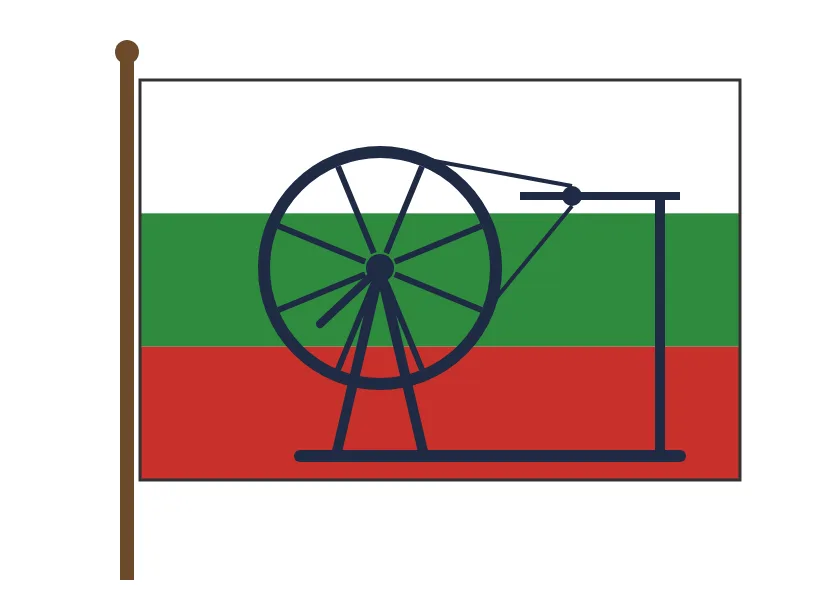
(a) It was the flag of the Swadeshi movement in Bengal, with eight lotuses for eight provinces.
(b) It was the flag of the Swaraj Party that C.R. Das and Motilal Nehru set up within the Congress.
(c) Gandhiji had designed it by 1921; its central symbol stood for self-help.
(d) It was the flag of the Khilafat Committee that was formed in Bombay in 1919.
3. Read the statements given below and choose the correct option.
Statement I: Potatoes, maize, tomatoes and chillies, which are everyday foods in Asia today, reached Asia and Europe only after Europeans began sailing to America about five hundred years ago.
Statement II: Potatoes were first carried from China to Europe by traders who used the silk routes.
(a) Statement I is correct and Statement II is incorrect.
(b) Statement I is incorrect and Statement II is correct.
(c) Both Statements I and II are correct.
(d) Both Statements I and II are incorrect.
4. Arrange the following events in chronological order, from the earliest to the latest.
I. Martin Luther put forward his Ninety Five Theses, questioning several practices of the Roman Catholic Church.
II. The Vernacular Press Act was passed in India.
III. The Buddhist text known as the Diamond Sutra was printed from carved wooden blocks.
IV. Marco Polo returned to Italy from China with knowledge of woodblock printing.
Choose the correct option:
(a) III, I, IV, II
(b) IV, III, I, II
(c) III, IV, II, I
(d) III, IV, I, II
5. 'The silk routes carried much more than silk.' Justify the statement with two points. (2 marks)
6. Analyse how Romanticism, folk culture and music helped to build the idea of the nation in nineteenth-century Europe. (3 marks)
OR
After 1871, why did the Balkans become the region most likely to drag Europe into war over rival nationalisms? Examine.
7. 'Different social groups joined the Non-Cooperation Movement, but each gave its own meaning to swaraj.' Examine the statement with reference to the peasants of Awadh, the tribal peasants of the Gudem Hills and the plantation workers of Assam. (5 marks)
OR
Evaluate why the Civil Disobedience Movement failed to win the full support of the Dalits and of large sections of Muslims.
8. Read the source given below and answer the questions that follow.
The Hidden Reader
A label in a gallery of an imaginary museum of printing
This glass case holds three objects from Bengal and north India: a worn alphabet primer, a few loose pages of a household almanac and a women's monthly magazine from about 1915.
The primer belonged to a young wife. Her family later said that she hid it among the kitchen tins and practised her letters while the rice boiled. She had reason to be careful. In many conservative homes of the late nineteenth century, a girl who read was thought to be inviting trouble. Some Hindu families feared she would soon be widowed, and some Muslim families worried that romantic stories in Urdu would lead her astray.
The monthly, on the other hand, was sold openly. A woman edited it, and its letters page was full of readers from small towns arguing with one another.
Visitors often ask us which object matters more. Our answer: without the primer, there could have been no monthly.
8.1 According to the label, why did some Muslim families not want girls to learn to read? (1 mark)
8.2 The museum says, 'Without the primer, there could have been no monthly.' Explain this statement with two points. (2 marks)
8.3 Name one woman of nineteenth-century India who used print to write about the lives of women. (1 mark)
9. Two places A and B have been marked on the given outline map of India. Identify them and write their correct names.
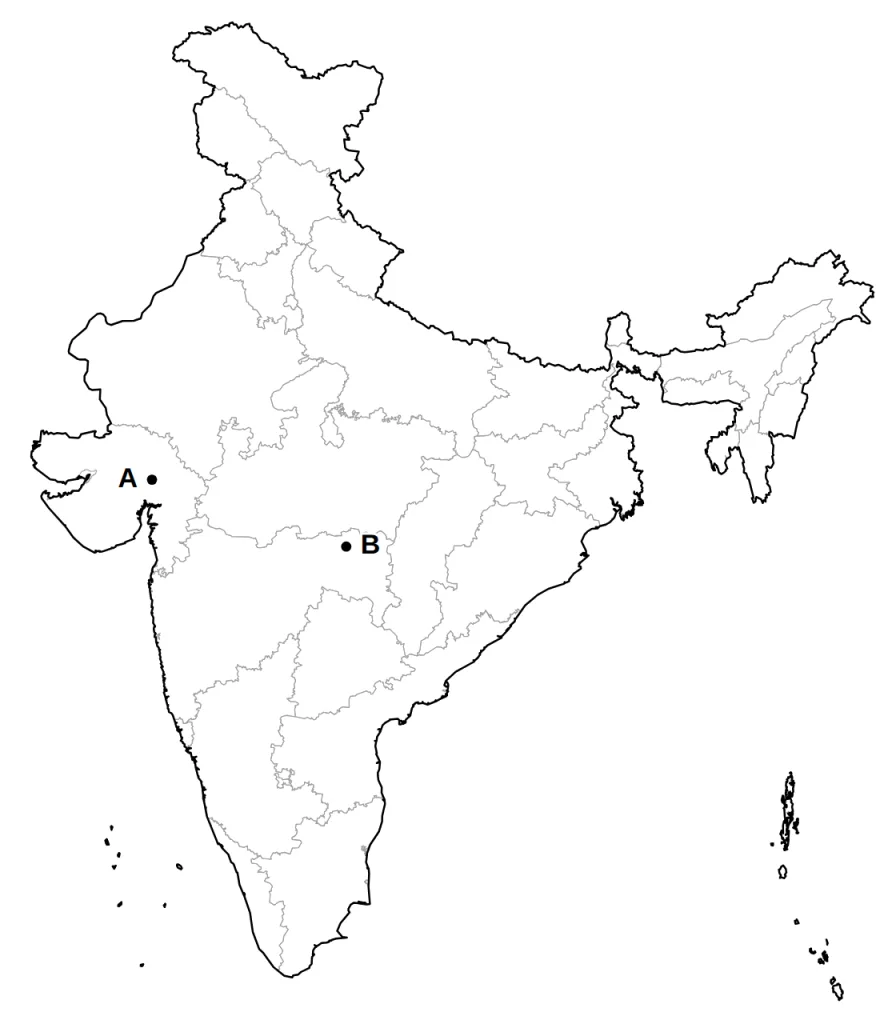
A The textile city where, in 1918, mill workers who were asking for higher wages were backed by a satyagraha led by Gandhiji. (1 mark)
B The place where the Indian National Congress held its session in December 1920, at which the Non-Cooperation programme was adopted. (1 mark)
Section B - Geography (20 marks)
Questions 10 to 19. Questions 10 to 15 are MCQs of 1 mark each; Question 19 is map-based.
10. A coffee grower in the hills of Karnataka tells visitors: 'Our year has a wet season and a long dry season. The heavy rains wash the plant food out of our soil, so we add plenty of manure, and we cut terraces so that the soil is not lost down the slope. Lower down, our neighbours grow cashew on a redder form of the same soil.' Which soil is he describing?
(a) Black soil
(b) Red and yellow soil
(c) Alluvial soil
(d) Laterite soil
11. Match Column I (group of states) with Column II (a main cause of land degradation there) and choose the correct option.
| Column I | Column II |
|---|---|
| 1. Jharkhand, Chhattisgarh, Madhya Pradesh and Odisha | X. Overgrazing |
| 2. Punjab, Haryana and western Uttar Pradesh | Y. Too much irrigation, which leaves fields waterlogged and makes the soil salty and alkaline |
| 3. Gujarat, Rajasthan, Madhya Pradesh and Maharashtra | Z. Forests cleared for mining |
(a) 1-Y, 2-Z, 3-X
(b) 1-X, 2-Y, 3-Z
(c) 1-Z, 2-Y, 3-X
(d) 1-Z, 2-X, 3-Y
12. Which of the following statements about multipurpose river projects in India are correct?
I. Jawaharlal Nehru saw big dams as symbols of the modern, developing India he hoped to build.
II. Because a dam slows the river, much of the silt it carries settles in the reservoir instead of reaching the plains below.
III. The Narmada Bachao Andolan first took up the loss of forests to the dam's waters, and later the rights of the people it displaced.
IV. By keeping the flow steady, big dams have made it easier for fish and other river animals to breed and move upstream.
Choose the correct option:
(a) I, II and IV
(b) I, II and III
(c) II, III and IV
(d) I, III and IV
13. A company plans to set up an aluminium smelting plant close to the source of its main raw material. Which choice of raw material and region is the most suitable?
(a) Hematite; the Bailadila hills in Bastar, Chhattisgarh
(b) Bauxite; the Panchpatmali deposits in Koraput district, Odisha
(c) Mica; the Koderma-Gaya-Hazaribagh belt of Jharkhand
(d) Copper; the Khetri mines in Jhunjhunu, Rajasthan
14. A sugar company that has run a mill in Uttar Pradesh for decades now plans its next two mills in Maharashtra and Karnataka. Which reason best supports this choice?
(a) Cane there gives more sugar, and the cooler climate lets mills crush for more months
(b) The big cities of the south and west are the largest markets for sugar in India
(c) Cheap hydroelectric power from the Western Ghats cuts the fuel bill of the mills
(d) Cane grown there keeps its sugar for weeks, so it can be hauled long distances
Directions: In Questions 15, 20 and 34, a statement of Assertion (A) is followed by a statement of Reason (R). Choose the correct option.
15. Assertion (A): The iron and steel industry is both a basic industry and a heavy industry.
Reason (R): It is called a basic industry because it uses only minerals, and no farm products, as its raw materials.
(a) Both Assertion (A) and Reason (R) are true, and Reason (R) is the correct explanation of Assertion (A).
(b) Both Assertion (A) and Reason (R) are true, but Reason (R) is not the correct explanation of Assertion (A).
(c) Assertion (A) is true, but Reason (R) is false.
(d) Assertion (A) is false, but Reason (R) is true.
16. A village in the dry western part of Rajasthan has no coal or oil nearby and is not connected to the power grid. Suggest two non-conventional sources of energy suitable for it, with a reason for each. (2 marks)
17. Lalremruata grows crops on a small forest patch that he has cleared on a hill slope in Mizoram. Gurpreet grows rice on his farm in Punjab using high-yielding variety seeds, chemical fertilisers and assured irrigation. Compare the two types of farming on any five points. (5 marks)
OR
An entrepreneur has to choose between setting up a cotton textile mill and a jute mill, and first wants to understand the raw materials. Compare cotton and jute on the basis of the climate and soil they need and their major producing states. If the mill is to be set up in the delta region of West Bengal, which fibre could be sourced locally, and why?
18. Read the source given below and answer the questions that follow.
Forty Years on the Saranpur Hills
From a newspaper feature about an imaginary district
When Leela Oraon was a girl in the 1980s, the hills behind her village were thick with sal trees, and anyone collecting mahua flowers at dawn kept an eye out for sloth bears. Today she walks two hours to gather one headload of fuelwood.
The villagers can list what went wrong. The lower valley now lies under the reservoir of a dam built to supply the district's towns with water and power. An iron-ore company was given the eastern ridge, and its trucks now roar through the forest where bears once crossed from hill to hill. As families grew, more slopes were cleared for fields, and large herds of goats nibble every sapling that comes up. The tiger that the old people talk about has not been seen for thirty years.
The bears have not gone away. They now raid the village at night for grain and mahua, and last winter two farmers were badly hurt. 'We are not their enemies,' Leela says, 'but we have taken away their home.'
18.1 Identify any one development project mentioned in the report that has led to the loss of forest. (1 mark)
18.2 Using the report and your own knowledge, explain how the loss of forest in Saranpur harms (a) its wildlife and (b) its people. Give one point for each. (2 marks)
18.3 Why does the report count the goats among the causes of forest loss, even though goats do not cut down trees? (1 mark)
19. On the outline map of India given for this question, locate and label any three of the following with suitable symbols.
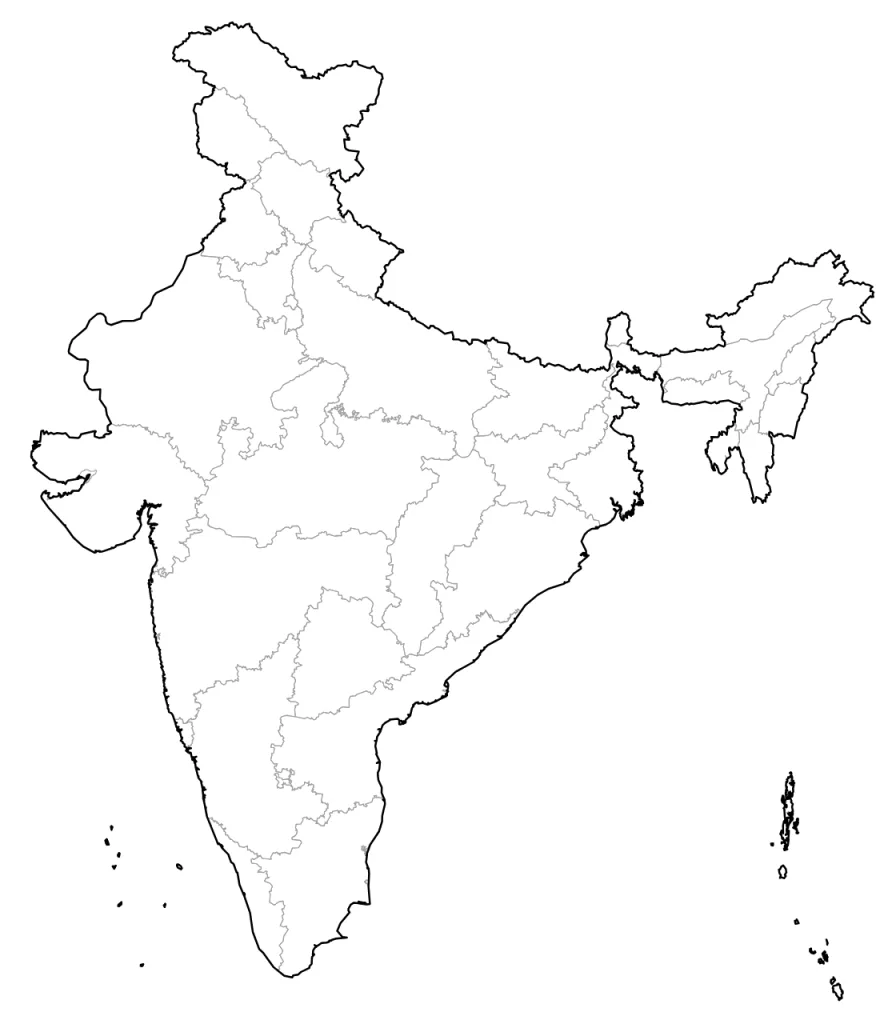
(i) Hirakud Dam (1 mark)
(ii) Kalpakkam Nuclear Power Plant (1 mark)
(iii) Indore - a cotton textile centre (1 mark)
(iv) Haldia - a major sea port (1 mark)
Section C - Political Science (20 marks)
Questions 20 to 28. Questions 20 to 23 are MCQs of 1 mark each.
20. Assertion (A): In Brussels, the Dutch-speaking community holds more seats in the government, because it is the majority in Belgium as a whole.
Reason (R): Belgium gave its two main language groups an equal say in some key bodies, so that neither group could dominate the other.
(a) Both Assertion (A) and Reason (R) are true, and Reason (R) is the correct explanation of Assertion (A).
(b) Both Assertion (A) and Reason (R) are true, but Reason (R) is not the correct explanation of Assertion (A).
(c) Assertion (A) is true, but Reason (R) is false.
(d) Assertion (A) is false, but Reason (R) is true.
21. Read the two situations given below.
P: The High Court cancels an order of the State government because the order breaks the law.
Q: The Union Government makes decisions on the country's defence, while the State government makes decisions on the police in the State.
Which option correctly identifies the arrangement of power seen in each situation?
(a) P: horizontal distribution among organs; Q: vertical distribution among levels
(b) P: vertical distribution among levels; Q: horizontal distribution among organs
(c) P and Q: both show horizontal distribution among organs of government
(d) P and Q: both show vertical distribution among levels of government
22. In the Legislative Assembly election of a State, Party P secures 7 per cent of the total votes and wins 3 seats. On this basis, how will the Election Commission treat Party P?
(a) As a national party, since it has won seats in a State Assembly election
(b) As an unrecognised party, since it won less than ten per cent of the seats
(c) As a State party, since both its votes and its seats meet the rule
(d) As a national party, since it won more than two seats in the State
23. Study the cartoon given below. Which outcome of democracy is the cartoonist questioning?
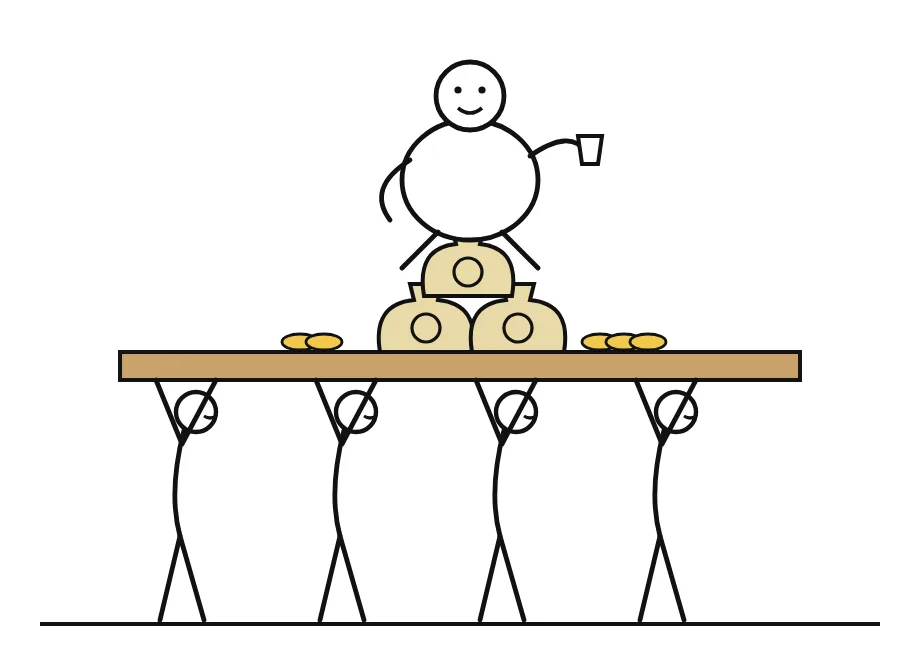
(a) Reduction of economic inequality and poverty
(b) Holding free and fair elections at regular intervals
(c) Accommodation of social and regional diversity
(d) Dignity and freedom of every individual citizen
24. Analyse two majoritarian measures adopted by the government of Sri Lanka after independence that increased the feeling of alienation among Sri Lankan Tamils. (2 marks)
25. A citizen complains that her democratically elected government took three years to decide where to build a new bridge. Explain two ways in which such a delay can still lead to a better decision. (2 marks)
26. 'Religion in politics is not always a problem, but communalism is.' Analyse the statement with three arguments. (3 marks)
27. A visitor from abroad fears that a country with so many languages, and with States drawn on the basis of language, must be in danger of breaking apart. Using India's experience of linguistic States and its language policy, examine why this fear has proved wrong and how federalism has become stronger. (5 marks)
OR
Distinguish between 'coming together' and 'holding together' federations. Explain, with three features, why India is described as a 'holding together' federation.
28. Read the source given below and answer the questions that follow.
A Worker's Letter
A letter to the editor of a newspaper in an imaginary town
Sir, I have worked for the Jan Pragati Party in our district for twelve years. I have put up its posters, sat through its rallies and knocked on doors in the summer heat. Last month the party chose its candidates for the Assembly election, and I learnt their names from the television like everyone else.
Our sitting MLA is not contesting this time, and his ticket has gone to his son, who came back from Delhi only last year and has never attended a ward meeting. The other ticket has gone to a man whose gang, everyone knows, 'looks after' the polling booths on election day, and who faces two criminal cases; the leaders say he is sure to win. Nobody asked the workers. For as long as I can remember, our party has not held an election for its own posts.
My neighbours say it hardly matters, since the other big party makes the same promises anyway.
I am told that the law now stops an MLA from crossing over to another party after winning, and that every candidate must file an affidavit about his property and any criminal cases. Good. But none of this touches what happens inside our own party.
A party worker
28.1 Which challenge to political parties is shown by the choice of the sitting MLA's son as the candidate? (1 mark)
28.2 The second ticket went to a man whose gang 'looks after' polling booths and who faces criminal cases. Explain two ways in which giving tickets to such candidates can weaken democracy. (2 marks)
28.3 The law against changing parties after winning has reduced defections. State one drawback of this law for elected members. (1 mark)
Section D - Economics (20 marks)
Questions 29 to 38. Questions 29 to 34 are MCQs of 1 mark each.
29. Two imaginary countries, P and Q, earn the same total income in a year, but P has only half as many people as Q. Which conclusion is correct?
(a) People in P and Q are equally well off, as the two total incomes are the same
(b) The average income per person in P is twice that in Q
(c) People in Q are better off, since more people means a bigger economy
(d) Every single person in P earns exactly twice as much as every person in Q
30. Choose the correct entries to fill in the blanks 1 and 2 in the table below.
| Sector | Ownership of assets | Main motive | Example |
|---|---|---|---|
| Public sector | Government | 1 __ | Indian Railways |
| Private sector | 2 __ | Earning profits | Tata Iron and Steel Company (TISCO) |
(a) 1: Earning profits; 2: Government departments
(b) 1: Collecting taxes; 2: Cooperative societies of workers
(c) 1: Public welfare; 2: The Government of India
(d) 1: Public welfare; 2: Private individuals or companies
31. A cotton grower sells raw cotton worth ₹ 4,000 to a spinning mill. The mill sells the yarn made from it to a garment unit for ₹ 7,000. The garment unit makes shirts from the yarn and sells them to customers for ₹ 15,000. Assuming no other inputs are used, what is the value added by the garment unit, and how much do the three activities together add to the GDP?
(a) ₹ 8,000; ₹ 26,000
(b) ₹ 15,000; ₹ 15,000
(c) ₹ 8,000; ₹ 15,000
(d) ₹ 11,000; ₹ 11,000
32. Sunita sells vegetables from a handcart and earns a little cash every day. She takes a bank loan of ₹ 10,000 to buy a bigger cart. If the interest rate is the same in every case, which way of repaying the loan would suit her best?
(a) Small weekly instalments that she pays out of her daily sales from the cart
(b) One single payment of the whole amount at the end of the year
(c) One single payment of the whole amount after the first month
(d) Two large equal payments, one after six months and one after a year
33. Which one of the following is NOT a feature of the formal sources of credit?
(a) They are supervised by the Reserve Bank of India.
(b) They usually charge lower rates of interest than informal lenders.
(c) They generally ask for collateral and proper documents.
(d) No organisation checks the rates of interest they charge.
34. Assertion (A): When a country allows foreign companies to set up factories that it once kept out, its production becomes more closely linked with other countries.
Reason (R): Countries still limit how many people from other countries may come to live and work in them.
(a) Both Assertion (A) and Reason (R) are true, and Reason (R) is the correct explanation of Assertion (A).
(b) Both Assertion (A) and Reason (R) are true, but Reason (R) is not the correct explanation of Assertion (A).
(c) Assertion (A) is true, but Reason (R) is false.
(d) Assertion (A) is false, but Reason (R) is true.
35. Ramesh, a landless labourer from a village in Bihar, spends six months of every year at a brick kiln near a town. He is paid according to the number of bricks he moulds, and nothing on days when rain stops the work. There is no written contract. When he hurt his hand last season, the owner paid nothing for his treatment and simply hired someone else.
(i) In which sector, on the basis of conditions of employment, does Ramesh work? Give one reason from the case. (1 mark)
(ii) Suggest two ways in which the government can protect workers like Ramesh, and say how each would help him. (2 marks)
36. Dinesh drives a hired e-rickshaw in Patna. To buy one of his own, he borrows ₹ 60,000 from a local financier at 4 per cent interest per month, and the financier keeps the vehicle's papers. During the monsoon, waterlogged roads cut his earnings sharply for weeks. Analyse how this loan can push Dinesh into a debt trap, and explain why a loan from a bank or a cooperative would have been better for him. (3 marks)
37. Imagine a country that, since 1991, has closed its borders completely to economic links with the rest of the world. Using the meaning of globalisation, explain three kinds of links with other countries that this country has cut itself off from. (3 marks)
38. A member of a district planning committee is comparing three districts of her state before deciding how a new development fund should be used. Study the table and answer the questions that follow. (The data are hypothetical, for practice only.)
| District | Average income per person (₹ per year) | Households with safe drinking water (%) | Children completing Class 10 (%) | Life expectancy at birth (years) |
|---|---|---|---|---|
| X | 1,80,000 | 62 | 55 | 66 |
| Y | 1,10,000 | 93 | 81 | 72 |
| Z | 70,000 | 48 | 40 | 63 |
(i) Using one pair of figures from the table, show that a higher average income does not always mean a longer life. (1 mark)
(ii) Y has a lower average income than X but better figures on the other three indicators. Suggest two public facilities that could explain this, linking each to a column of the table. (2 marks)
(iii) The fund for District Z can pay either for a new factory that is expected to raise average income, or for safe drinking water in every village. Which would you choose? Give two reasons from the table. (2 marks)
OR
Study the same table and answer the following.
(i) Which district would you expect to have the highest infant mortality rate? Give one reason from the table. (1 mark)
(ii) Suggest two public facilities, other than drinking water, that could raise the share of children completing Class 10 in District Z, and explain how each would help. (2 marks)
(iii) Using the table, explain how giving safe drinking water to more households in District Z could also improve two of its other indicators. (2 marks)