
Nationalism and the Anti-Colonial Struggle
In India, as in many colonies, the growth of modern nationalism was intimately connected to the anti-colonial movement. People discovered their unity in the process of their struggle with colonialism — the shared sense of being oppressed tied many different groups together. But each class and group felt colonialism differently, and their notions of freedom were not always the same. The Congress under Mahatma Gandhi tried to forge these groups into one movement, though this unity did not emerge without conflict.
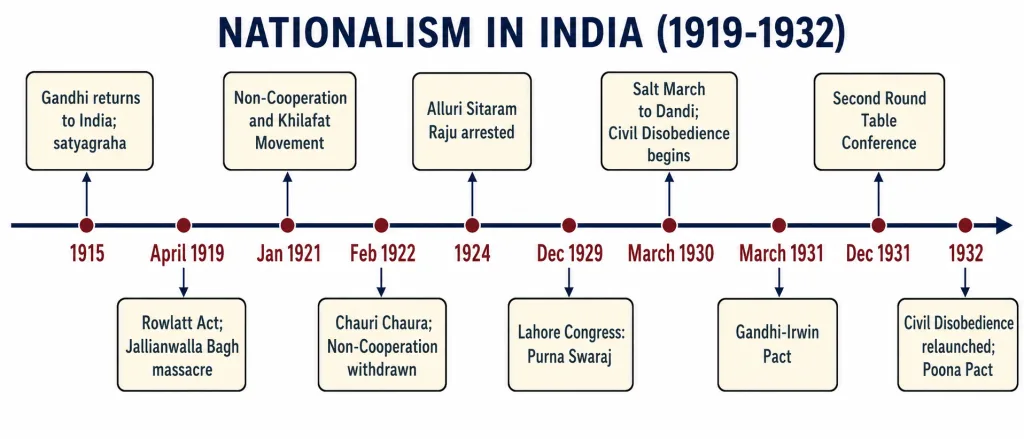
The Impact of the First World War
The First World War created a new economic and political situation. It led to a huge rise in defence expenditure, financed by war loans and increased taxes: customs duties were raised and income tax introduced. Prices doubled between 1913 and 1918, causing extreme hardship. Villages were called upon to supply soldiers, and forced recruitment in rural areas caused widespread anger.
In 1918–19 and 1920–21, crops failed, bringing acute food shortages, and an influenza epidemic struck. According to the census of 1921, 12 to 13 million people perished from famine and disease. People hoped their hardships would end after the war, but they did not.
The Idea of Satyagraha
Mahatma Gandhi returned to India in January 1915 from South Africa, where he had fought the racist regime with a novel method of mass agitation called satyagraha. The idea of satyagraha emphasised the power of truth and the need to search for truth. It suggested that if the cause was true and the struggle was against injustice, physical force was not necessary to fight the oppressor. A satyagrahi could win through non-violence, by appealing to the conscience of the oppressor. Gandhi believed this dharma of non-violence could unite all Indians.
Gandhi's Early Satyagrahas
After returning to India, Mahatma Gandhi successfully organised satyagraha movements in various places:
- In 1917, he travelled to Champaran in Bihar to inspire the peasants to struggle against the oppressive plantation (indigo) system.
- In 1918, he went to Ahmedabad to organise a satyagraha among cotton mill workers.
- Also in 1918, he supported the peasants of Kheda in Gujarat, who — hit by crop failure and a plague epidemic — could not pay the revenue and demanded that its collection be relaxed.
These early successes established Gandhi as a leader who could mobilise ordinary people.
Questions and Answers
Q1. Why is the growth of nationalism in the colonies linked to an anti-colonial movement? Ans. Because people discovered their unity in the struggle against colonialism. The shared sense of being oppressed under colonial rule provided a common bond that tied together many different groups, even though each experienced colonialism differently.
Q2. What is meant by the idea of satyagraha? Ans. Satyagraha emphasised the power of truth and the search for truth. If the cause was true and against injustice, physical force was unnecessary; a satyagrahi could win through non-violence, appealing to the conscience of the oppressor.
Questions and Answers (continued)
Q3. How did the First World War help the growth of the national movement in India? Ans. The war raised defence expenditure, financed by war loans and higher taxes; prices doubled (1913–18); villages faced forced recruitment; and crop failures and an influenza epidemic (1918–21) killed 12–13 million people. This widespread hardship created deep anger against British rule.
Q4. Name Gandhiji's three early satyagraha movements in India. Ans. Champaran (1917) against the indigo plantation system, Ahmedabad (1918) among cotton mill workers, and Kheda (1918) in support of peasants demanding relaxation of revenue collection.